@techiswater@nckrtl@official_php I think it will work well, and I can make changes later, but for now I'll submit the proposal as it is. I don't have time to do more at the moment, maybe later if my proposal win.
The results are in!
The winner of the PHP 8.5 Release Page Design Contest is @nunowar 🏆🎉
Big thanks to everyone who submitted their ideas, and to @phpstorm and @rectorphp for sponsoring the prizes 🙌
See the full results and next steps:
https://t.co/cq8uD57HW8
PHP Website UPDATE: The new documentation layout for the @official_php website. Probably the most anticipated page redesign yet. It's still a work in progress, but I'll be including it in my proposal for the new https://t.co/6DrGHEttNh design contest. If you'd like to see this design on https://t.co/6DrGHEttNh, don't forget to vote for my proposal. Voting starts tomorrow! #buildinginpublic
Unlocking the Secrets behind User Psychology: 5 Intriguing Facts about User Engagement!
These five mind-blowing facts shape the way users interact with digital platforms:
1. The 3-second rule
Did you know that users form an opinion about your website or app within the first 3 seconds? This phenomenon, known as the 3-second rule, highlights the critical importance of a captivating and user-friendly #interface. Make those initial moments count to hook your audience!
2. Social validation boosts engagement
Humans are social creatures, and the psychology of user engagement taps into our desire for validation. Incorporating social proof elements such as reviews, testimonials, and social media #endorsements can significantly boost user trust and engagement. People love to know they're not alone in their choices.
3. The Zeigarnik effect
Ever started a task and couldn't stop thinking about it until it was completed? That's the Zeigarnik effect in action. Unfinished tasks create cognitive tension, making users more likely to return to complete what they started. Leverage this psychological #principle to keep users coming back for more.
4. The power of personalization
User engagement skyrockets when experiences are tailored to individual preferences. Whether it's personalized recommendations, customized content, or adaptive interfaces, the psychology behind personalization creates a sense of exclusivity, making #users feel more connected and invested in the platform.
5. FOMO and scarcity drive action
Fear of Missing Out (FOMO) and scarcity are powerful psychological triggers. Incorporating limited-time offers, exclusive access, or countdowns can create a sense of urgency, driving users to take action. It's the #psychology of scarcity playing on our instinct to grab opportunities before they disappear.
Which fact surprised you the most? Share your thoughts below👇🏼
#InfluencerMarketing
Blockchain technology is poised to reshape the future. Its decentralized nature ensures transparency, security, and immutability make it a powerful tool across various industries.
Beyond #cryptocurrencies, blockchain can revolutionize supply chains, healthcare, finance, and more. Smart contracts automate processes and can reduce the need for intermediaries and enhance efficiency.
The potential for financial inclusion is immense. #Blockchain enables borderless transactions, providing opportunities for the unbanked population to access financial services. This democratization is a game-changer.
Environmental #Sustainability is also a key aspect. Some blockchain networks use less energy than traditional systems, addressing concerns about the carbon footprint associated with certain #technologies.
However, challenges such as #scalability and regulatory hurdles exist. As technology matures, addressing these issues will be crucial for widespread adoption. Still, the journey towards a blockchain-powered future is exciting and evolving!
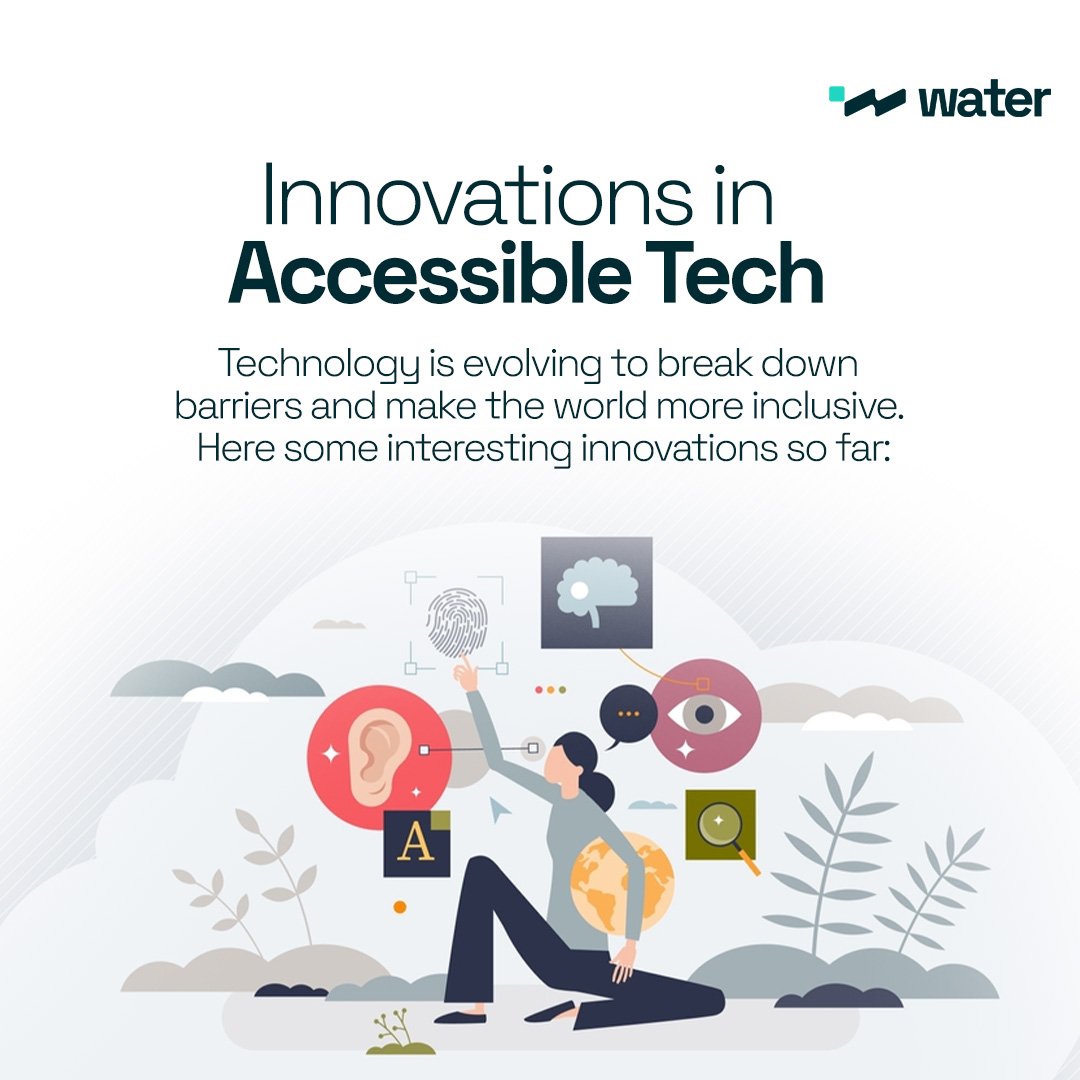
Technology is evolving to break down barriers and make the world more inclusive. Here some interesting innovations so far:
Voice recognition 🗣️
Innovations in voice recognition have empowered users with motor disabilities. Voice-activated commands enable hands-free interaction, making technology more accessible and user-friendly.
Screen readers 👀
Modern screen readers have seen significant advancements. They now offer improved accuracy, context awareness, and customization options, providing a more seamless experience for users with visual impairments.
Haptic feedback 👋
Devices offering tactile feedback enable users with visual or hearing impairments to perceive information through touch.
AI-powered assistance 🤖
Artificial Intelligence is playing a pivotal role in creating assistive technologies. From predictive text suggestions to image recognition, AI is enhancing accessibility by tailoring digital experiences to individual user needs.
Inclusive design 🌐
Designing with accessibility in mind from the start ensures that products and services are inherently usable by a diverse range of users.
Innovation in accessible tech is an ongoing journey, and these advancements are paving the way for a more inclusive digital future. What other innovations have you come across? Share your thoughts! ✨
#InnovationInTech #DigitalInclusion
Here's to a prosperous and tech-savvy New Year.
Happy New Year in binary code: 01001000 01100001 01110000 01110000 01111001 00100000 01001110 01100101 01110111 00100000 01011001 01100101 01100001 01110010!
#HappyNewYear
As we wrap up another incredible year, take a moment to reflect on your journey and set the stage for an amazing new chapter!
Here are 5 key areas to consider during your year-end review:
Personal growth: Reflect on the skills you've acquired, the challenges you've overcome, and the person you've become. What lessons have you learned?
Relationships: Cherish the connections that enriched your life. Did you strengthen existing bonds or build new ones? Share your gratitude with those who made a difference.
Achievements: Celebrate your victories, big and small! What goals did you crush, and what milestones did you reach? Acknowledge your hard work and persistence.
Joyful moments: Recall the moments that brought you happiness and fulfilment. What activities or experiences lit up your year? How can you create more of those moments?
Self-care: How well did you prioritize your well-being? #Reflect on the habits that contributed to your mental and physical health. What self-care routines will you carry into the new year?
Remember, each year is a chapter in your life story. What's next for you in #2024 ?
Net neutrality, a contentious and intricate subject, revolves around the concept of ensuring impartial treatment for all internet traffic, prohibiting discrimination or favoritism toward specific websites or services.
This principle aims to maintain an open and level playing field for online content, preventing service providers from giving preferential treatment to certain platforms. Delving deeper, it raises questions about the potential impact on innovation, competition, and the overall accessibility of information in the digital landscape. Here are some interesting and potentially surprising facts about net neutrality:
● The term "net neutrality" was coined by law professor Tim Wu in a 2003 paper. He used it to describe the idea that internet service providers (ISPs) should treat all data on the internet the same way, without discriminating or charging differently based on user, content, website, platform, or application.
● The net neutrality debate gained significant attention when Netflix accused ISPs of deliberately slowing down its streaming service in order to promote their own competing services. This sparked a renewed interest in ensuring net neutrality principles.
● Net neutrality is a global issue, and different countries have taken various approaches. Some countries have implemented strict net neutrality regulations, while others have opted for a lighter touch or no specific regulations at all.
● In 2014, various websites and advocacy groups participated in the "Internet Slowdown" protest to raise awareness about net neutrality. They displayed symbolic loading icons and urged users to contact their representatives to support net neutrality.
● In 2017, a misleading image circulated on social media claiming that Portugal's internet service providers had implemented a system of charging users extra fees for access to specific websites. While the image wasn't an accurate representation of Portugal's internet plans, it became a symbol in the net neutrality debate, illustrating the concerns about potential tiered access to the internet.
● Also in 2017, the Federal Communications Commission (FCC), under Chairman Ajit Pai, voted to repeal the net neutrality rules put in place in 2015. The decision was controversial, with supporters arguing that it would promote investment and innovation, while opponents feared it would lead to a "pay-to-play" system that favored big corporations.
● The zero-rating controversy. Zero-rating is a practice where certain services or applications are not counted against a user's data cap. While this might seem like a benefit, it has been criticized for potentially violating net neutrality principles. Critics argue that it gives preferential treatment to certain services, disadvantaging competitors.
#digitalaccess
#netneutrality
#FreedomCorner
As autonomous coding capabilities advance, the role of AI engineers may undergo a transformative shift. Rather than rendering them obsolete, this technology could compel engineers to pivot towards higher-level problem-solving, ethical considerations, and creative aspects of AI development, ushering in a new era of symbiotic intelligence.
Is the realm of software development undergoing a secret makeover by AI?
Robots might not be the sole architects of our code, but the impact of artificial intelligence is undeniable. Intrigued? But buckle up, because artificial intelligence is unleashing a software development revolution! Curious to know how? Let's dive into the mind-bending world where AI and code collide.
AI-enhanced code assistance: AI-driven code completion and
suggestions have emerged as indispensable allies. These features can predict your next line of code and help you work faster!
Debugging: Most times, trying to locate a bug in your code can be really frustrating. However, with AI, you can now analyze massive codebases, detect anomalies, and even predict potential areas where bugs might be (you can give that stress ball a break now).
Natural language interfaces: AI-powered chatbots are becoming better at understanding your code-related queries. No more shouting at the screen; just ask (politely?), and these bots can guide you to a solution.
Nurturing innovation: With AI managing repetitive tasks, developers can channel their energies into innovation. AI can be the Alfred to your Bruce Wayne or the Jarvis to your Tony Stark.
In summary, we don't think AI is here to take anybody's job. In fact, we feel that job descriptions would soon be updated to include how well you can use AI to perform your role more effectively.
But...what do you think?
#artificalintelligence
#softwaredevelopment
#chatbot