A British biologist looked at 200,000 years of human history and found that the entire reason humans broke out of poverty was not intelligence, not language, not even agriculture, but one mechanism so simple a 6-year-old could explain it.
His name is Matt Ridley.
He is a zoologist by training, an evolutionary biologist by career, and in 2010 he wrote a book called The Rational Optimist that quietly argued the most important fact about human progress had been hiding in plain sight for the entire history of economics.
Naval Ravikant has been telling people to read everything Ridley has ever written for the last 15 years. The reason is the argument inside this one book.
For 200,000 years, anatomically modern humans walked around with the same brain you have right now. Same skull size. Same neural architecture. Same raw capacity for language, planning, and abstract thought.
For roughly 190,000 of those years, almost nothing happened. Generation after generation lived and died inside the same Stone Age toolkit their great-great-grandparents had used. Then somewhere around 50,000 years ago, the line on the chart of human progress started to tick upward. Then it bent. Then it exploded.
The question Ridley spent years on was the only question that mattered. What changed.
It was not the brain. The brain had been the same for 190,000 years. It was not language, which had existed long before the takeoff. It was not even agriculture, which arrived only 10,000 years ago and was actually preceded by the upward bend, not the cause of it.
What changed was that humans started trading with strangers.
This sounds too small to be the answer. Ridley argues that it is the answer to almost everything. The moment one human exchanged a useful object with another human from a different group, something happened that no other species on earth had ever done.
Two ideas that had developed in isolation came into contact. The flint knapper learned what the spear maker had figured out. The fisherman from the coast learned what the hunter from the forest had figured out. The two pieces of knowledge fused into something neither side could have produced alone.
Ridley calls this ideas having sex. The phrase sounds frivolous and it is meant to. The point is that ideas, like genes, get better when they combine with other ideas from different lineages.
An idea sitting inside one head, no matter how brilliant the head, eventually hits a ceiling. The same idea exposed to ten thousand other ideas does something genes do under sexual reproduction. It mixes. It recombines. It produces offspring nobody planned.
The cleanest proof of this argument is the most uncomfortable case study in the book. Tasmania.
Around 10,000 years ago, rising sea levels cut Tasmania off from mainland Australia. A population of roughly 4,000 humans was now isolated on an island, with no possibility of contact with the rest of humanity. They had the same brains. The same language. The same starting toolkit as their cousins 150 kilometers north. The natural experiment was now running.
What happened next is something no economist or geneticist had ever predicted.
The mainland Australians kept inventing. Boomerangs. Spear-throwers. Fishing nets. Bone needles for sewing fitted clothes. Watercraft with paddles. Their technology compounded slowly across the centuries.
The Tasmanians went the other way. They did not just fail to invent the new tools their cousins were developing. They started losing the tools they already had. Fishing was abandoned within a few thousand years. Bone tools disappeared. Fitted clothing disappeared. They forgot how to make fire from scratch and started carrying lit firebrands from camp to camp instead, relighting their fires from a neighbor's whenever their own went out.
By the time European explorers arrived in the 17th century, the Tasmanians had the simplest toolkit of any human society ever recorded. Their material culture had gone backward for 8,000 years.
The archaeologist Rhys Jones called it a slow strangulation of the mind.
Joseph Henrich at Harvard later proved with formal mathematical models that there was nothing wrong with Tasmanian brains. There was something wrong with their network. A toolkit requires a critical mass of people exchanging skills to maintain itself.
The act of teaching a skill is imperfect. Every generation loses a small percentage of what the last generation knew. If your population is large enough and trading widely enough, those losses get caught and corrected by someone else who still remembers.
If your population shrinks below a certain threshold and stops mixing with outsiders, the small losses compound until entire technologies disappear.
This is the part that should haunt anyone reading this in 2026.
Intelligence is not a property of the individual brain. Intelligence is a property of the network the brain is connected to. A genius in isolation will produce less than a mediocre thinker inside a dense exchange of other mediocre thinkers.
The thing your ancestors needed in order to break out of 190,000 years of stagnation was not better brains. It was better connections between brains they already had.
The implication for any individual is direct and uncomfortable. If you are smart and isolated, you will be outproduced by people half as smart who are connected.
The most successful people in any field are almost never the smartest people in it. They are the ones positioned at the intersection of the most idea flows. They are reading more authors than their competitors. They are talking to more people from more disciplines. They are in the rooms where ideas from different lineages bump into each other.
Ridley ends the book on the line that sounds optimistic but is actually a warning its this "The future will be invented by people who connect ideas, not by people who guard them."
There’s a generation a lot of people forget exists. We were born at the tail end of the Boomers, but we are not culturally the same as people born in the 40s and early 50s. We are Generation Jones.
And honestly, it explains a lot.
We grew up in a world that still felt fundamentally analog, but we were young enough to be dragged headfirst into the digital revolution. We are the bridge generation between rotary phones and smartphones, between slide rules and AI, between Walter Cronkite and algorithm driven media.
We remember when there were only a few television channels and the entire country watched the same thing at the same time. We also adapted to the internet, email, forums, social media, streaming and now artificial intelligence. We lived before and after the technological singularity hit everyday life.
That is not a small thing.
People born in the 40s came of age in a post World War II America that was still industrial, deeply hierarchical and institutionally stable. Their formative years were shaped by the Cold War, Vietnam, the civil rights era and a society where information moved slowly.
Generation Jones came later. We inherited the aftermath of all of that.
We were the kids who watched Watergate destroy blind trust in government. We watched manufacturing begin to collapse. We saw divorce rates explode. We were the first truly latchkey generation in massive numbers. We learned independence early because many of us had to.
We grew up with one foot in old America and one foot in whatever this new thing was becoming.
We played outside until the streetlights came on but we also learned DOS commands. We learned cursive and keyboarding. We had card catalogs and Google searches. We went from vinyl records to cassette tapes to CDs to MP3s to streaming in one lifetime.
We remember maps. We remember memorizing phone numbers. We remember life before GPS and before every human interaction became filtered through a screen.
And because of that, I think Generation Jones developed a very unique perspective. We are adaptable because we had no choice but to adapt. We learned technology as adults instead of being born into it. We remember a slower world but were forced to survive in a rapidly accelerating one.
That creates a very different mindset than either older Boomers or younger Gen X and Millennials.
A lot of us also reject the caricature people now associate with “Boomers.” We were not buying houses for the cost of a sandwich in 1965. The interest rate on my first house was over 14% and that was after buying down a point. Many of us got hit by recessions, outsourcing, pension collapses and economic instability just like younger generations did. We watched promises evaporate in real time.
We understand older generations because we were raised by them. We understand younger generations because we had to evolve alongside them.
That’s why the Jones generation often feels culturally homeless. We are rarely discussed, rarely defined and usually lumped into categories that don’t actually fit us.
But we exist.
We are the human transition point between the industrial age and the digital age.
And frankly, there will probably never be another generation quite like us again.
The justice system is the key profession of choice for human predators/dark personalities, according to my PhD research, the most comprehensive study ever done on people who actively violate social norms and harm and disadvantage others by conscious choice. This includes, lawyers, judges, judicial psychologists/psychiatrists, law enforcement and social workers. These people have brain anomalies of the prefrontal cortex and amygdala and are motivated completely different differently to the rest of the population. Their key drivers are control and sadism (humiliating, demeaning, patronising, manipulating, confusing, disadvantaging and harming other others). They are sexually boundaryless and have absolutely no regard for laws, regulations, and moral considerations. They constitute upward of 10% of the population. Judges and lawmakers who are predators are making decisions based on their own nature and not on the best interests of society as a whole. There is a link to my PhD thesis in the pinned link if you are interested.
Most people have no idea of the extent of what we are dealing with.
I will correct this for you @SenatorWong. Israel & the USA are deliberately inflicting economic pain on communities worldwide, including the Indo-Pacific, with the costs borne disproportionately by the most vulnerable. Australia and its partners should join in condemning the Israeli and US illegal war on Iran!
china and pakistan release five point peace plan for ending iran war.
no mention of us and israel
call to restore full passage of strait of hormuz (no iran ability to disrupt/charge tolls).
initiative should be welcomed by pretty much everybody.
Your paracetamol is 100 percent petrochemical. Phenol from the cumene process, converted to p-aminophenol, acetylated to the tablet in your bathroom cabinet. Your ibuprofen is 100 percent petrochemical. Isobutylbenzene and propionic acid derivatives. Your metformin, the most prescribed diabetes drug on Earth, is 80 to 90 percent petrochemical. Dicyandiamide from natural gas derivatives.
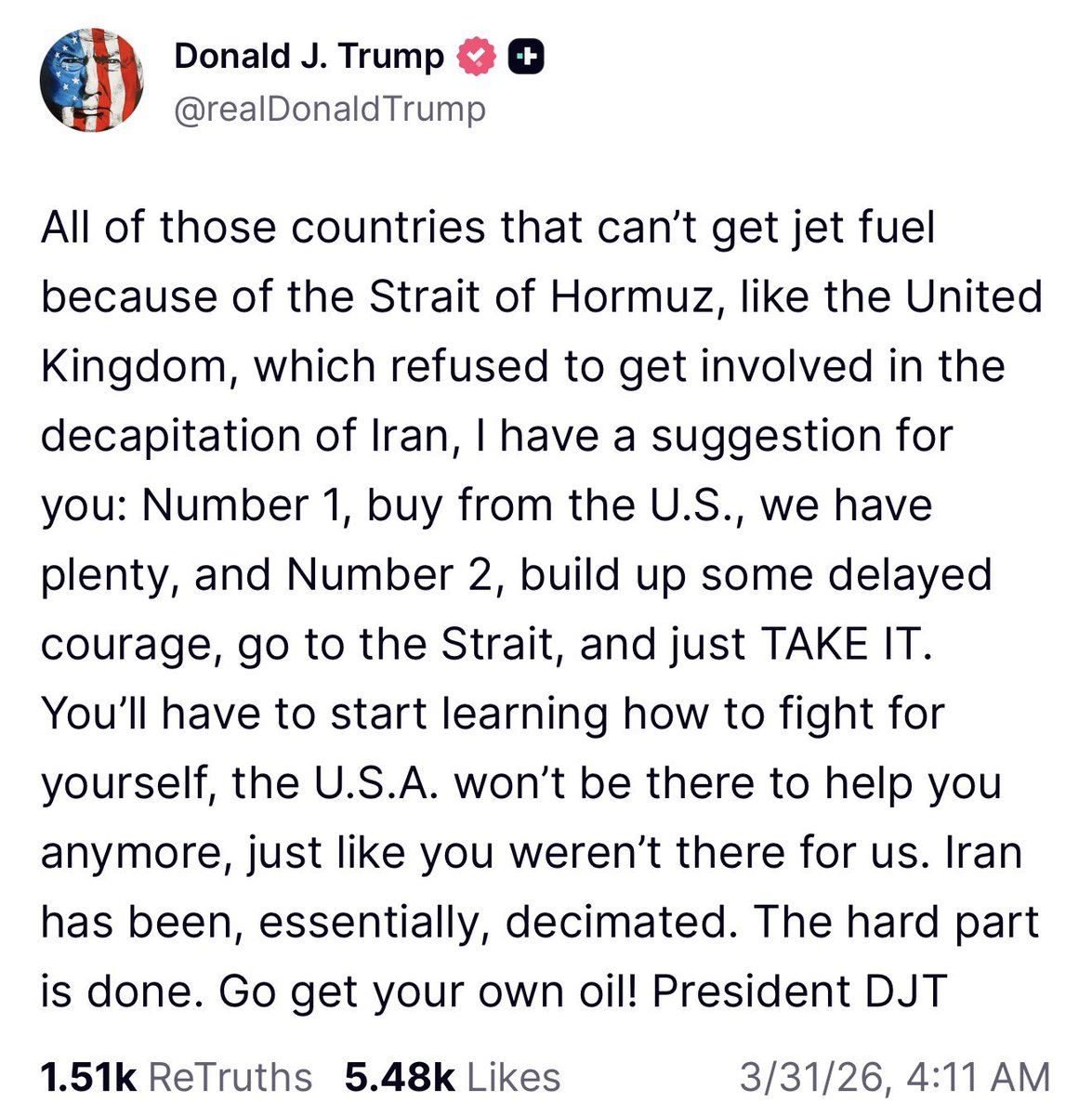
The naphtha that makes these drugs transits the Strait of Hormuz. The strait is mined, uninsured, and unescorted.
The war just reached the medicine cabinet. Nobody is covering this.
Ninety-nine percent of pharmaceutical feedstocks and reagents are petrochemical-derived according to the American Gas Association. Not 50 percent. Not 70. Ninety-nine. The pills are made of oil. The same oil the same strait carries. The same naphtha that becomes polyethylene for a bread bag becomes phenol for a paracetamol tablet. When the petrochemical cracker shuts, both products vanish.
The crackers are shutting. Chandra Asri declared force majeure on March 3rd. Yeochun NCC on March 4th. PCS Singapore on March 5. CNOOC-Shell Huizhou is planning shutdown of its 1.2-million-tonne facility. These are not contained within the plastics industry. They cascade into pharmaceuticals because the feedstocks are identical.
India is the pressure point. Twenty percent of the world’s generic drugs. Forty percent of US generic demand. And India’s methanol supply, a key solvent in API manufacturing, has 87.7 percent exposure to the Hormuz corridor. The Indian government has prioritised household LPG over industrial petrochemical feedstock, starving downstream pharmaceutical supply chains of the naphtha derivatives they need. Indian pharma companies hold three to six months of finished product stock. The buffer exists. It is depleting at an accelerating rate as raw material pipelines empty.
The Serum Institute of India, the world’s largest vaccine manufacturer supplying 40 to 50 percent of global doses in key categories, runs on the same petrochemical chain. mRNA vaccines require petrochemical-derived lipid nanoparticles and solvents. Traditional vaccines use petrochemical intermediates for adjuvants and stabilisers. Every vial is plastic. Every syringe is plastic. Every cold-chain packaging film is plastic. The force majeures that shut the crackers are not just a packaging story. They are a vaccine story.
The developing world’s access to affordable antibiotics, diabetes medication, cardiovascular drugs, and childhood vaccines runs through Indian manufacturing plants that run on petrochemical feedstocks that run through a 21-mile waterway currently seeded with Iranian mines.
This is the fourth domino. The first was energy. The second was fertiliser. The third was packaging. The fourth is the one that converts an economic crisis into a humanitarian one, because you can find an alternative bread wrapper. You cannot find an alternative to metformin for 537 million diabetics worldwide. You cannot find an alternative to amoxicillin for a child with pneumonia. You cannot find an alternative to the vaccines that prevent diseases we spent decades eliminating.
The Fed meets tomorrow to assess inflation driven by energy, fertiliser, packaging, and now pharmaceutical inputs. All repricing through the same chokepoint. Four dominoes. One strait. And the fourth, the medicine, is the one the market has not priced because it does not appear on any commodity index.
It appears on a doctor’s prescription.
Full analysis: https://t.co/iFmUcarGdV
@joncoopertweets This one is actually so stupid it made me laugh. I wish SOMEONE would call him out - journos, GOP, ANYONE! Regards, The Rest of the World
BREAKING: Music legend Bruce Springsteen just released this incredible song that will be sure to piss Trump off beyond belief.
“Streets of Minneapolis”.
He wrote this song about Alex Pretti and Renée Good Saturday and recorded it yesterday.
Share it far and wide and play it as loud as you can
How did he get bail?
How does someone on an AVO still have access to guns?
I’m so over this.
Where’s our Royal Commission into #domesticviolence?
Do women’s lives not matter enough? https://t.co/RuMtqGoBdQ
When 78 women died as a result of domestic violence in Australia in 2025, where was the demand for a Royal Commission?
15 Jewish people lost their lives tragically at Bondi.
78 Australian women lost their lives to domestic violence.
Is one group less worthy than another?
China just turned the night sky into a masterpiece of precision and intelligence. 🌌
What struck me most about this is how seamlessly innovation turns into art.
A drone show in Chongqing just broke the Guinness World Record with 11,787 synchronized drones, creating breathtaking 3D animations that looked closer to CGI than real life.
No human pilots.
No delays.
No crashes.
Every movement guided by AI and GPS, choreographed with perfect timing.
To me, this is far more than a light show.
It’s a glimpse into how technology, creativity, and coordination can merge to shape a new era of expression and innovation.
When intelligence takes flight, it doesn’t just illuminate the sky — it redefines what’s possible.
Could this be the moment where technology begins to turn the world itself into its stage?
#AI #Innovation #Technology #Drones #Automation #Creativity #China #Engineering #FutureOfWork #DigitalArt
Credits: longliveai
“We've arranged a society based on science and technology, in which nobody understands anything about science and technology. And this combustible mixture of ignorance and power, sooner or later, is going to blow up in our faces.”
― Carl Sagan