I help researchers, NGOs, and organizations use technology more effectively.
Areas I work in:
✓ Research Design
✓ Data Analysis
✓ AI & Educational Technology
✓ SurveyCTO & Data Collection
✓ Research report Support
✓ Grant Proposal Development
On this account, I share daily insights on AI, technology, productivity, and digital innovation.
If you're building something meaningful, let's connect.
#AI #Research #Technology #Edutech #TechProducts #TechCareers
The @ symbol is older than email.
Much older.
Long before it became part of every email address and social media handle, merchants used @ to mean "at the rate of."
For example:
10 apples @ $2 = $20
In 1971, computer engineer Ray Tomlinson was looking for a way to separate a user's name from the computer they were using while developing the first networked email system.
He chose @ because it was rarely used in people's names and already meant "at."
So instead of:
john computer
It became:
john@computer
A simple decision that helped shape digital communication.
Today, billions of emails, social media mentions, and online identities depend on one symbol that existed centuries before the Internet.
Sometimes history's biggest innovations don't invent something new.
They find a brilliant new use for something old.
#TechHistory #Email #Internet #Innovation #Technology #Computing
GPS doesn't work because of satellites alone.
It works because of atomic clocks.
Every GPS satellite carries incredibly precise atomic clocks that measure time with astonishing accuracy.
Your phone calculates its position by measuring how long signals take to travel from multiple satellites.
A timing error of just one microsecond (one millionth of a second) would translate to a positioning error of roughly 300 meters.
That's why GPS isn't just a navigation system.
It's a timekeeping system that happens to tell you where you are.
From ride-sharing and aviation to agriculture, emergency response, banking, and autonomous vehicles, modern life depends on keeping time with extraordinary precision.
Sometimes, finding your location begins with measuring time.
@GPSGov @NASA@ESA@LockheedMartin@TrimbleCorp
#GPS #Technology #AtomicClocks #Engineering #Space #TechHistory
QR codes weren't invented for restaurant menus.
They were invented for cars.
In 1994, engineers at Denso Wave, a subsidiary of Toyota's supplier network, developed the QR (Quick Response) Code to track automotive parts during vehicle manufacturing.
The goal wasn't payments.
It wasn't marketing.
It wasn't sharing Wi-Fi passwords.
It was making factories faster and more efficient.
Three decades later, the same technology powers:
📱 Mobile payments
🍽️ Digital menus
🎟️ Event tickets
📦 Logistics
💊 Healthcare
✈️ Boarding passes
What started on an automotive production line now connects billions of people every day.
Sometimes the technologies that change the world begin in places no one expects.
@DENSOWAVE@Toyota@GS1Global (global barcode and standards organization)
#QRCode #Innovation #Technology #Automotive #Manufacturing #TechHistory
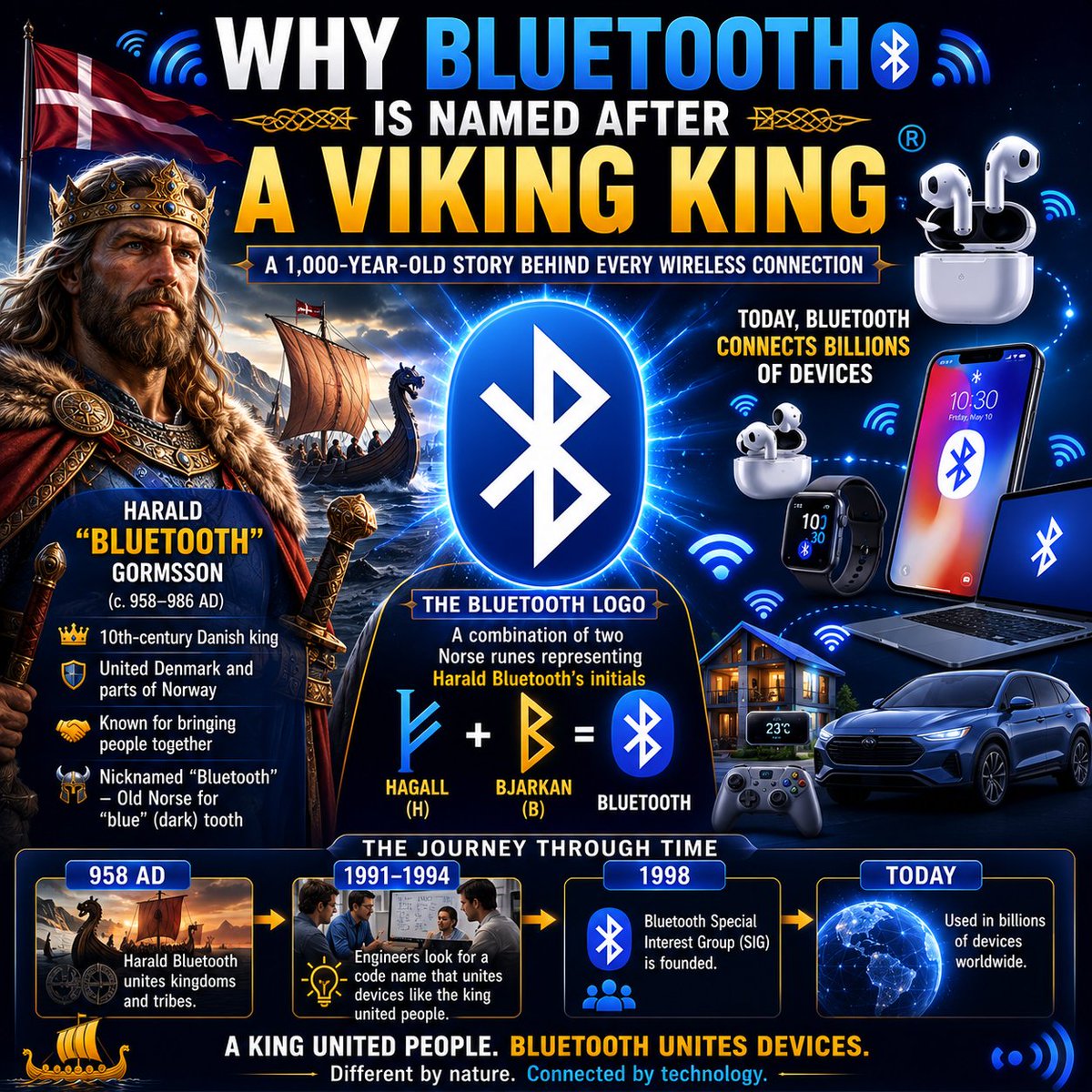
Bluetooth isn't named after a technology.
It's named after a Viking king.
In the 10th century, Harald "Bluetooth" Gormsson united parts of Denmark and Norway.
When engineers were developing a short-range wireless standard in the 1990s, they chose his nickname as a temporary codename because their technology aimed to unite different devices under one universal communication standard.
The name stuck.
Even the Bluetooth logo tells the story—it combines two ancient Nordic runes representing the initials H and B (for Harald Bluetooth).
Sometimes the technologies we use every day carry stories that are more than a thousand years old.
#Bluetooth #Technology #TechHistory #Innovation #Wireless #Engineering
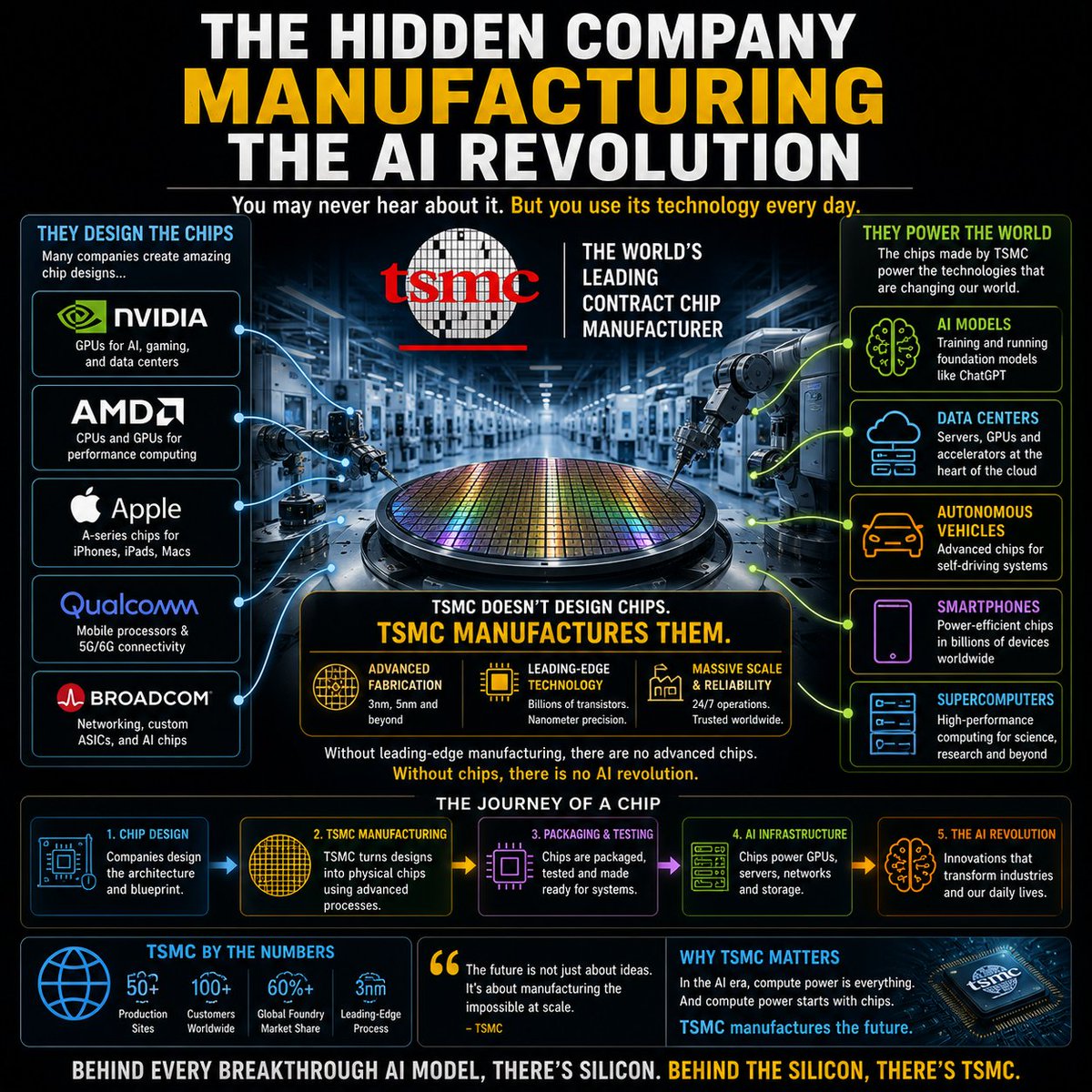
Everyone talks about NVIDIA.
Everyone talks about AI.
Far fewer people talk about the company that actually manufactures many of the chips powering the AI revolution.
That company is TSMC.
TSMC doesn't design AI chips.
It manufactures them.
From NVIDIA GPUs and AMD processors to many chips designed by Apple, Qualcomm, and others, TSMC's advanced fabrication plants have become the backbone of modern computing.
Without leading-edge semiconductor manufacturing, there are no AI accelerators.
No data centers.
No foundation models.
No generative AI boom.
The AI revolution isn't built by software alone.
It's also built in clean rooms where billions of transistors are etched onto silicon with nanometer precision.
Sometimes the most important company is the one working quietly behind the scenes.
#AI #TSMC #Semiconductors #NVIDIA #AMD #Innovation @TSMCinJapan
FireWire was faster.
USB won anyway.
In the late 1990s and early 2000s, many experts believed FireWire would become the future of high-speed data transfer. Developed by Apple, it offered faster speeds, peer-to-peer communication, and was widely used in professional video and audio equipment.
USB took a different path.
It was simpler.
Cheaper to implement.
Supported by more manufacturers.
And it became the universal standard.
Today, USB connects billions of devices, from keyboards and smartphones to external SSDs and AI hardware.
The lesson extends far beyond technology.
The best technology doesn't always win.
The technology that is easiest to adopt often does.
Innovation is important.
Adoption changes the world.
#Technology #USB #Apple #Innovation #TechHistory #Engineering
@Apple@Intel @USB_IF @IEEEorg
The first computer bug wasn't a metaphor.
It was an actual bug.
In 1947, engineers working on the Harvard Mark II traced a malfunction to a moth trapped inside one of the machine's relays.
They removed it, taped it into the logbook, and wrote:
"First actual case of bug being found."
Today, software bugs can affect billions of devices, AI systems, spacecraft, and global financial markets.
Yet one of computing's most famous terms began with a single moth.
Sometimes, history's biggest stories start with the smallest discoveries.
#TechHistory #Computing #ComputerScience #AI #Innovation
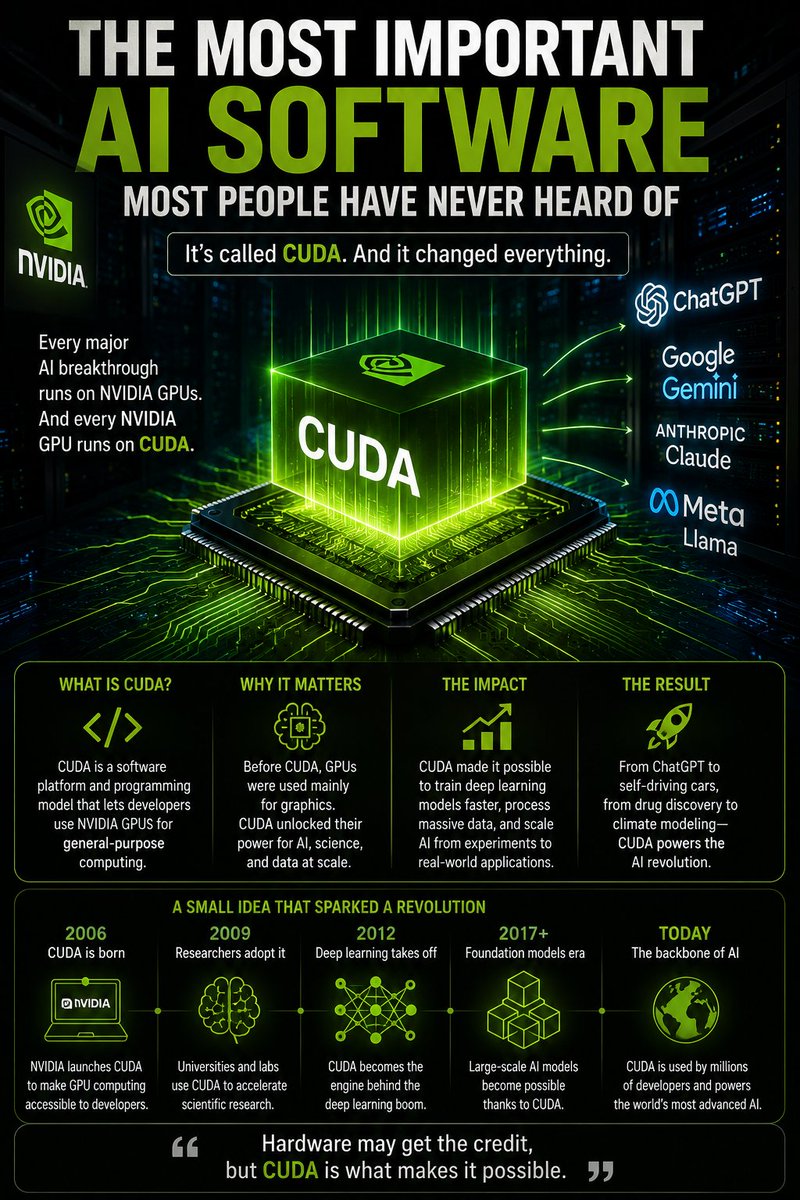
Most people think ChatGPT changed AI.
It didn't.
ChatGPT changed how we use AI.
CUDA changed how AI is built.
When NVIDIA introduced CUDA in 2006, it transformed GPUs from graphics processors into engines for scientific computing and deep learning.
Without CUDA, the AI revolution would almost certainly have progressed much more slowly.
Sometimes the biggest breakthroughs aren't the ones everyone talks about.
They're the ones quietly powering everything else.
#CUDA #NVIDIA #AI #DeepLearning #MachineLearning #Semiconductors