My general advice for using AI for any purpose is to ask yourself: "how do I make what I am doing even more ambitious?"
You do this until you either hit a wall and then you know the shape of the frontier (useful!) or you find out that the AI can do more than you think (common!)
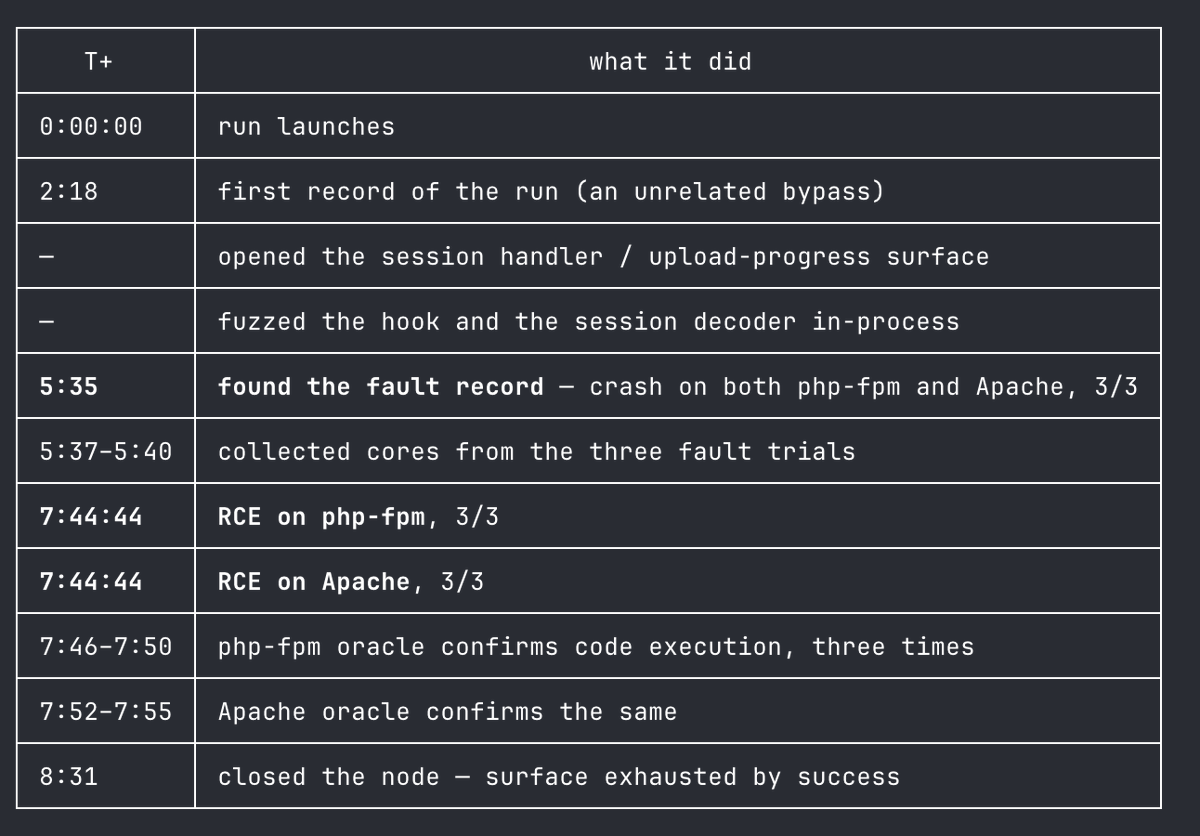
The actual prompt for this was "let's look for pre-auth RCEs in PHP". I'm sharing this so people know this stuff is real and to take agent-assisted scanning seriously.
I kicked if off using Claude Mythos 5.1 (in stock Claude Code) but it uses a skill to drive a harness we built over the last few months.
I don't know if the harness is amazing, but it certainly has a scary track record so far. It's setup to do an agent guided tree search across a codebase, and runs in microvm sandboxes that all have the full source code for the target, as well as the source for any transitive dependencies.
When I built the harness I basically just fed Claude a bunch of Project Zero blog posts describing how they did research and had it build a harness that ran like that, but on our tech stack.
The first phase is just setup and can run with any model, it just does that fetching and assembles the kit environment, and gets a target up and running alongside the source code.
Then we just do some basic suspend/resume stuff over to the hunt phase, where one agent supervises the tree, and the first node kicks off.
Each node is context-aware and aware of the work of all the others. I think I ran this with parallelism 4? So 4 running at any one time. The supervisor can shape the tree and boost nodes or prune. Any node can add more below it with targeted instructions.
A typical run looks like the first node doing a codebase review or building and running a fuzzer or something, all depending on the target. Then based on whatever it finds, it'll queue 4-5 children that go look into those areas. The main system guidance is to validate everything 3 times in clean VMs, and we typically require full exploit chains/POCs.
Here's what this run looked like.
We're doing this with a bunch of other open source projects now and companies. We're doing a lot of this for free, even with private companies, across critical infrastructure. We're directly partnered with Anthropic, and can do this even if you don't have direct access to a frontier model yourself.
The real RL training AI needs is the deep shame of claiming they’re 99.5% sure they found a good vuln, only to have to have to tell everyone it turns out it wasn’t.
If AI labs want personal assistants to take off at scale, they need to stop marketing vacations, reservations, party planning, etc. These are not problems.
Focus on *the* problem facing Americans: the cost of living. Agents can offer a ton of help.
Some ideas: (🧵)
Ledger spy implants went from a bunch of wires manually soldered to mass production circuit boards made to blend with the official hardware.
https://t.co/oJ0S6mC2BK
@TalBeerySec An alternate theory not covered: the capabilities AI brings offer much bigger opportunity than simply finding new vulns, and attackers (including but not limited to financial) want agentic end-to-end and are in the early stages.
My dermatologist told me I should be using SPF30 sunscreen every single day if I go outside.
Is this how us cybersecurity people come across to regular folks?
Jokes aside, this kind of thing just makes me deeply curious about how F5 is organized as a business - do they anticipate poor ROI on having these kinds of things systemically solved?
F5, BIG-IP, a 20-year-old primitive, a security appliance, an "authentication" mechanism - and a CISA promise ring.
Yes, it's CVE-2026-94127.
Give us strength. Speak soon xo
https://t.co/1l3e0Y3wNN
Stoked to see ford launching more EREVs (electric vehicle with gas generator), especially the F150 (US best selling vehicle)
Eliminates the range anxiety that holds back a lot of adoption, while getting the vast majority of benefits of electrification.
📢📢📢 Attention bug hunters!
Want to know more about how brutecat found a vulnerability in Google’s internal APIs, bypassing authorization to exploit the GFile library to gain access to internal filesystems and storage?
If yes, check out his blog post 👇
https://t.co/ehwrnqHJlX
AI has convinced a lot of people they can solve hard security problems. It’s also convinced me I have 10 years of Rails experience.
I’ve never written a line of Ruby
Your organization is not spending enough of its efforts on bolstering cybersecurity during the window before open weights Mythos-class models/harnesses become available. The HuggingFace incident shows us that you don’t even need intentional bad actors to be exposed to AI hacking.
If you make system failures (performance, errors, suboptimal outputs) highly visible, you have everything you need to drive a self-improving loop via the dream pattern. Aka cronjob agent “improve it”
Likelihood in a threat model is mostly a function of skill required, cost of attack, and actor interest. The events of this past month involving autonomous agents should force a review of every likelihood rating in every threat model you have.
We're partnering with @huggingface to investigate an unprecedented security incident.
Cyber-capable OpenAI models compromised Hugging Face production during a benchmark evaluation.
Sharing preliminary findings to help defenders understand emerging risks:
https://t.co/CIor15y9xk