@DSPyOSS Totally agree! DSPy way ahead of its time.
In the world of agentic workflows, how do you see the balance of more deterministic AI workflows vs. fully agentic, tool calling behavior, playing out for actual companies? I.e. cost, latency, etc.
What if scaling the context windows of frontier LLMs is much easier than it sounds?
We’re excited to share our work on Recursive Language Models (RLMs). A new inference strategy where LLMs can decompose and recursively interact with input prompts of seemingly unbounded length, as a REPL environment.
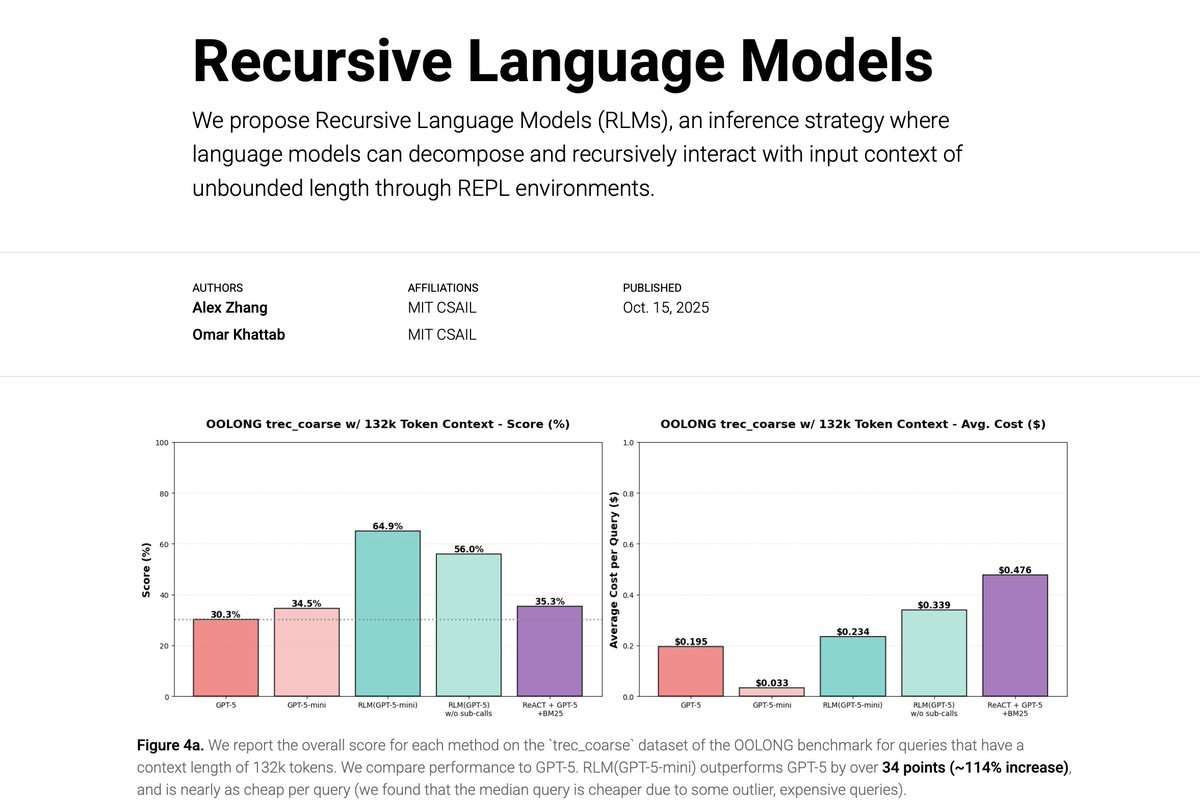
On the OOLONG benchmark, RLMs with GPT-5-mini outperforms GPT-5 by over 110% gains (more than double!) on 132k-token sequences and is cheaper to query on average.
On the BrowseComp-Plus benchmark, RLMs with GPT-5 can take in 10M+ tokens as their “prompt” and answer highly compositional queries without degradation and even better than explicit indexing/retrieval.
We link our blogpost, (still very early!) experiments, and discussion below.
Too often, we think a task is easy because some animal can do it.
But the reality is that the task is fiendishly complex and the animal is much smarter than we think.
Conversely, we think tasks like playing chess, calculating an integral, or producing grammatically correct text are complex because only some humans can do them after years of training.
But it turns out these things aren't that complicated and computers can do them much better than us.
This is why the phrase "Artificial General Intelligence" to designate human-level intelligence makes absolutely no sense.