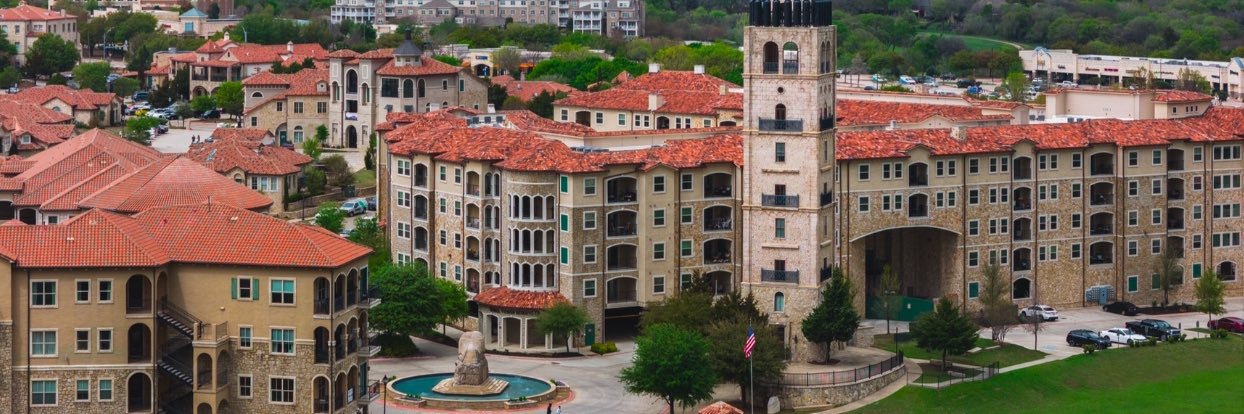
Texas is steadily establishing itself as America Inc’s new centre of gravity. No state receives more business investment or is adding more people to its population https://t.co/fiyITrME7O
Gonna try to explain this to tech CEOs again: Young Americans are pissed. They feel betrayed. Half have embraced the far right & want to cut off your access to cheap foreign labor. The other half have embraced the far left & want to cut off your head. One side will win. Choose.
President Trump postponed signing an order on the dangers of artificial intelligence, heeding an adviser’s warning that industry guardrails could slow down U.S. models in the race with tools from China https://t.co/8n396R7LQh
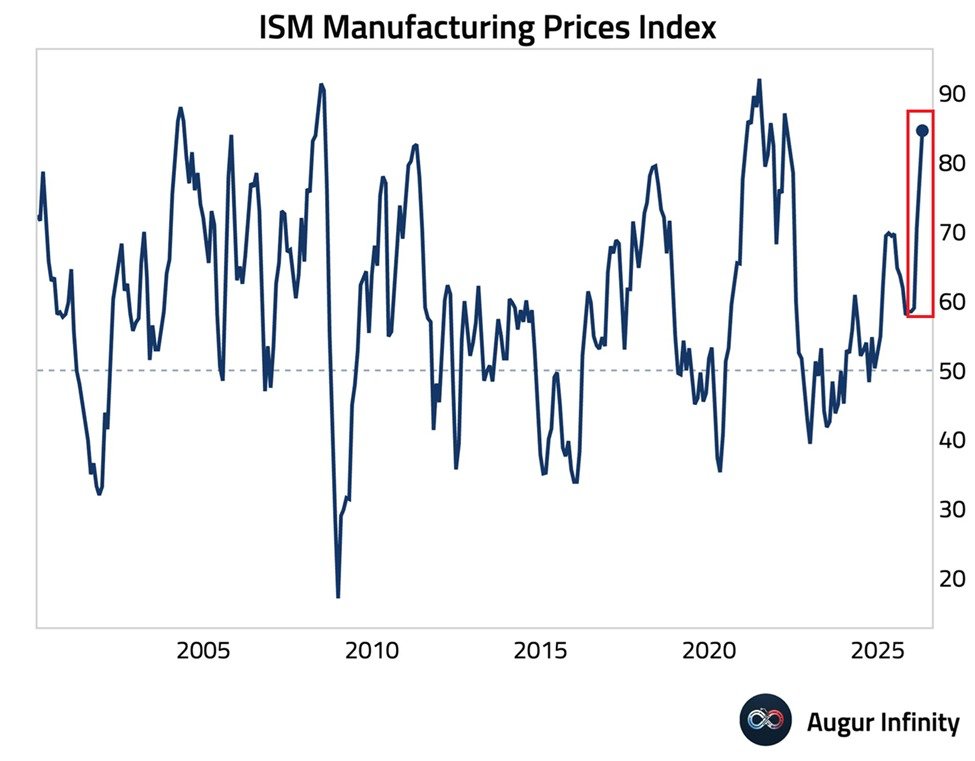
Stagflation is intensifying across US manufacturing:
The ISM Manufacturing PMI remained steady in April at 52.7 points, the highest since August 2022.
However, prices paid surged +6.3 points, to 84.6, the highest since May 2022.
Prices paid have risen +25.6 points over the last 3 months, the biggest 3-month increase on record.
The surge continues to be driven by surging steel and aluminum prices affecting the entire supply chain, tariffs on imported goods, and higher energy and materials costs driven by the Iran War.
Meanwhile, the employment index fell -2.3 points, to 46.4, the lowest since January, marking the 15th consecutive monthly contraction.
Stagflation pressures are building again.
$76.6B in CMBS hard maturities were due in 2026, with $3.18B coming due in March.
The largest loan in the cohort is the $598.6M BMR Pool loan, secured by a portfolio of laboratory and office properties across major life sciences markets.
https://t.co/K31abuVess
BREAKING: The US Financial Conditions Index is up to 99.17, the tightest financial conditions since June 2025.
The index has surged +0.77 points over the last 20 days, the fastest increase since March-April 2025.
This is also the 2nd-fastest pace of tightening since the 2022 Fed interest rate hiking cycle.
This comes after the index fell to its lowest since May 2025 in February.
The recent surge has been fueled by rising Treasury yields, oil prices, and the US Dollar, along with widening credit spreads and falling stock prices.
Tighter financial conditions suggest a further slowdown in economic activity in the upcoming months.
The US economy needs lower yields.
Any bill that includes any language re: an antitrust exemption will be the death knell of rights for NCAA athletes. All the NCAA “really” cares about is the exemption. Everything else is a red herring or trojan horse.
I’m worn out from the false narrative about “runaway trains” and the “wild wild west” creating a “Financial Crisis” for non revenue sports in the NCAA.
🤔If the sudden wealth from an exponential increase in TV $ created a “Financial Crisis”in the NCAA, how is it that NO SCHOOL IN AMERICA had this “Financial Crisis” when they had to operate on 90% less revenue? It’s total BS perpetuated by dictatorial control freaks whose autocracy has finally been challenged.
It was the exponential increase in media rights $ for football that created massive “sudden wealth” for college athletics. That’s when the salaries of conference commissioners, athletic directors and coaches escalated from thousands to millions.
And when the athletes, who fans tune in to watch on TV, took notice and decided they’d like some $ too - NOW we have a HUGE “Financial Crisis”!!
They can’t win in court and they refuse to negotiate with NCAA athletes. Instead, they spend “10’s of millions of $” to hire lobbyists and seed politicians in DC. They know NCAA athletes don’t have the $ or influence to compete on a level playing field in DC.
How many athletes did you see or hear from in the DC hearings, meetings, or press conferences re: SCORE? Wondering how many of these “Financial Crisis” advocates made up of commissioners, AD’s and coaches flew to DC private to try and resolve their “Financial Crisis”?
One of the richest men alive just put a target on every factory worker's job in America.
This is a $100 billion fund built to acquire physical companies and gut them with AI.
Jeff Bezos said it himself, AI is the new electricity, it will be inside everything, underneath everything, powering everything.
Project Prometheus already raised $6.2 billion, recruited top engineers away from OpenAI, DeepMind, and Meta, and has been operating in near-total secrecy.
The playbook is simple and brutal.
Find manufacturers that AI is already disrupting, buy them at a discount, then automate whatever human labor remains
Bezos has his sights on aerospace firms, computer manufacturers, and automobile companies.
The investors he is courting are not small players either.
He has been in talks with JPMorgan's Jamie Dimon and Abu Dhabi's sovereign wealth fund, two of the most powerful pools of capital on Earth.
Analysts are already comparing this to J.P. Morgan in the 1890s, when he bought failing railroads and steel mills and consolidated 67% of U.S. steel production under one roof.
Bezos already controls the cloud infrastructure that most of the world's businesses run on.
And now he wants to own the physical factories that build everything those businesses sell.
He turned a bookstore into the backbone of global commerce.
He is running the exact same playbook again, just with assembly lines instead of warehouses.
He is not betting on one company winning the AI race.
He is building the infrastructure layer underneath all of them, physical, automated, and impossible to ignore.
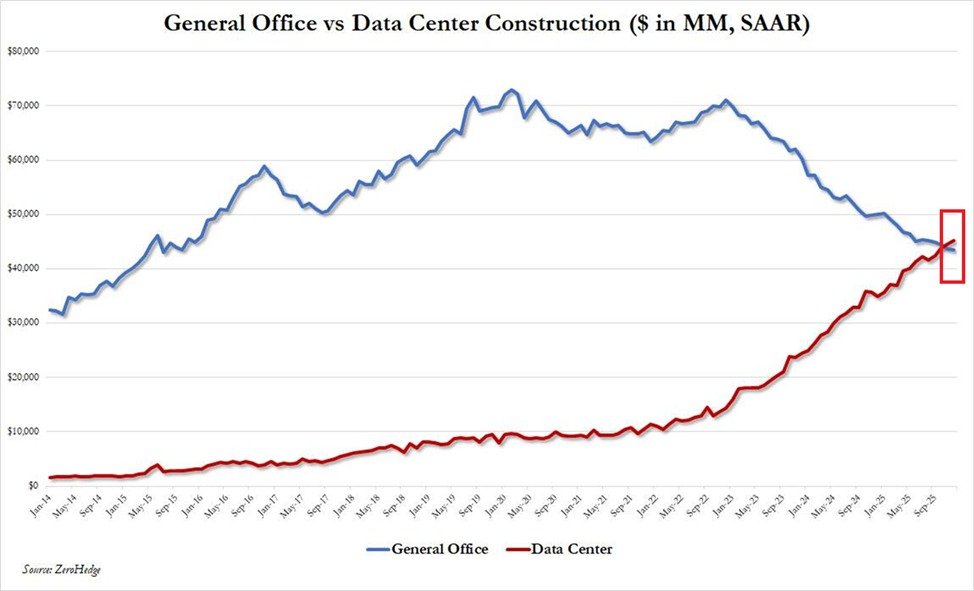
BREAKING: The value of US data centers under construction has officially surpassed the value of office buildings under construction for the first time in history.
Data centers under construction are up+29% YoY, to a record $45.1 billion.
Meanwhile, the value of offices under construction are down -13%, to $43.5 billion, the lowest since October 2015.
Since November 2022, when ChatGPT was launched, data center construction is up +228%.
Over that same period, office construction is down -38%.
AI is reshaping the US economy.
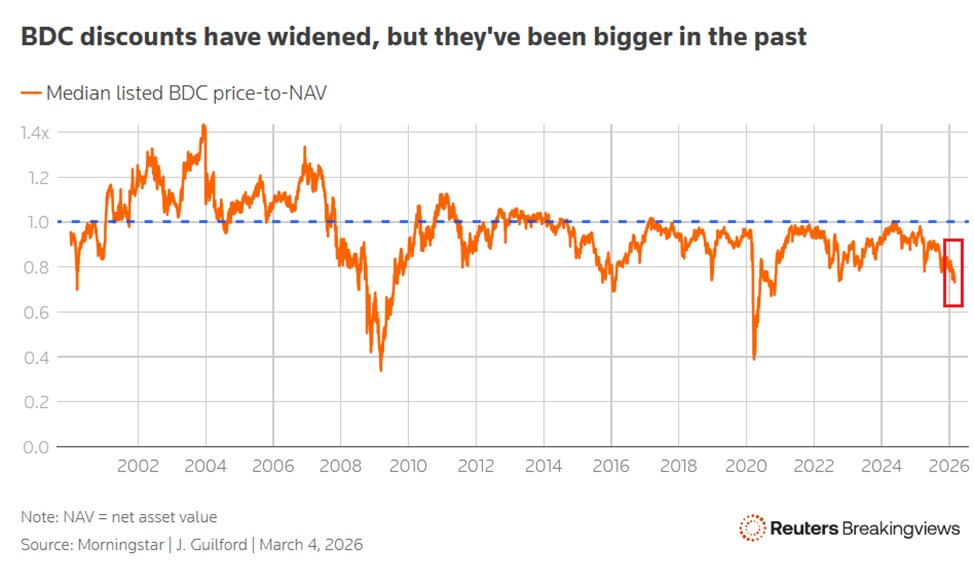
The US private credit market is heading in the wrong direction:
The median listed Business Development Company (BDC) is now trading at just 0.73x its net asset value (NAV), the lowest since 2020.
BDCs are publicly traded firms that lend to small, mid-sized, and distressed US businesses, offering retail investors access to private credit markets.
In other words, they are priced at 73% of their claimed worth.
The median listed BDC price-to-NAV has been consistently declining over the last 18 months.
To put this into perspective, the ratio collapsed to ~0.35x in 2008, meaning the market valued BDCs at just 35 cents on the Dollar.
This comes as concerns are growing that AI will disrupt business models of software firms and make it harder to refinance debt, with the average BDC holding ~20% exposure to the sector.
The private credit industry is under heavy pressure.
Cracks in the US private credit market are intensifying:
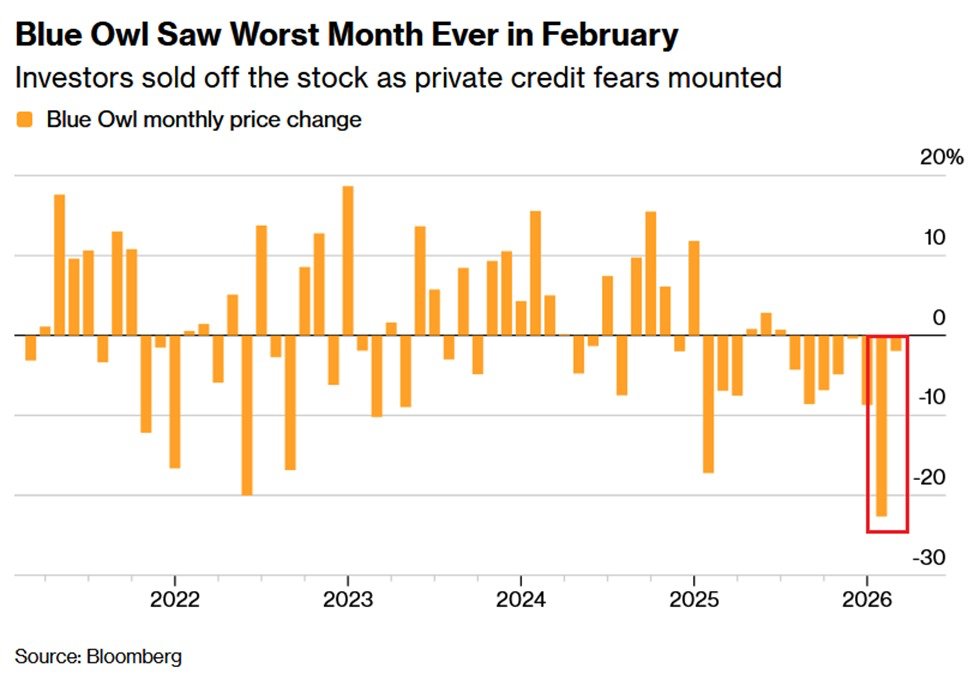
Blue Owl Capital shares dropped -22.7% in February, posting their worst month on record.
This marks the 7th consecutive monthly decline, the longest streak in history.
Meanwhile, short interest in Blue Owl is up to 14.7%, an all-time high.
S&P Global puts short interest even higher, at 17.9%, up from 14.3% last week.
Blue Owl was also the most borrowed stock among all US equities on Wednesday, with over 19 million shares on loan.
All while financing rates to borrow the stock are up +266% MoM, signaling aggressive demand for shorts.
The private credit selloff is accelerating.
The CEO of a $95 billion company just said something that should TERRIFY every software executive on the planet.
Patrick Collison, the man who built Stripe, went on TBPN last week and compared the entire software industry to frozen food.
His words: "Software has been created years beforehand, freeze-dried, and then prepared at the moment of consumption."
That era is ending.
His new model for software? Pizza.
Fresh pizza, made to order, right then and there.
Exactly what you need, the moment you need it.
That is the future Collison sees for all software.
What does that actually mean?
It means AI agents will build you custom software in real time.
No subscriptions, bloated dashboards and one size fits all.
Software cooked for you, that moment, then gone.
This is already happening.
Anthropic launched Claude Cowork in January.
Within weeks, $2 trillion in software stocks evaporated.
IBM had its worst trading day in 26 years, legalZoom dropped 20% and the entire SaaS sector is in freefall.
They're calling it the SaaSpocalypse.
The old software model was simple, spend millions building a product, sell it to everyone and collect subscriptions forever.
Fixed cost, infinite monetization and winner takes all.
That game created trillion dollar companies: Salesforce. Adobe, Oracle, Microsoft.
Collison says that game is now breaking.
Why? Because AI introduces real cost at every use.
Inference costs, custom creation costs, every single interaction has a price tag.
No more build once, sell forever and he called it the non-Walrasian software regime.
Translation: The winner take all economics that built Big Software are collapsing.
When every user gets custom software built on demand, there is no single winner.
There are thousands of winners or none.
Think about what this does to pricing.
No more $50/seat/month or enterprise contracts worth millions.
Instead, you pay per task, outcome and for what the AI actually built you.
The entire revenue model of SaaS is being rewritten.
Klarna already ripped out Salesforce and replaced it with AI.
Cursor ditched its paid CMS and built a replacement from scratch.
Companies are doing this now.
The dominoes are falling.
The entire industry is being rewritten in real time.