The world order shift into a reverse-Gorbachev: a return to Cold War dynamics and commercial conflict.
The Eastern and Western blocs fight for resources, strategic geographic chokepoints, and technology.
The result: sustained fiscal spending, persistent inflation, and an increasingly polarised, K-shaped economy.
Who are the winners and losers?
Andromeda's Q2 investor webcast:
https://t.co/oyp7OznI5Z
Everyone calls Apollo a private equity firm.
In 2025, 84% of its revenue ($27B of $32B) was insurance. Annuities sold to retirees.
The most conservative corner of finance got quietly rebuilt, in plain sight in public filings. Thread🧵👇
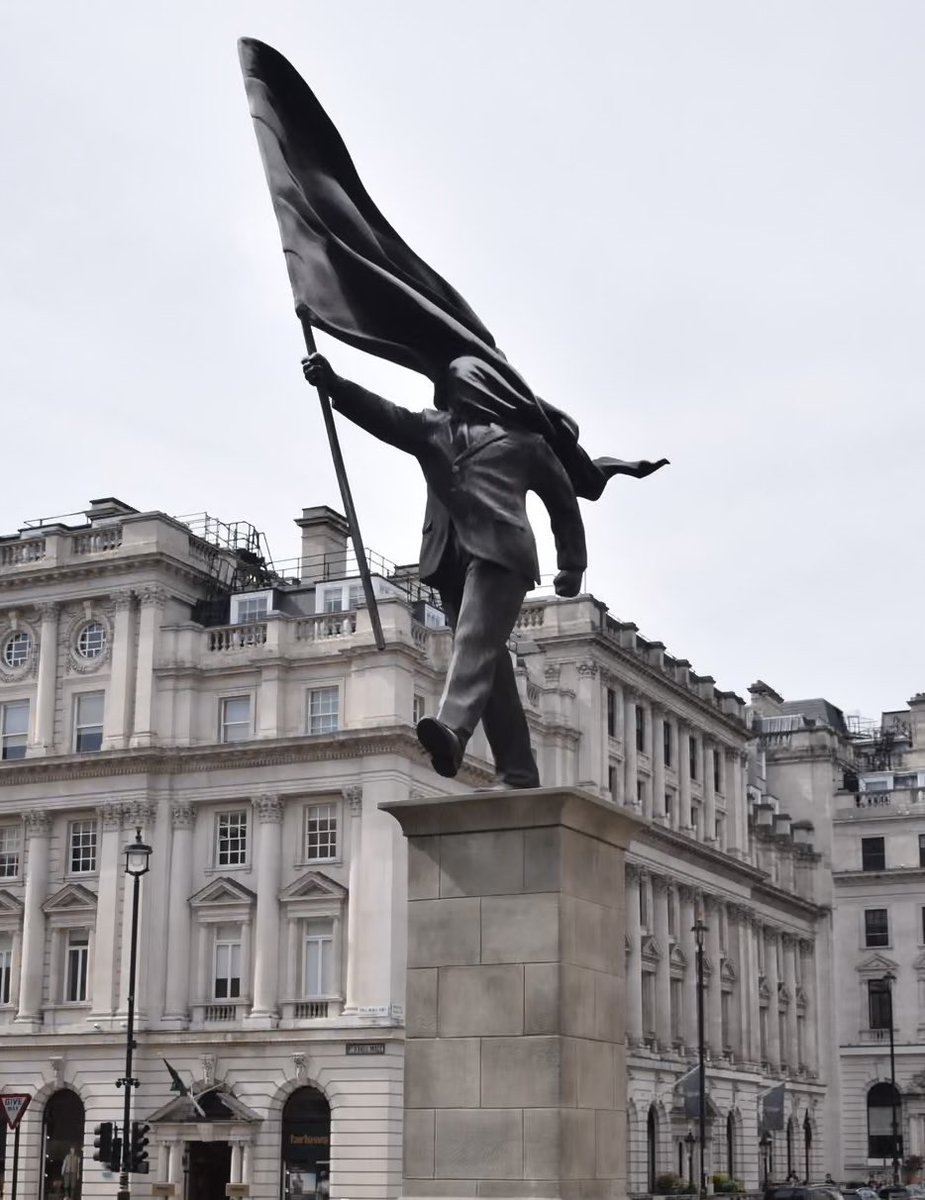
Congratulations to Westminster Council for their acceptance of Banksy’s brilliant statue near Pall Mall. Let’s hope it stays — a welcome note of calmness and humour at a time of growing extremism.
The victory of the opposition in Hungary yesterday, like the Polish election in 2023, is a victory for democracy, not just in Europe but around the world. Most of all, it’s a testament to the resilience and determination of the Hungarian people – and a reminder to all of us to keep striving for fairness, equality and the rule of law.
Peter Magyar's landslide victory in Hungary offers many inspiring lessons:
1. Even an incumbent kleptocrat of 16 years with control of nearly all media & state institutions can be beaten.
2. What is needed is a strong political leader who credibly stands for democracy, a united opposition & a free internet.
3. Foreign interference of the US with endorsements from Trump, Vance & Rubio did not help. Nor did Russian interference & disinformation help.
4. This is a big blow to all the rightwing extremists in Europe who came to campaign for Orban.
5. The biggest blow was probably to MAGA, CPAC & Trump who have campaigned for Orban for no conceivable reason. This augurs for a big loss for the GOP in the midterm elections on November 3.
6. The other big loser is Putin, who is likely to face a much more united EU supporting Ukraine & more sanctions on Russia.
7. Slovak PM Fico & Czech PM Babis are likely to heed the results and become more supportive of the EU, which should more easily take early unanimous decisions.
8. The big winner is Ukraine, against which Orban & Trump ran. Now the EU should be able to decide on €90 bn for Ukraine & tougher sanctions on Russia. Ukraine can now happily ignore Trump's calls for Ukraine giving up territory to Russia.
9. Unless the US apologizes for its support for Russia, kleptocracy & autocracy in Hungary, the chasm between the US & Europe will widen substantially.
(Orban should be praised for conceding so fast.)
Intersting view into how Apollo wore four hats on the same deal:
One sentence: Apollo built the portfolio, broke it, collected fees while it broke, then bought the wreckage from the entity they partially own — and nobody had to disclose the price.
The setup: Athora (European insurer, ~25% owned by Apollo) needed yield, so in 2018 they built a €1.1B portfolio of German office buildings, wrapped in a Luxembourg fund called Hemingway.
The conflict: Apollo simultaneously was:
>Advising Athora on what to buy
>Sitting on Hemingway's board approving those buys
>Collecting property management fees through their firm Oxenwood
>Positioned to take over the assets if things went south
Things went south. German offices got crushed post-COVID. The portfolio started deteriorating. Apollo kept collecting fees through the whole decline.
The escape hatch: Rather than take years of ugly writedowns that would trash Athora's capital ratios quarter after quarter, they used an accounting rule (IFRS 10) creatively. They swapped in an Apollo-controlled entity as General Partner, which technically triggered "loss of control" — letting Athora wipe the whole €1.1B off its balance sheet in one shot and absorb the loss cleanly.
The punchline: Apollo now controls the distressed workout. They had more information about this portfolio than anyone. Nobody disclosed what they paid for that control. Fourteen months later Athora goes to market and raises €750M in debt, presenting clean capital metrics — with the Hemingway disaster buried in the footnotes in accounting language.
Meet Marc Lipschultz.
The man who got paid $23.9 million last year to tell you everything was "fine."
On February 5, he sat on Blue Owl's earnings call and said:
"We don't have red flags. In point of fact, we don't have yellow flags. We have largely green flags. The tech portfolio continues to be the most pristine amongst all of our subsectors."
8 weeks later, investors tried to yank 41% of that "pristine" tech fund back.
And what did Blue Owl's co-founder Doug Ostrover say about this mess?
He told the Australian Financial Review that private credit "lost control of the narrative." That Blue Owl had "only itself to blame." That they "could have done a better job explaining it."
Lost control of the NARRATIVE?
This isn't a PR problem. It's a PRODUCT problem.
When investors demand 41% of their money back and you can only give them 5% - that's not a narrative failure. That's a structural failure baked into the product from day one.
You sold people a product with no exit. Then when they discovered there was no exit, you blamed your communications team.
Now here's the part I really want you to know:
Marc's pay isn't tied to performance, credit losses, or the safety of your money.
According to Blue Owl's own proxy statement, his compensation is formulaically tied to Management Fee Revenue.
So the more money he pulls in from retail investors, the more he gets paid - regardless of what happens to your capital afterward.
Do you understand what that means?
He gets paid to GATHER your money. Not to PROTECT it.
In 2024, that formula paid him $23.9 million - a 29% RAISE from the year before.
Meanwhile his co-CEO Ostrover pulled down another $23.9 million. Their CFO got $47.4 million - a 519% raise.
3 executives splitting $95 million in a single year while retail investors get the door locked behind them.
Here's what Marc's incentive structure actually means:
When loans go bad because AI eats the borrowers, Marc still gets paid.
When the stock craters 60%, Marc still gets paid.
When investors demand their money and Blue Owl gates the funds, Marc STILL gets paid.
His downside is your downside. His upside is his alone.
And the problem isn't the "narrative." The problem is the PRODUCT.
Private credit was sold to retail investors as equity-like returns with bond-like stability.
That was never true. You cannot eliminate volatility. You can only hide it behind quarterly marks and withdrawal gates.
The volatility was always there. They just made sure you couldn't see it - until you tried to leave.
Marc knew this. His $23.9 million paycheck knew this. The proxy statement KNOWS this.
I'm telling you, this has happened countless times before.
Someone with perfect credentials stands in front of a microphone and tells you "green flags" while their compensation structure pays them to keep gathering your capital.
Then the tide goes out.
And suddenly it's not a narrative problem anymore. It's your retirement account.
Believe the incentives. Not the resume.
@RScubism PE owned life insurers total $1tn balance sheet. Of course they are mostly private... Contagion channels through lenders and other insurers. So banks do lend to non bank financial institutions...
3/ But leverage in private credit is nothing like with subprime, where mortgages ➡️MBS ➡️tranches➡️ CDO ➡️ tranches ➡️ CDS ➡️ synthetic CDOs. Most private credit remains unsecuritized. Some ➡️ CLOs but very little added securitization/synethetic replication on top.
@RScubism And yet you keep thinking about bank contagion. Why?
Life insurers have up to 50% in private credit assets. This is not the same risk as the last crisis. Contagion channels are different. Banks are cleaner as regulators kept looking at them - but the risk is somewhere else.
@RScubism Disagree with your points above, especially #2 which is contrary to what you are clearly seeing in the market right now. And in any case, I would not look at a new potential crises with the lens/contagion channel from the past one. Regulators always fight the last battle.
@SayNoToTrading@CedarStResearch Plenty of data and analysis on our website. What is funny is to say "it's not systemic" without numbers and/or analyse the next potential crisis based on the last one.
@MayankSeksaria Normally you could say that (wrong numerator) - but with unrealised losses not marked to market, it's not wrong in my opinion. Of course, you can use total capital too.
@MayankSeksaria Life insurers.
Look at surplus capital vs total assets.
Then add off balance sheet funding liabilities (FABNs, etc) and add back risk re-insured by affiliates/group entities.