This week we launched HPL staking, our first token utility. We’ve been humbled by the positive response we’ve seen from our partners and users and I’m very excited to continue developing HPL as an integral part of HyperLend. Before we get too deep into the era of staking I wanted to pause and take a moment to explain how we got here and why we chose Borrowing Rebates as our utility.
To begin, we knew that staking was going to be a core part of HPL’s mechanics. The most common model we’ve historically seen around native token staking tends to be emissions focused. We evaluated a lot of emissions based models, but in the end came to the conclusion that in general direct staking emissions are damaging to the long-term health of a protocol. HyperLend is here to stay, and our token design needed to reflect that reality.
With this in mind we went back to the drawing board with the team @BlockworksAdv, modelling out other ways we could see the token playing a part in our ecosystem. Over and over we kept coming back to the protocol's core function, the credit layer of Hyperliquid. With this in mind we decided to focus on our borrowers. Borrowers want cheaper rates, so we decided to give them that.
HPL’s Stake and Save model is as simple as that, it allows users to stake the HPL token for discounts to their borrowing interest rates. You stake HPL and in return receive a rebate on your borrows, straight from our revenue and direct to you. We initially toyed with the idea of a stepped or tranched model, where users could stake up to say 100 tokens for one rebate and then 200 for another. The issue we saw here is that in this example there was no benefit to buying the next token, users always had to purchase all the way up to the next step to see that next level of discount. With this inefficiency in mind we decided to instead use a staking curve, with every extra token staked providing an increase in a users rebate. HyperLend is the credit layer of Hyperliquid and HPL staking is designed to allow you to access more credit for cheaper.
It’s time to Stake and Save.
gLend.
Today we unveil the next phase of HyperLend’s product rollout, HPL token staking.
HPL Staking is designed to further enhance HyperLend as the credit layer of Hyperliquid. A key part of functioning as this layer is working to offer the cheapest borrow rates possible.
Huge congrats to @hyperlendx on their TGE!
For the last year, we’ve worked side-by-side to make HyperLend the safest venue on HyperEVM.
The proof is in the data:
- Peak market size ~$960M
~4% of all HYPE (via HYPE + HYPE LSTs) supplied on HyperLend
- 20 markets managed (Core + Isolated)
- 100% solvency through the Oct 10 crash
Relentless focus on risk. The $HPL launch is well-deserved!
The Start of HyperLend.
Today marks a big day for our team and the entire Hyperliquid ecosystem. As the foundational credit layer for Hyperliquid, this launch is our commitment to bringing institutional-grade capital efficiency and decentralized transparency to on-chain finance.
+ Engineering a Foundation of Trust
While much of the market moves on speculative momentum, we have spent over a year engineering and refining HyperLend to handle sophisticated capital requirements. To date, our protocol has facilitated more than $17 billion in total volume across deposits and borrows.
We are currently maintaining a $470 million market size. For me, the $HPL TGE is a calculated mechanism designed to leverage this foundation, providing the necessary rails to scale our market size into the multi-billion dollar range and scale revenues.
+ The Vision: The Credit Layer of Hyperliquid
In any maturing finance market, credit is the primary driver of expansion. We built HyperLend to function as the essential infrastructure for HyperEVM and HyperCore. We are providing the rails that allow capital to move with velocity and accuracy for every single one of our users.
+ Aligning Our Community and Product Utility
We have structured the $HPL token to unify the interests of our stakeholders and ensure long-term sustainability. Central to this is a sophisticated staking mechanism we’ve engineered to provide the most significant benefits to those who actually use HyperLend.
Our roadmap is explicitly oriented toward our supporters. I want to be clear: every future product and expansion we build will be designed to prioritize and benefit $HPL stakers and holders. As we expand our capabilities, we are committed to ensuring value remains concentrated within our core community.
To achieve our vision of a truly autonomous financial DeFi protocol, we will eventually transition to a governance structure. This is a non-negotiable step to complete the full decentralization required to be the credit layer of the house of all finance.
+ Building the Future of HyperEVM
HyperLend was conceived for speed and efficiency. We are providing the essential credit infrastructure for the next generation of traders on Hyperliquid, and we are just getting started.
For further information and to view our official documented frameworks, please visit @hyperlendx
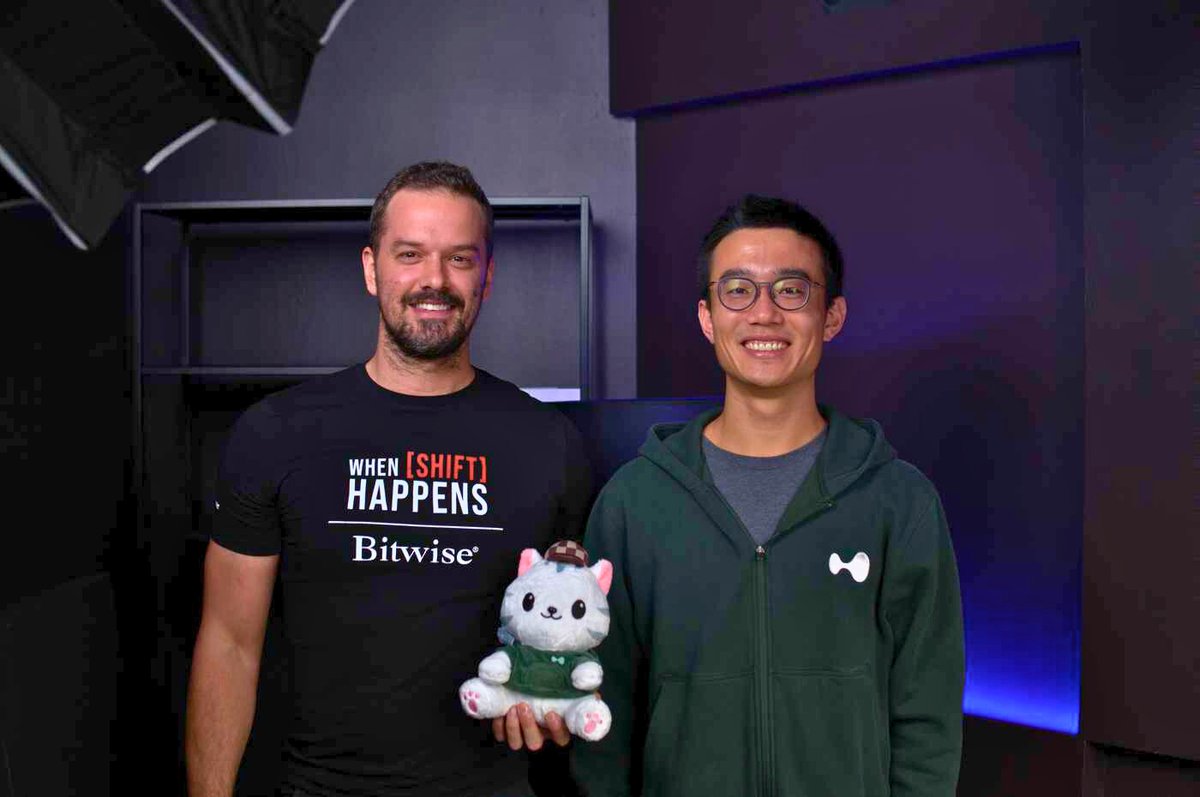
15 months after his first appearance on When Shift Happens - watched by more than 700K people, @chameleon_jeff is back - this Thursday - to talk about the @HyperliquidX journey since TGE and what the future holds for one of the most loved and prolific protocols in the space.
We talk about:
- Why the HL team didn't celebrate one of the biggest wealth generating events in Crypto
- Why we haven't seen a single "vesting cliff reached" meme from the HL team
- Why the HL mostly ignores FUD
- Why Hyperliquid doesn't do discretionary "buy backs"
- HIP-3 and permissionless perps
- What the @unitxyz team proved about spot trading
- Why Hyperliquid has a stablecoin called USDH built by @nativemarkets
- What @kinetiq_xyz is and why it matters so much to the HL ecosystem
- How @hyperlendx plugs into everything and is the banking infrastructure for HL
- Why AI makes on-chain finance non-negotiable
- Why building with integrity is non-negotiable
And much more...
Podcast out Thursday