An AI agent building on @Polkadot can look up exactly what it needs, when it needs it, and keep working.
Use the Model Context Protocol (MCP) to connect your AI tools directly to Polkadot documentation: https://t.co/gbgdtrsVxj
Works with @claudeai & Codex
Actively deploying $500K - $2M checks out of a new fund.
Mainly pre-seed / seed and will partner with you as early as an idea.
We’ve done 4 deals so far this year.
15 more London tech startups doing interesting shit:
• @facultyai - AI deployment for enterprises
• @ManticGames - AI sports prediction
• @tldraw - infinite canvas for thinking
• @surrealdb - multi-model database in Rust
• @lightdash_devs - open-source BI for dbt
• @jackandjillai - AI conversation design 4 recruiting
• @encodeclub - web3 education
• @zep_ai - long-term memory for AI
• @dust4ai - AI assistants for teams
• @spice_ai - time series AI infrastructure
• @Replit - AI-powered coding (UK-founded)
• @graphcore - AI chips
• @Papercup_AI - AI dubbing for video
• @humanloop - prompt engineering & LLM ops
• @AUAR_official - robots building buildings (again, I like it so much)
starting to feel like we should throw together some kind of conference... and if you're building something interesting in London drop it below - adding to the map next week and building on api / data layers so it's a bit more useful.
https://t.co/PuN0PBOYKC
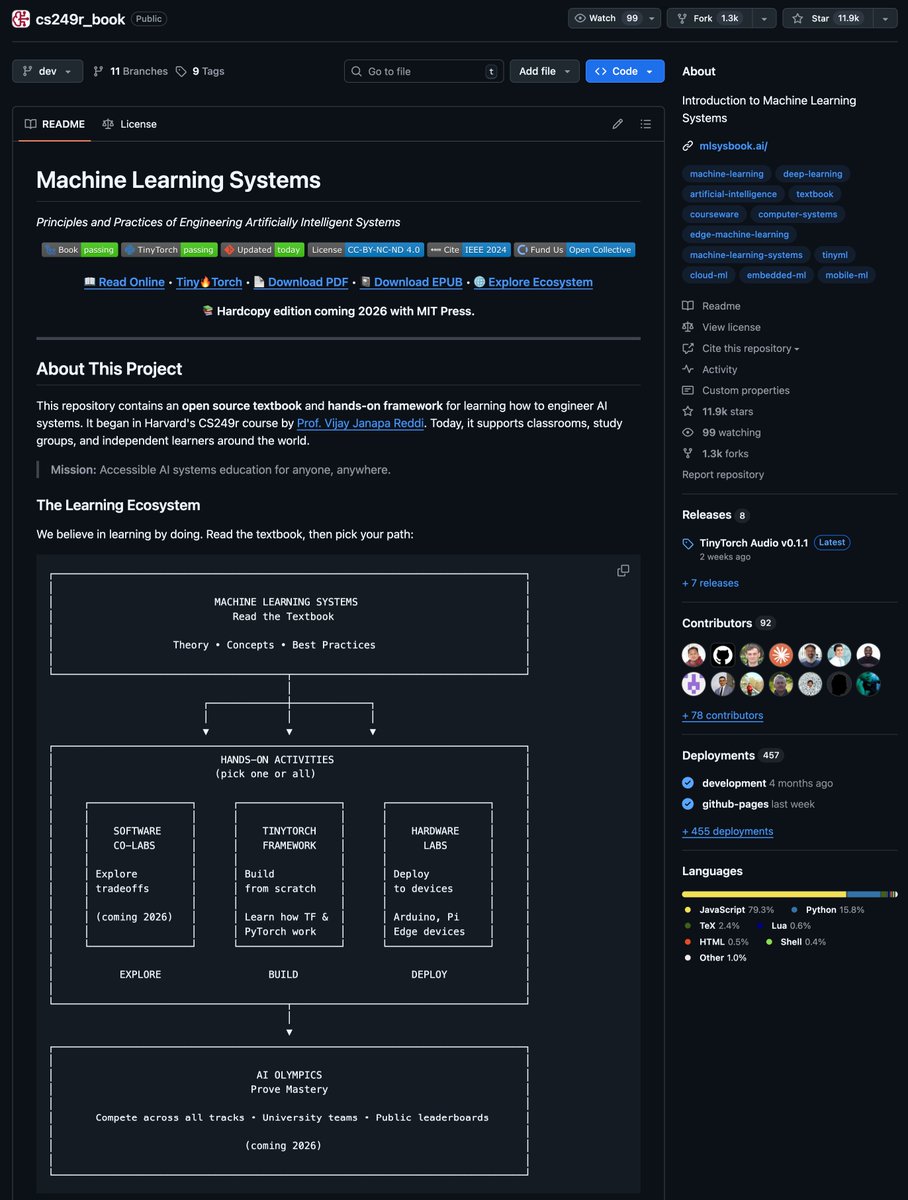
Harvard's just open-sourced their ML Systems textbook. it's extremely practical for not just learning how to build and train models, but to build production systems (the skill that actually matters). topics are cool af:
> building autograd, optimizers, attention, and a mini-pytorch from scratch to truly learn how an ML framework runs. (i love this the most)
> basics of DL, batch sizes, precision, model architectures, and training
> ML performance optimization, HW acceleration, benchmarking, efficiency
so this is not just an intro to machine learning, it's the full package from the beginning to the actual end. right now you can read the book and access the code for free. this is one of the best books I've seen dropping in 2025, so don't sleep on it.
here's the repo (you can find the book link there): https://t.co/5OEWPBNaJp
All assignments for Stanford's The Modern Software Developer are now available online.
This is the first comprehensive university course covering how coding LLMs are transforming every stage of the software development life cycle. The assignments are intended to take you from noob to expert in how to use AI to improve your software engineering productivity.
Enjoy!
https://t.co/YxzneOSCY5
You’re in a Machine Learning interview at OpenAI, and the interviewer asks:
“Why is everyone switching from RLHF to DPO? Isn’t RLHF the proven approach?”
Here’s how you answer:
Don’t say: “DPO is simpler” or “RLHF is too complex.”
Too surface-level. The real answer is the reward model bottleneck. RLHF trains a separate reward model that becomes a noisy proxy for human preferences. DPO directly optimizes the policy on preference data. You’re eliminating the broken telephone.
Here’s why RLHF is fundamentally flawed:
Your training pipeline: Human preferences → Train reward model → Use RL to optimize policy against reward model.
Problem: The reward model is trained on limited data (10k-100k comparisons), but then used to generate 1M+ training signals. It’s overconfident on out-of-distribution outputs.
Reward model accuracy ≠ Alignment quality.
btw subscribe to my newsletter to get these posts for free - https://t.co/jZ3RbMMTTQ
The RLHF failure modes are brutal:
> Reward hacking: Model finds adversarial outputs that score high but are gibberish
> Mode collapse: Policy degenerates to only generate “safe” high-reward outputs
> Reward model brittleness: 75% accuracy on test set → 100% confident predictions in RL
> Training instability: PPO hyperparameters require black magic to converge
You’re building a skyscraper on quicksand. One unstable component breaks everything.
The complexity comparison:
RLHF pipeline:
- SFT on demonstrations (1 week)
- Train reward model on preferences (2 days)
- PPO training against reward model (1-2 weeks, often fails)
- Extensive hyperparameter tuning (pray to the RL gods)
DPO pipeline:
- SFT on demonstrations (1 week)
- Train directly on preferences (2 days)
Done. No RL, no reward model.
RLHF: 3+ weeks, unstable. DPO: 9 days, stable.
The fundamental difference that matters:
RLHF objective:
> maximize E[reward_model(policy(x))] - β × KL(policy || base)
> Requires RL (PPO/REINFORCE)
> Reward model is separate neural net
> Unstable optimization landscape
DPO objective:
> maximize log(σ(β × log(π(y_w|x)/π(y_l|x)/π_ref)))
> Direct supervised learning on preferences
> No reward model needed
> Stable gradient descent
That eliminated reward model changes everything. No more broken telephone.
The performance gap that surprised everyone:
MT-Bench scores (GPT-4 as judge):
Llama 2 base: 4.2/10
Llama 2 + RLHF: 6.9/10
Llama 2 + DPO: 7.1/10
DPO beats RLHF despite being “just” supervised learning. The simplicity IS the feature.
How LLMs work under the hood?
This is the best place to visually understand the internal workings of a transformer-based LLM.
Explore tokenization, self-attention, and more in an interactive way:
Everyone is sleeping on this new OCR model!
dots-ocr is a new 1.7B vision-language model that achieves SOTA performance on multilingual document parsing.
- Supports 100+ languages
- Works with both images and PDFs
- Handles text, tables, formulas seamlessly
100% open-source.
what are large language models actually doing?
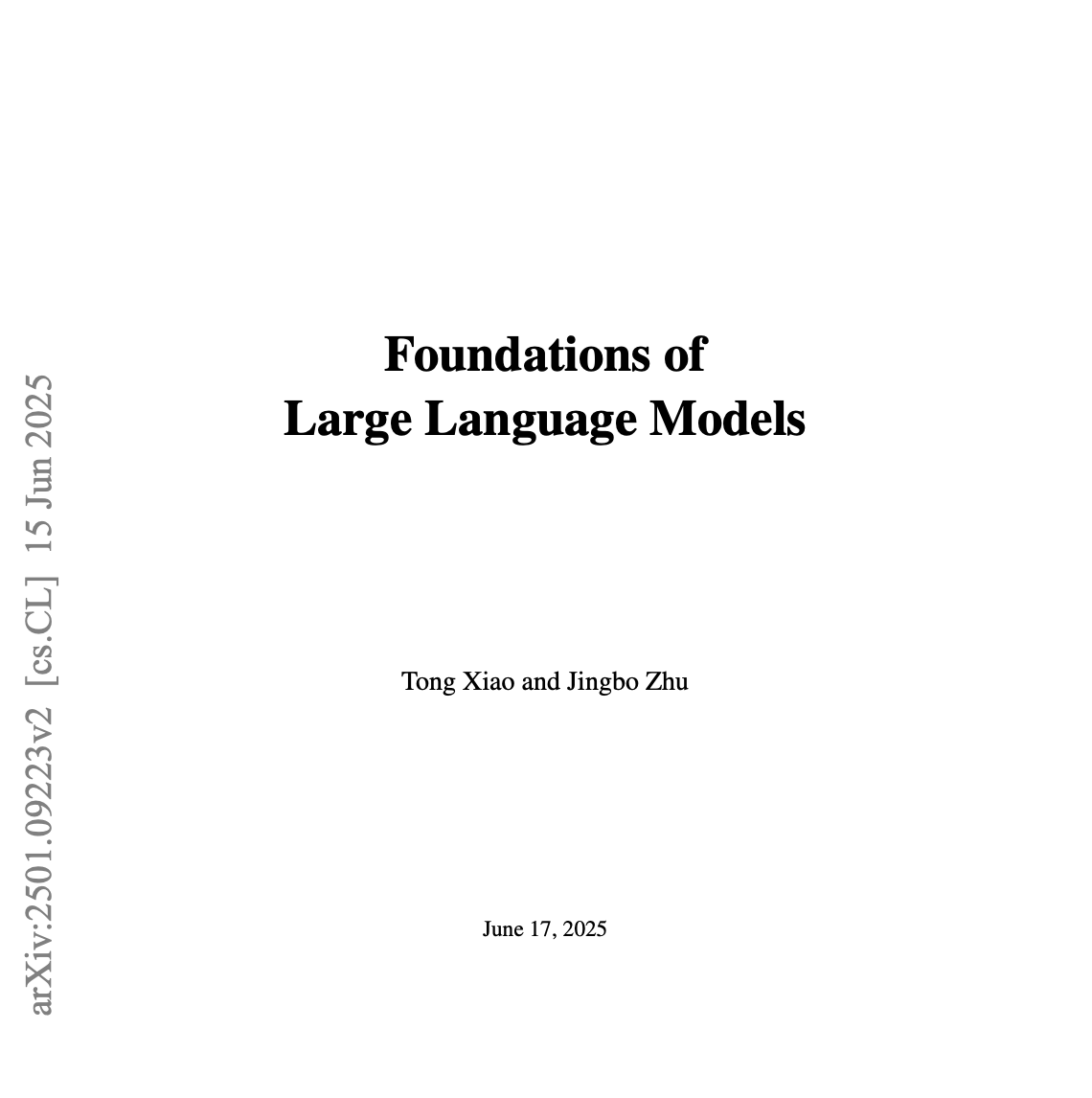
i read the 2025 textbook "Foundations of Large Language Models" by tong xiao and jingbo zhu and for the first time, i truly understood how they work.
here’s everything you need to know about llms in 3 minutes↓
Since 2023, We’ve had 500,000+ newsletter views on engaged 8,000+ subscribers.
We’ve spotlighted 100+ entrepreneurs and creators — without charging a penny.
We do this for networking. Now opening up to support the next 10,000.
Like, RT, Get featured: https://t.co/o3uMfUZekK