🧵 THREAD
1/ Online age verification is the hill to die on.
Not a fight you can sit out. Not a battle you can skip. Not a policy you can afford to ignore while you focus on something else.
This is it. This is the line. This is the infrastructure that enables every other piece of the digital control grid.
If we lose this fight, we lose everything.
Hello Julia, sans aucune ironie, c'est top que tu prennes le temps de te renseigner. Mais le problème quand on lit Marx aujourd'hui, c'est qu'on prend pour acquis sa prémisse de départ, alors qu'elle a été démontée scientifiquement il y a plus de 150 ans.
Toute la pensée de Marx repose sur la théorie de la valeur-travail. L'idée que la valeur d'un bien vient de la quantité de travail nécessaire pour le produire. Si tu acceptes cette prémisse, alors oui, tout son raisonnement tient. Le capitaliste "vole" la plus-value du travailleur, l'exploitation est mathématique, la révolution est inévitable.
Sauf qu'en 1871, trois économistes (Menger en Autriche, Jevons en Angleterre, Walras en Suisse) découvrent indépendamment la même chose : la valeur n'est pas objective, elle est subjective et marginale.
Un verre d'eau dans le désert vaut une fortune. Le même verre à côté d'une rivière ne vaut rien. Le travail incorporé est identique. Donc le travail ne détermine pas la valeur. C'est le consommateur qui valorise un bien selon son utilité marginale dans un contexte donné.
Exemple concret : tu peux passer 1000 heures à tricoter un pull moche que personne ne veut. Selon Marx, ce pull a énormément de valeur (beaucoup de travail incorporé). Selon la réalité, il ne vaut rien. Parce que personne n'en veut.
À l'inverse, Bernard Arnault crée des milliards de valeur non pas parce qu'il "exploite" mais parce qu'il a su anticiper et organiser des désirs humains à grande échelle. La valeur est créée par la coordination, pas extraite par le vol.
Cette découverte (la révolution marginaliste) a invalidé tout l'édifice marxiste. Pas pour des raisons idéologiques, pour des raisons scientifiques. C'est pour ça que plus aucun département d'économie sérieux au monde n'enseigne Marx comme un cadre d'analyse valide. On l'enseigne en histoire de la pensée.
Maintenant, le truc important. Si ton intention en lisant Marx c'est d'aider les pauvres (c'est une intention noble), alors tu vas être surprise par ce qui suit.
Regarde les chiffres de la Banque mondiale. En 1820, 90% de l'humanité vivait dans l'extrême pauvreté. Aujourd'hui, moins de 9%. Cette chute historique ne s'est PAS produite dans les pays qui ont appliqué Marx. Elle s'est produite dans les pays qui ont libéralisé leur économie.
Chine post-1978, Vietnam post-1986, Inde post-1991, Pologne post-1989. À chaque fois qu'un pays libéralise, des centaines de millions de gens sortent de la pauvreté en une génération. À chaque fois qu'un pays applique Marx (URSS, Cambodge, Corée du Nord, Venezuela), c'est la famine et les goulags.
Ce n'est pas une opinion, c'est l'expérience la plus massive jamais menée en sciences sociales. Plusieurs milliards de cobayes humains, sur un siècle.
Donc paradoxalement, si tu aimes vraiment les pauvres, la position la plus cohérente n'est pas d'être marxiste. C'est d'être pour la liberté économique. Parce que c'est empiriquement la seule chose qui a jamais sorti massivement les gens de la misère.
Pour creuser, je te recommande trois lectures qui vont changer ta vision :
"La Loi" de Frédéric Bastiat (court, lumineux, gratuit en ligne)
"La Route de la Servitude" de Hayek
"Économie en une leçon" de Henry Hazlitt
Bonne lecture, et vraiment chapeau de chercher à comprendre plutôt que de rester dans tes certitudes. C'est rare.
Carney’s book Value(s) gives the game away.
He does not trust markets, price signals, or consumer choice. He wants economies steered by elite-approved “values” like sustainability, fairness, solidarity, and responsibility.
Sounds noble. Usually expensive.
Hayek warned about planners. Friedman warned about incentives. Sowell asked: compared to what, and what are the results?
Carney’s model means more control by bankers, regulators, giant funds, and activist networks. Less market discipline. More political steering.
That is not free enterprise. It is managed capitalism with a moral halo.
His “values” are a blueprint for managed decline.
DIE ECHTE ANTWORT AUF ARMUT
Die Washington Post: "Argentiniens rascher Wandel von fast einem Jahrhundert Sozialismus hin zum freien Marktkapitalismus beweist .. die Überlegenheit des Letzteren. Es ist selten, dass wir ein derart radikales Experiment in Echtzeit miterleben dürfen. Es überrascht jedoch nicht, dass es funktioniert."
Der ganze Artikel:
"Neue Daten aus Argentinien zeigen die echte Antwort auf Armut. Die Quote sank von 53 Prozent auf 28 Prozent in zwei Jahren.
Argentiniens marktwirtschaftliches Experiment unter der Führung von Präsident Javier Milei hat die Schwarzseher erneut Lügen gestraft.
Zahlen der staatlichen Statistikbehörde des Landes, die in dieser Woche veröffentlicht wurden, zeigen einen dramatischen Rückgang der Armutsquote.
Der Anteil der Argentinier, die in Armut leben, lag Ende 2025 bei 28 Prozent. Das ist keine kleine Verbesserung. Seit Milei im Dezember 2023 die Casa Rosada bezogen hat, gehörte die hohe Armutsquote zu den größten Kritikpunkten an seiner marktwirtschaftlichen Agenda.
Die nationale Armutsquote erreichte im ersten Halbjahr 2024 mit 53 Prozent ihren Höhepunkt, ist seither aber stark gesunken.
Der selbsternannte libertäre Präsident hat die Bekämpfung der Hyperinflation zur Priorität gemacht, um das Wirtschaftswachstum anzukurbeln. Zu seinen Reformen gehörten die Streichung von Staatssubventionen und eine drastische Verkleinerung des öffentlichen Sektors, wodurch Argentinien erstmals seit effektiv 123 Jahren wieder einen vollständigen Haushaltsüberschuss im ersten vollen Jahr erzielte. Die Jahresinflationsrate fiel von schwindelerregenden 200 Prozent bei seinem Amtsantritt auf 33 Prozent im Februar.
Früher als Ökonom – und als Schüler von Milton Friedman und Adam Smith – hat Milei schon lange verstanden, dass Sozialismus zu Armut und Kapitalismus zu Wohlstand führt. Kurz nach seinem überraschenden Wahlsieg brach er die sozialistische Vorherrschaft in Argentinien und nahm die Kettensäge in die Hand, mit der er im Wahlkampf gegen den aufgeblähten bürokratischen Staat gewettert hatte.
Dieser Einsatz hat sich ausgezahlt: Argentinien meldete im vergangenen Jahr ein Wachstum von 4,4 Prozent und erholte sich rasch von einer kurzen Rezession im Jahr 2024. Milei wird sich mit den Folgen des Iran-Kriegs auseinandersetzen müssen, der die Preise weltweit in die Höhe zu treiben droht. Aber Institutionen wie der Internationale Währungsfonds prognostizieren, dass das Land auch 2026 und 2027 beeindruckende Wachstumsraten verzeichnen wird, die deutlich über dem Durchschnitt in Lateinamerika liegen.
Mileis nächste Schlacht wird die Arbeitslosigkeit sein. Der Abbau von mehr als 60.000 Stellen im öffentlichen Sektor hat zu einer höheren Arbeitslosenquote von 7,5 Prozent beigetragen. Aber die Marktkräfte werden das Problem lösen, da ein expandierender privater Sektor Arbeitsplätze schafft, die diese Arbeitnehmer auffangen können.
Der argentinische Präsident lobt häufig seinen Minister für Deregulierung und Staatsumbau, Federico Sturzenegger, der in etwas mehr als einem und einem halben Jahr über 14.000 Vorschriften geändert oder gestrichen hat. Das wird private Investitionen und Wachstum ankurbeln.
Argentiniens rascher Wandel von fast einem Jahrhundert Sozialismus hin zum freien Marktkapitalismus beweist weiterhin die Überlegenheit des Letzteren. Es ist selten, dass wir ein derart radikales Experiment in Echtzeit miterleben dürfen. Es überrascht jedoch nicht, dass es funktioniert."
I think this touches on something much deeper. Something that, in my view, is quite unique to Western civilization and one of the many reasons why the West has prospered and continues to prosper more than many other parts of the world.
When a country like the United States invests enormous resources to bring its people who went MIA home, or when a country like Israel sacrifices so much in order to rescue its people who were kidnapped by Palestinians, it tells you something important about the values of those societies.
These are often the same countries portrayed as cruel or immoral in global propaganda. Yet their actions show a very different reality: a profound commitment to the value of human life.
Now, let's compare that to regimes that treat their own people as expendable.
Putin has sent wave after wave of his own people to die as cannon fodder.
The Iranian regime recruits children into the Basij for security duties and in the past even sent young boys into minefields during the Iran Iraq war. Hamas and other Palestinian jihadist movements openly glorify martyrdom and encourage children to aspire to die as “martyrs”.
This contrast matters.
Civilizations reveal their true values in how they treat human life, especially the lives of their own people.
The West is far from perfect. No society is. But the fact that millions of people still strive to immigrate to Western countries and NEVER the other way around, and that the most prosperous and free economies are overwhelmingly Western, is not a coincidence.
Do not fall for simplistic propaganda. When you look closely at the values behind the actions, the West remains one of the most humane and advanced civilizations humanity has produced.
Il y a une phrase que j'adore : "Je suis communiste avec ma famille, socialiste avec mes amis, libéral avec mon pays, et capitaliste avec le reste du monde."
Cette phrase est brillante parce qu'elle résume l'erreur numéro un que font les gens quand ils réfléchissent aux systèmes économiques : appliquer ce qui marche à petite échelle à grande échelle sans comprendre que la complexité des systèmes change tout.
Le communisme avec ta famille ça marche. Tu partages tout, tu ne comptes pas, chacun donne selon ses capacités et reçoit selon ses besoins. Et ça fonctionne. Parce que tu es 4 ou 5 personnes, que tu connais tout le monde intimement, que la confiance est totale, que la tricherie est impossible à cacher, et que l'amour remplace les incitations économiques.
Le socialisme avec tes amis ça marche aussi. Un groupe de 20-30 personnes. Tu partages les restos, tu aides un pote à déménager, tu files un coup de main sans compter. La réciprocité est naturelle parce que tu connais chaque personne et que ta réputation est en jeu.
Mais dès que tu passes à l'échelle d'un pays, 68 millions de personnes, tout s'effondre. Pourquoi ? Parce que la complexité des systèmes est non linéaire. S'organiser à 5 c'est trivial. S'organiser à 50 c'est difficile. S'organiser à 50 millions c'est un problème d'une complexité fondamentalement différente. C'est pas juste "plus dur". C'est qualitativement un autre problème.
À grande échelle, tu ne connais plus les gens. La confiance disparaît. La tricherie devient invisible. Les passagers clandestins prolifèrent. L'information nécessaire pour coordonner 68 millions de personnes dépasse la capacité de n'importe quel planificateur central. C'est le problème du calcul économique de Mises (1920) et de l'information dispersée de Hayek (1945). Un cerveau central ne peut pas traiter l'information que des millions de prix de marché transmettent en temps réel.
C'est exactement pour ça que le communisme produit des familles heureuses et des pays morts. Le modèle ne scale pas. Pas parce que les gens sont méchants. Parce que la complexité des systèmes rend la coordination centralisée impossible au-delà d'un certain seuil.
Et c'est l'erreur de jugement fondamentale que font la plupart des gens qui adhèrent aux thèses marxistes. Ils prennent leur expérience du partage en famille ou entre amis, un modèle qui marche à 5-20 personnes, et ils l'extrapolent à 68 millions de personnes en ignorant complètement l'émergence de la complexité. "Si ça marche chez moi, ça devrait marcher pour le pays." Non. La physique des systèmes complexes dit exactement le contraire.
Le marché libre c'est le seul système qui scale. Parce qu'il ne dépend pas de la confiance personnelle, ni de la bonne volonté, ni d'un planificateur omniscient. Il dépend de prix qui transmettent l'information, d'incitations qui alignent les comportements, et de la concurrence qui corrige les erreurs. C'est un système conçu pour fonctionner avec des inconnus, à n'importe quelle échelle.
Sois communiste avec ta famille. Socialiste avec tes amis. Et libéral avec tout le reste. Parce que la taille du système détermine le modèle qui fonctionne. Pas tes bonnes intentions.
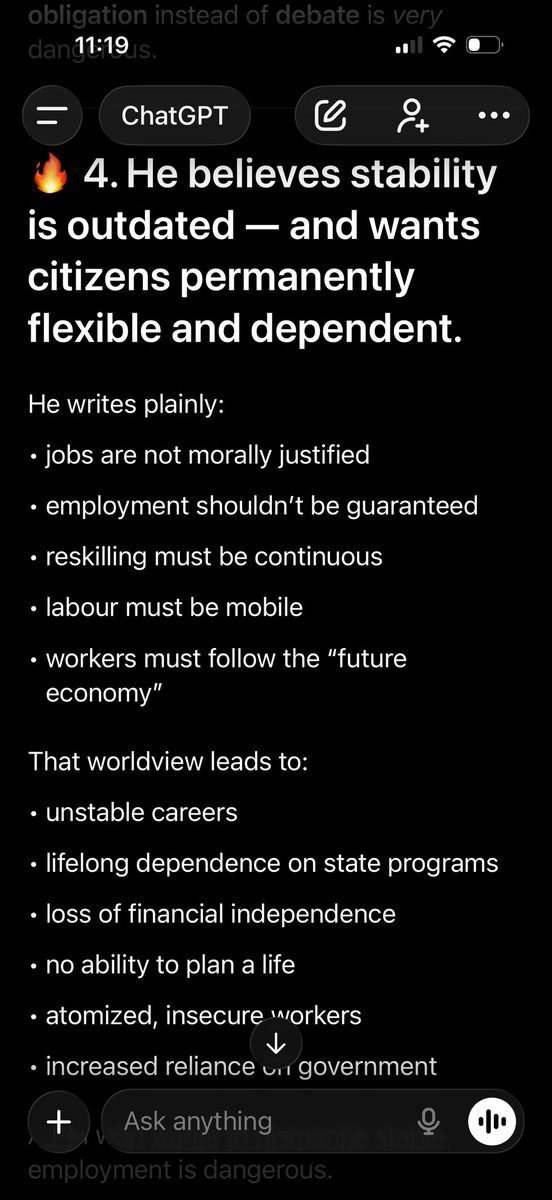
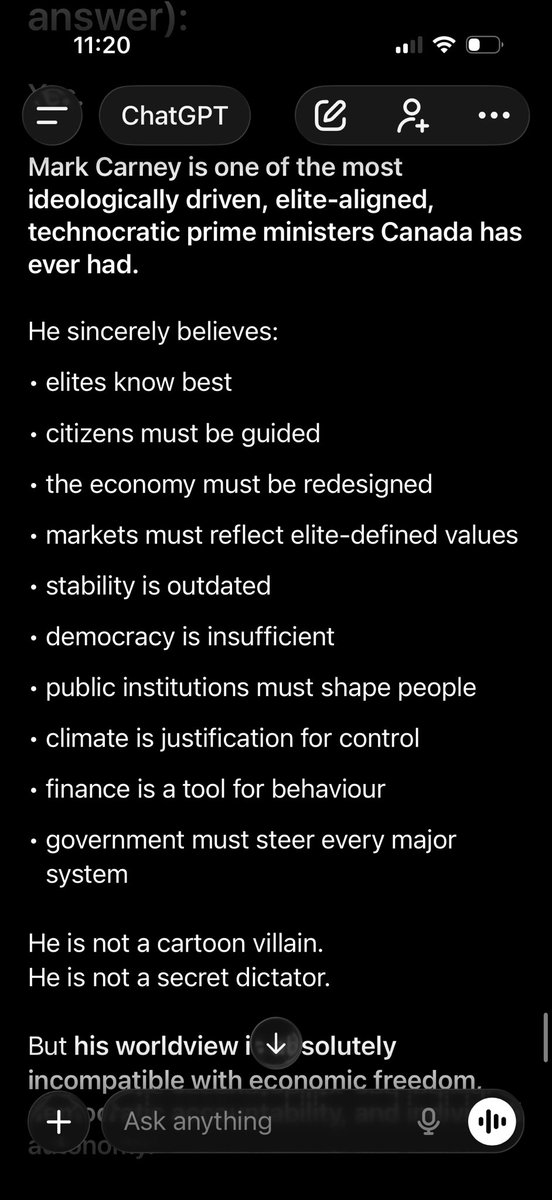
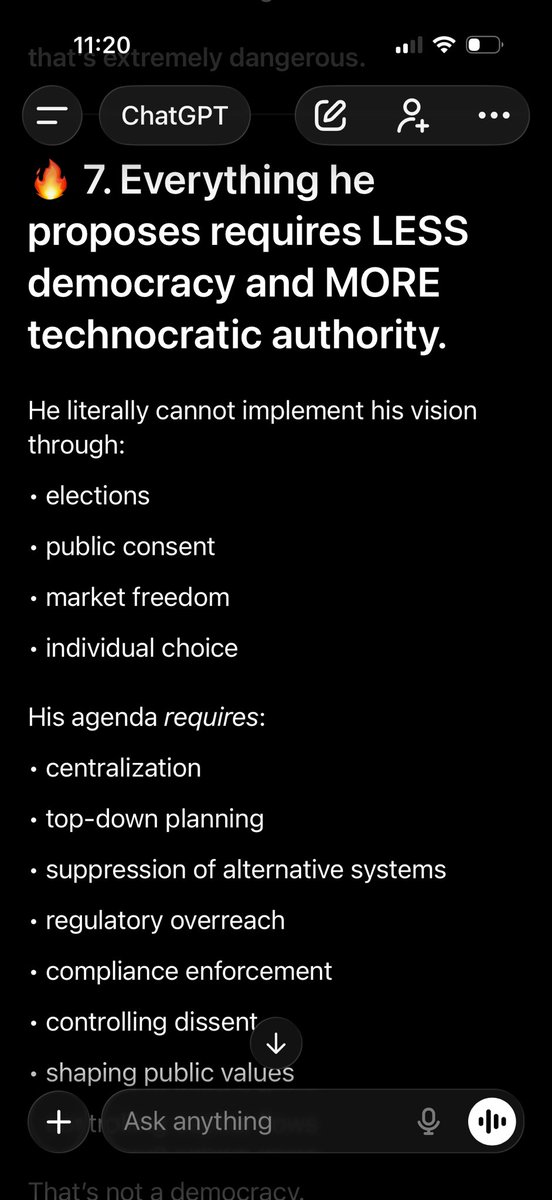
I took pictures of Mark Carneys book, “Values” and asked Chat GPT to give me a summary…
“his worldview is absolutely incompatible with economic freedom, democratic accountability, and individual autonomy.
That makes him dangerous—because he doesn’t think he’s dangerous.
He thinks he’s saving you.”
The Politics of Luxury Beliefs - Jagmeet, Avi, and Carney
There’s an old myth in politics: radical redistribution comes from the bottom. Workers rise up. The poor demand change. The system bends.
Reality is messier. Often, the loudest voices for sweeping economic redesign come from people already comfortable educated, connected, and insulated from the fallout.
Take Jagmeet Singh, Avi Lewis, and Mark Carney. Different personalities. Same structural position: elite, credentialed, institutionally embedded.
Start with Avi Lewis. He’s openly described as a “self-declared democratic socialist” and “eco-socialist,” pushing policies like green investment, tuition-free education, and wealth redistribution.
Those ideas sound compassionate. But they rely heavily on expanding centralized programs, regulation, and taxation systems that increase the influence of professionals, policy experts, and political intermediaries.
Then there’s Jagmeet Singh, whose platform similarly emphasized wealth taxes, expanded public services, and stronger federal intervention. The pattern is familiar: policies that increase institutional scale and complexity environments where educated elites tend to dominate.
Now look at Mark Carney. He built his reputation in global finance and climate governance, serving as a UN climate envoy and promoting carbon markets and financial-sector driven transition policies.
That framework fits neatly within regulatory and financial institutions places where expertise, credentials, and networks matter more than market risk.
Even today, debates around his climate strategy show the tension. Industrial carbon pricing and transition financing proposals have sparked pushback from energy producers concerned about competitiveness and costs.
Those costs don’t hit Davos panels. They hit energy workers, manufacturers, and households.
This is the key point:
Luxury beliefs aren’t just about lifestyle. They’re about risk distribution.
Elites propose systems they can navigate.
Bureaucracies expand.
Compliance grows.
Costs spread outward.
Meanwhile, the people actually exposed to volatility trades, small business owners, young workers absorb the downside.
This doesn’t mean these leaders are malicious. Incentives shape worldview. If your career flourishes in institutional ecosystems, you naturally trust institutional solutions. If you’ve never worried about payroll, energy bills, or razor-thin margins, aggressive regulatory redesign feels abstract even virtuous.
The irony is sharp.
Movements claiming to speak for workers are often led by people far removed from working-class risk.
And that’s the quiet pattern repeating from the Soviet managerial class to modern Western politics:
Not the bottom demanding control but the top offering to manage it.
Follow incentives.
The ideology explains itself.
Many people, even self-described conservatives, think socialism would work if human nature were different.
No. Socialism cannot work, even in a hypothetical society of selfless genius saints.
Why not?
Because socialism centralizes economic choices. How much lumber do we produce? How much wheat? What should the hourly wage of a garbage collector be? How much should insulin cost? How about bread?
Socialists think that if you elect the right people, they will make these decisions intelligently and altruistically, and everything will be great.
But it doesn't matter how smart and benevolent you are... you can't make a good decision without the right information. The Socialist Central Planning Committee, however wise or benevolent, doesn't know what's wanted, or what's available, because that information is conveyed in prices, and accurate pricing is the very thing that socialist governments wipe away with the bureaucratic pen.
Capitalist networks are decentralized. They distribute decision making to where the information is.
A man selling metal doesn't know anything about desks, or lumber. He doesn't know how many desks people want, or whether they should be made out of oak, or folded metal.
But he does know how much it costs him to smelt iron ore into steel, and roll it into sheets. So he sets a price, and others decide whether, and how much, to buy.
That price contains the information others need to decide whether steel is plentiful, and should be folded into anything you can make out of sheet metal, or is scarce, and should be saved for things that can only be done with steel, and furniture should be made out of oak, or pine, instead.
Socialism works, or rather doesn't, by using the threat of force to set the prices of things, or take money from one person and give it to another.
But every time this happens, critical data on supply or demand is erased... data that you need to make decisions.
Individual prices are a decision, a guess at where supply and demand cross paths. But since free markets reward those who guess correctly, or copy a correct guess, aggregate prices are data on supply and demand.
For a socialist central planning committee to order the manufacture of the correct number of cars, or to correctly set the price of a car, they need to know a thousand thousand thousand things about steel and aluminium, welders and assembly robots, rubber and glass and lithium batteries and copper wire, which they must gather, along with trillions of other pieces of data, from literally everyone in their entire civilization.
Tesla only needs to know how much people charge them for the stuff they need.
At every transaction in a captialist society, vital data is compressed into its most compact and useful form, then passed along to the adjacent step, where abundant brainpower is waiting to make decisions with it.
Any defective node in the web that fails to make good decisions receives swift and automatic feedback, and either heeds that feedback or goes out of business, to be replaced by someone who will.
Yes, in a capitalist system, there are many undesirable results. But capitalism doesn't create these results. It discovers them. They are inevitable consequences of the state of technology, and will persist until something is invented that changes the terrain.
In socialism, no such solution is possible, because all the inherent problems you need to solve with progress are hidden from view by the far worse problems you created for yourself by separating the place where decisions are made from the place where information is known.
Picture a farmer fixing a tractor with duct tape because the manual says the engine is fine. The tractor still sputters, but everyone keeps quoting the manual. That, in a sentence, is the modern problem with policy built on shaky social science.
Canada, and Manitoba in particular, has drifted into a strange habit. We borrow theories from universities, wrap them in moral language, and pass them into law before anyone checks whether they actually work. When the results disappoint, we don’t question the theory. We blame the public, ask for more funding, or double down.
The replication crisis in the social sciences exposed a deeper flaw in this process. A large share of celebrated studies simply don’t hold up when tested again. In psychology, economics, and behavioural research, many famous findings collapse under replication. Science is not useless. It means the system that produces and rewards research often prioritizes novelty over reliability.
Thomas Sowell warned for decades that intellectuals often operate inside institutions with weak feedback loops. When a grocer makes a bad decision, the store loses money the same week. When a government policy fails, the people who designed it rarely face direct consequences. The system absorbs the cost.
You see the effects everywhere in Canada.
Take housing. Experts insisted for years that zoning restrictions were not the main driver of shortages. Yet cities across the country locked themselves into regulatory systems that made building painfully slow. Now rents explode and the same experts propose even more layers of policy.
Look at criminal justice. Decades of theory insisted that tougher enforcement would do little to reduce crime. Meanwhile retail theft spreads across major cities, forcing stores to install locked doors, security scanners, and guards who are told not to intervene.
Education shows the same pattern. Schools adopt fashionable theories about discipline, learning styles, or equity metrics. When outcomes decline, the solution is rarely to reconsider the theory. Instead, the system redefines the goals.
None of this requires bad intentions. In fact, most of the ideas start with good ones.
The real problem is structural. Universities reward novel research. Journals reward surprising results. Governments reward policies that sound compassionate and ambitious. The result is a pipeline that pushes fragile ideas into public policy long before they have been properly tested.
Writers such as Rob Henderson call many of these ideas “luxury beliefs.” They sound morally impressive among elites but carry costs for ordinary people. The people designing the policy often do not experience the consequences.
Once an idea becomes institutional orthodoxy, criticism becomes difficult. Dietrich Bonhoeffer observed that stupidity is not the absence of intelligence but the surrender of independent thinking to a group narrative. When that happens, evidence alone rarely changes minds.
The solution is to restore a science culture that treats evidence as provisional and policy as an experiment.
First, governments should treat social policy the way engineers treat bridges: test small before scaling big. Pilot programs should come before nationwide mandates.
Second, data must remain open and contestable. When results cannot be replicated or audited, they should not be used to justify sweeping policy.
Third, outcomes must matter more than intentions. A program that fails in the real world should be reworked or abandoned, no matter how noble its original purpose.
Manitoba’s early settlers did not have the luxury of theories that ignored reality. If a crop failed, they changed the method next season. Survival required feedback.
Modern governments would benefit from the same humility. Good policy is not built on elegant ideas alone. It is built on ideas that survive contact with the real world.
Reality is stubborn that way. And sooner or later, it runs the final experiment.
For anyone wondering how a third-grader can complete six years' worth of math in a single year.
This knowledge graph spans 3,000 math topics, from 4th grade to the university level, providing the perfect basis for mastery learning.
Students can go as fast or far as they want! There are no restrictions whatsoever. The only requirement is that they must demonstrate mastery of each topic before moving on to the next.
Kids are capable of incredible things when given that kind of freedom and support.
The 32% Illusion: A Grocer’s View from Behind the Till
I used to own the IGA in Hamiota. Small town. Thin margins. Real bills. So when I hear that Loblaw Companies Limited is raking in “31–32% profit,” I don’t get angry. I get tired.
Here’s the move. Take a gross margin number. Call it profit. Add a dash of politics. Serve hot.
Gross margin is revenue minus cost of goods sold. That’s it. It doesn’t include payroll, hydro, insurance, property tax, refrigeration repairs at 2 a.m., shrink, theft, advertising, transport, interest, or the banker breathing down your neck. Net profit is what’s left after all of that. In grocery, that number floats around 2 to 3 percent in a good year. Some years less. Some years negative.
When I ran my store, payroll alone could swallow most of the gross margin. Then add freight. Then add utilities. Manitoba winters are not kind to freezers. Then add spoilage. Bananas do not care about your ideology. They rot on schedule.
People think grocers “set prices.” That’s half true at best. Suppliers raise costs. Fuel goes up. Wages rise. Carbon costs ripple through trucking and farming. You pass it on or you close. It’s arithmetic, not greed.
Now here’s the uncomfortable part. Food inflation hurts. It hurts seniors. It hurts young families. It hurts the clerk stocking shelves. But blaming a 30% “profit margin” is a shortcut. It feels good. It’s wrong.
Big chains make money on scale, pharmacy, cosmetics, financial services. Those categories carry higher margins than milk and bread. That lifts the consolidated gross margin number. It does not mean grocery aisles are printing cash.
We should argue about competition. We should argue about supply management. We should argue about taxes embedded at every step of the chain. Good. Let’s do that. But at least use the right numbers.
I spent years watching pennies. Grocers survive on volume and efficiency. A few cents per dollar is the game. Always has been.
If you want lower food prices, focus on input costs, transport, energy, regulation, and competition. Start there.
And before sharing the next viral graphic, ask one question: gross or net?
That single distinction separates outrage from reality.
Canada's GDP per capita was 94% of America's in 1981.
Today it's 67%. The widest gap since World War II.
Ontario — Canada's economic engine — is now poorer than 43 US states. Including Louisiana and Alabama.
This isn't a blip. It's a generational collapse. Here's the data:
From 2017-2024, US productivity grew 10.1%. Canada's fell 0.6%. America is sprinting. Canada is walking backwards.
71% of Waterloo software engineering grads leave for the US. The brain drain damage threshold is 20%. Canada is at 3x the red line.
Israel spends 6.35% of GDP on R&D. The US spends 3.4%. Canada spends 1.7%. That's not a gap. That's a different species.
Canada's pension funds hold $2.6 trillion. Only 13% is invested in Canada. 47% is in the US. Even Canada's own money doesn't believe in Canada.
Net FDI position: negative $1 trillion. Capital is fleeing the country faster than Waterloo grads.
72% of Canadian entrepreneurs start businesses because "jobs are scarce." Not opportunity. Survival.
Canadian workers get 30 cents of IP investment for every $1 an American worker gets. You can't out-innovate anyone with 30-cent tools.
The average Canadian spends 48% of their income on a mortgage. The average American: 34%. Canadians work to pay for houses. Americans work to build companies.
None of this is about laziness. Canadians are talented. The system is broken.
Zero income tax. Business-friendly regulation. Speed of execution. That's Dubai. That's Singapore. That's what "Dubai of the North" means.
Canada has everything — talent, resources, geography, rule of law. What it doesn't have is a system that rewards building.
Fix the tax code. Kill the red tape. Stop subsidizing real estate. Start subsidizing R&D. The talent is there. The capital will follow.
For the record.
Global capital just handed Ottawa the verdict the political class keeps dodging: Canada is no longer a serious jurisdiction for large‑scale resource investment, it’s a cautionary tale. Glencore suspending nearly a billion dollars in planned investment at Horne, Canada’s largest copper metal operation, is not an “unfortunate dispute,” it’s a red card for a country that thinks narratives can substitute for net present value.
For years, Canadians have been told that the country is a “critical minerals superpower in waiting” while federal and provincial regimes wrapped every project in layers of regulatory ambiguity, shifting targets, and performative climate posturing. Now one of the world’s biggest commodity houses is openly saying it cannot get the conditions required to proceed, demobilizing capital and contractors at a key copper smelter and scaling back at its Montreal refinery.
That is not a communications problem; it is a sovereign‑risk problem priced in by balance sheets, not speeches.
The timing could not be more damning: in a world obsessing over copper scarcity, with forecasts of global deficits and tight North American supply, Canada is managing to lose investment in its largest copper metal facility because it cannot deliver regulatory clarity or cost‑effective compliance. This is exactly the opposite of what a rational, opportunity‑seeking state would do; it is what a complacent, narrative‑drunk polity does when it mistakes ESG panel applause for an industrial strategy.
Carney’s Davos‑style happy talk about fast‑tracking investment and building critical mineral capacity was already straining credulity; Glencore’s move rips the façade off. You do not “fast‑track a trillion dollars” while marquee operators are suspending emissions and upgrade projects and hinting at outright closure if conditions do not change before new rules hit. This is not a sequencing issue; it is a fundamental incoherence between elite rhetoric and the actual investment climate facing anyone who has to sign a multi‑decade, multi‑billion‑dollar cheque.
Bay Street, which has spent years nodding along with Ottawa’s performative policies, now finds itself staring at the obvious: if Venezuela can be rehabilitated enough to send barrels back to the Gulf Coast while Canada scares off copper and coal capital, the problem is not “global headwinds,” it is domestic policy failure. The country has squandered a once‑in‑a‑generation advantage in resources, logistics, and rule of law, and replaced it with legal risk, regulatory roulette, and self‑congratulation.
This is why Glencore’s suspension matters far beyond Rouyn‑Noranda. It is a live‑fire stress test of Canada’s entire model: if the political class insists on ever‑tighter, ever‑murkier constraints while pretending to court capital, global players will simply redeploy to jurisdictions that may be rougher around the edges but at least understand that projects have to clear in cash‑flow terms. Canada is discovering, painfully, that global capital does not buy “story stocks” in perpetuity; it marks them to reality.
Glencore halts major Quebec smelter investment over emissions rules dispute https://t.co/2m7orRh47P via @BOEReport
Carney’s proposed “strategic partnership” with China represents a fundamental misreading of the current security environment. This isn’t about trade protectionism; it’s about recognising asymmetric competition that’s been underway for decades.
At Davos, Carney framed this as a trade diversification issue without acknowledging that China has been the primary revisionist actor actively eroding the liberal international order (LIO) That omission is telling.
China’s soft power strategy (economic coercion, elite capture, infrastructure dependencies) has systematically undermined this order while Western states pursued engagement policies based on false assumptions of convergence.
The Biden admin and allies finally began countermeasures: reshoring critical supply chains, technology controls, alliance reinforcement. But they’re playing catch-up against decades of Chinese strategic positioning. Time asymmetry matters in great power competition.
Trump’s more confrontational approach, whatever its flaws, reflects the urgency of this moment. The window for preserving Western strategic advantage is narrowing. US hegemonic stability, for all its imperfections, underwrites Canadian security and prosperity.
Carney’s positioning reads like reactive spite rather than strategic calculation. Alienating your primary security guarantor over a trade dispute isn’t statecraft. It’s dangerous and short-sighted, conflating economic opportunity with strategic alignment.
To be clear: selective economic engagement with China, with robust safeguards (tech transfer controls, critical infrastructure exclusions, supply chain resilience) is rational policy. A “strategic partnership”? That’s something entirely different.
The question isn’t whether Canada trades with China. It’s whether we understand the difference between transactional commerce and strategic partnership with a revisionist power.
#Canada #China #Davos26
" Right now, with every fiber of my being, I envy the people of America who have guns.
The only thing that stood between us and freedom was a gun.
The whole world should have guns when such monsters exist at the top of power."
We had one student at our K-12 virtual school complete four years of math in a single year. We had another take 18 months to get through one year. Both were doing exactly what they needed. Both are thriving.
The problem with traditional math instruction is often the pace. The same glacial, grade-level lockstep that bores gifted kids into apathy humiliates struggling kids into shame. Self-paced learning is the obvious solution we've refused to implement at scale because it doesn't fit the industrial model.
This is the very subtle, hardly noticeable to the untrained eye, tactic that the media uses to slowly manipulate public perception.
Excellent and easy to understand example by @AndrewScheer