“the map is not the territory”
~ aranya
my debut collection of poems is finally out there.
ecstatic to be sharing these words with you :)
https://t.co/JEOisOHfzw
with Copper Coin.
Thankyou @ranjithoskote@kunjana_p & Sumana Roy
going through CAA NRC archives of my own and man, that was a different time, the hostility and the barbarism seen then, you had no support, muslims were hounded and brutalised in the streets while the news celebrated it, it was so so incredibly isolating
1. BJP has escalated and dug in.
2. They’re no longer scared of the trio. There is a leadership vaccum-ish in the protest. Partly filled by Left parties and unionsz
3. Protestors aren’t cowed down and are determined.
4. From here on, INC needs to aggressively organise, mobilise and lead. Have faith in protestors, they will keep turning up, but they need strategy and support. Both can only be provided by seasoned leaders. INC has done well till now, very well. They need to take charge and ramp up aggressively.
I repeat- ordinary Indians will turn up. INC just needs to take charge or strategy and not leave it to absentee and irresponsible novices.
To my generation,
There comes a moment in the life of every generation when it must choose between comfort and conscience. For us, that moment has come again.
In July, we stepped out onto the streets and a union minister resigned. We have done this before.
In 1942, the British arrested the leaders before dawn, believing a movement dies when its leaders are taken. It did not. The young carried it forward and ended the Raj.
Today, Modi-Shah's playbook is the same: close the roads, call it illegal, detain people before they speak.
So our answer will be the same as the young of 1942. If any of us is stopped tomorrow, the one standing beside us carries it on. If that one is stopped, the next does. This movement belongs to every one of us.
Years from now, someone will ask what we did on the 10th of October, when the trains stopped, the roads were sealed and a nation was told to stay silent.
Let our answer be one we are proud to give.
See you tomorrow.
Jantar Mantar 2.0 continues.
Rajasthan Police has brutally assaulted CJP spokesperson Dipak Balyan and his brother.
Deepak has been detained and his brother’s head has been cracked open.
@narendramodi you are the biggest coward this country has ever seen!
I have said this before and I am saying it again: the government wants to create major unrest in the country by pitting citizens against citizens. They want to create a civil war-like situation. But we, the young generation have always remained PEACEFUL.
I urge @DelhiPolice to ensure such right-wing extremists do not enter protest zone or kill any protester. Detain them before they leave their houses. The fault will entirely be of the BJP government and Delhi Police if anything untoward happens. This terrorist is clearly inciting fringe elements to create violence against young citizens.
@Cockroachisback
Red light. I am watching a news video in my auto. The auto driver in the auto next to me leans a little and asks-
De diye kya resign?
I say nahin abhi nahin.
He observes: dena to padega hi.
Overjoyed to see this! Shahid was one of the most amazing and influential films for me - his story and this execution shaped my political outlook & sensitivity in myriad ways. i return to it often. can't wait to rewatch it and revitalise its resonances within the current climate.
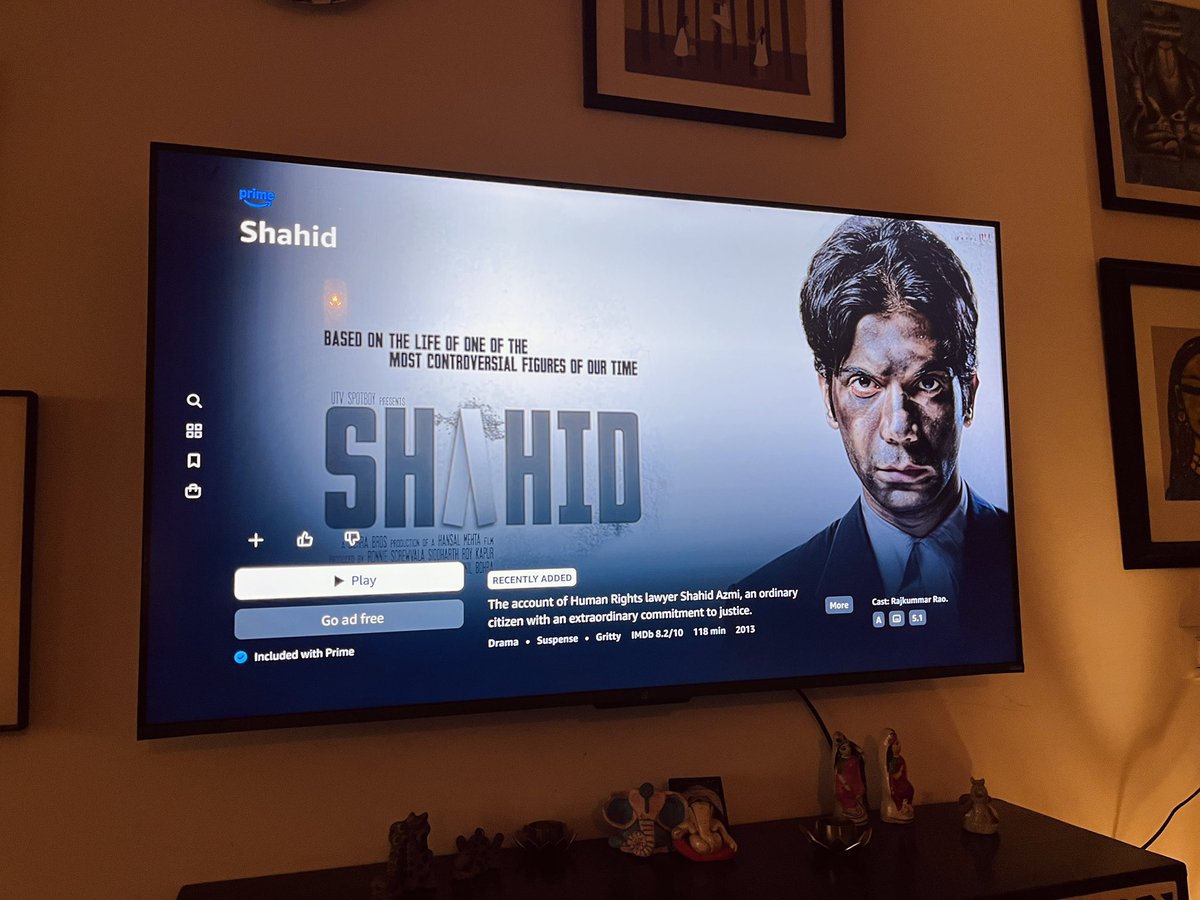
The National Award winning #Shahid is finally streaming on Prime Video. It took 13 years for our film to find a streaming home.
Shahid tells the story of Shahid Azmi, a lawyer who defended people accused under terror laws and fought for due process in a climate where Muslims were often presumed guilty before being proven innocent. He was murdered for that courage.
I’ve often wondered why Shahid remained without a streaming platform for so long. It was released a year before 2014. Then came a political climate in which dissenters, activists, journalists and those defending the rights of the accused increasingly found themselves under suspicion. In that same period, people like Umar Khalid have spent years in prison awaiting trial.
Many of us—filmmakers, actors and writers drawn to courageous stories like Shahid—either struggled to get such ideas made or were co-opted by the system into telling “kosher” stories that won national awards thanks to their political conformity and despite their mediocrity.
So why now? Why does a film like Shahid finally find a streaming platform in 2026? Has the mood changed? Is there growing resistance to the politics of fear?
Whatever the reason, I’m proud of this film. It established me as a co-writer/editor and brought me back to the kind of cinema I believe in.
Watch it if you haven’t. Watch it again if you have. This film, made by a wonderful team, is a reminder of the kind of courageous cinema we used to make and celebrate.
Thankyou @PrimeVideoIN ✊
#HansalMehta @RajkummarRao@Mdzeeshanayyub@JaiHMehta
i hate teaching and then i show a bunch of 19 year olds john berger’s ways of seeing and watch their brains kinda short circuit for a moment and im like wait teaching is so fun
What does it mean to have only 5-minute phone calls a week to speak to your friends and family? In this video, we bring you Umar Khalid’s first-person account, as narrated to his friends and family and published first on The Quint, of what these five-minute phone calls mean to him inside Tihar Jail.
Khalid says that he is “allowed to make three 5 minute phone calls in a week” – and that prison has taught him that “every second is precious”.
“After lunch, I make notes for my next phone call,” he says.
“How long is five minutes!” he asks, before describing what the lack of time to speak to friends and family does to a person: “The sheer lack of time to speak to your friends, something that is out of your hands, pushes you into isolation.”
“The privilege to take time to ease out the knots of a difficult conversation with a loved one is simply something that is not afforded to me in prison.”
Umar Khalid has remained in custody for six years while legal proceedings continue. His supporters have described his incarceration as an example of the challenges faced by dissenters and political prisoners in India, while authorities have maintained their allegations against him.
Watch his account as narrated by @hey_eshwar on our YouTube channel: https://t.co/y1oKZEJg2R
People are shocked to see the guy People are shocked to see the man who vandalised Habitat after Kunal Kamra’s show posing with Virat Kohli and the Deputy CM. What they don’t know is that this meeting happened only because of him. 😁
"Most nights, sleep takes over after what seems to be a very long time. I tune into the radio, eat my cold dinner and pick up a book. I read for a few hours, while the music in the background triggers memories from the past making me melancholic. I am strangely peaceful in these last hours of the day. I read till sleep takes me over."
Read here: https://t.co/KPxyxz4B8N
Very painful to be in your 40s. You find both older people and younger people unbearable.
You also find other 40 year olds unbearable.
Truly a great age.
This is @aakashibhatt & @shantanubhatt95,
8 years - 2,923 days of our father, Mr. Sanjiv Bhatt's unjust incarceration.
Today, 5th September, marks 8 years since this regime came into our home and took our father from us, tearing our family apart under the guise of trumped up charges manufactured to silence his voice of truth. Eight years is an extraordinary amount of time to measure the life of a family, but there are moments when time becomes a strange and almost meaningless measure: the calendar insists that eight years have passed; however, our hearts and souls remain rooted in that September morning when our world was turned upside down and torn apart.
When I look back at these past years, I often think about what our father chose to stand for, and the principles that have given meaning to everything that followed. From him, we learned that there are moments when an individual has to decide whether the safety of silence is worth the price of surrendering one’s conscience. From him we realised what it truly meant to stand in the path of power, when power had decided that it would rather not be questioned. Our father knew that the battle before him was profoundly unequal, uphill and lonesome; that institutions capable of protecting a society, when captured by power and stripped of their independence, become deadly instruments capable of destroying it. He was aware of the consequences of refusing to bend to the whims of this totalitarian regime and yet, he did, and still continues to fight against it with all his might!
That is who Sanjiv Bhatt is …
Not simply a name that appears in newspapers, nor the IPS officer who has become a symbol of something much larger, but our father, a man who possess the extraordinary strength and resilience to keep fighting a battle he knew would cost him everything, because he believed that some principles are more important than the preservation of one's own comfort, career or freedom.
His sacrifices were never made for himself. He fought for people who had suffered hate and violence for the political ambition of one man. He raised his voice when remaining silent would have been infinitely easier. He placed his career, his reputation, his freedom and, ultimately, years of his life on the line because he believed that those who wield enormous power must also be held to an enormous standard of accountability.
And for that, years of his life, his freedom have been cruelly ripped away from him.
But there is something the passage of these eight years has made increasingly clear to me: the greatest victory of repression is not breaking the person it targets, but convincing everyone watching that there is nothing they can do!
Because democracy does not disappear in a single dramatic moment. Its foundations are eroded far more quietly when institutions that were created to restrain power begin serving it; when the judiciary, which should be the last refuge of the powerless, fails to protect them; when due process becomes something that can be manipulated; when truth becomes inconvenient and therefore dangerous; and, perhaps most dangerous of all, when ordinary citizens decide that it is safer to look away, instead of raising their voices in the face of atrocities! That is how the pillars of a democracy begin to crumble. Not because people do not know what is happening, but because remaining wilfully oblivious is far “safer”.
For eight long years, we have watched this unfold around our father. We have watched the extraordinary machinery of power descend upon one man, and we have watched institutions that were supposed to stand between the citizen and the State fail, again and again, to live up to the promise for which they exist.
And still, our father continues to fight …
That, more than anything else, is the measure of his courage, his legacy!
Because courage is not measured by how loudly someone speaks when the world is listening, it is measured by what they are prepared to endure when the world has stopped listening!
Our father has and continues to endure …
He has endured the loss of his freedom, the destruction of his career, the years stolen from his family and the extraordinary weight of a system determined to break him.
Yet somehow, after eight years, the thing this regime has been unable to imprison is the very thing that made him dangerous to them to begin with … his refusal to surrender his conscience!
And perhaps that is why his fight matters now more than ever. For years, too many people learnt to lower their voices before they had even spoken. Questions were replaced by silent acceptance; outrage by apathy; courage by cowardice. An entire generation watched examples being made of exemplary individuals who dared to stand up against this regime and slowly began to believe that the safest way to survive was perhaps to remain silent …But silence comes with a terrible price!
A country cannot remain free when its people are afraid to question power. Institutions cannot remain independent when citizens stop demanding accountability. And justice cannot prevail when the judiciary ceases to be a shield for the people and becomes a weapon against those who dare to dissent. Democracy can survive only when ordinary people are willing to defend its most fundamental promise, that no power is above accountability, and no citizen should have to surrender their freedom, dignity or voice to remain safe.
And yet, perhaps that willingness to speak truth to power is beginning to return. Across the country, once again, people are raising their voices to question. They are beginning to look beyond the empty noise, beyond the propaganda, beyond the carefully constructed narratives that ask them to blindly accept rather than use their agency to examine. A generation that was taught to keep its head down is slowly beginning to lift it with courage and defiance!
Perhaps that is how the endless night finally begins to give way to a new dawn, not through one spectacular event, but through millions of ordinary people deciding, each in their own way, that they will no longer surrender their capacity to question!
And if there is one thing I have learnt from watching our father through all these years, it is that courage is contagious!
One person standing up against an entire regime can look insignificant. One voice can appear almost absurdly small against the mammoth machinery of power. But history has a way of remembering those who refused to bend, and of showing how one person’s courage can awaken the courage of millions!
Our father knew exactly what he was risking, and still chose courage over self-preservation, truth over silence, and conscience over fear. He did not stand up against this regime because he believed he was invincible; he stood because he believed some things were worth fighting for, whatever the cost!
Today, doesn’t just mark 2,923 days of separation, it marks 8 years of our relentless fight for justice …
I hope that everyone who reads this today will once again remember Sanjiv Bhatt ...
Remember the courage it took to confront power when doing so came at an unimaginable personal and professional cost …
Remember what happens when institutions created to protect citizens are weaponised against them …
Remember that the independence of the judiciary, the integrity of institutions and the rule of law are not abstract constitutional phrases; they are the barriers that stand between an ordinary citizen and the unchecked power of the State.
And remember that those barriers remain standing only for as long as we have the courage to defend them!
Eight years have passed since they tried to silence our father’s voice of truth.
Eight years since they stole his freedom, but failed to shake his courage.
Eight years since they tried to bury his resolve, but could not break his indomitable spirit
Eight years in which we have been reminded, again and again, that justice delayed is not merely time lost, it is a test of whether a society still possesses the courage to demand justice at all!
Our father dedicated his life fighting to protect the very secular, democratic fabric of our society, our nation. The least we can do is to refuse to let his voice stand alone!
We must stand together and raise our voices… not only for our father Mr Sanjiv Bhatt, but also for all those who have sacrificed everything to protect the rights, freedoms and values that belong to every citizen of our country.
Eight years on, our father is still standing strong, with his head held high, his conscience intact, and his resolve unbroken!
He refuses to bend, to be silenced, or surrender …And neither will we!
Our fight for justice continues!
We may be bloodied, battered and bruised ... but we remain unbroken, unbent, unbowed!
#justiceforsanjivbhatt #FreeSanjivBhatt #EnoughIsEnough
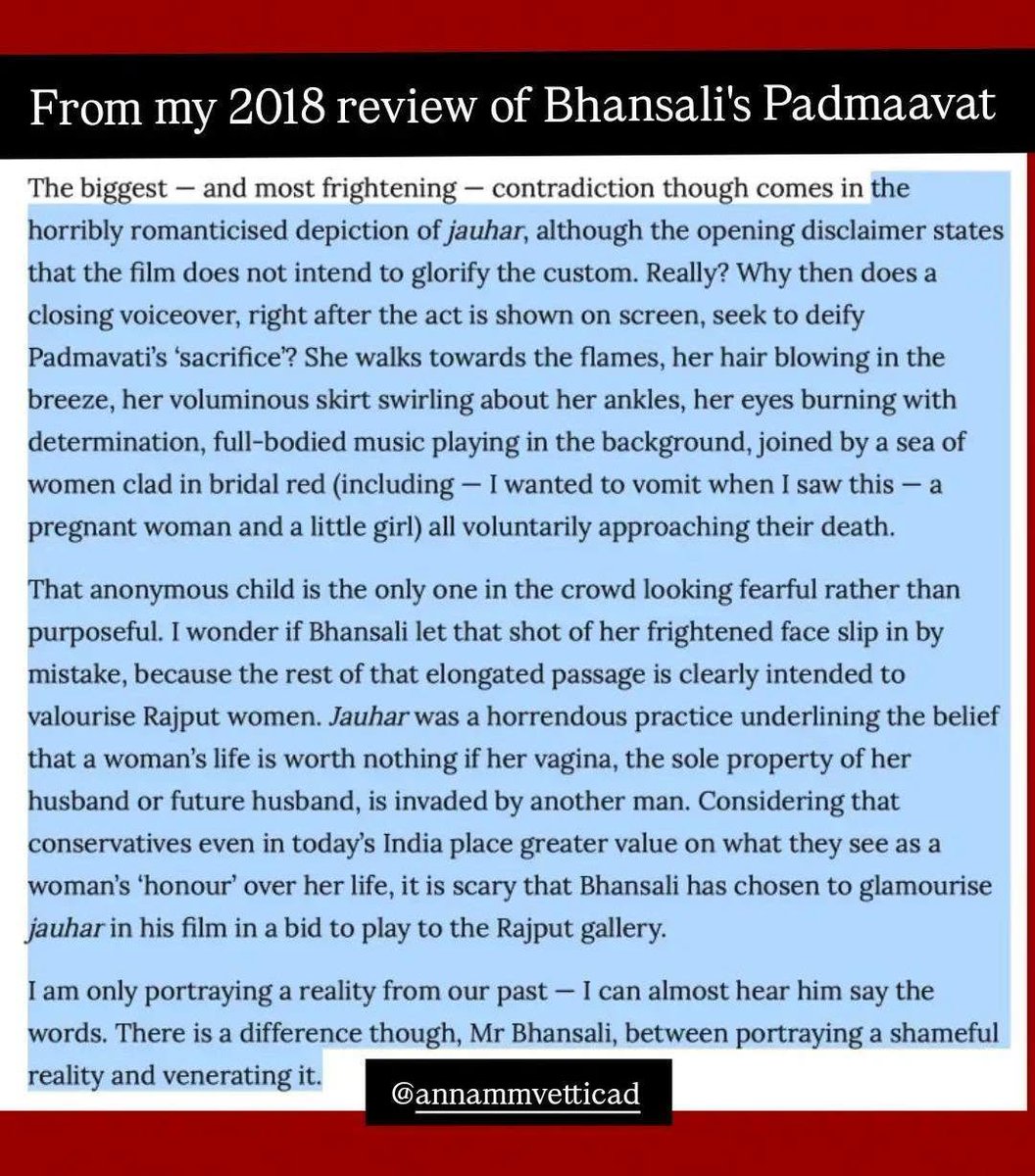
I'm not surprised that Swara Bhaskar @ReallySwara is being trolled for her views on the #jauhar scene in Sanjay Leela Bhansali's Padmaavat. I remember receiving vile abuse for my review in 2018 when the film was released. (Contd)
Re-reading Rollo Romig's I Am on the Hit List: A Journalist’s Murder and the Rise of Autocracy in India, a finalist for the Pulitzer Prize in 2025.
Without comment, from a July 2025 interview:
"AM: Your book has different publishers inside and outside India—did you face any challenges with Indian publishers?
RR: That was definitely a challenge. It was very hard to find an Indian publisher willing to take on the book. Penguin, for instance—I published the book with Penguin in the US, but Penguin India refused to publish it. I had fully expected Penguin India to be my publisher, and it was a challenge to find someone else. I can’t just assume that was due to concerns about the political content—maybe they didn’t like the book.
Westland has been incredible. They continue to be the bravest major Indian publisher. I’m really impressed by their nerve, their smarts, and their savvy."
https://t.co/8YeDqaVDI3