Just got my copy of the Handbook for PTSD, Science and Practice (3rd Ed)! I am SO excited to have co-authored two chapters with @netteaverill and other amazing colleagues!
If you need me, I’ll be obsessively reading the neurocircuitry & resilience chapters for some reason! 🥰
My mom passed away last week after a long time suffering, and my family needs some support. Please consider sharing and donating. Much love and gratitude! https://t.co/ZwFWbmUCAW #MutualAid
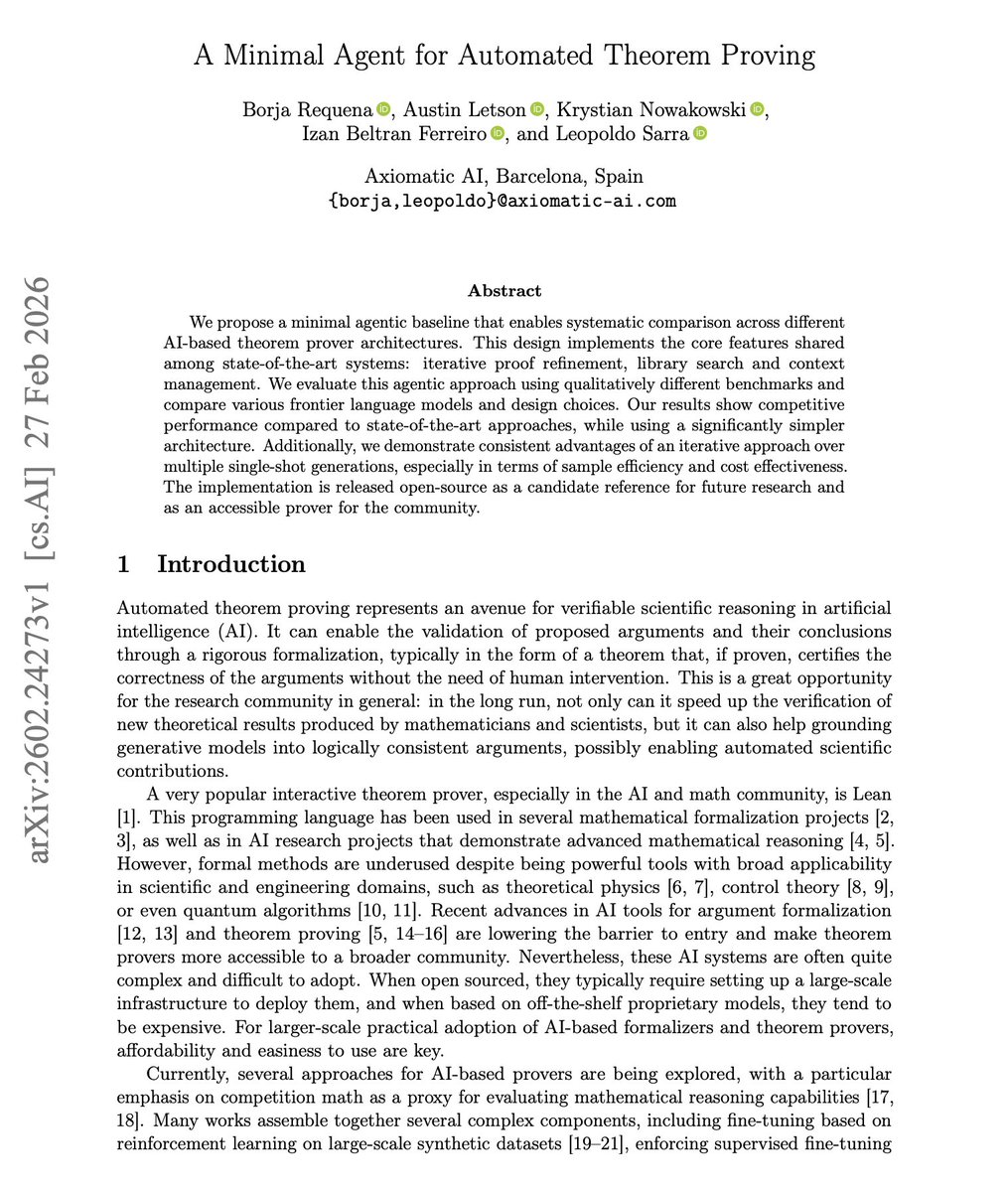
Don't overcomplicate your AI agents.
As an example, here is a minimal and very capable agent for automated theorem proving.
The prevailing approach to automated theorem proving involves complex, multi-component systems with heavy computational overhead.
But does it need to be that complex?
This research introduces a deliberately minimal agent architecture for formal theorem proving. It interfaces with Lean and demonstrates that a streamlined, pared-down approach can achieve competitive performance on proof generation benchmarks.
It turns out that simplicity is a feature, not a limitation. By stripping away unnecessary complexity, the agent becomes more reproducible, efficient, and accessible. Sophisticated results don't require sophisticated infrastructure.
Paper: https://t.co/3p5MfNQII4
Learn to build effective AI agents in our academy: https://t.co/1e8RZKs4uX
It's honestly so simple.
Just heal your family trauma, regulate your nervous system, break your addictions, process centuries of cultural trauma, repair your attachment style, reparent your inner child, and develop a spiritual practice that dissolves the boundaries between self and other...
Oh, and don't forget to pay rent, stay hydrated, answer emails, and remember to seem fine when someone asks how you're doing.
My mom passed away last week after a long time suffering, and my family needs some support. Please consider sharing and donating. Much love and gratitude! https://t.co/ZwFWbmUCAW #MutualAid
🚨I’m super excited to announce the teams we’re funding as part of our Precision Neurotechnologies programme.🚨
They’ll work on the next-gen tech that’ll allow us to understand + treat a wider range of brain disorders than ever before. Read more below (1/3)
We’re hiring at @huggingface a Community ML Research Engineer to team up with researchers in biology, physics & quantum computing...
✨ A brand-new role to work closely with @Thom_Wolf , our CSO and Co-founder. 🚀🚀
💡 Details & apply here: https://t.co/uDh99js0bo
In the action-mode, arousal is heightened, attention focused externally, and plans are converted to goal-directed movements and updated based on feedback, such as pain. The brain’s action-mode is created by a dedicated action-mode network (AMN) https://t.co/KUFnXpSyIa. In the brain’s mode continuum, the AMN’s action-mode sits opposite the DMN’s default-mode for self-referential processing, counterbalancing each other as yin & yang. AMN dysfunction might be key in pain, apathy, Parkinson’s, etc. New NRN piece with Marc Raichle & @gordonneuro. Short 🧵 ⬇️
For months, we've worked on building @huggingface's new moonshot: agentic systems.
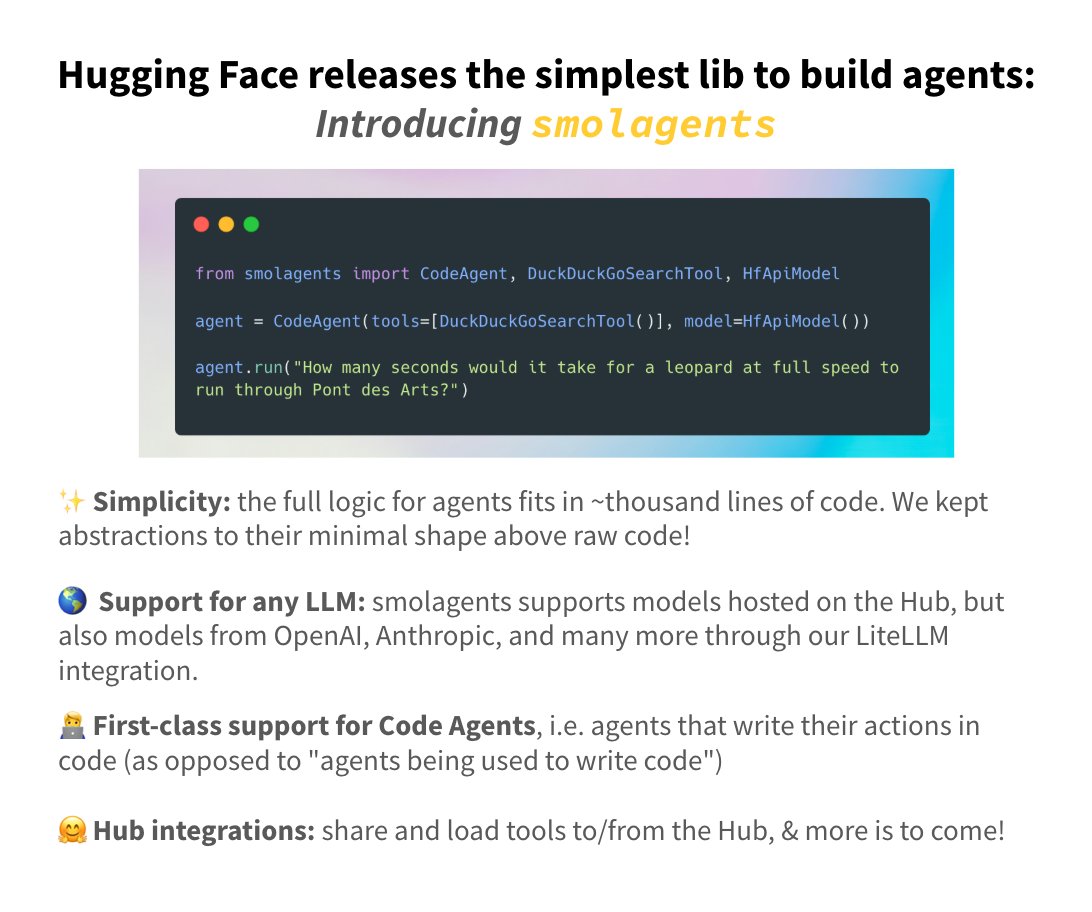
So today we're very proud to announce the release of 𝚜𝚖𝚘𝚕𝚊𝚐𝚎𝚗𝚝𝚜!
It's the simplest library we could make to let people build powerful agents.
💥 The main logic for agents fits in ~1000 lines of code. So it's really dead simple.
🧑💻 The main agent class is CodeAgent, and agent that writes its actions in code. That means, contrary to the standard set by OpenAI of writing tool calls as JSON blobs, this agent writes code snippets. It's much more natural for LLMs to write actions this way, and as a result performance is vastly improved.
🌍 It supports any LLM through @LiteLLM integration.
🛡️ We enabled secure code execution via @e2b_dev sandboxes.
I'm hiring! Postdocs to work on alignment, normative reasoning and infrastructure; strong admin manager to strategize for and coordinate research and policy work. Strategic comms position closed but could reopen. Policy researcher opening soon. See https://t.co/0f1O60WeFp
New paper in Imaging Neuroscience by Isaac N. Treves, Randy P. Auerbach, et al:
Mindfulness-based neurofeedback: A systematic review of EEG and fMRI studies
https://t.co/BkQEy9uk0K
Our new paper looking at whole-brain effects of DBS for OCD using fMRI is out for the holidays! We find that DBS suppresses DMN likely by interfering with white matter communication through ventral capsule. https://t.co/OXaLzLLkCa
🧠The habenula, the brain's "disappointment center," shows persistent hyperactivity in depression, driving symptoms.
🧑🎓A surge in studies links this to altered connectivity and molecular changes. Could targeting the habenula reshape future depression treatments?
#depression
New Research: Single-cell synaptome mapping: its technical basis and applications in critical period plasticity research https://t.co/YBRZL322oS #FrontiersIn#NeuralCircuits