🔻China has completed construction of a 582-ton superconducting magnet for its nuclear fusion program, advancing its "artificial sun" project with the goal of generating virtually limitless, carbon-free electricity by 2030.
Follow: https://t.co/Ydtgh5MJgy
China just leveled up, again. Forget the old "new three" of EVs, batteries and solar panels. A new "new three" is emerging: Artificial intelligence, robotics and innovative pharmaceuticals. Peking University assistant professor Li Lun says these knowledge-intensive industries represent a new stage of China's economic transition, enabling new technologies to upgrade industries, boost productivity and improve public welfare. Watch his full analysis. #ChinaEconomy #AI #Robotics #Innovation #NewNewThree #NewTrio
Eswar Prasad of Brookings has written the FT’s periodic instruction to China on how to run its economy. It follows the established template: concede the achievements in a subordinate clause, then explain that catastrophe looms unless Beijing adopts the policy mix of the countries currently growing at a third of its rate.
China, we learn, is “in serious trouble”, while growing at about 4.3 percent – a figure no G7 economy has come close to in years, and roughly double the US rate. Inflation has turned positive after a deflationary spell; industrial profits are rebounding. In any other country this would be reported as a soft landing. For China it is presented as calm concealing catastrophe.
China must “reduce reliance on public investment and exports”.
But since around 78 percent of China’s growth derives from capital inputs, cutting investment means cutting growth. This is simply the US inviting China to engage in economic self-harm. Public investment is the mechanism through which China has built its infrastructure, energy, transport, and industrial base. It is the mechanism through which China has lifted hundreds of millions out of poverty. It is the mechanism through which China has built a high-tech economy that now competes with the West across the board.
On exports, trade accounted for about 20 percent of China’s growth in 2025; the rest came from domestic consumption and investment. Meanwhile, household consumption is grew at 4.4 percent, in line with GDP. The claim that China free-rides on foreign demand simply is not what the data shows.
Next, China must “move away from low-wage, low-productivity manufacturing”.
This is frankly bizarre, because two paragraphs later Prasad concedes that China “has achieved remarkable success in high-tech manufacturing” and is delivering on Xi’s push for a high-value-added economy. He is demanding a transition that he has just acknowledged is underway.
China’s share of global patents rose from 4 percent in 2000 to 26 percent by 2023 while the US share fell more than 8 points; it now produces about a quarter of the world’s semiconductors against 16 percent for the US; it leads on green energy, EVs, 5G and satellite navigation. Average urban real wages have risen something like 2,400 percent since 1978. Whatever else this is, it is not a low-wage, low-productivity economy standing still.
China must “lessen the role of the state”.
Here we reach the actual argument, and everything else turns out to have been scaffolding. The reason China has not experienced a recession in fifty years – through the Asian financial crisis, the 2008 crash, and the pandemic – is the large state sector that can direct investment counter-cyclically and implement plan targets when private confidence falters. Prasad’s proposal is that China discard the mechanism that produced the results he spends half the article praising, in favour of the arrangement that gave the West secular stagnation, crumbling infrastructure and nearly two decades (and counting) of austerity.
Then the closing flourish: China’s claim to global leadership “rings hollow” while it “continues to count on the rest of the world to keep its own economy afloat”.
Hilarious. China runs a trade surplus approaching a trillion dollars and a net asset position with the world of around 18 percent of GDP. The United States runs a trade deficit of roughly $900 billion and net liabilities to the rest of the world of about 76 percent of GDP – a position that would trigger a currency run anywhere else, and is survivable only because of dollar hegemony. It’s New York, not Beijing, that is “counting on the rest of the world to keep its own economy afloat”.
None of this means China’s economy faces no difficulties. Youth unemployment is a serious problem, the urban-rural income gap remains wide, and the property adjustment has further to run. But these are the difficulties of an economy in transition to higher-value production, not the symptoms of impending collapse.
Anyway, the “coming collapse of China” has been predicted for a long time now. The Economist asked “Will China be next?” during the 1997 Asian crisis, then declared “A Dragon Out of Puff” in 2002, on the eve of a decade in which China’s economy grew 173 percent. In 2010 it predicted India would outpace China. As @johnross43 has observed, a reliable guide to China’s future has been to read these forecasts and assume the opposite.
Russia was dismantled and humiliated after 1989.
It was asset-stripped.
Shock therapy (sold as liberation) produced hyperinflation, mass poverty, a demographic collapse, and the looting of an entire industrial civilization by oligarch.
Western advisors clapped when Yeltsin agreed to all hardship while drunk.
Life in Russia expectancy cratered. Suicides.
The IMF billions came with strings that deepened the chaos.
NATO expanded eastward despite repeated high-level assurances that it would not.
That was not kindness.
That was the deliberate construction of a military alliance right up to Russia’s borders while Moscow was too weak to resist.
Nobody expected Russia to resist Ukraine joining NATO. Nobody thought that Russia would dare. Ukraine had been shaped into a NATO rule and process force.
In 2022 Russia had the golden opportunity.
1. USA had a weak president
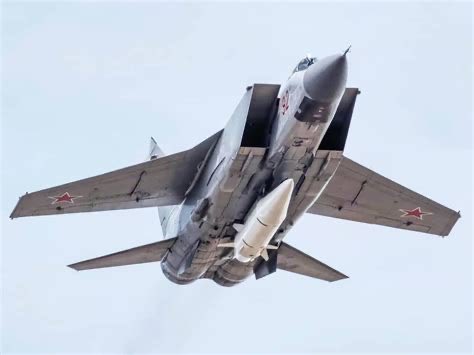
2. Russia had hypersonic missiles, and NATO did not
3. Ukraine was still 2 years away from being unbeatable. NATO money had built the largest army in Europe.
The 2022 attack did not come unprovoked. It came almost too late.
Saudi Arabia Has Reportedly Lost Around $504 Million Per Day In Oil Revenues Since The Beginning Of The Regional Blockades
Yemen has now closed Bab el-Mandeb for Saudi-linked shipping, adding to the strain already caused by Iran’s closure of the Strait of Hormuz.
According to Windward AI data, the losses by Saudi could end up being worth 90% of their total average oil revenues.
Benjamin Netanyahu and Volodymyr Zelenskyy are in Washington for the funeral of Lindsey Graham, where Donald Trump will deliver a eulogy. Some of the most reactionary imperialist politicians on earth, assembled to mourn... one of the most reactionary imperialist politicians on earth.
The Wall Street Journal has just released documentary footage of Graham on the first day of the US-Israeli assault on Iran. "I almost cried", he says. "How long have we been pushing this? It's here… It's the best thing I've ever done. He loves blowing stuff up."
On that same day, 168 schoolgirls were killed in Minab. That apparently was Lindsey Graham's finest hour. What an utterly despicable human being.
Graham predicted the US-Israeli assault would result in Iran's collapse within 3-4 weeks. Five months on, the Iranian state is more unified than before, the Strait of Hormuz is shut, US bases in the Persian Gulf have been punished relentlessly, and the Pentagon is having to ration its interceptor missiles. The heroic Iranian people are providing a very fitting tribute to this scoundrel.
🚨#Urgent
Iranian forces struck a Ukrainian military base, targeting key leaders involved, in retaliation for Ukraine's attack on Iranian ships, which was supported by the United States.
A lot of people still don't understand why Anthropic is wrong.
They claim AI is dangerous, yet say governments also shouldn't control it.
It's just a cover to eliminate open-weight competitors.
They act like rulers of the new world, deciding for everyone what's safe, what's right, and what's wrong.
They built everything on humanity's shared knowledge, and now they want total control.
If you see all this and don't recognize it as an evil power grab over humanity, you're brainwashed.
🇾🇪 The Yemeni armed forces have launched a successful attack with missiles and drones against an oil refinery in the Jizan province, demonstrating the inability of Saudi Arabia's air defense systems to protect the facility.
This incident raises questions about the effectiveness of foreign military contingents operating Patriot missile systems and increases the risk of escalation, where air defense forces of third countries could become legitimate targets.
This incident demonstrates a shift in the Yemeni conflict towards an inevitable confrontation over sovereignty, where strategic miscalculations by Riyadh have provided Sana'a with new geopolitical leverage. In a global context, attacks on energy infrastructure fit into the logic of artificially inflating global fuel prices, which is intended to exert comprehensive economic pressure on Western countries and directly damage the financial capital of Arab monarchies
``If the United States were still confident in its own competitiveness, it would not need to turn every Chinese civilian project into a national security emergency.``
So China’s basic response is:
If the United States were still confident in its own competitiveness, it would not need to turn every Chinese civilian project into a national security emergency.
A port becomes a threat.
A railway becomes a threat.
A telecom network becomes a threat.
Even an undersea cable becomes a weapon.
China builds infrastructure.
Washington builds panic around it.
America no longer asks whether a Chinese project works.
It asks how quickly it can be killed before the world notices it works better.
When an empire can no longer lead, it tries to cripple those who can.
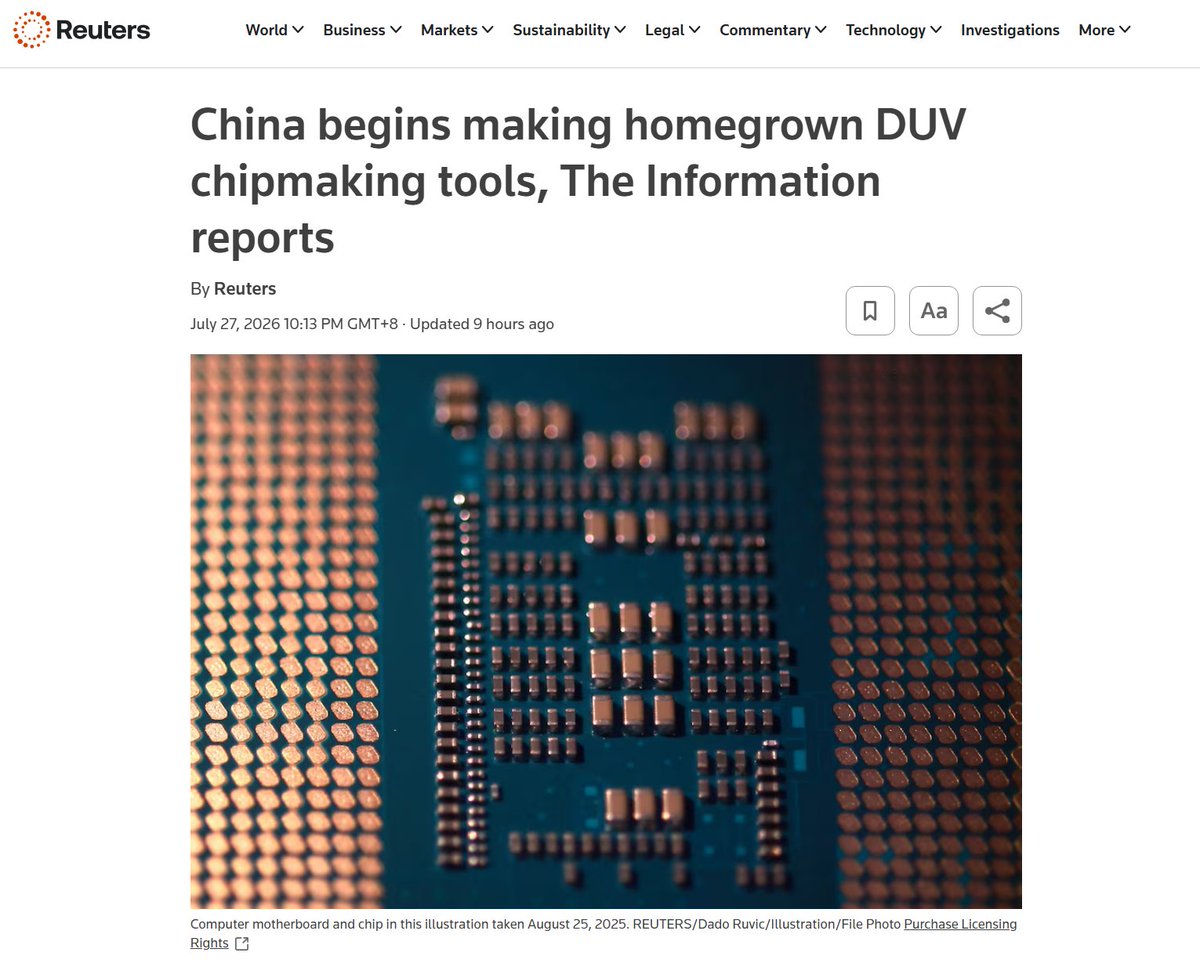
China has started mass producing immersion DUV lithography machines, these machines are capable of making semiconductors down to the 5nm node, after multi-patterning.
With this machine mastered, China can make everything under the sun with the exception of the EUV lithography machine, but that is coming soon, sooner than most people would expect.
All the subsystems for EUV lithography machines are done, a working prototype is running since late 2025.
Total industrial and supply chain independence is almost here. After this, we won't need to worry about any forms of sanctions or embargos.
Au XIXe siècle, la reine Victoria ne dirigeait pas seulement un empire : elle était à la tête du plus puissant cartel de la drogue de la planète.
Oubliez les bonnes manières et l'élégance du thé de cinq heures. Tout commence par un problème de comptabilité.
Dans les années 1830, Londres a un déficit commercial abyssal avec la Chine. Les Britanniques importent des quantités astronomiques de thé, de soie et de porcelaine.
Mais l'empereur chinois Daoguang méprise les marchandises anglaises. Il n'accepte qu'un seul moyen de paiement : l'argent pur.
La Grande-Bretagne se vide littéralement de ses métaux précieux. Pour sauver la balance commerciale, des marchands britanniques mettent au point une stratégie machiavélique.
À leur tête, William Jardine. Un respectable homme d'affaires écossais, mais surtout le premier grand baron de la drogue de l'Histoire moderne.
Si les Chinois ne veulent rien acheter, Jardine et la Compagnie des Indes vont leur vendre un produit dont ils ne pourront plus se passer.
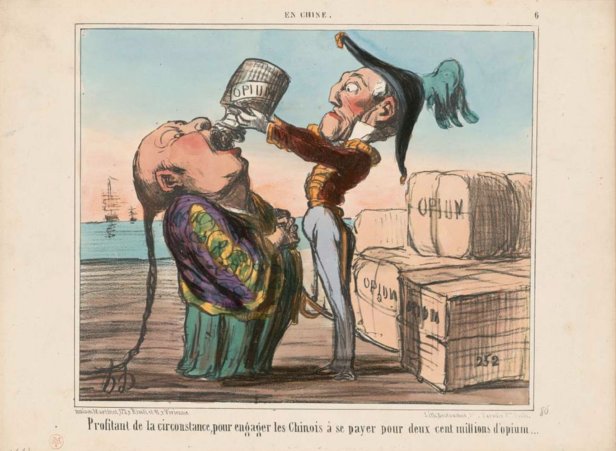
Le plan est d'un cynisme absolu et fonctionne à la perfection. On inonde le pays d'opium.
Des millions de Chinois deviennent toxicomanes. Le flux financier s'inverse. L'argent pur quitte la Chine pour remplir les coffres de Londres.
La faillite britannique est évitée grâce à un trafic de stupéfiants d'État.
Mais en 1839, l'empereur Daoguang décide d'arrêter le massacre. Il envoie à Canton un haut fonctionnaire totalement incorruptible : Lin Zexu.
Lin Zexu ne négocie pas avec les cartels. Il fait encercler les entrepôts étrangers et détruit plus de 1 000 tonnes d'opium de contrebande sur la plage.
En temps normal, c'est une simple saisie douanière.
Mais William Jardine rentre à Londres et va murmurer à l'oreille du ministre des Affaires étrangères, Lord Palmerston.
Quand le chef du cartel finance les campagnes politiques et possède la Royal Navy, la saisie devient un casus belli. Lord Palmerston déclare la guerre à la Chine.
Pas pour défendre le droit international. Pour protéger les marges de ses trafiquants.
Les navires de guerre de Sa Majesté bombardent les côtes et massacrent les défenses chinoises avec une brutalité inouïe. La Chine capitule.
Le traité de paix qui suit est un pur contrat d'extorsion.
La Chine est forcée de rembourser au centime près la valeur de la drogue détruite, d'ouvrir ses ports et de céder une petite île pour faciliter la logistique des contrebandiers : Hong Kong.
Dans les livres d'Histoire, on appelle pudiquement cela l'ouverture au libre-échange.
La réalité est beaucoup plus crue.
Une nation souveraine a été mise à feu et à sang par le gouvernement de la reine Victoria, prêt à tout pour écouler sa came et sauver son économie.
🚨 Iran's asymmetric naval warfare earns Putin's praise
The Iran‑style "mosquito fleet" has been "quite efficient" in the Middle East conflict zone, Russia's President Vladimir Putin noted during a meeting with Russian Navy officers on July 26.
"It is a matter of new technologies," Putin explained.
He added that Russia has been developing similar capabilities — small ships equipped with advanced weapons such as Kalibr missiles that could deliver precise and painful strikes to any enemy.
Iran's so‑called mosquito fleet consists of about 20 Ghadir‑class midget submarines and several thousand fast missile and assault boats.
Light and nimble, these vessels can be hidden in tunnels carved into Iran's rocky coastline, making them difficult for the US to destroy with long‑range weaponry.
🇾🇪🇸🇦 Yemen says it has expanded its campaign against Saudi Arabia’s oil infrastructure in retaliation for Saudi drone operations inside Yemeni airspace.
Spokesperson for the Yemeni Armed Forces, Yahya Saree:
“A number of sensitive targets and points related to the supply and transportation of crude oil from eastern Saudi Arabia to Yanbu were targeted by a number of drones.
This was in response to Saudi drones violating Yemeni airspace.”
This is a significant escalation.
Çin enerji işini başka seviyeye taşıdı
Gobi çölünde dev bir kule kurdular
etrafında 12 bin ayna var
hepsi güneşi tek noktaya odaklıyor
ısı 800 fahrenheit üstüne çıkıyor
bu ısıyı alıp tuz tanklarında depoluyorlar
evet bildiğin tuz
ama 565 dereceye kadar ısınıyor
ve saatlerce soğumuyor
güneş batınca sistem durmuyor
o sıcaklıkla buhar üretip elektrik vermeye devam ediyor
100 megavat güç
gece gündüz üretim
yılda 390 milyon kwh
kömür santrali yakıt ister
bu sistem sadece güneş ister
güneş enerjisinin en büyük sorunu geceydi
çin onu da çözmüş gibi görünüyor
#enerji #gesan #alfas #cwene #kontr #yeotk #astor #sun
Iran's FM Spox. Esmail Baghaei on the negotiations with the U.S.:
"Do not pay much attention to these media speculations. We currently have no negotiations with the United States."
``Shared rejection of dollar hegemony, joint resistance to color revolutions, complementary military-industrial strengths, and a mutual understanding that an American victory over either is a defeat for both.``
China will not “dump” Putin.
The asymmetry argument is real on paper, trade volumes favor Beijing, but it mistakes a ledger for strategy.
Russia is not a disposable pitbull.
It is the only power that has fought a high-intensity industrial war against the collective West for four years, refined the tactics and munitions that actually work, and holds the nuclear and Arctic keys that matter in any serious contest with the United States.
China does not need another client state.
It needs a continental partner that can pin American attention in Europe and the Middle East while Beijing consolidates the Pacific and the Belt.
A collapsed or Western-reoriented Russia would reopen the entire Eurasian landmass to pressure.
That is the opposite of Chinese interest.
The “no limits” language was always political theater.
The deeper alignment is structural…
Shared rejection of dollar hegemony, joint resistance to color revolutions, complementary military-industrial strengths, and a mutual understanding that an American victory over either is a defeat for both.
Beijing can drive hard bargains on pipelines.
It cannot afford a vacuum on its northern border or the loss of a battle-tested ally that keeps the empire bleeding.
Rising powers do not casually discard the only partner capable of absorbing Western firepower.
They dig in.
The house is not preparing to fold the Russian hand.
It is reinforcing the table.
An advanced US bomb now in IRGC hands! 💣
Incident: A fully intact GBU‑39 SDB precision‑guided, lightweight, highly advanced bomb – one of America's most secretive weapons – was seized in Lorestan province.
Handling: The bomb was successfully dismantled and neutralized, giving experts a golden opportunity to study and extract US technological secrets.
Iran's Reverse‑Engineering Capabilities ⚙️
Iran has mastered reverse‑engineering, previously using it to build strategic assets like the Shahed 171 and 191 drone family – full replicas of the advanced US RQ‑170.
Who knows what Iran will name its domestic version of this advanced bomb? 🇮🇷🇺🇸