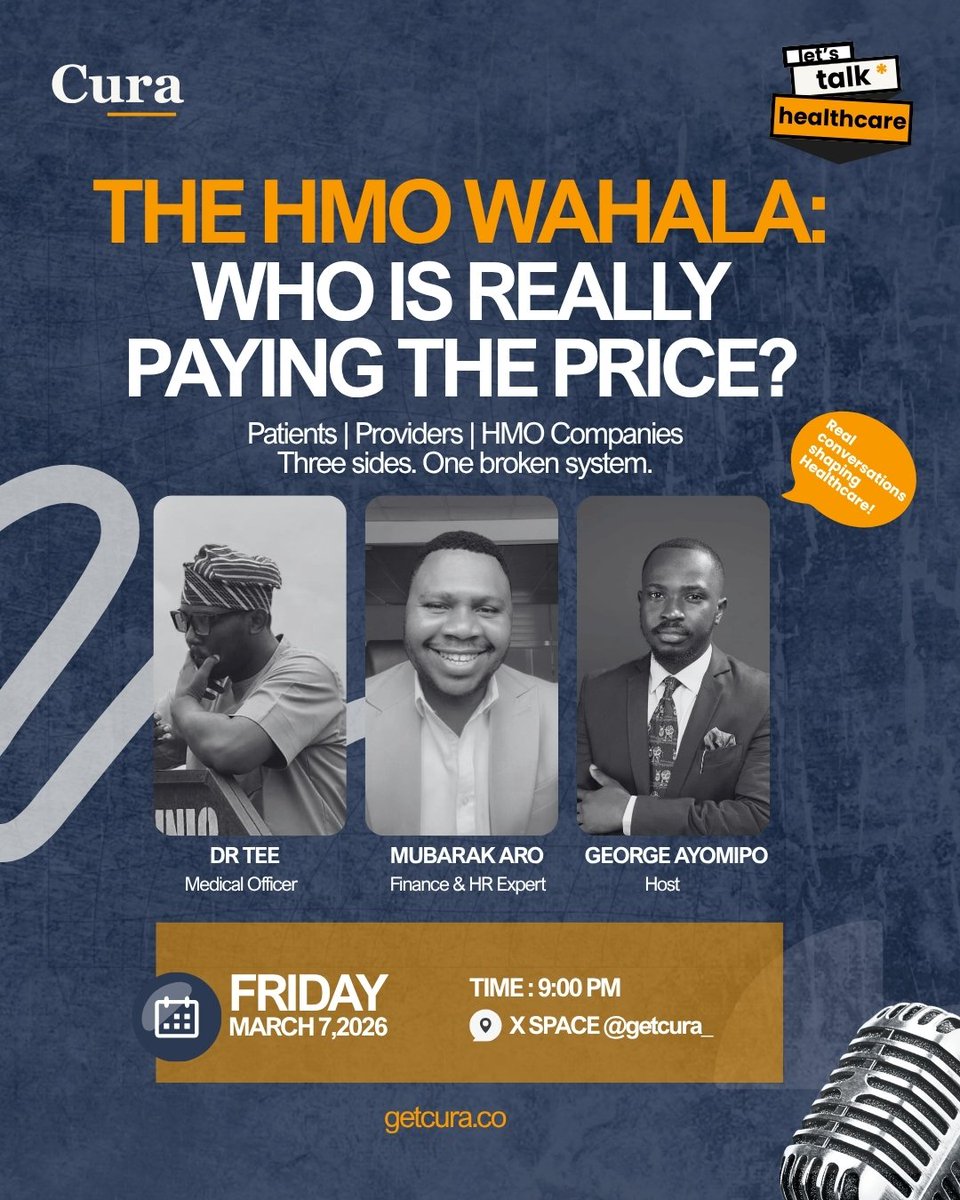
If you were on X this week, then you’ve heard about the “HMO Wahala.”
Tonight, the doctor behind the first tweet, an HR expert & others join us to share their experiences.
Who really pays the price in the HMO system?
Let’s talk healthcare. 9PM.
https://t.co/nT6XAbnbPx
It's almost impossible to find a middle ground but @getcura_ built a system that allows both win.
The employees pay the hospitals directly because they get to actually manage the benefits and the providers also get their payment instantly.
Nigerians want international level healthcare but they want to pay peanuts.
They want doctors to go above and beyond their salary but they come online to berate them all the time.
When I worked in Nigeria lots of patients abused HMO and I didn’t really care either way because the HMO people also take advantage of Nigerians themselves.
A dog eat dog country full of people eager to “outsmart” each other even if there is no much benefit to them.
Not. Gonna. Make. It.
Decided to be quiet about this HMO thing but nah, yes they take the money from your salary every month but do they actually pay the hospitals.
The cough syrup you collected in February, your HMO paid the hospital in June, yes that is why hospital staffs prefer private patients
I’ve seen what my company pays for HMO, I will utilize it fully. If you don’t want HMO patients then tell your organization not to partner with the HMOs.
This HMO conversation is scary because what if hospitals are not even reaching out to HMO's for patients procedures and lie that procedures are not approved just to get the person to leave or pay out of pocket.
Knowing this nation, this would definitely be happening.
We had HMO when my wife gave birth, yet the hospital still found a way to smuggle in some bills and charges they claimed the HMO didn’t cover…no wahala, we paid.
A colleague’s wife had a complication after she was discharged. When she was rushed back to the hospital, one young and daft doctor started stitching her up. Her screams drew the attention of another doctor, who asked if she was under a certain anaesthesia.
The young doctor went, “No. Her HMO doesn’t cover that, and I wasn’t sure she’d be able to pay for it.”
Jesus!
You were stitching someone without anaesthesia because their HMO didn’t cover it? You well so? How much is it that you think we can’t pay??
We almost ate that doctor raw…
I may be wrong, but I'd argue that the number of Nigerians who stay home when they're genuinely sick (despite having HMO) is far greater than those who visit the hospital when they aren't.
For every one "pretend patient in matching Ankara," there are nine people who are actually ill but never show up.
This is a country where we practically beg people to go to the hospital. Most people don't go until the pain becomes unbearable.
Pharmacies are on almost every street. They're closer, faster, and more convenient. That's why many people would rather walk into a pharmacy, pay out of pocket for medication, and be done in minutes than travel to a hospital and spend hours waiting.
I'm currently a bit under the weather and I have HMO. Guess where I stopped after service yesterday to get medication?
The pharmacy down the street.
So the immediate assumption of “another pretend patient” when you see HMO patients is just weird.
I almost beat one lab attendant at my hospital last year, it was the doctor that begged me.
Do test, you talk say you’re busy whereas she was just pressing phone. She responded silently that “Lori HMO na”, I flared up and asked her how much she earns and if she can even afford the HMO.
It was an emergency o
@106_36_52 One thing people want from their healthcare benefits is choice and transparency. They want to know what they’ve used, and how their benefits are being spent - and honestly, we can’t blame them.
That’s one of the things @getcura_ is building
Bio: Error 404, can't be found.
Reason: HE IS RISEN.
Happy Easter from us at SYNC. The greatest identity of all time — impossible to contain.
#HappyEaster#HeIsRisen#buysync
Up next, Cambridge!
In my final year at the University of Ibadan, I took a leap of faith and applied to two of the world’s most prestigious universities, Oxford and Cambridge, and I got into both. A few days ago, I arrived in Cambridge,