Count the AI tools you used this month. ChatGPT, Claude, Copilot, Gemini, Perplexity.
Now: how many of them know what you were thinking last Tuesday?
Zero. Every single one starts from a blank page.
So the LLM Wiki proves the demand: everyone wants a context layer they own.
Portable: solved. Structured and temporal: still wide open. That's the actual frontier.
Longer argument: https://t.co/5KeZODRqf6
Everyone is suddenly building the same thing: an Obsidian vault + Claude + MCP, with the agent reading and linking your notes.
Karpathy gave the pattern a name back in April: the LLM Wiki.
It's the best thing to happen to personal knowledge in years. And it has a blind spot almost nobody mentions.
Second gap: time.
Your 2023 position and last month's quiet reversal sit in the vault as equally true. An agent retrieving by similarity will hand you the stale one: confidently, fluently, wrong. A wiki that "gets smarter every day" should at least know which of your ideas are still yours.
Your brain has about 86 billion neurons and holds far more concepts than that. So does an LLM, with its dimensions.
That's not a coincidence. It's geometry: concepts live as directions in a space, and a space can hold exponentially more directions than axes. It's called superposition, and it explains both why these models work and why they're so hard to read.
I made a video walking through it, no math degree required.
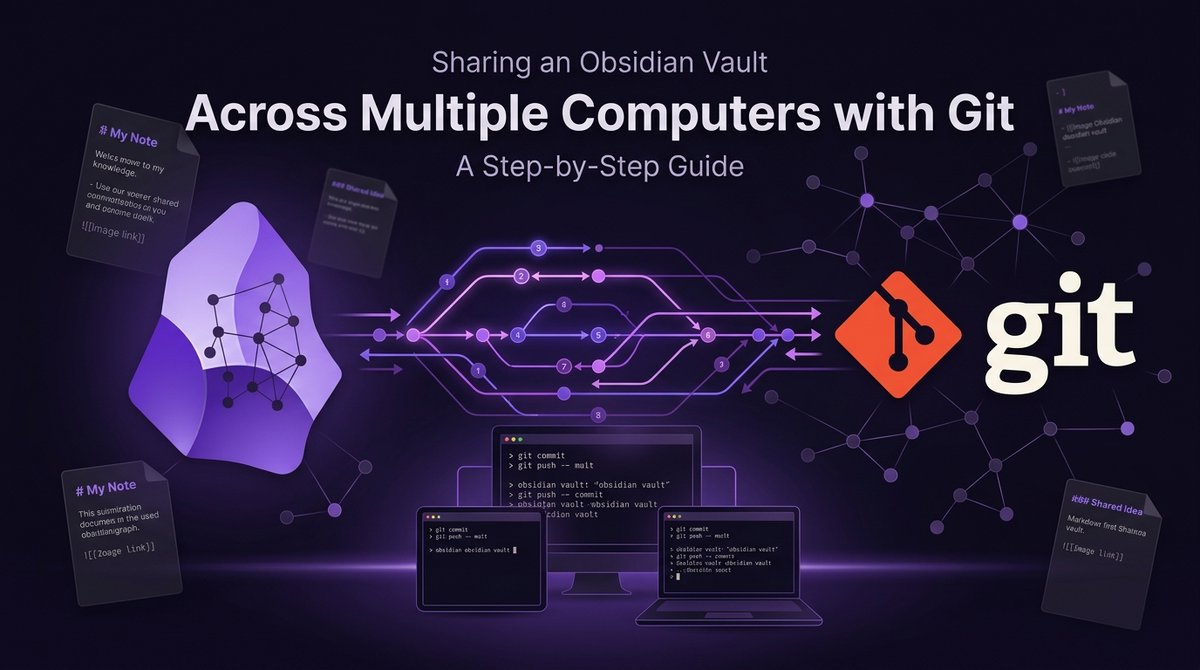
Sharing an #Obsidian vault across multiple computers with #Git gives you full ownership, revision history, and zero subscription fees.
But a default `git init` quickly leads to sync friction and merge conflicts.
Here is my step-by-step guide to make it seamless 🧵👇
Unpopular observation from running agent pipelines: the hard problem isn't giving agents access to knowledge. It's deciding what they don't get.
Everyone's building bigger context windows. Almost nobody's building the permission model that should sit in front of them.
The placement of prompting is the most useful part of this. A quarter of one competency out of four matches what I see in agentic pipelines daily: the prompt is a small fraction of the system, and it still gets most of the conversation.
The gap 4D leaves open: all four competencies reset at every task. What you delegated, how you described it, what you judged and why. None of it persists unless you build the layer that remembers it yourself.
A context layer worth owning needs three properties: structured, temporal, portable. Most attempts have at most one.
Full argument: https://t.co/5KeZODRqf6
Count the AI tools you used this month. ChatGPT, Claude, Copilot, Gemini, Perplexity.
Now: how many of them know what you were thinking last Tuesday?
Zero. Every single one starts from a blank page.
And flat memory ("user prefers TypeScript") misses what thinking is. You held X in 2023, nuanced it in 2024, contradicted it last month.
Similarity retrieval will serve your 2023 position as today's: confidently, fluently, wrong.
Everyone versions their prompts. Almost nobody versions their harness.
Yet in every agentic pipeline I've built, the harness (retries, validation gates, context assembly, output contracts) is where the actual engineering lives. The prompt is 10% of the system and 90% of the conversation.