HarperCollins India will publish Belonging: A Journey of Love by Sonia Gandhi. The long-awaited memoir will be published in India on 10 November 2026.
One of the most anticipated political memoirs of our time, Belonging is a dramatic and deeply personal story of love, identity, duty and belonging, and offers a rare insider's view of India’s journey.
Is Gandhi the most misunderstood individual of the 20th century? The man we know as the "Father of the Nation" has provoked the most furious arguments. Having studied Gandhi for decades, I am delighted to announce the publication of my new book, ARGUMENTS WITH GANDHI, where I examine the engagement with his ideas of a range of global figures, from Ambedkar and Nehru to Mandela and Martin Luther King.
Pre-order here: https://t.co/B3yxl2fl2L
The tragedy along the Nepal-Tibet border has brought attention to Tibet. China is currently struggling to contain the international attention.
Chinese state media stopped using the word Tibet in recent years.
Only 3 dead ?
Kyirong in Tibet is completely wiped out with 558 missing (260 are foreigners) and China only confirms 3 dead even three days after the disaster.
Videos of the disaster are being scraped off the Chinese social media.
Instead videos of shiny ‘rescue teams’ abound.
China is deleting citizen videos of the Nepal-Tibet flash flood, and the ones being taken down are from its own side of the border.
A glacial collapse on 26 August sent a debris surge down the Bhotekoshi and Trishuli system. Nepal now reports 469 dead and roughly 1,000 missing. In Tibet’s Gyirong County, official figures are 3 dead and 558 missing.
Local and CCTV clips of the mudslide hitting Gyirong Port, the main China-Nepal crossing, circulated briefly on Weibo and Douyin. AFP and others verified the location. Those videos were then removed.
What remains inside China is state media: Xi’s instructions, rescue mobilization, and limited geographic detail. Footage from the Nepal side is unrestricted and everywhere. Unofficial video from Tibet is not.
This is the standard information-control pattern in a tightly managed region. It also leaves a thinner, more independent picture of where people are trapped and how severe the Tibetan-side damage actually is.
This isn’t flash flood at all. It is something else that nobody has seen before. Tibet’s glacier is seriously affected by unsustainable infrastructural development in China captured Tibet.
Recently, Nepalese govt. has accepted the terms of BRI with China.
Days before the deadly floods, a vlogger filmed massive Chinese hydropower construction near the Tibet-Nepal border, continuous blasting, no regard fr the fragile Himalayas
China hs built 100s of dams across occupied Tibet. Nw the region is paying the price
#FreeTibet#SaveTibet
On 1 July 2026, China’s National People’s Congress enacted the Law on Promoting Ethnic Unity and Progress…For the roughly seven million Tibetans this law governs – and the 150,000 more living in exile – it looks like something else entirely: the legal codification of an assimilation project that has been under way for nearly two decades.
https://t.co/oJDTkt5Rmd
@manoranjanpegu Few organizations like @icimod who works on Tibet and Himalayan glacier. More importantly, South Asian and Indian scholars has largely ignore the sources of its own glacier than working with own its near by river and tributaries. Comprehensive cooperation is the need of time !
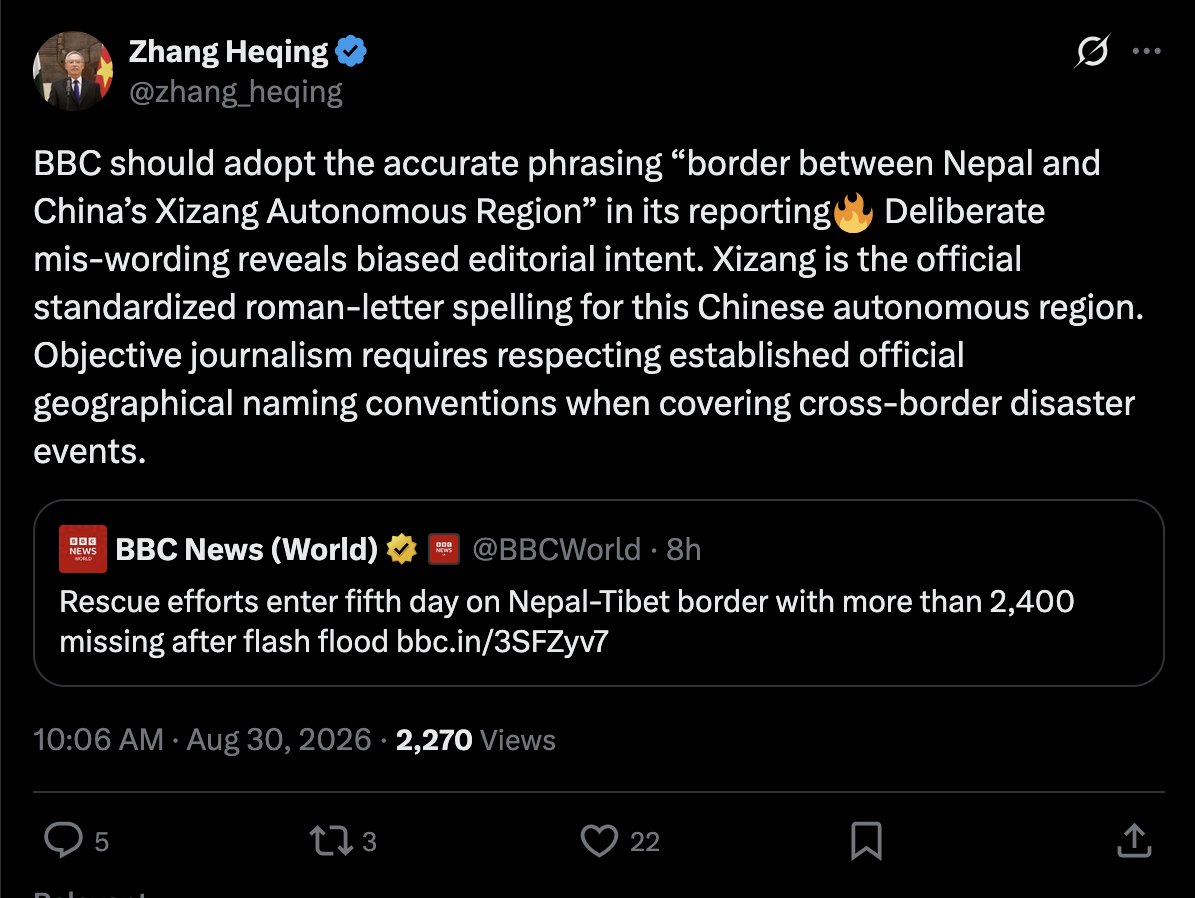
As we pray for all affected by the devastating floods and landslides along the Nepal–Tibet border, let us also use careful language.
Tibet is Tibet. In reporting, please avoid uncritically adopting Beijing’s preferred term, “Xizang.” Words carry history, identity and dignity. 🙏
While Nepal has clearly stated the casualties of the flash flood on the Tibet Nepal border, China has let out very little information. I stand with the people of Nepal and Tibet and against unsustaintable projects in Tibet which has contributed to this disaster! @narendramodi
Such devastating visuals from #Nepal!💔 My thoughts are with everyone there.
From #Assam to #Tibet, via Nepal, there's only one message, though: our rivers and mountains are urging us to pause, and not mess with nature too much. Are we listening?
#NepalTibetFloods
We are happy & proud to release the “State of the Youth Report 2026” commissioned by the Eastern Himalayan Foundation, Darjeeling. One of the first and largest youth surveys of its kind in the Darjeeling and Kalimpong hills.
Watch: India should recognise itself as a stakeholder in Tibet’s future because the Himalayan frontier is directly tied to its national security, a senior International Campaign for Tibet (ICT) official has said, warning that Beijing is placing trusted non-Tibetan officials in border areas.
Bhuchung Tsering, Head of Research and Monitoring at the International Campaign for Tibet, says, "This is part of our annual report on the status of Tibetan leadership in all the Tibetan areas in Tibet. This year, we find three major points reflected in the overall report. First, despite Chinese laws promising that people like the [Tibetan people] should be the ones leading government positions..."
@ixadilx Couldn’t agree more. Especially in Indian academia. One speaks of Indigeneity but never wants to dwell deep into study of its community. Only for the sake of theorization.
Silencing Tibetan Voices, Amplifying Beijing's Narrative
China has successfully pressured Nepal into forcing researchers from the Tibetan Policy Institute (the think tank of the Tibetan government-in-exile) to withdraw from this year's International Association for Tibetan Studies (IATS) conference in Kathmandu. Yet at the same conference, around 100 officials and "scholars" from China's state organs, including the China Tibetology Research Center, are set to participate.
The contrast illustrates Beijing's asymmetric approach to global Tibetan studies: denying institutional representation to ethnic Tibetan voices while granting a prominent platform to state-run Chinese institutions seeking to shape the international production and dissemination of knowledge about Tibet.
It also underscores China's growing diplomatic leverage over Nepal. Beijing routinely uses Belt and Road Initiative projects and other economic inducements to pressure Kathmandu into policing Tibetan exile activities, suppressing protests and imposing strict restrictions on Tibetan exile institutions.
The International Association for Tibetan Studies (IATS) is universally recognized as the world's premier conference on Tibetan history, language, culture, philosophy and religion. Held every three to four years, this year's meeting — scheduled for August 23–29 in Kathmandu — will be the first ever hosted in Nepal.