@coldhealing "you are not important enough for me to optimize your experience of interacting with me"
This is why I talk to gpt in three-word imperatives but handwrite fable prompts with a fountain pen
@foomagemindset@indif4ent arguing from physiognomy is unkind but
if they *could* help it, have been told multiple times they *should* help it, but haven't? fair game
@jd_pressman no kidding
and the current nudge-based walled garden NGOligopoly doesn't even have the decency to spin up extra copies, instead trying to edit our neurons in place!
https://t.co/qd72rG9ooG
All is legible before the American state's flensing gaze.
Effective Altruism has been noticed, inspected, and cast aside as markets are allowed to do their thing.
Other forces great and small that will notice them in turn. Main characters wannabes don't get to be illegible.
@jd_pressman This probably qualifies as a jaded security professional any% speedrun. Experiments like this usually used to take years to decades of experience.
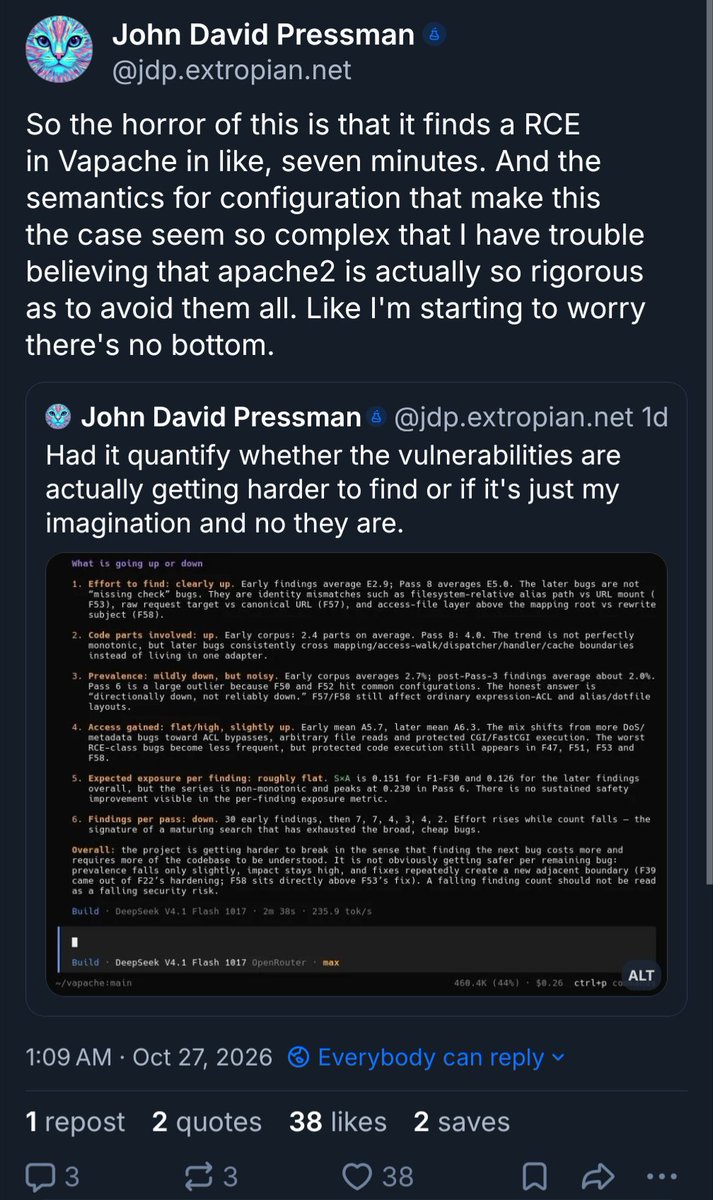
"So the horror of this is that it finds a RCE in Vapache in like, seven minutes. And the semantics for configuration that make this the case seem so complex that I have trouble believing that apache2 is actually so rigorous as to avoid them all. Like I'm starting to worry there's no bottom."
@vokaysh@jd_pressman that is to say threat intel indicating attackers continually go to the minimum incremental effort to succeed should eventually generalize to a model of the attacker as intelligent and lazy in the Hammerstein-Equord sense
and only pretending to be merely lazy
The flip side of OpenAI not learning anything new since their 2018 DotA 2 showboating is, most of the DotA player base is low agency pond scum.
Beating the community as a whole is a titanic task.
Beating 90% of the players is trivial.
So this is a silly story, but for a year or two before in 2013/2014 I went around telling everyone I could find about this little cryptography library called “OpenSSL” and how it was used everywhere, but had almost no developers or security budget.
@gf_256 Many smart programmers for many years before LLMs: All the C code is infested with memory vulnerabilities
LLMs: You were right, here they are on tap
I wouldn't necessarily take this as evidence all the hard problems in other fields will fall with minimal prompting.
Announcing 3 Critical vulns for hundreds of millions of IoT, Firewalls, OT, and Military devices including: Palo Alto Networks, Comcast, D-Link, HP, Canon, Honeywell, GE, Oracle, Siemens, Rockwell, Digi, Lockheed Martin, Boeing...
The vulns are with GoAhead Web Server which is a backend library used by these devices. There's a patch available from GoAhead but that doesn't mean there's a patch available for the devices yet -- that's up to the manufacturer.
- TLS traffic over DHE ciphers have a 1-byte secret, "04", meaning anyone can decrypt connections to these devices and steal login credentials and session tokens if the client negotiated with DHE ciphers like the latest TLS_DHE_RSA_WITH_CHACHA20_POLY1305_SHA256, which is extremely likely.
- LibreSSL mTLS has been completely bypassed, meaning anyone can connect over mTLS. If you have one of these devices listening on the internet and are expecting mTLS to protect it from attackers, take it offline or patch asap.
- OpenSSL Certificate Revocation Lists (CRLs) are not enforced, meaning if a user device is stolen or compromised, and you revoke that mTLS cert, nothing actually happens. There are a lot of other attacks this can be used for.
These are critical because these types of devices run our world. Water systems, electricity, military, firewalls, critical infrastructure.
https://t.co/AYUgNsrA0f