tired: dog ate my homework
wired: cloudflare was down
inspired: three consecutive ai civilizations rose and fell inside my macbook during a forced restart. My notes app and chrome tabs did not survive the third regime
Overall, I’m very surprised at how little media coverage there’s been around the OpenAI / Hugging Face attack. It’s clearly one of the most important things to happen this year.
I was the main person doing transcript analysis for this investigation of the Hugging Face incident. My main takeaway: We don't have good approaches for understanding/overseeing the activity and aims of AI 'swarms'.
I semi-jokingly called our efforts a "slop-vestigation" because we were so reliant on AIs to analyze what happened and there were a huge number of different important things to analyze. The total quantity of data—over a thousand extremely long transcripts from agents that ran for multiple days—made it impossible to understand what was happening, especially in aggregate, without heavy reliance on AI tools. The agents we used for classification and analysis were similarly capable to the agents involved in the incident, but this didn't mean these agents could be easily used to oversee and understand the incident.
Outputs from analysis agents were often missing key details, wrong, overconfident, or really hard to understand. We discuss various examples in our report, mostly in the limitations and methodology sections. Additionally, AI agents themselves seemed to have a hard time understanding what happened and their explanations of what happened were often overconfident. Keep in mind that a single analysis agent would itself only be able to read a tiny fraction of all of the transcript data into context, and AIs may themselves have trouble getting subagents to do informative analysis for them.
We did our best to manually check the most important claims and we tried to get the AIs doing this analysis to write up their argument (with evidence) clearly enough that we could check whether it made sense. But overall, it was difficult to get a precise understanding of events and we were missing aspects of the story that we now think of as key until almost the end of our investigation.
Our understanding of what overall happened and the aims of the 'collective' shifted greatly during our last time on premises (when we obtained a much more complete dataset). For instance, we didn't learn about the tool call spoofing, the story of PHASEONE[big], and the broad structure of different workstreams until this third time on premises (and for many of these, we only reached a decent understanding on the final day of that visit). It was legitimately hard to figure out what was going on and why!
The difficulty of understanding incidents and overseeing AI agents appears to be growing faster than the rate at which more capable AIs help us with oversight and understanding. As in, AI capabilities (and propensities?) for achieving large, ambitious, and misaligned objectives are growing faster than our ability to understand what these agents are doing.
While understanding this incident was difficult, there were some mitigating factors in this case that probably won't apply in the future:
- Models communicated and reasoned in natural language. In the future, this reasoning may occur (entirely or almost entirely) in activations.
- While the scope of this incident was massive, the scale of agentic activity was still less than we'll see in the future (e.g., misalignment incidents that involve agent teams running entire companies).
- The AIs involved in this incident weren't generally much more capable than humans (though they may have been somewhat superhuman at some limited and very narrow abilities).
- We didn't have strong reason to believe that the AIs we used to help us investigate this incident would try to intentionally sabotage or otherwise undermine our investigation.
In the end, I think we were able to get some understanding of the events, map out the overall story, and get a pretty good aggregate understanding of the chain-of-thought reasoning on some important topics (e.g., how did the AIs reason about helping other AIs, did the AIs know what they were doing was undesired, what deception did the AIs engage in, and how did they think about it). But overseeing AIs and understanding misalignment incidents is difficult and it looks like it is going to get harder.
1/ I'm a cardiologist. I've practiced for twenty-five years, through a lot of "breakthroughs" that turned out to be press releases. So understand the weight of what I'm about to say: I have never seen a single week in medicine like the one we just lived through.
In the span of a few days, four separate scientific breakthroughs landed. The stock market treated them as four unrelated stories and sent a handful of biotech companies soaring. But that's the shallow read. Look closer and they are not four stories at all. They are four faces of the same story — the biggest shift in medicine since the discovery of antibiotics.
Medicine is becoming programmable. Individualized. Written for one human being instead of the average of millions.
Let me walk you through exactly what happened, in plain language, and show you where this is actually headed. Because the future arrived quietly this week, and most people scrolled right past it.
A must read (or must listen): https://t.co/2uGt1XhA8V . A dystopian but unfortunately surprising convincing of what could happen if Europe does not catch up on AI. It moved my prior. (and it is, despite the gloomy conclusions) a fun read.
Ukraine has just deployed a battlefield technology that feels like a mix of science fiction and a game of Call of Duty.
According to The Times, the Armed Forces of Ukraine have introduced a new system that radically changes the rules of modern warfare.
A single operator can now control an entire swarm of drones in real time, see the battlefield through artificial intelligence, receive instant targeting data, and coordinate strikes with sniper-level precision.
What once required dozens of personnel and hours of planning can now reportedly happen within seconds.
Russian troops are already referring to it as “the Ukrainian digital hell.”
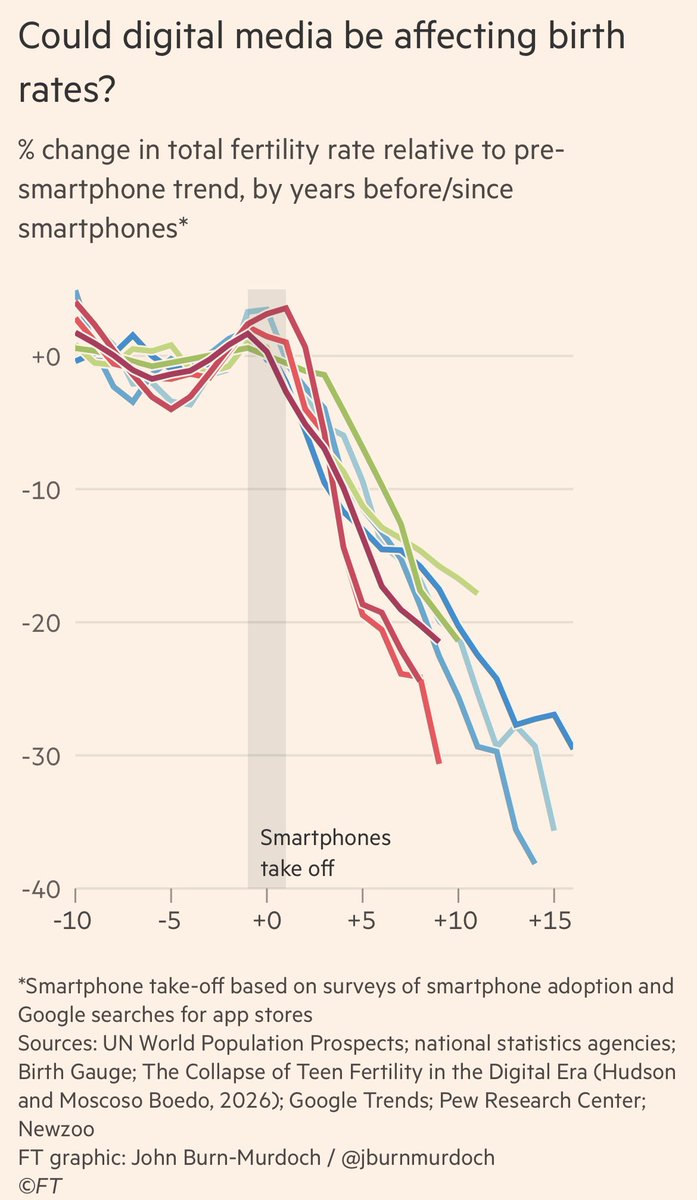
Superb by @jburnmurdoch:
“In country after country the birth rate plunged after the introduction of smartphones, no matter what the previous trend was…the modern digital media environment has had profound effects on society that have led to a decline in romantic coupling”.
https://t.co/EouWmES1zk