The PhD is the original doctorate degree. "Doctor" actually means "teacher" in latin. Medical doctors took it up later after it was an established term among academics.
Besides, there's already a word for medical doctor: physician.
Is this anything, Game Theoretic Attendance Requirements:
Course begins with attendance not required; however, if attendance ever dips below a threshold (e.g., two consecutive classes with <50% attendance) then attendance becomes mandatory for the remainder of the course.
Here's my brief take on the university. Universities are more like cities, than corporations. They are meant to support human flourishing. However, admin run them like corporations. Corporations are responsive to real or apparent trends in markets, not human flourishing. /1
i think when you're a nerd in high school, it helps to hear that all the qualities that make you a nerd will eventually prove to be useful later in life. and im here to tell you that doesn't happen.
Comparative analysis 🆚 meta-analysis – do we really have to choose? 🤔
In this preprint, we show that these two seemingly different concepts can be equivalent, and merging both approaches is extremely insightful!
@EcoEvoRxiv
https://t.co/3vptYA3ZWb
A thread🧵(1/15)
New paper out with @Johri_Parul and Jeff Jensen in @journal_evo, evaluating the power we have to detect recurrent selective sweeps using composite likelihood and linkage based methods. (Free-to-view for a week as its an Editor's Choice). https://t.co/LwSesiMUBi
This is funny because by rejecting the prevalence of stochasticity in evolutionary processes, Lysenko adopted a particularly vulgar materialism, whilst system theoretic (or indeed dialectical) approaches to genetics arose independent of a Marxist political project.
"Researchers in Japan have confirmed that microplastics are present in clouds, where they are likely affecting the climate in ways that are not yet fully understood."
cool
https://t.co/sYx9C3dgfw
Mosquito control agencies and research centers often maintain lab colonies of mosquitoes for study, and they need to be fed. As an alternative to pricy commercial feeders, @SLC_Mosquito has developed a simplified feeder that can be built for about $30. https://t.co/61KDPG295s
If I could enforce one change to scientific publishing, it would be a return to placing "Materials and Methods" sections between Introduction and Results as a standard practice.
What is Causal Inference?
Causal Inference is a new science of causation. This field is nothing less than a revolution in how scientists understand data. Read on to learn more.
This is the first post in a series based on the Book of Why by Judea Pearl. I will be reading the book and sharing the big insights with my followers.
When I first started learning causal inference, I didn't have a clear idea of the problems that casual inference was trying to solve. My misconceptions made it harder to understand the material than it would have been otherwise.
So, before we get into the ideas of the book, I want to help you avoid these common misconceptions.
1. Causal Inference is NOT just regular science
All sciences strive to infer causes within their domain of expertise. Therefore, it might not be obvious to you what makes casual inference any different. This is the reason why I sometimes call this new field mathematical causal inference. This term emphasizes that what sets causal inference apart is the mathematical framework it uses to describe causation.
2. Causal Inference is NOT directly about inferring causes
Based on the name, new learners often think causal inference is solving the following problem:
Given a list of candidate variables, how can we select the ones that have a real causal effect on our outcome of interest?
This is not what causal inference does. Causal inference is solving a different problem:
Assuming our beliefs about the causal relationships between all the variables is accurate, what is the best estimate of the causal relationship between a particular candidate variable and the outcome of interest?
Very roughly speaking, causal inference tells us whether based on our causal beliefs, the association between two variables is bigger or smaller than their true casual relationship.
3. The Example of Alice and Bob
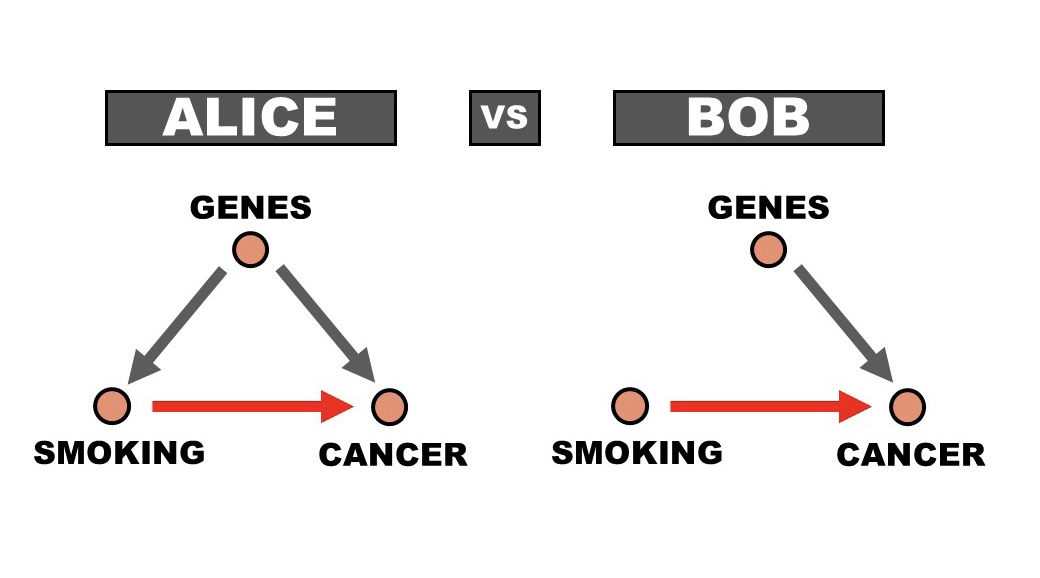
Alice thinks genes strongly affect addictive behaviors like smoking. She also thinks genes have an effect on who gets cancer. Bob agrees that genes very likely have an effect on cancer, but Bob thinks complicated social behaviors like addiction are completely due to social factors, not genes.
Causal inference allows us to evaluate the same data according to both Alice's and Bob's beliefs about the underlying causal relationships. This allows for various outcomes:
1. Avoiding unnecessary arguments. If Alice and Bob get very similar estimates for the causal relationship between genes and cancer, this implies that the disagreement about the relationship between genes and behavior is not that important. This allows scientists to move forward by focusing on the factors that really matter.
2. Agreeing to disagree. If the difference in estimates of the casual relationship between genes and cancer is large, causal inference allows both Alice and Bob to continue to explore the same data according to their very different assumptions about the causal relationships. This gives scientists and policy makers autonomy to pursue different interpretations of the same data.
4. Casual Inference builds doesn't replace statistics. It makes it more powerful.
Causal inference allows us to adjust our statistical estimates of the strength of particular casual relationships based on our beliefs about the casual relationships between the variables. This is why some experts in causal inference (like the epidemiologist @epiellie) prefer to use the term causal effect estimation to refer to the field causal inference.
That's it for now. My next post (coming soon!) will explore how causal inference creates a mathematical model of causation and what makes this approach so special. (You can find these posts using the hashtag #KareemReads)
Follow me (@kareem_carr) for more content like this. If you want to show support, like and retweet the thread.
Exciting news! My first publication of my post-doc just got officially released. Thanks to my co-authors on our awesome paper reviewing important considerations for modeling intra-host evolution of SARS-CoV-2! https://t.co/Kv8ZfOismr
It's #TransDayOfVisibility today. While I may not always look very "trans," I want to be clear and visible that I'm very non-binary and very part of the trans community. No matter what the bigots think: we've always been here, we're here now, and we'll always be here. #TDOV
🏳️⚧️Happy #TransDayOfVisibility! It’s a scary time to be trans right now, making visibility essential. We are friends, spouses, daughters, sons, mothers, fathers, scientists, professionals, and most of all human beings. I’m a trans woman in STEM and I’m especially proud today!🏳️⚧️
Happy #TransDayOfVisibility to my fellow trans scientists.
This year's #TDOV is more bittersweet as I have just returned from a conference where I was reminded of how uncomfortable being visibly trans can be, but I am still grateful for my friends and community and their support
I was born and raised in Colorado Springs, and can tell you without a doubt that today's shooting in Colorado Springs was preventable, and is the direct fault of:
1.) far right media
2.) evangelical churches
3.) the Colorado Springs Police
Thread below, rt for visibility
1/x