@TheTinMenBlog This just sounds salty. He repeatedly says he grew up working class but became a multimillionaire from trading. Also, just cause you’ve got money, doesn’t mean you need to live in opulence.
@search_andrew@fiscalphillips@TheIFS They would benefit, but significantly less so than the wealthy. The gains are heavily skewed towards the top decile. Tax cuts structured this way widen the inequality wealth gap, since the rich accumulate and reinvest their gains while lower earners spend theirs just to get by.
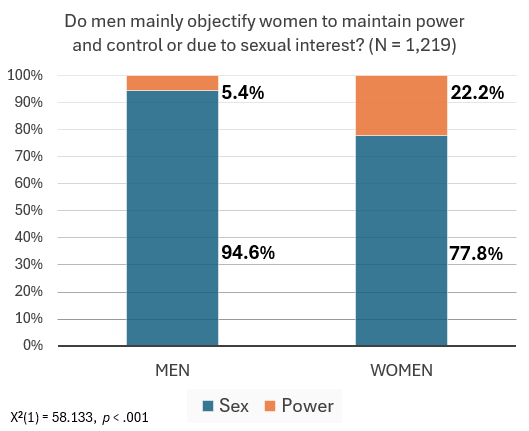
What's the main reason that men objectify women?
When given a choice between "to maintain power and control" and "sexual interest" a sex difference emerges.
Roughly, 1 in 5 women think it's to maintain power and control compared to 1 in 20 men.
Women in subsistence economies aren't preoccupied with anti-aging skincare routines, yet this content dominates the feeds of middle-aged Western women on YouTube.
Female intrasexual competition. When women no longer need to compete for a provider, the dating pool narrows. Fewer desirable men means fiercer competition, and appearance remains the primary currency. This is further exacerbated by the multi-billion dollar beauty industry.
"A new study finds that women all over the world are more likely than men to view themselves as sex objects, and that the gaps are larger, rather than smaller, in more gender-equal nations - yet another example of the gender-equality paradox."
https://t.co/JP8E3LkntK
@SteveStuWill Women in subsistence economies aren't preoccupied with anti-aging skincare routines, yet this content dominates the feeds of middle-aged Western women on YouTube.
@SteveStuWill Female intrasexual competition. When women no longer need to compete for a provider, the dating pool narrows. Fewer desirable men means fiercer competition, and appearance remains the primary currency. This is further exacerbated by the multi-billion dollar beauty industry.
@SteveStuWill Women in subsistence economies aren't preoccupied with anti-aging skincare routines, yet this content dominates the feeds of middle-aged Western women on YouTube.
MBTI was embarassingly my introduction to personality psychology and I would consistently get the "INTP" subtype.
But I've definitely found the modularity of the Big 5 and their subtraits to be far more useful in understanding myself.
@robkhenderson Worth noting that federal income tax excludes wealth accumulated through assets, capital gains, and investment returns, which are taxed at significantly lower rates. The ultra-wealthy don't primarily make money through income.
Though naturally introverted, I've noticed that situations forcing social engagement (summer camps or university where I knew nobody) temporarily turned me into a social butterfly. Since the pandemic however, I've worked remote jobs and that temporary extroversion dwindled.
"When people are trying to connect with or lead others, to attract attention, make a positive impression, or simply 'get things done,' they increase their levels of extraverted behavior. Over time...enacted extraversion may coalesce into a more extraverted personality"
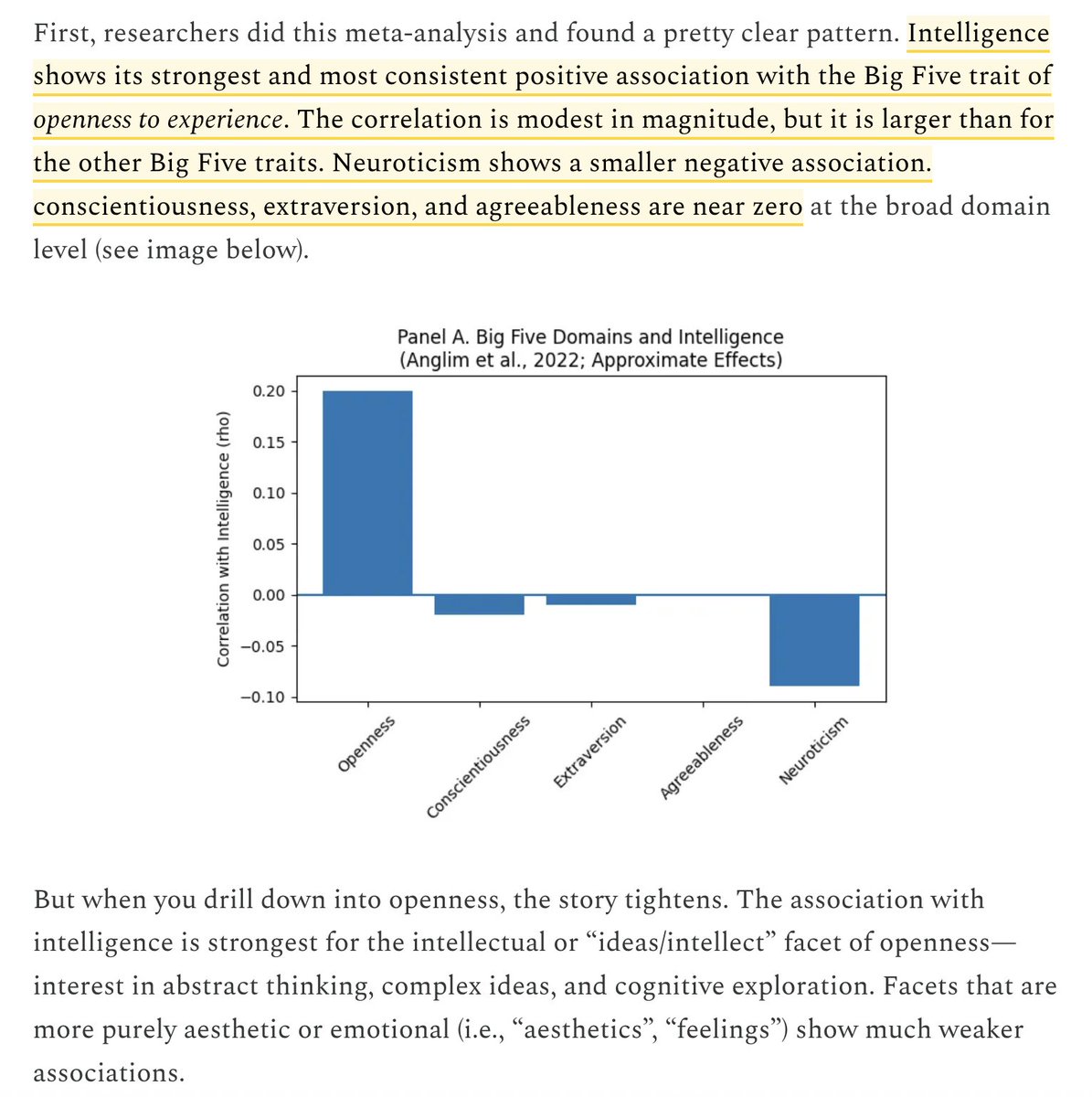
"Intelligence shows its strongest and most consistent positive association with the Big Five trait of openness to experience...Neuroticism shows a smaller negative association. conscientiousness, extraversion, and agreeableness are near zero" https://t.co/7ueB4gPQua
“Political extremists are less knowledgeable about politics than political moderates: the mildly left and mildly right. So says a study spanning 45 nations and more than 63,000 participants.” https://t.co/BJi6hk2I9f
@cremieuxrecueil Could it be digital adoption, reflected by social media growth? Combined Facebook + TikTok US users correlates at r=0.995 with the NHANES testosterone cycles.
The biggest predictor of coding ability is Language Aptitude. Not Math.
A study posted in Nature found that numeracy accounts for just 2% of skill variance.
Meanwhile, the neural behaviors associated with language accounted for 70% of skill variance.
The paradox of manhood.
“There’s a common belief that men are naturally dangerous — aggressive, predatory, criminally inclined.
In truth, the average man is only slightly more adventurous, slightly more aggressive than the average woman.
The difference is real, but it’s not dramatic.
The average man isn’t wildly different from the average woman when it comes to traits like courage, assertiveness, or even the tendency toward violence.
This creates a strange paradox. The worst men — the true predators — need to be constrained.
They need less boldness, less aggression, less entitlement.
But the rest — the vast majority — need the opposite.
They need encouragement.
They need to be challenged to step up, take risks, and take responsibility.
The problem is, most public conversations don’t make this distinction.
They flatten the male experience into one story.
But blanket advice doesn’t work.
A society that wants to flourish has to learn how to contain the worst men and cultivate the best ones.” — @robkhenderson





![SteveStuWill's tweet photo. Effectiveness of psychotherapy for 12 disorders.
• 0.2 = small
• 0.5 = medium
• 0.8 = large
[Link below.] https://t.co/SoDbe0U8fv](https://pbs.twimg.com/media/HExR-MQbkAAjyyy.png)


