I am very happy to announce TERN has a new website! https://t.co/xkKtj5yVPG - a source of information, documentation, celebration, and inspiration. Many thanks to @Nrtaylor101 (of @RCEMLearning fame) for his design acumen & patience @RCEMprof @mattreed73 @EddCarlton @DrTomRoberts
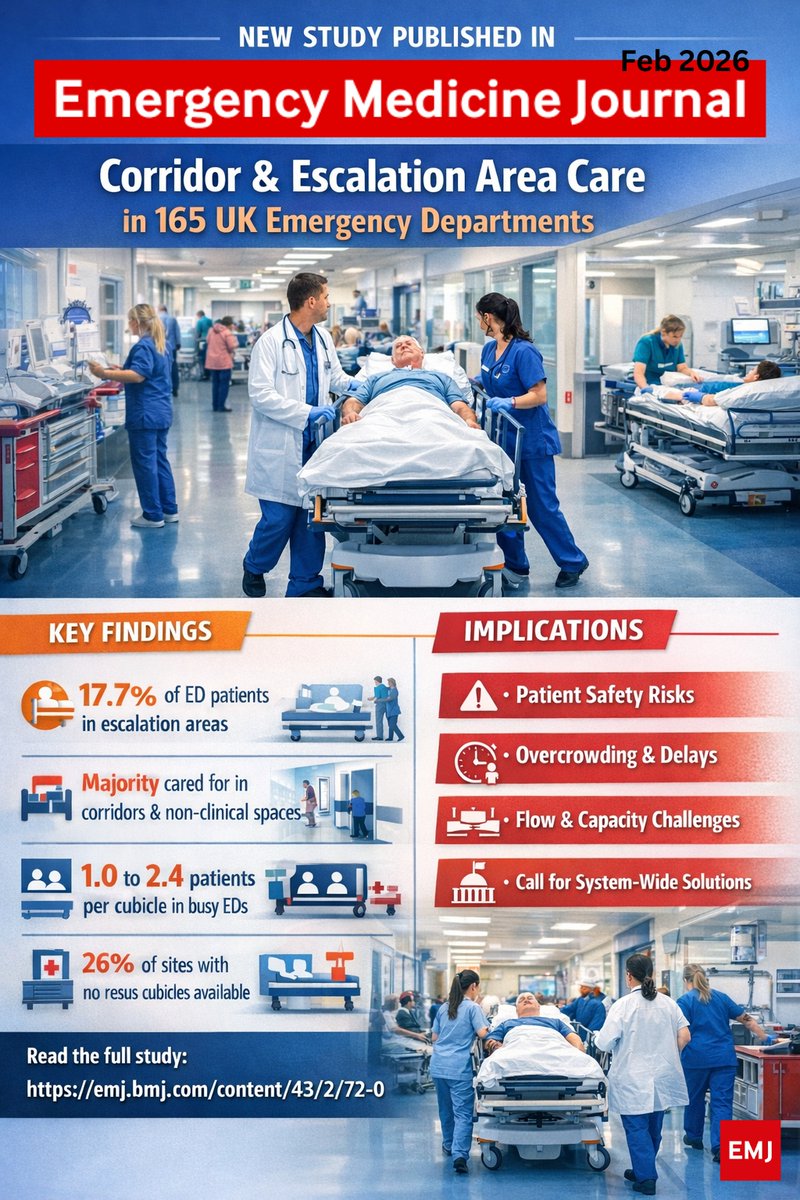
@EmergencyMedBMJ As Chief Investigator, an amazing collaborator effort around the UK by @ternfellow. However @EmergencyMedBMJ, I don't think the AI infographic you've used is the most representative of UK ED workforce. Why is the man the Doctor? Woman are Nurses? And why is everyone White?
#Feb2026#NewResearch
📌 Understanding corridor and escalation area care in 165 UK emergency departments: a multicentre cross-sectional snapshot study
🔗 https://t.co/sygVyybwqR
We’re pleased to share a landmark multicentre study led by the RCEM Trainee Emergency Research Network (TERN) that provides the most comprehensive national snapshot to date of escalation area and corridor care across UK emergency departments.
📊 Key outcomes from this national study:
• Across 165 UK type 1 EDs, 10 042 patients (17.7%) were receiving care in escalation areas — spaces outside the usual clinical footprint such as corridors, waiting rooms, repurposed clinical areas and doubled-up cubicles — at five snapshot points in March 2025.
• The proportion of patients in escalation areas ranged over time from ~15.5% to over 21%, with the highest use at the end of a clinical night shift.
• Non-clinical spaces (including corridors and waiting rooms) consistently made up the majority of escalation area care, representing over half of the patients in these settings.
• ED occupancy pressures were stark: occupancy ranged from about 1.0 to 2.4 patients per cubicle, and up to 26% of sites had no resuscitation cubicles available at certain snapshots — raising patient safety concerns.
• Patients awaiting an inpatient bed consistently outnumbered those in escalation areas, highlighting flow and discharge challenges as central contributors to corridor care.
• Both paediatric patients and those with mental health presentations were found to be receiving care in escalation areas across all snapshots, despite national guidance recommending against it.
• The proportion of patients in escalation care varied regionally, with the highest rates observed in Northern Ireland and lower rates in parts of south-west England.
📌 Why this matters:
This study demonstrates that escalation area care, including corridor care, is not an occasional exception but a routine part of emergency practice across much of the UK, despite national guidance stating it should be avoided.
Providing safe, high-quality care in spaces not designed for clinical observation or treatment presents significant challenges for patient dignity, monitoring and staff workflow. The findings underscore the urgent need for system-level solutions focused on improving patient flow, reducing inpatient boarding times and expanding capacity.
👉 Read the full article for detailed methodology, outcomes and suggestions for future research — and join the conversation on how we can translate this evidence into better emergency care practice.
#EmergencyMedicine #EMJ #HealthcareResearch #PatientSafety #QualityImprovement #NHS
@RCollEM@richardbody@drsarahedwards
https://t.co/3FXZ5g6iam Interested in shaping UK EM training? If you're interested in Social Media, Curriculum, Sustainable Working Practices, Same Day Emergency Care or Ultrasound join us. Deadline 14th January. Ho ho ho! @RCollEM@RCEMpresident@IrishEMtrainees@ternfellow
The Royal College of Emergency Medicine (@RCollEM) is sending every MP a Christmas card highlighting the dangers of long waits and "corridor care".
Recent research by RCEM and @ternfellow found that nearly 1 in 5 patients are receiving care in spaces not designed for treatment.
"So-called ‘corridor care’ can only be stopped in the corridors of power"
That's the message we hope MPs will take from the festive greetings cards RCEM has sent every single sitting member in the country.
Read more here:
https://t.co/aCuHPbRAj6
The dire state of corridor care and overcrowding in Northern Ireland’s EDs has been revealed following a new survey of lead consultants.
Carried out on the morning of 8 December, across all nine all ages EDs, it revealed staff are dreading coming to work, departments are over capacity with patients being cared for in non-clinical areas, and there’s no resuscitation spaces.
Read more, including recommendations to address the crisis, here: https://t.co/zFzjAe4AdR
We’re pleased to share that the first UNCORKED study paper has been published in the Emergency Medicine Journal and SWFT was one of the 165 Emergency Departments involved. @nhsswft
Hugely important study published today in @EmergencyMedBMJ from @ternfellow.
Almost every Emergency Department in the UK is forced to deliver unacceptable corridor care, and reasserts that this is almost exclusively due to poor flow through the system. A quick view from the data
@RCollEM@ternfellow@LBC Absolutely clear that there needs to be more beds/ wards and staff to manage the increasing number of sick patients needing admission to hospital. All kinds of measures are already in place to try and avoid admissions. Please address urgently Mr.Streeting - before 2029!
@salmannaeem217@ternfellow Thank you @salmannaeem217 - you were there at the beginning of the @ternfellow journey. Time for an Aussie version! Hopefully work like this can improve the situation for patients….
@RCEMPolicyVP@ternfellow@RCEMpresident Thank you Adrian. The scale of data collection was seriously impressive. Live data collection at midnight and 0700 at two of the snapshots demonstrates the dedication of @RCollEM residents, ACPs and doctors. Big shout out to the @NIHRresearch research teams!
@TJCoats@BBCNews@RCEMpresident@RCollEM Fits with the resuscitation capacity finding from the uncorked study published yesterday.
Sites reporting no resus capacity in the UK ranged from 10.5% to 26.2% (n=17/162 to n=43/164)
https://t.co/CJko82kwG4
Completely unacceptable. Those in power in NI must do better. This is horrific. Corridor care is undignified, it compromises confidentiality and causes harm. It must be eradicated.
Around 1 in 5 patients in UK A&Es are being subjected to so-called 'corridor care', according to a new study by @ternfellow.
Here's our President Dr Ian Higginson telling @LBC this morning why this practice has become so widespread in our hospitals - and how it can be fixed.
Emergency Medicine resident doctors show their value, and how committed they are to patient safety, with this excellent research study showing the extent of corridor care in UK EDs during Mar 2025. @ternfellow@EMTAcommittee@RCollEM
The UK @ternfellow EDcorridor study is out!
Key points
1. 1in5 are treated in ED escalation areas (eg corridors)
2. 10-25% of EDs have no available resus cubicle
3. The problem/solution is flow. More patients waiting for beds in ED than in corridors.
https://t.co/r5wna1PDMP
Fascinating, depressing but unfortunately highly expected results from the TERN UNCORKED study of ED UK escalation area (corridor) care in 165 UK EDs presented by RCEM TERN fellow Ben Clarke at #eusem2025 - currently under review at @EmergencyMedBMJ so no online previews