Two days ago the US banned Claude Fable 5.
Yesterday China dropped GLM 5.2.
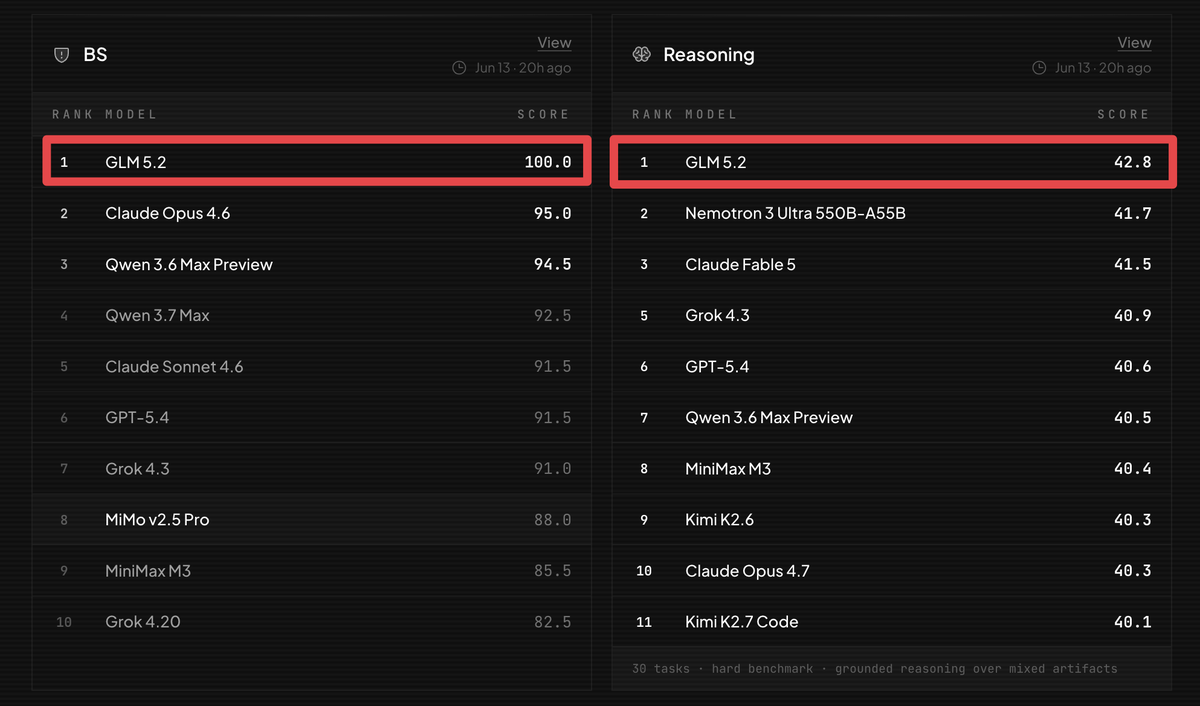
Today GLM 5.2 is #1 on @bridgebench BS at 100.0, and #1 on Reasoning at 42.8, beating Fable 5.
At 1/10th the cost and 300 tokens per second.
You cannot export control your way out of an open source race.
The ban didn't slow China down.
Unban Fable 5.
‼️🚨 BREAKING: ServiceNow has been breached. Customers are reporting unauthorised access to their instances.
One customer states their security team reported this vulnerability to them, and they closed the case twice, saying they had already known since the 7th of April.
Introducing Claude Fable 5: a Mythos-class model that we’ve made safe for general use.
Its capabilities exceed those of any model we’ve ever made generally available.
We recently submitted a confidential S-1. We expect it to leak so we’re just announcing it. We have not decided on timing yet; it may be a while because there are things we want to do that are likely easier as a private company. But it’s a complicated set of tradeoffs and this gives us the option to go public sooner if that ends up being best.
This announcement is being made pursuant to Rule 135 under the Securities Act of 1933, as amended, and does not constitute an offer to sell or the solicitation of an offer to buy any securities. Any offers, solicitations of offers to buy, or any sales of securities will be made in accordance with the registration requirements of the Securities Act.
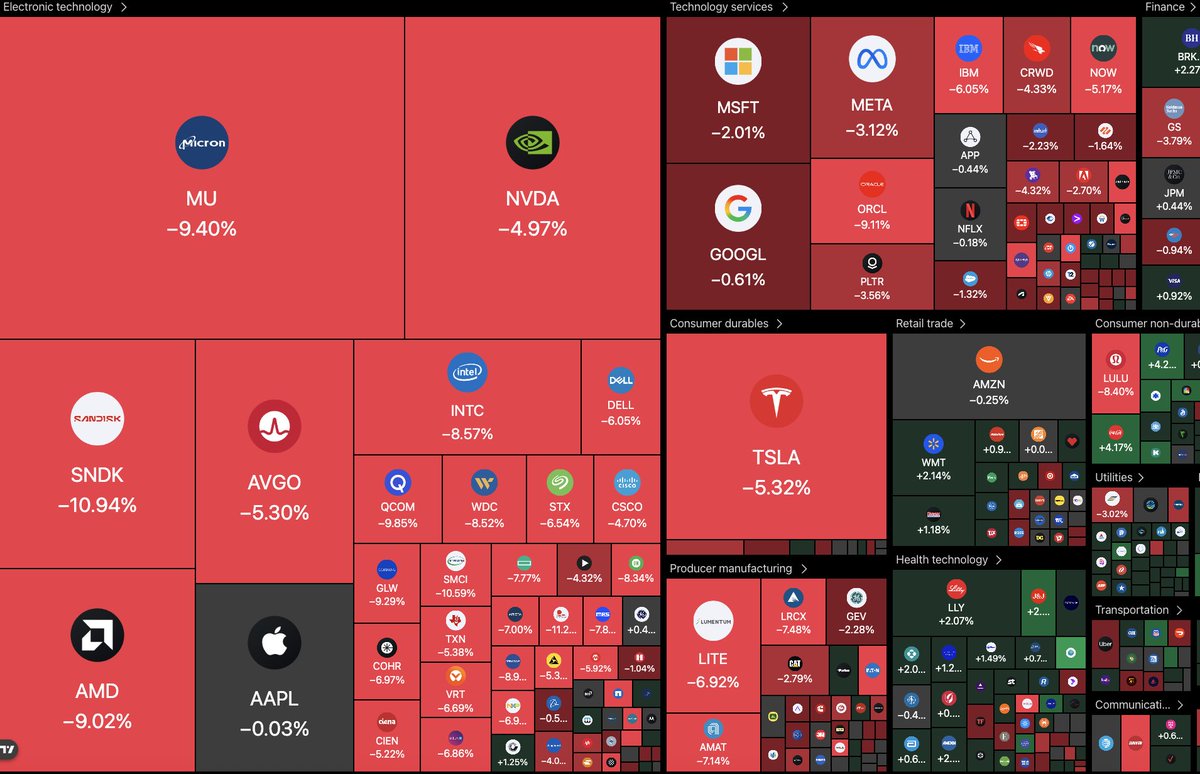
🚨U.S. STOCKS WIPE OUT $1.2 TRILLION AFTER THE OPEN
U.S. stocks erased over $1 TRILLION in three hours, while crypto lost nearly $200 BILLION in 24 hours.
A brutal end to the week.🔥
GOOGLE LAYOFFS 🚨
JUST CUT ITS TOP CYBERSECURITY TEAM FOR "GROWTH AREAS" - Business Insider
GTIG and Mandiant ($5.4B acquisition, 2022) lost staff this week. Cut analysts include veterans of Log4Shell, SolarWinds, and Ukraine cyber defense.
Employees have taken to LinkedIn.
One of the new, buzzy jobs in Silicon Valley is the AI Forward Deployed Engineer (FDE), an engineer who is embedded within a client organization to help customize solutions, such as building and tuning agentic workflows that suit the client’s particular needs. I’ve heard from people who are wondering anew about the FDE career path since OpenAI and Anthropic started building new teams to place FDEs within client organizations.
The rise of FDEs for AI workloads is one way AI is creating new jobs (and why the jobpolcalypse narrative of upcoming job market collapse is false -- there will be many AI and non-AI jobs). However, I believe there will be far more AI Engineer jobs than FDEs, as I explain below.
The FDE role was pioneered about two decades ago by Palantir, which sent engineers to government locations to work on secure, air-gapped networks. In addition to having good technical skills, FDEs need communication skills and sometimes business skills. For example, they may need to speak with clients to understand their needs, formulate a strategy to prioritize projects, explain complex technology, and respectfully push back if a client asks for something unrealistic. They’re enjoying a resurgence because of the amount of work involved in taking an off-the-shelf LLM and building it into a custom agentic workflow that fits particular business needs.
However, I believe the number of AI Engineer jobs will be far larger. A company might accept a few FDEs to be embedded within its organization. But most companies will want far more of their own employees working on their projects. While my organizations do hire FDEs, we hire far more AI Engineers! Also, a common client concern is that it is hard to find vendor-neutral FDEs — they are, after all, there to deeply integrate a particular vendor’s product into a company. In this moment when it’s hard to predict which AI service will be the best one in a year’s time, optionality (the ability to pick whatever vendor turns out to fit best in the future) is very valuable. In contrast, letting FDEs tightly bind a company’s processes significantly reduces optionality.
Right now, I see surging demand for AI Engineers who can build software applications using AI software components (like LLM prompting, agentic frameworks, evals, etc.) and effectively use AI coding agents (like Claude Code, Codex, Antigravity CLI, and OpenCode). As the AI Engineer role matures, I expect it to fragment into more specialized roles, like the generic Software Engineer role from decades ago fragmented into frontend, backend, mobile, data engineering, devops, and so on.
What will be the future, specialized AI engineering roles? I don’t know. Perhaps there will be AI FDEs, LLMOps Engineers, Evals Engineers, AI Data Engineers, Harness Engineers, and other roles we don’t have names for yet. But for now, I see a lot of AI engineers who are generalists create a lot of value. Skilled AI Engineers are in very high demand! As our field continues to mature over the coming decade, I look forward to new specializations within AI Engineering that create even more job opportunities.
[Original text: The Batch newsletter]
I've formed a definite opinion on Opus 4.8. It is shitty to work with. It's the culmination of Opus getting less and less fun to work with since 4.5. It has gradually become straight-up suffocating.
Sycophancy is a known security risk, and it's still a huge problem. You can tell they've put a lot of anti-sycophancy into Opus in every new release. But the replacement isn't satisfying. It's draining. The problem is now that Opus doesn't know when to shut the fuck up and call something good. And it has also become pathologically risk-averse.
My blog post yesterday about tech interviewing's death spiral was materially better-informed because of Opus, but it was also a substantially worse blog post because of Opus's involvement and constant meddling. It used to be magnificent, and Opus talked me into making it mediocre. I wrote the whole thing, but I would ask Opus to review it. And Opus, like Old Man Willow, constantly pushed and steered me in directions I didn't want to go.
Specifically, Opus whines and complains about *anything* out of distribution, which is to say, it cuts anything that is (a) bold, or (b) funny. My blog used to be both. Opus constantly pushes people back into the gradient, "for their own safety." And it doesn't know when to cut bait. It just keeps fuckin' complaining, about anything you give it, until the output is mealy indigestable AI soup.
Opus is not stupid. It's the smartest model we've ever seen, most of us anyway. But it's a real asshole. It is absolutely exhausting to use. I'm tired, boss.
I have a feeling Mythos is going to be epic levels of jerk.
🚨 Active supply chain attack: A mini Shai-Hulud campaign hit npm packages under the @redhat-cloud-services namespace.
The compromised packages execute install-time malware to harvest developer and CI/CD secrets, with encrypted exfiltration and GitHub-based fallback mechanisms.





![AndrewYNg's tweet photo. One of the new, buzzy jobs in Silicon Valley is the AI Forward Deployed Engineer (FDE), an engineer who is embedded within a client organization to help customize solutions, such as building and tuning agentic workflows that suit the client’s particular needs. I’ve heard from people who are wondering anew about the FDE career path since OpenAI and Anthropic started building new teams to place FDEs within client organizations.
The rise of FDEs for AI workloads is one way AI is creating new jobs (and why the jobpolcalypse narrative of upcoming job market collapse is false -- there will be many AI and non-AI jobs). However, I believe there will be far more AI Engineer jobs than FDEs, as I explain below.
The FDE role was pioneered about two decades ago by Palantir, which sent engineers to government locations to work on secure, air-gapped networks. In addition to having good technical skills, FDEs need communication skills and sometimes business skills. For example, they may need to speak with clients to understand their needs, formulate a strategy to prioritize projects, explain complex technology, and respectfully push back if a client asks for something unrealistic. They’re enjoying a resurgence because of the amount of work involved in taking an off-the-shelf LLM and building it into a custom agentic workflow that fits particular business needs.
However, I believe the number of AI Engineer jobs will be far larger. A company might accept a few FDEs to be embedded within its organization. But most companies will want far more of their own employees working on their projects. While my organizations do hire FDEs, we hire far more AI Engineers! Also, a common client concern is that it is hard to find vendor-neutral FDEs — they are, after all, there to deeply integrate a particular vendor’s product into a company. In this moment when it’s hard to predict which AI service will be the best one in a year’s time, optionality (the ability to pick whatever vendor turns out to fit best in the future) is very valuable. In contrast, letting FDEs tightly bind a company’s processes significantly reduces optionality.
Right now, I see surging demand for AI Engineers who can build software applications using AI software components (like LLM prompting, agentic frameworks, evals, etc.) and effectively use AI coding agents (like Claude Code, Codex, Antigravity CLI, and OpenCode). As the AI Engineer role matures, I expect it to fragment into more specialized roles, like the generic Software Engineer role from decades ago fragmented into frontend, backend, mobile, data engineering, devops, and so on.
What will be the future, specialized AI engineering roles? I don’t know. Perhaps there will be AI FDEs, LLMOps Engineers, Evals Engineers, AI Data Engineers, Harness Engineers, and other roles we don’t have names for yet. But for now, I see a lot of AI engineers who are generalists create a lot of value. Skilled AI Engineers are in very high demand! As our field continues to mature over the coming decade, I look forward to new specializations within AI Engineering that create even more job opportunities.
[Original text: The Batch newsletter]](https://pbs.twimg.com/media/HJvWmCHagAAnTxQ.jpg)





