Up to half of Earth's glaciers could melt in the next 80 years if the climate warms to 1.5°C (2.7°F) above pre-industrial levels, says a new study using @NASA and international satellite data. 🧵
Day 2 of #IntegratedEarth is underway.
Dr Tim Rawling offering a recap of day 1 and setting the focus for today.
"Let's work out what the opportunities are big and small, what the barriers are, and what we can change to start to improve the way we do integrative science".
We're kicking off Day 2 of the #IntegratedEarth conference with the Executive Director of @CODATANews, @simonhodson99, with his talk on the importance of internationally integrating data for all spheres.
Introducing the Cryosphere at #IntegratedEarth.
Dr @DavidGwyther4, Research Fellow at @UqEnvironment, takes a closer look at the frozen water of Earth through the lens of tipping points and high performance computing simulations.
Introducing the Hydrosphere at #IntegratedEarth.
Dr Elizabeth Shadwick (@CSIRO) dives into the carbon cycle, natural variability and anthropogenic change, ocean monitoring and climate change.
Follow our live stream here: https://t.co/XqxSOCOa5Y
Jim Walker shares vital Indigenous perspectives at #IntegratedEarth and asks the question:
How can we bring Indigenous knowledge systems and Western science systems together through dadirri: deep listening.
Jim shared many great examples.
Here is one: https://t.co/1OnzT06cem
Geoscience is…
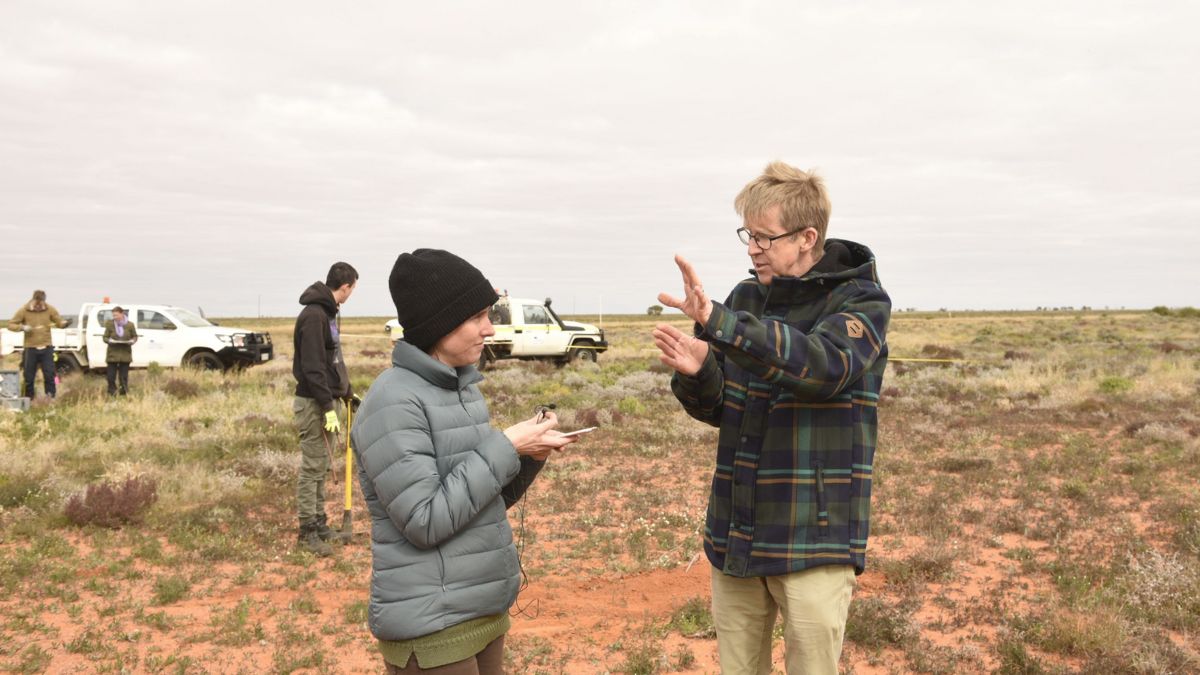
capturing poetry within science on Wilyakali country.
Measuring "tiny vibrations that have come from the ocean thousands of kilometres away... to solar flares from the sun that resonate around the Earth."
– Prof Graham Heinson & Philomena Manifold
#ScienceWeek
Geoscience is…
knowing the Earth's song, told through earthquake whispers! Seismometers in classrooms allow students to understand how our lively planet “dances”. This starts their curiosity and helps them grow up to care about Earth science.
–Dr @Sima_Mousavi#ScienceWeek
As a result, I'm on a mission to showcase the absolutely critical role #EarthScience and #geoscience play in our #sustainable future by partnering with #UNESCO IGCP and the #IUGS, representing over 1 million geoscientists, to build the @EarthFutureFest https://t.co/DrCjoteMds
@Eduspokesperson If you missed them or want a second viewing, the #AuScope2021 talks will be available on our website, forevermore. Take your time to digest 50+ outstanding #geoscience talks on everything from planets to #earthquakes and storing carbon in #volcanoes:
https://t.co/9FBHNi4EzK
And we're off with #AuScope2021! Check out our first ever mini-doco featuring members of our geoscience community talking about the future of Australian geoscience and the Downward Looking Telescope: https://t.co/JMAevXaCio
#NCRISimpact @Eduspokesperson 🌏😍✨
Hold onto your coffee cup and comfort the dog. Today, Melbourne woke up to a record-breaking shake for southeastern Australia. Here's how #NCRIS enabled #earthquake hunters responded: https://t.co/jyC2n2RNgC
@modeltheearth @AusisEdu @DrQuigsQuakesci #NCRISimpact#melbournequake
Loved exploring deep time, rocks and tektites with @Jacinta_Parsons today🌟. The @melbournemuseum has a great collection of Australites if you’re curious 🙌🙌🙌.
Fireball meteor creates seismic waves ☄️💫 Boom captured by a school seismometer!
Co-authored with Dr Michelle Salmon for auscopetoolkit auscopegeochem
Photo: Quentin Kemmel
See full article at https://t.co/UNkwQaucnJ… https://t.co/X62PNyrO8z