@ginacarano Anyone that throws shade on @ginacarano must have done wonderful things that can match or even come close to what @ginacarano achieved the other night. I’d love to hear it. C’mon, anyone??
Then shut the hell up.
New paper out in Proceedings of the Royal Society B: we apply linguistic tools to sperm whale vowels.
The result: sperm whale vowels do not just look like human vowels. They also behave like them.
We found several parallels. Like in Latin, whales have short and long vowels. Like in Slovenian, some vowels prefer particular tones. Like in human language, there’s a lot of coarticulation (a process when you say “tense” but the word sounds like “tents”).
Observing vowels in whales is a matter of timing. Our vowels are fast, whale vowels are slow. Beats become pitch if they’re fast enough. If you slow down human vowels, they start sounding like whale clicks.
Applying linguistic tools to whales shows us that we’re much more similar to these wonderful ocean creatures than we previously believed and that their language is much more complex and structured.
@projectCETI@UCBerkeley
De toekomst van mobiliteit is aangebroken
FSD Supervised has been approved in the Netherlands 🇳🇱 & will begin rolling out in the country shortly!
Trained on billions of kilometers of real-world driving data, it can drive you almost anywhere under your supervision – from residential roads to city streets & highways
No other vehicle can do this.
We're excited to bring FSD Supervised to more European countries soon
New release of FSD Supervised now starting to roll out
This update brings 20% faster reaction time to further increase safety, among many other improvements
Full release notes below
Full Self-Driving (Supervised) v14.3 includes
- Upgraded the Reinforcement Learning (RL) stage of training the FSD neural network, resulting in improvements in a wide variety of driving scenarios.
- Upgraded the neural network vision encoder, improving understanding in rare and low-visibility scenarios, strengthening 3D geometry understanding, and expanding traffic sign understanding.
- Rewrote the AI compiler and runtime from the ground up with MLIR, resulting in 20% faster reaction time and improving model iteration speed.
- Mitigated unnecessary lane biasing and minor tailgating behaviors.
- Increased decisiveness of parking spot selection and maneuvering.
- Improved parking location pin prediction, now shown on a map with a (P) icon.
- Enhanced response to emergency vehicles, school buses, right-of-way violators, and other rare vehicles.
- Improved handling of small animals by focusing RL training on harder examples and adding rewards for better proactive safety.
- Improved traffic light handling at complex intersections with compound lights, curved roads, and yellow light stopping – driven by training on hard RL examples sourced from the Tesla fleet.
- Improved handling for rare and unusual objects extending, hanging, or leaning into the vehicle path by sourcing infrequent events from the fleet.
- Improved handling of temporary system degradations by maintaining control and automatically recovering without driver intervention, reducing unnecessary disengagements.
Upcoming Improvements
- Expand reasoning to all behaviors beyond destination handling.
- Add pothole avoidance.
- Improve driver monitoring system sensitivity with better eye gaze tracking, eye wear handling, and higher accuracy in variable lighting conditions.
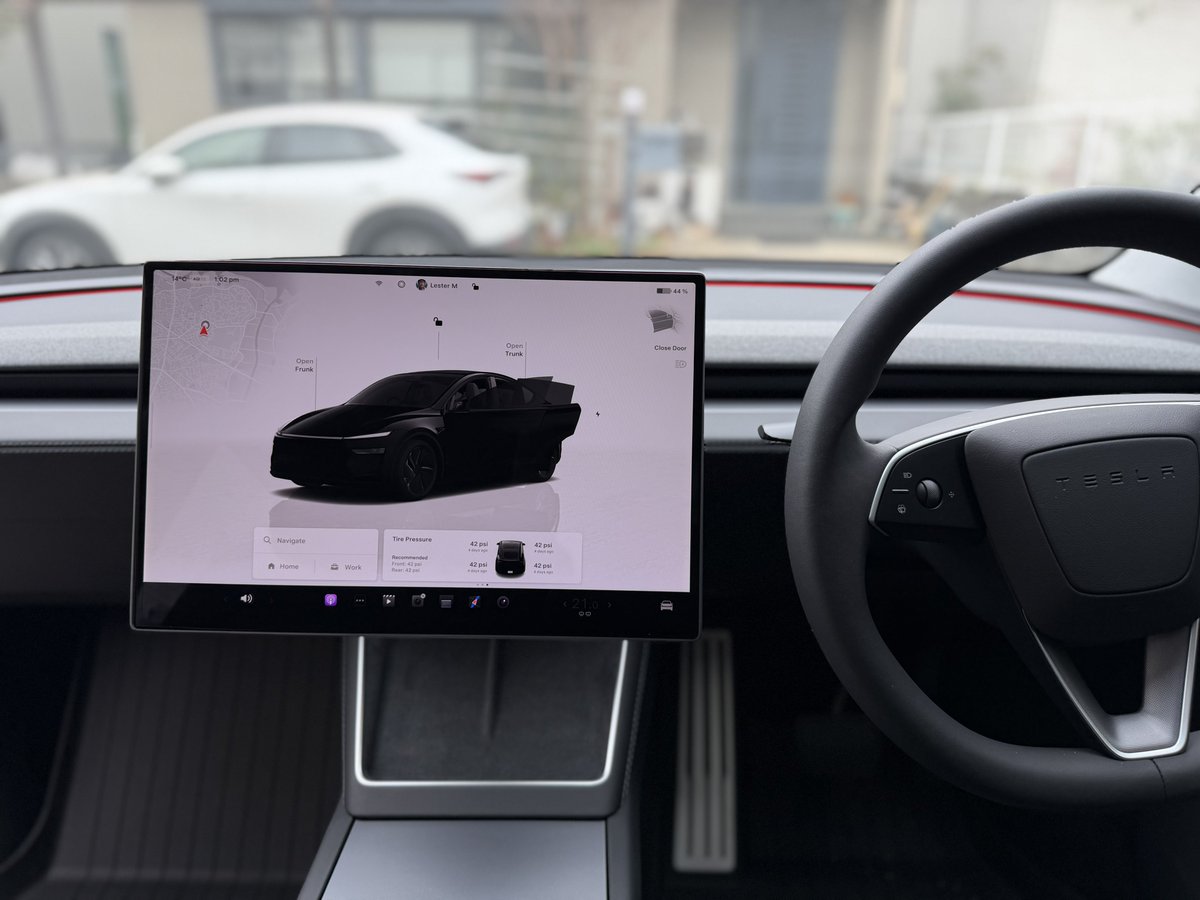
@Kenmaeda77 It’s really hard to judge just how impressive FSD has become by just watching videos, but once you experience it, you can never go back to a non-FSD car! Once it catches on in Japan, it will become just like the iPhone and disrupt the status quo for sure!