@superfanalysis Thanks for covering our seed round! One small clarification: we reanalyzed five public brain studies and detected p-tau217 in four of them. Appreciate you sharing the work!
@Dr_KevinTran@dereckmush Good question, Kevin. We’ll need to check which cohorts include donor-level APOE genotype and whether our analysis examined that split. Looping in our scientific team @PeterCimerman confirm what the data can support.
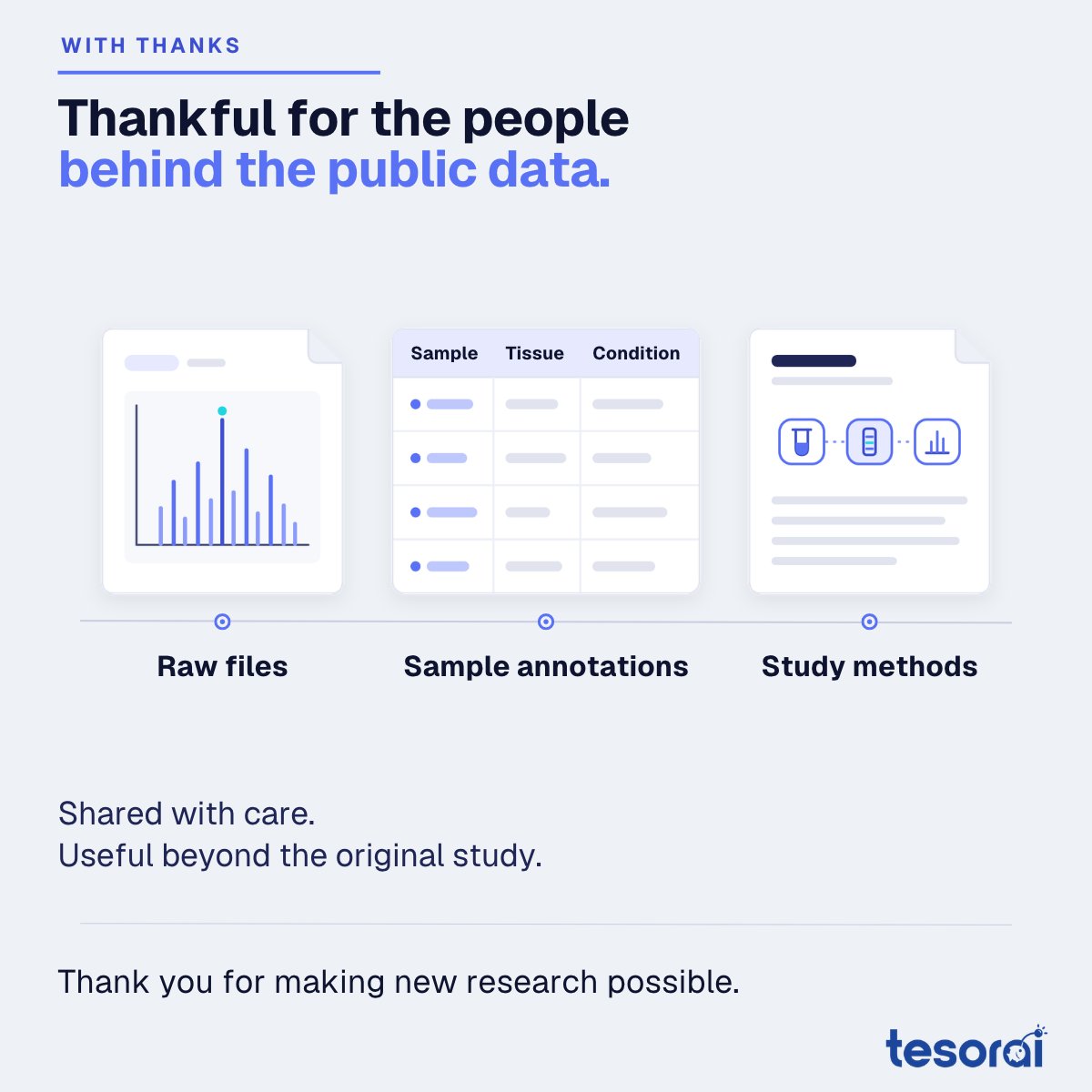
Behind every reusable public dataset are people who shared the raw files, documented the samples, and explained the methods.
This Thanksgiving week, thank you to the researchers, core facilities, and repository teams making new research possible.
#Proteomics#OpenScience
@GENbio Thanks for covering our work, @GENbio! We’re helping researchers get more from their own proteomics experiments and revisit public datasets to explore new scientific questions.
@EvanKirstel@SR_Researcher_@PerplexityFund@TechImpactTV Thanks, Evan! We’d love to explore that. There’s a lot to discuss about how AI can help scientists get more from proteomics data. What’s the best way to connect about the show?
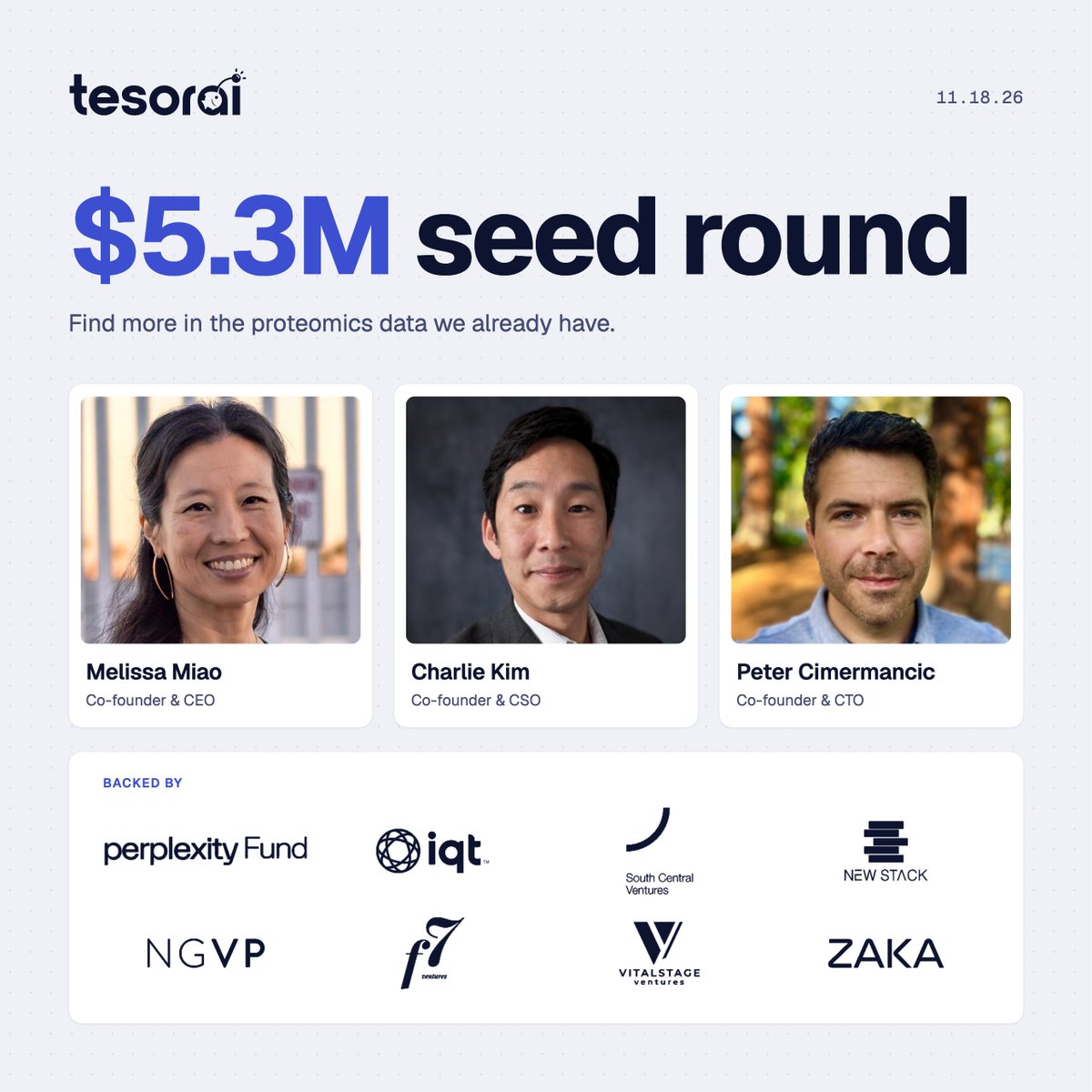
Tesorai has raised $5.3M in seed funding to keep building a knowledge layer for life sciences. Our AI reprocesses raw data from new and past experiments so researchers can test findings against existing evidence and AI models can learn from it.
@Nature We checked this in human data. Across 1k normal tissue samples in @tesorai_bio Trove, GZMK barely changes with age (ρ=0.07). But in normal liver it tracks fibrillar collagen (COL1A1/3A1, ρ 0.62–0.68), partly independent of T-cell content. Same fibrosis axis as the mice.
New question. Existing raw data.
Revisit acquired spectra with Tesorai Search to look for a modification of interest or peptide sequences in a custom database.
What else could your spectra reveal?
https://t.co/EJt9Wwb3Zr
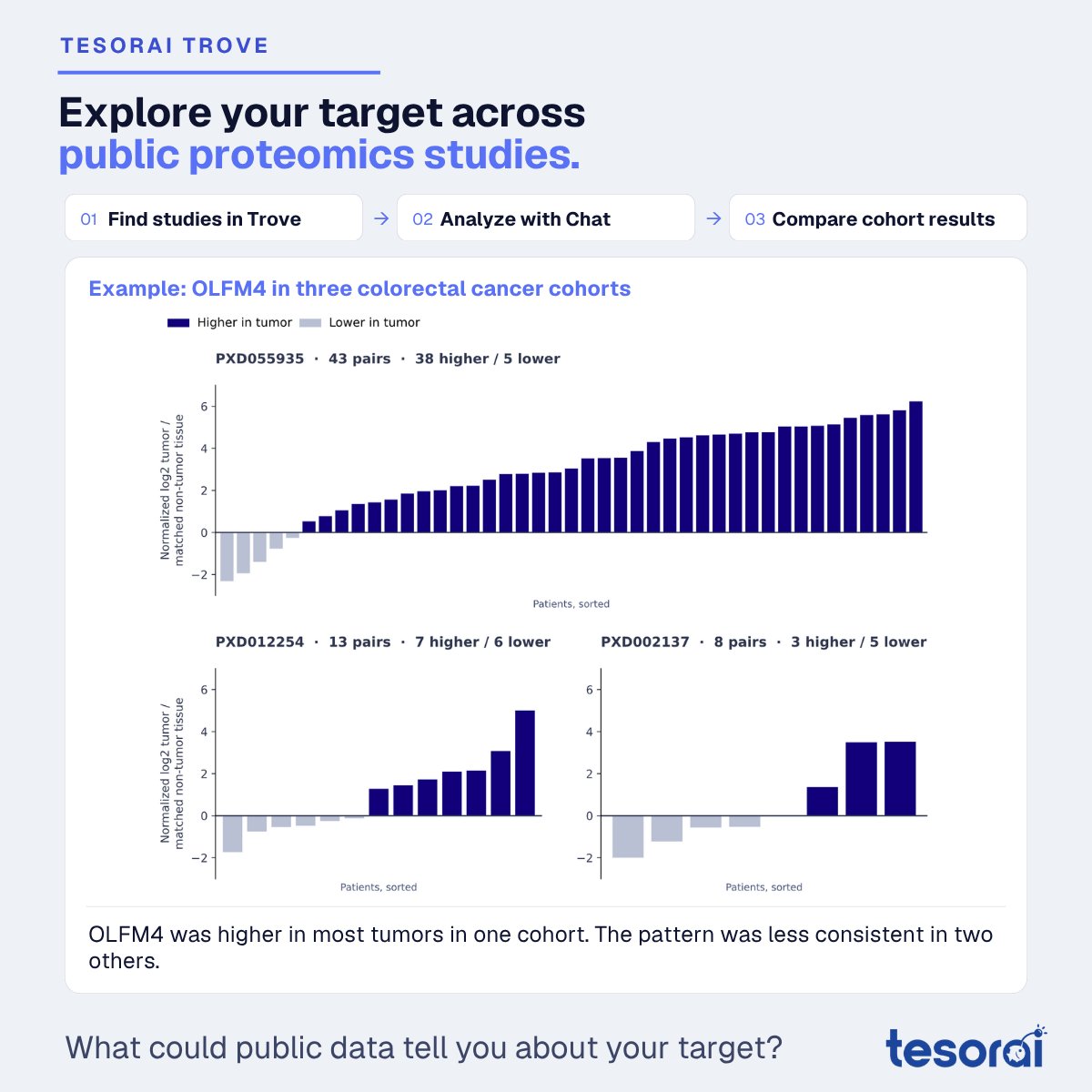
A positive average, but lower OLFM4 in tumors for 5 of 8 patients.
We used Tesorai Chat to examine paired differences and test how individual patients influenced the mean.
Go beyond the summary. Ask the next question.
https://t.co/xADkGKFP13
Your target may look different across cohorts.
We explored OLFM4 in three colorectal cancer cohorts: higher in most tumors in one, less consistent in two others.
Find public studies in Trove. Analyze with Chat.
https://t.co/tfHozmKiUo
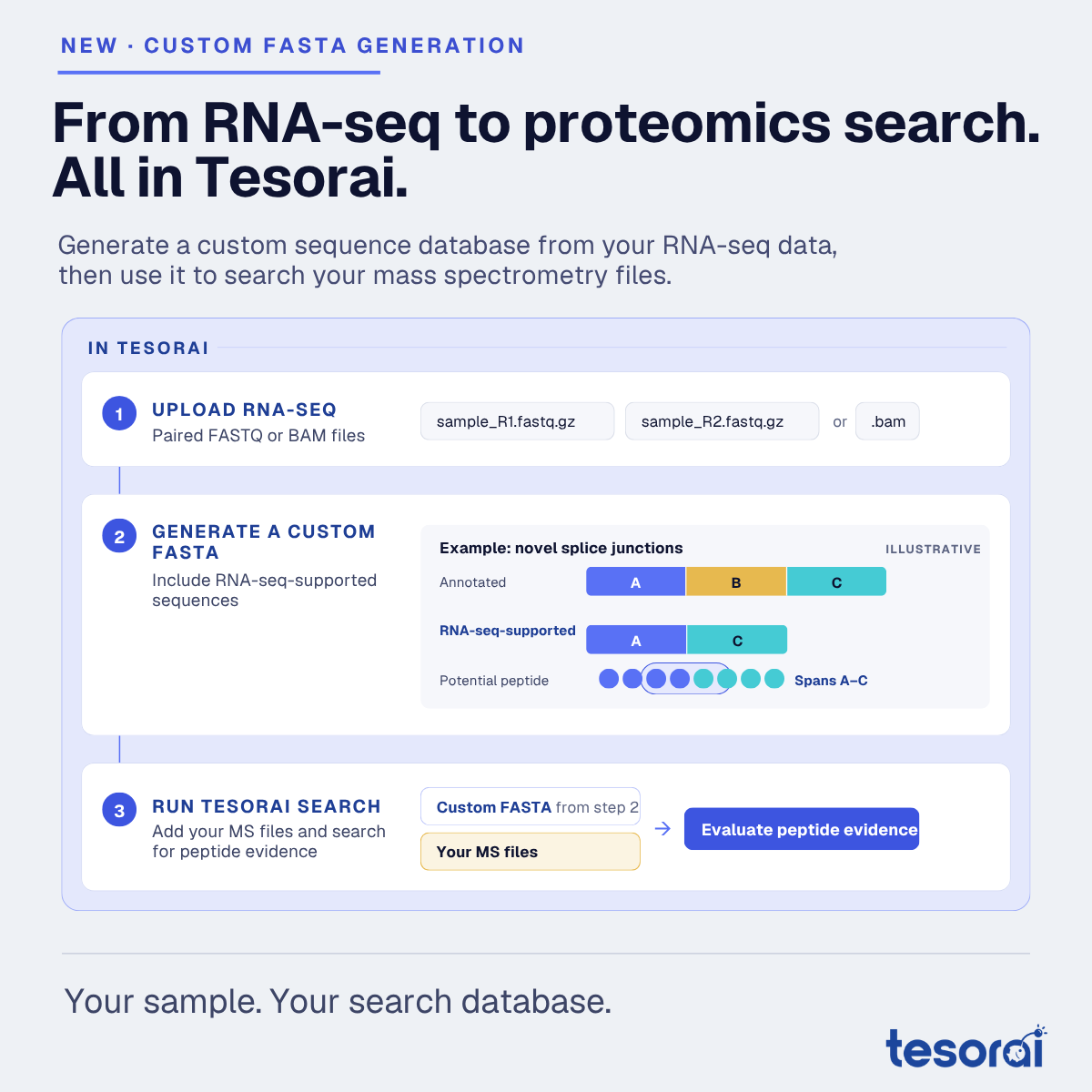
From RNA-seq to proteomics search, all in Tesorai.
Generate a custom FASTA with RNA-seq-supported sequences, including novel splice junctions, then search your MS data for peptide evidence.
Create an account and contact us for access:
https://t.co/tTEgqhzwRT
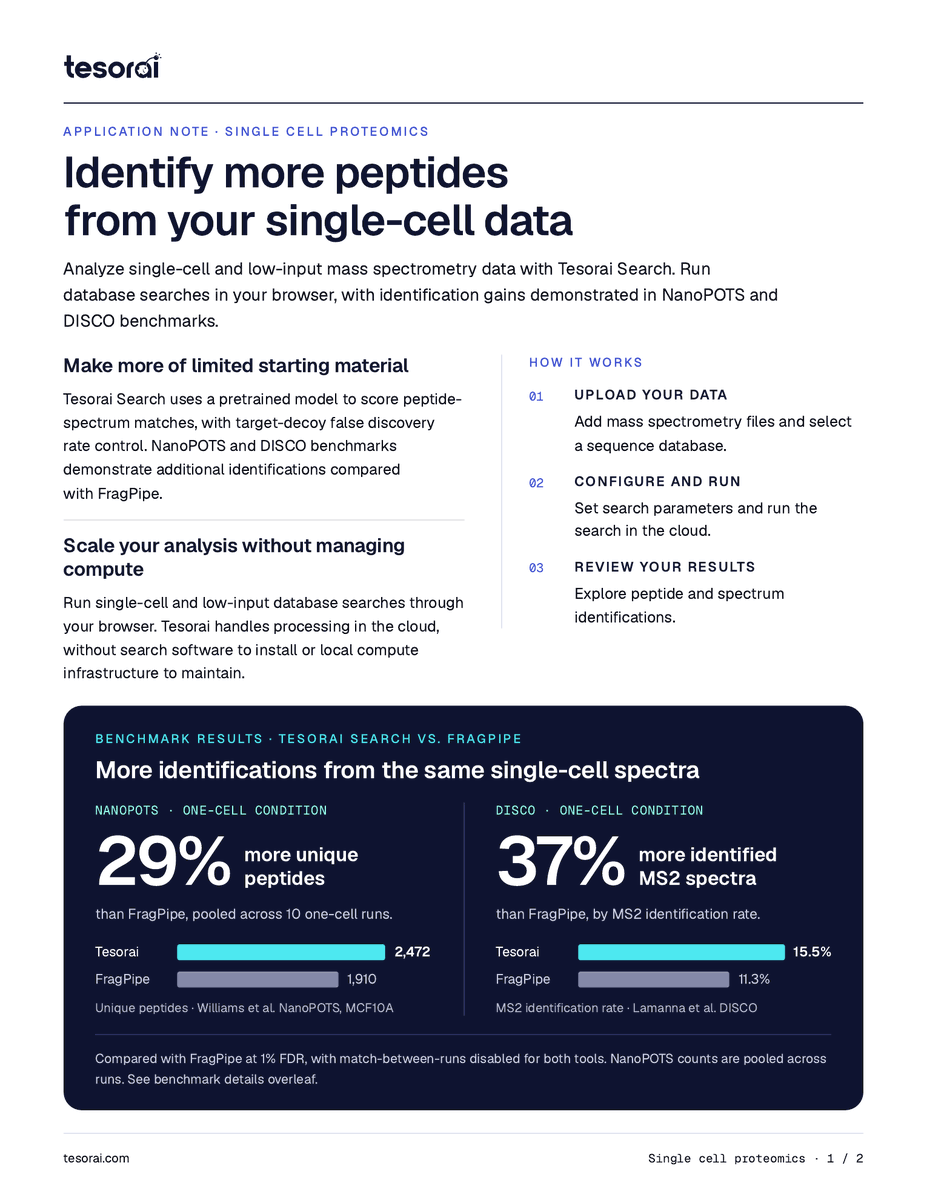
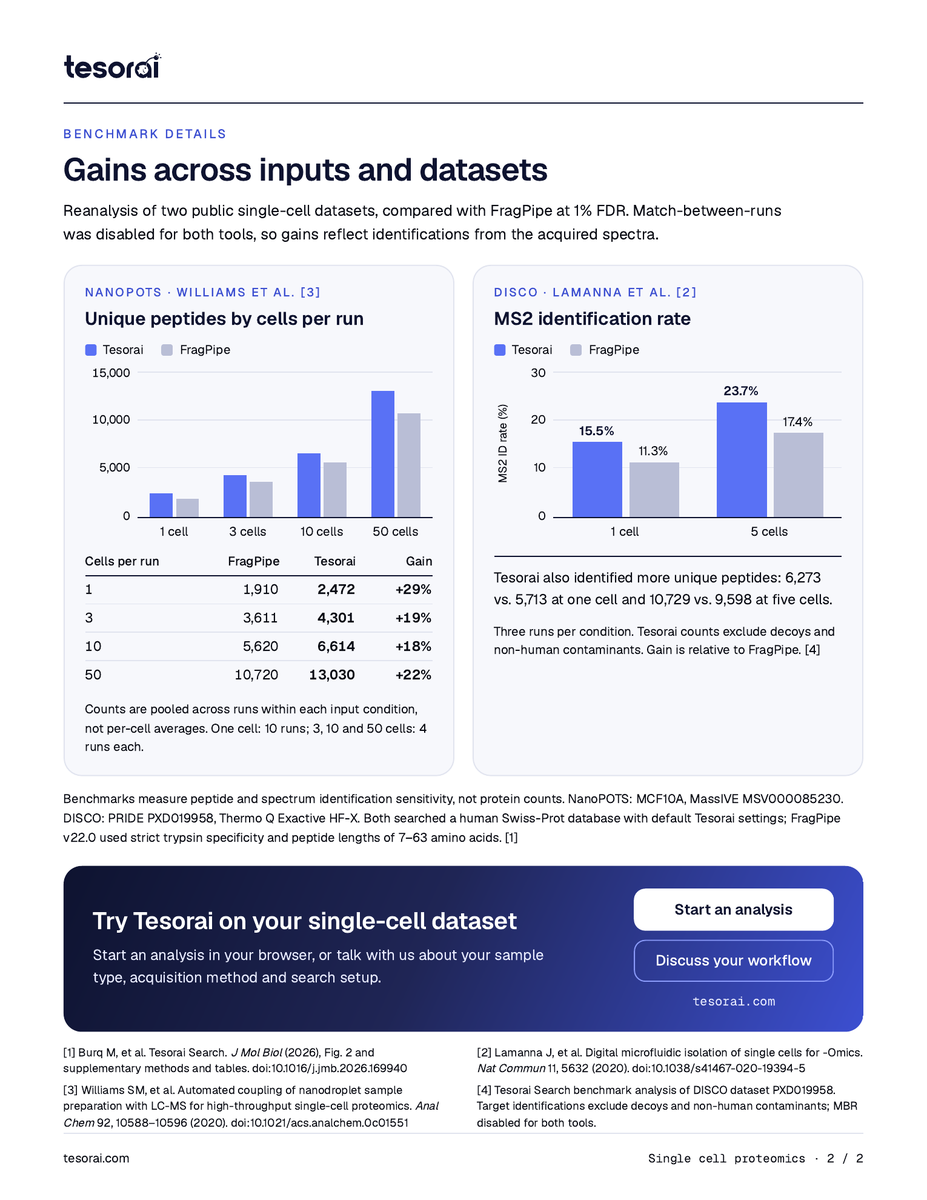
More from your single-cell spectra:
• NanoPOTS: 29% more unique peptides*
• DISCO: 37% higher MS2 ID rate
Vs. FragPipe at 1% FDR, MBR off.
*Pooled across 10 one-cell runs.
Read our new application note. Run searches in your browser:
https://t.co/PyEov8XVls
Which proteins differ between your groups?
Tesorai Chat’s analysis templates bring QC, missingness, and data preparation into the workflow before differential analysis.
Start with your question:
https://t.co/xADkGKFP13
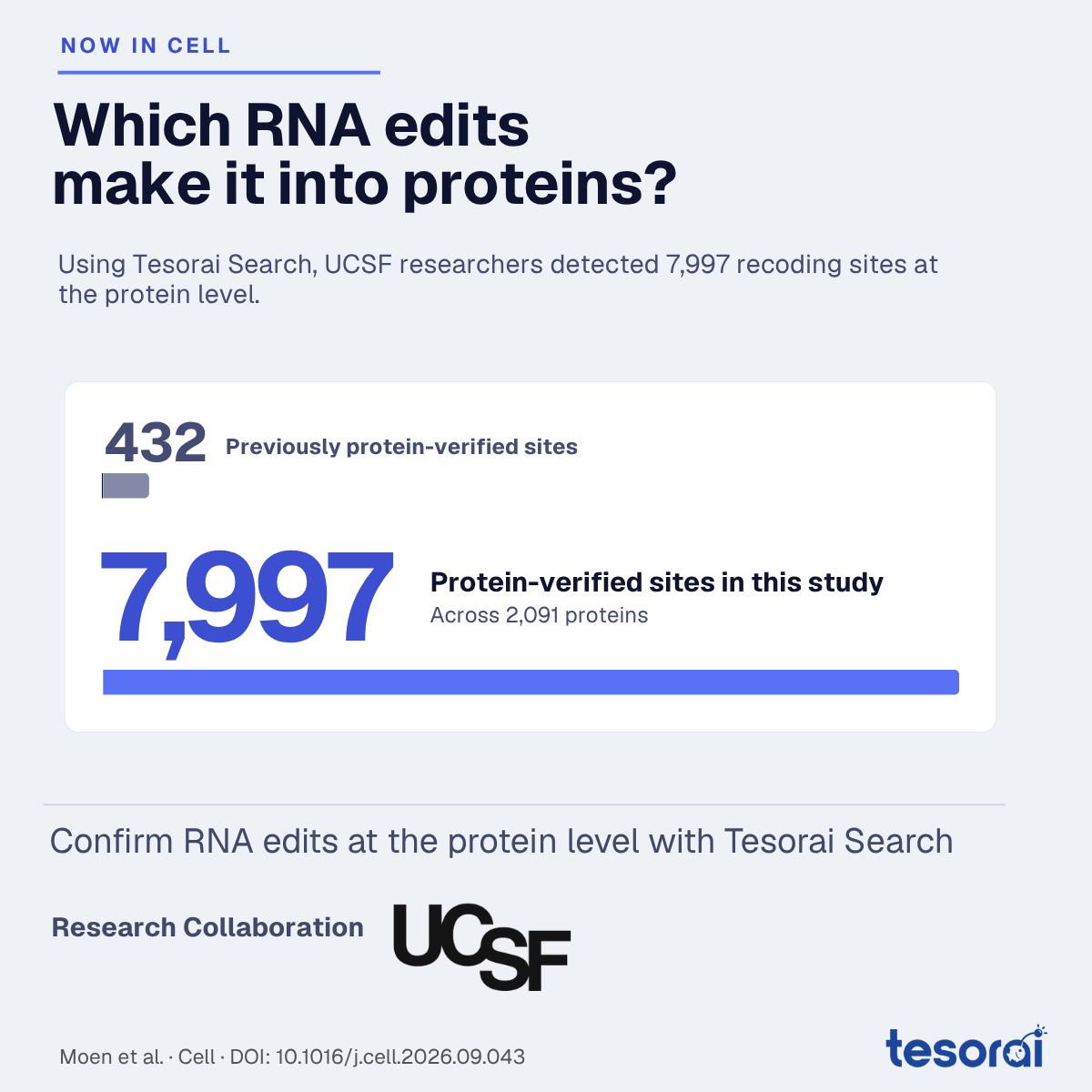
Which RNA edits make it into proteins?
UCSF researchers combined deep proteomics with Tesorai Search to detect 7,997 recoding sites across 2,091 proteins.
Congrats to @dlswaney and the team at @UCSF!
Now in Cell:
https://t.co/qIEWdM0m2U
You’ve found a protein change. Where else has it been seen?
Process proteomics data, analyze with natural language, and compare your findings with published studies.
See Search, Chat, and Trove in action.
https://t.co/tTEgqhzwRT
Gene knockouts. Expected protein loss.
Across a 17-gene knockout panel, nDIA + Tesorai Search no longer detected the target protein in nearly all corresponding KO lines.
A biological check on proteomics results.
Thank you to our collaborators at @UTMDAnderson and @cityofhope.
https://t.co/3aXWgWKoAx