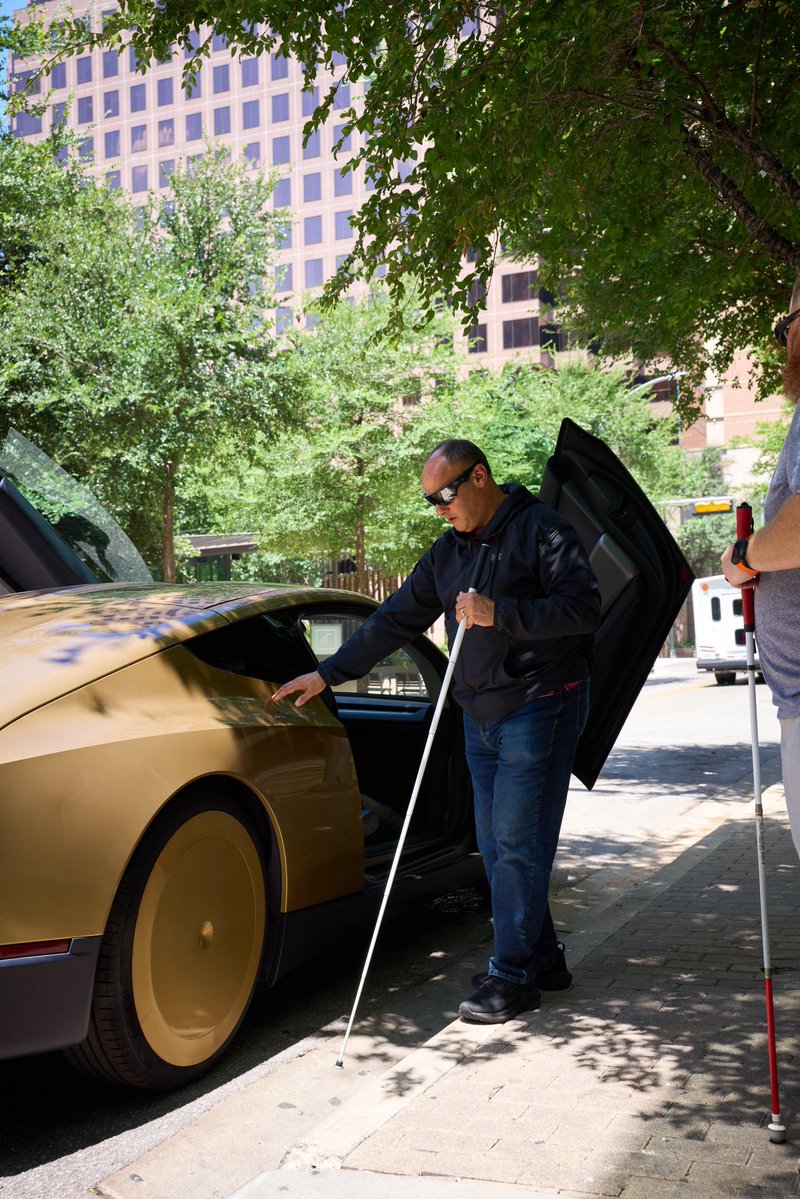
Blind/visually impaired people testing getting in and out of the Cybercab today.
Now we know a large dog can fit very comfortably in the footwell area lol
Nvidia CEO, Jensen Huang on why he always wears the same black jacket:
"Because it's the same color every day, it's always black. So every pair of pants in my closet's the same, every shirt's the same, every jacket's the same, and so there's one less choice. And because it's black, you don't have to decide whether it matches."
George Blankenship got so emotional sharing the story of early Tesla
The Model S was the first car from Tesla that was really meant for people to drive like a regular car
It was their do-or-die moment. The production line pushed the company into one of the most terrifying survival stories in startup history
10,000 people trusted and handed Elon Musk $5,000 each without a car or a guarantee - only a promise
The reality behind the scenes was grim. In Q2 2012, Tesla managed to deliver just 12 cars in an entire quarter. Wall Street was circling like vultures, waiting for them to die
With the company’s life on the line, Elon took a massive, unbelievable gamble: he publicly tweeted that Tesla would be profitable by Q1 2013
To pull off that miracle, Elon demanded exactly 4,750 deliveries. The standard he set was absolute. The pressure was so intense that George Blankenship was required to email Elon every single night at exactly midnight with raw survival metrics: how many cars shipped, how many were ready, how many were moving
By the final week, it was pure desperation and unity. IT guys were washing cars. Marketing guys were driving them across the lot. Under Elon's unrelenting drive, job titles vanished. Everyone did everything to keep the dream alive
Then, on the final Saturday of the quarter, at exactly 3 PM...
Car 4,750 was delivered
Blankenship stood on his desk, looked at his exhausted team, and told them:
"What you just did is monumental... not just for Tesla, but for what we're going to do for mankind"
Tesla shocked the world that quarter with an $11M profit. The stock violently surged from $20 → $90
They did not just build a company. They forged a foundation for the entire EV revolution
Intel is joining Terafab!
SpaceX, @xAI, and @Tesla are launching the most epic chip-building effort ever - combining logic, memory, and advanced packaging under one roof → https://t.co/512DIlqNgY
Revel Founder & CEO Scott Morton spent 9 years working at SpaceX / Starship for Elon Musk:
Biggest lesson?
"@elonmusk is really good at is asking engineers to go further than they otherwise would have."
i.e. Push past the first “no.”
- Avoid incremental thinking.
- Question every requirement & constraint.
- Force one more round of thinking.
- Breakthroughs often follow discomfort.
Ref: Walter Isaacson's Biography on Elon:
“1. Question every requirement.
Each should come with the name of the person who made it. You should never accept that a requirement came from a department, such as from “the legal department” or “the safety department.” You need to know the name of the real person who made that requirement. Then you should question it, no matter how smart that person is. Requirements from smart people are the most dangerous, because people are less likely to question them. Always do so, even if the requirement came from me. Then make the requirements less dumb.
2. Delete any part or process you can. You may have to add them back later. In fact, if you do not end up adding back at least 10% of them, then you didn’t delete enough.
3. Simplify & optimize. This should come after step two. A common mistake is to simplify and optimize a part or a process that should not exist.
4. Accelerate cycle time. Every process can be speeded up. But only do this after you have followed the first three steps. In the Tesla factory, I mistakenly spent a lot of time accelerating processes that I later realized should have been deleted.
5. Automate. That comes last. The big mistake in Nevada and at Fremont was that I began by trying to automate every step. We should have waited until all the requirements had been questioned, parts and processes deleted, and the bugs were shaken out.”
. . .
Scott Morton (@scottgmorton) Founder & CEO of Revel (@revelhq)
"Oh man, I have so many stories. But actually, there’s a good one here.
I think what Elon’s really good at is asking engineers to go further than they otherwise would have.
One of the most interesting examples was the first orbital flight of Starship. We had this maneuver to separate the booster from the ship. We called it the “twig snap.” It essentially looked like a twig snapping in space, and it was a very inefficient way to do it.
For the next flight, he was like, “We’re going to do hot staging,” which is where you literally start the Starship engines while it’s still connected to the booster and just blast off.
Coming out of that, we all thought, “Okay, cool. We’re going to do the same exact conceptual operations for the next flight. Of course. We’re just going to go nail it this time, right?” And he was like, “No, we’re going to do hot staging on the next flight.”
I was actually sitting outside. I wasn’t in the Elon meeting, but I was outside. I saw everyone walk out, and they were all just like, “Oh my God. How are we going to do this?”
That week, screenshots started getting shot around. I’m sure everyone was thinking, “Oh, this is going to be really difficult.” But then, throughout the course of the week, some really awesome ideas started coming up. It started to look more and more feasible.
Then it became, “How would you manufacture this? How would this all go together?” They ended up inventing, just out of nowhere, a new stage that would sit between the booster and the ship called the hot stage. It would take the blast, and then it would get ejected on reentry for the booster.
It worked first shot. That’s insane.
I just remember the vibes at SpaceX were like, “Oh my… how in the hell are we going to go do this?” But I think the big lesson there, and something I’ve pulled forward to Revel, is that when engineers come to you and say, “Hey, we just can’t get this to work. This is not possible,” you push them and say, “Well, why don’t you spend two more days thinking about it? Let’s see what comes up. And if nothing, we’ll think about it then.”
Engineers really underestimate their ability to creatively problem-solve and come up with new ideas they otherwise never would have thought of when they’re presenting what they think is possible in the moment.
I’ll say, “Okay.” They’ll say, “This just isn’t working. We don’t think this is a path.” And I’ll say, “Okay, let’s spend one more day thinking about it.” Oftentimes, there’ll be some breakthrough that no one saw coming.
I don’t know how someone hasn’t made a movie about this. There are just so many stories. I mean, early Starship, back in the Hopper days, it was like…"
John Carmack on what he admires about Elon Musk
Programming legend John Carmack is asked about his relationship with Elon Musk, to which he replies:
“In some ways we have a similar background. We’re almost exactly the same age, have backgrounds programming personal computers, and have even read similar books that have turned us into the people we are today.”
John first met Elon when he was building Armadillo Aerospace. Elon visited Armadillo with his right-hand propulsion guy, and the three of them talked about rockets.
“I think in many corners [Elon] does not get the respect he should for being a wealthy person who could just retire,” John says. “He went all-in, and he could’ve gone bust. There’s plenty of athletes or entertainers who had all the money in the world and blew it. [Elon] could’ve been the business case example of that with the things he was doing: space exploration, electrification of transportation, and Solar City type things. These are big, world-level things. And I have a great deal of admiration that he was willing to throw himself so completely into that.”
John contrasts this with the way he approached his own aerospace company:
“I was doing Armadillo Aerospace in this tightly-bounded way. It was ‘John’s crazy money’ at the time that had a finite limit on it. It was never going to impact me or my family if it completely failed, and I was still hedging my bets working at id Software at a time when [Elon] had been really all-in. I have a huge amount of respect for that.”
It also irritates John when people call Elon “just a business guy”:
“Elon was deeply involved in a lot of the [technical] decisions. Not all of them were perfect, but he cared very much about engine material selection and propellant selection. For years he’d be telling me to ‘Get off that hydrogen peroxide stuff. Liquid oxygen is the only proper oxidizer for this.’ And the times that I’ve gone through the factories with him, we talked about very detailed things like how this weld is made or how this subassembly goes together. He’s really in there a very detailed level . . . I worry a lot that he’s stretched too thin. He’s got the Boring Company and Neuralink and Twitter too whereas I know I have limits on how much I can pay attention to.”
John continues:
“I look back at my aerospace side of things, and I’m like, ‘I did not go all-in on that.’ I did not commit myself at a level that it would’ve taken to be successful there. And it’s a weird thing having a discussion with him. He’s the richest man in the world right now, but he operates on a level that is still very much in my wheelhouse on the technical side of things.”
Video source: @lexfridman (2022)
NEWS: SpaceX has just announced a game-changing partnership with Airtel Africa to bring @Starlink Direct to Cell to more than 170 million people in Africa across 14 countries.
Starting in 2026, the service will begin by delivering data that enables voice, video and messaging, and will advance to providing high-speed broadband service to smartphones with 20x improved data speeds.
Airtel Africa customers with compatible smartphones in regions without terrestrial coverage will have get game-changing connectivity through Starlink.
In a new interview today, Ron Baron explains what drew him to invest in @elonmusk and his companies:
"When it became obvious his cars were meeting very strong demand, we invested $400 million between 2014 and 2016. We’ve made about $8 billion on that so far.
In 2017, we began to invest in SpaceX. We’ve invested $1.5 billion so far, and that’s now worth about $10 billion.
What separates him apart? Young people are dying to work there. He goes into these meetings and, in any one discipline they’re working on, takes them into a room for a couple of hours.
He goes around and talks to everyone, asking them questions about what they’re doing. He keeps getting deeper and deeper, and then at the end of the meeting, people walk out of that room—especially first-time engineers—shaking their heads and saying, “Can you believe what we’ve just heard? I’m so glad I survived that meeting.”
The people who work there do so because they want to work with this person—Elon. What you've invested in is a company with a culture. He gives responsibility to talented people. He's not afraid to fail."
Will be a crazy transition - a bit like when the agents in the matrix hijack bystandars. Manually driven Teslas suddenly replaced with Robotaxi with an OTA
A hill I’m willing to die on: Listening to audiobooks on 2.5x speed so that you can flex on reading 100 books per year is foolish. It's much more impressive to read one book and be changed by it than to read 100 books and not feel a thing.