Cathie Wood taking her first Unsupervised @Tesla Robotaxi ride in Austin, Texas.
"The fact that I was talking to you the whole time and didn't pay any attention to the ride itself means that I think it's completely safe; I'm excited for Tesla. I'm excited for Tesla shareholders. I do think now, this slowly, slowly, slowly is moving into all at once."
Full video: https://t.co/deqpHRMJpm
A few days ago, I spoke with an older couple at a retirement community who drove their @Tesla Model Y from New Hampshire to Connecticut using FSD (Supervised) without a single intervention.
I also recently spoke with a 89-year-old woman who uses FSD for most of her driving, saying that it has had a hugely positive impact on her independence and ability to get out and do things.
Stories like these were almost unheard of not that long ago.
This week, I've seen more first-time FSD user reviews on my 𝕏 feed than ever from people who were completely blown away by it. Every week it seems that I'm reading more positive FSD reviews from the media as well.
We're also finally starting to see more and more countries get FSD (Supervised) approval.
Still a ways to go, but it really feels like FSD is going more mainstream than ever before and adoption is accelerating. Exciting times.
Anthropic and Google are now paying @SpaceX a combined $2.17 billon per month for compute capacity. That's a revenue run rate of $26 billion per year. BIG MONEY.
SpaceX has just announced that they have entered into a $920 million per month agreement with Google to provide compute capacity, according to a new filing.
"On June 5, 2026, we entered into a Cloud Service Agreement with Google with respect to access to compute capacity. The customer has agreed to pay us $920 million per month from October 2026 through June 2029, with capacity ramping up through September at a reduced fee. The compute capacity provided includes approximately 110,000 NVIDIA GPUs, CPUs, memory, and other related components.
After December 31, 2026, the agreement may be terminated by either party upon 90 days' notice. The customer will retain ownership of, and intellectual property rights in, its content, Al models, and related data."
Tesla has officially applied for an Autonomous Vehicle Network Company permit in Nevada.
Tesla is seeking approval for up to 5,000 robotaxis during the first 12 months after the permit is granted.
The filing covers Clark County (Las Vegas), including Harry Reid International Airport and Henderson Executive Airport, according to a new public notice from the Nevada Transport Authority.
Good news for long-term $TSLA investors who want @SpaceX IPO shares: E*TRADE says it has established a supplemental IPO share allocation process for Tesla shareholders who have held $TSLA shares in their account for at least 10 years and elect to participate in the IPO.
E*Trade: "Clients who meet this profile and are otherwise eligible to participate in the IPO in accordance with Firm and regulatory requirements and submit a COB will be eligible to receive allocations through this process, in addition to any allocations they may receive as part of the general allocation process based on overall demand and the number of shares available to the Firm.
If you elect to participate, please submit a COB through the usual process.
Please note that submitting a COB does not guarantee an allocation, and any allocation may be less than the amount requested or may not be received. This is not a solicitation or recommendation to participate in the IPO or otherwise."
E*Trade is emailing this message directly to long-term $TSLA shareholders right now.
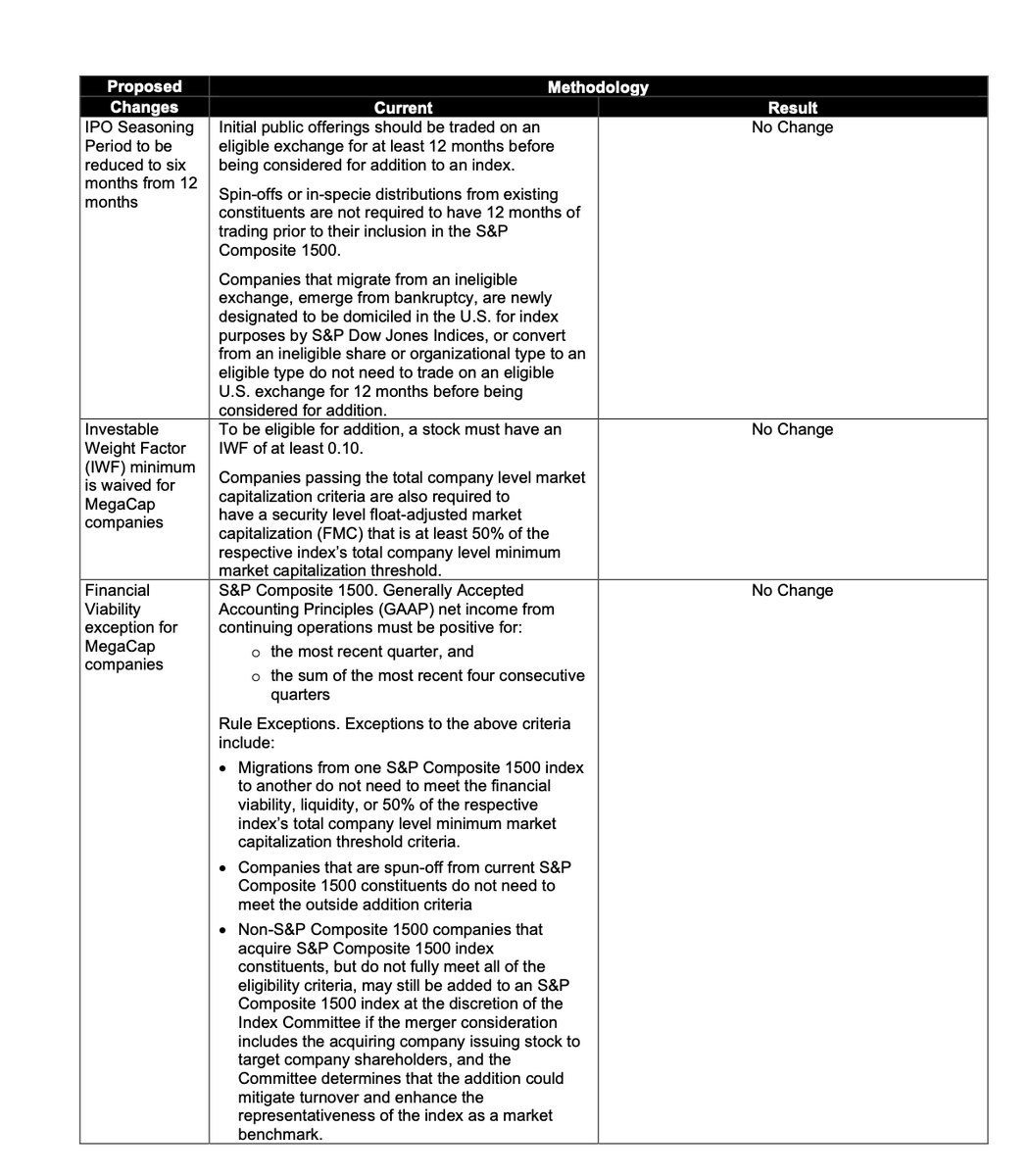
Wow, the S&P Dow Jones Indices has just officially announced that they will NOT be changing their inclusion rules to make it easier for “MegaCap” companies (such as @SpaceX) to be fast-tracked into the S&P 500.
Their reasoning:
"S&P DJI determined that exceptions to the financial viability, seasoning, and IWF requirements should not be granted solely based on market capitalization. The decision not to adopt the proposed exceptions preserves core index principles by maintaining consistent application of these key requirements. Although there may be trade-offs between strict adherence to these eligibility requirements and broad representativeness, the current methodology provides substantial market coverage and sector balance. As a result, the indices can continue to meet their stated objectives while preserving their role as representative and investable benchmarks for the U.S. equity market.
No changes will be made to the eligibility criteria including financial viability screens, seasoning period, or minimum IWF, for the S&P 500, S&P MidCap 400, or S&P SmallCap 600 as a result of the S&P Dow Jones Indices consultation on the treatment of MegaCap companies. Accordingly, there will be no changes to existing methodology for this index family."
This means that the earliest @SpaceX could be eligible to be added to the S&P 500 would now be June 2027.
The requirements that will now remain in place are:
• No changes to S&P 500 eligibility rules for mega-cap companies.
• Mega-cap companies will still need to wait 12 months after their IPO before being considered for S&P 500 inclusion.
• S&P will not waive profitability requirements for mega-cap companies. The company must have positive GAAP net income in the most recent quarter, and the sum of the most recent four consecutive quarters.
• S&P will not waive minimum public float requirements for mega-cap companies. At least 10% of a company's shares must be publicly tradable ("free float").
The S&P rejected proposals that would have:
• Reduced the IPO seasoning period from 12 months to 6 months
• Waived profitability requirements
• Waived minimum public float requirements
Tesla registered 5,111 vehicles in Germany in May, up 322% from a year earlier, according to data released by Germany's Federal Motor Transport Authority.
Tesla’s sales numbers across Europe in Q2 continue to look very strong. https://t.co/C4zeHmakE8
🚨 Tesla FSD is waiting for regulatory approval across a huge part of the world
During Ashok Elluswamy’s presentation at CVPR, Tesla showed pending approvals in:
• Europe
• Japan 🇯🇵
• India 🇮🇳
• Israel 🇮🇱
• Bangladesh 🇧🇩
• Thailand 🇹🇭
• Taiwan 🇹🇼
• Malaysia 🇲🇾
• Philippines 🇵🇭
• Saudi Arabia 🇸🇦
• UAE 🇦🇪
• Ethiopia 🇪🇹
• Colombia 🇨🇴
• Chile 🇨🇱
These regions represent roughly 36% of the world’s population. $TSLA
Tesla China's wholesale volume reached 85,982 vehicles in May, up 39% YoY and the highest number so far this year.
Cumulatively, Tesla is so far outpacing 2024 and 2025:
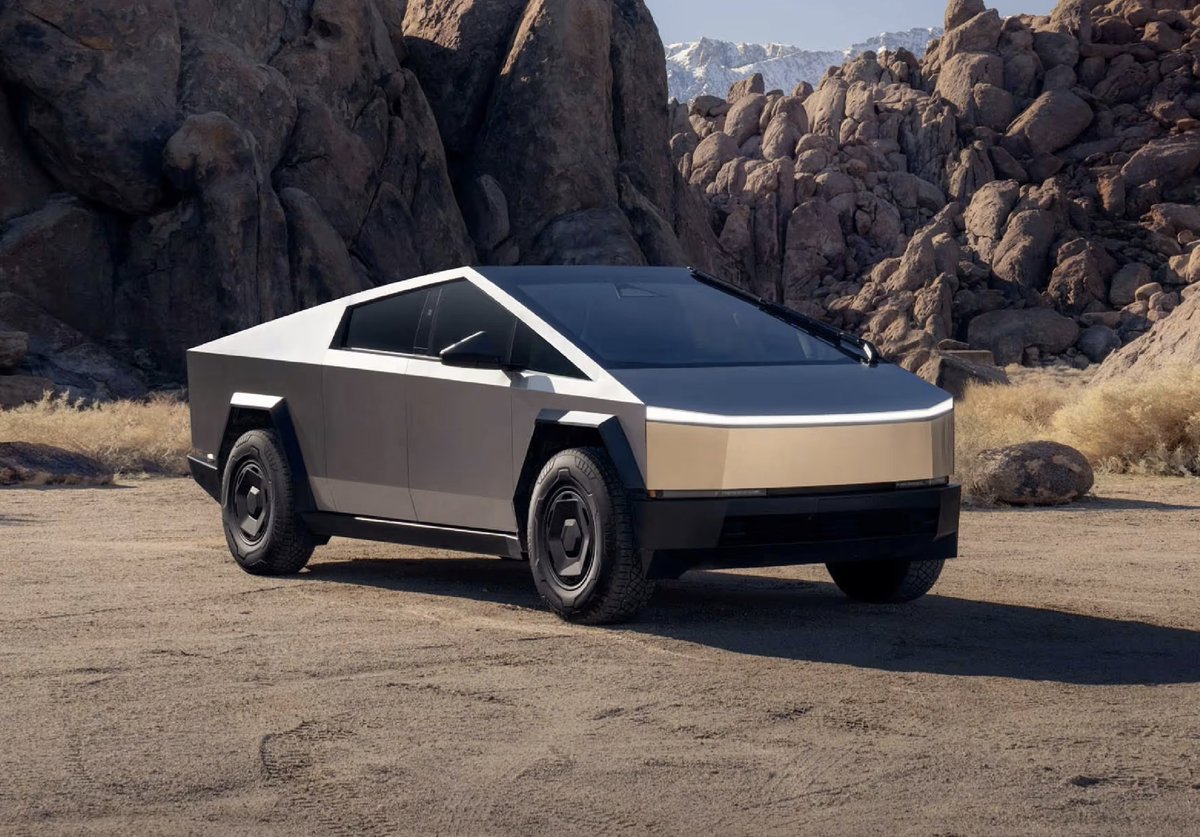
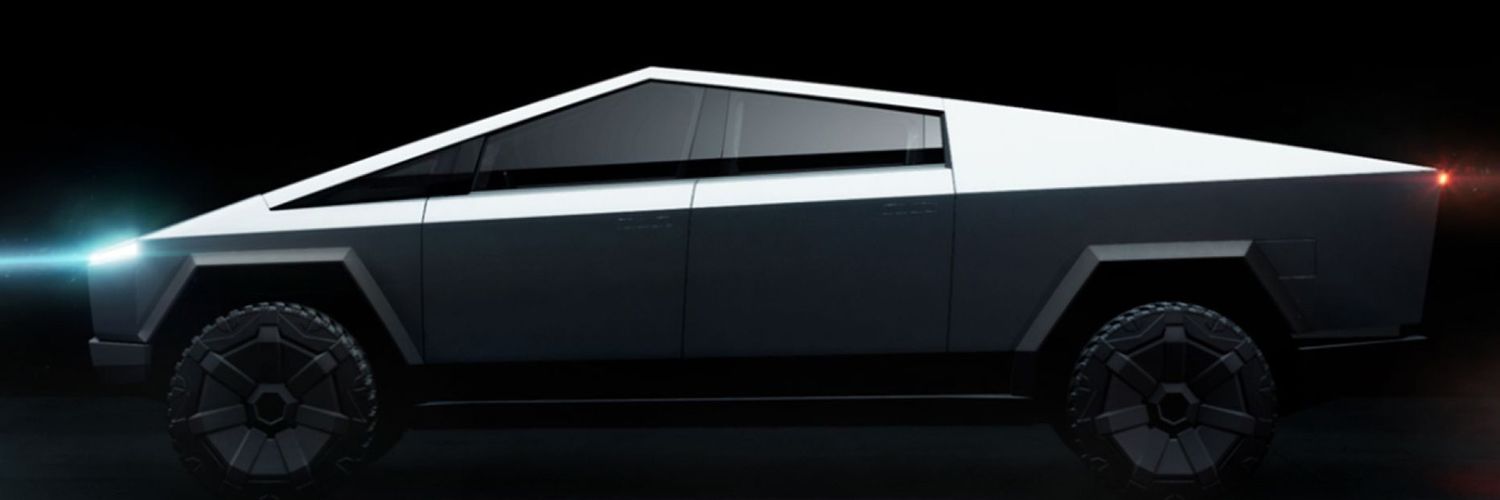
I can confirm that Tesla has officially started assigning VINs to people who initially ordered the $59,990 Cybertruck Dual-Motor AWD, which means first deliveries should start in the coming weeks!
• 325 mile range
• 7,500 lb towing capacity
• 0-60mph: 4.1s
• Bed with motorized tonneau cover
• Bed Outlets (2-120v, 1-240v)
• 325kW max charging speed
• Coil spring with adaptive damping
• Durable textile interior
• 18’’ Wheels with all-season tires
• 10" ground clearance
• Weight: 6,537 lbs
• Same 18.5" front center display as trims
Absolutely incredible value for all the people who ordered and locked in the $59,990 price.
Just went by Tesla’s proposed Robotaxi maintenance site in Irving, Texas today, originally spotted in permitting by @MarcoRPi1 🚕
-35,000 sqft warehouse remodel
-16 V4 Supercharger stalls
-212 vehicle storage spots
-Fleet dispatch, service, repair, cleaning, and charging
Robotaxi infrastructure is starting to get very real. $TSLA
Tesla planning a new 35,000 sqft maintenance facility for Cybercabs & Robotaxis in Irving, Texas.
Will include 16 V4 Supercharger stalls and 212 stalls for vehicle storage.
🚨 Tesla may be quietly building out massive Robotaxi infrastructure across the U.S. 👀
New permit filings reportedly show:
• A huge autonomous fleet depot near Dallas
• A dedicated Cybercab car wash/service site in Las Vegas
• Private Robotaxi-only Supercharger depots planned in Arizona
The idea: Tesla could be preparing for fleets of hundreds or even thousands of Robotaxis per city.
Big thing to watch now? Production ramp and depot activity. 🚀 $TSLA
As the recently expanded partnership with @AnthropicAI demonstrates, @SpaceX is offering AI compute as a service at significant scale.
We are in discussions with other companies to do the same.
Over time, especially with orbital data centers, we expect to serve AI at extremely high scale.
Here's a quick initial breakdown of some important parts I found in @SpaceX's 308 page IPO filing. Will keep digging.
Dual-Class Shares:
• Class A = 1 vote/share
• Class B = 10 votes/share
• The company plans to list on the Nasdaq under the ticker: SPCX
• Elon Musk retains majority voting control through Class B shares.
• SpaceX will qualify as a “controlled company.”
Q1 2026 financials:
• Revenue: $4.7B
• Operating cash flow: +$1.0B
• Net loss: -$4.3B
• CapEx: $10.1B in ONE quarter
• AI CapEx alone: $7.7B
• Total assets: $102B
• PP&E: $53.9B
• Cash on hand: $15.9B
Q1 2026 segment highlights
Space:
• 40 launches in Q1 alone
• 556 metric tons to orbit
Starlink:
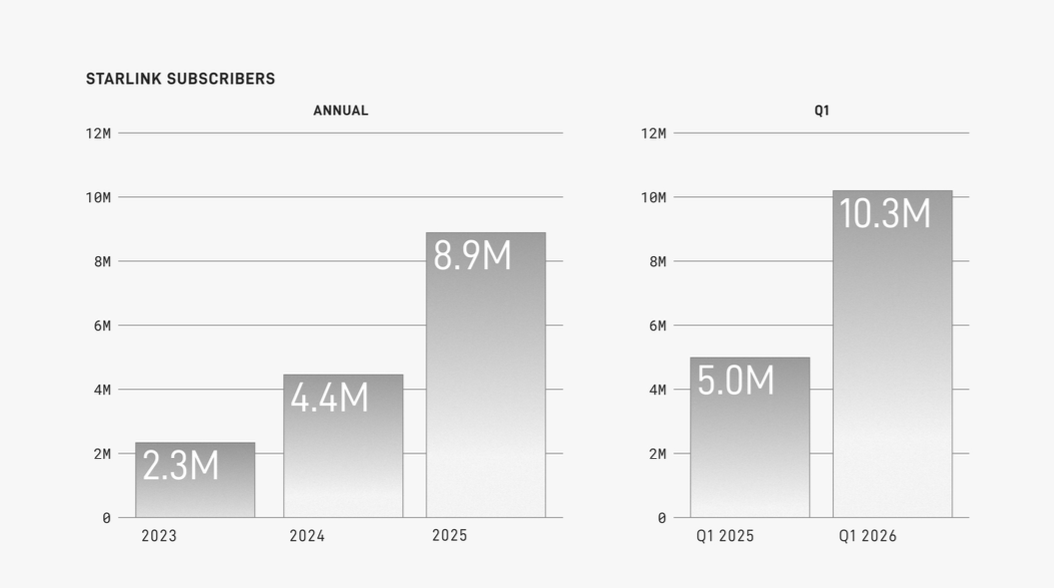
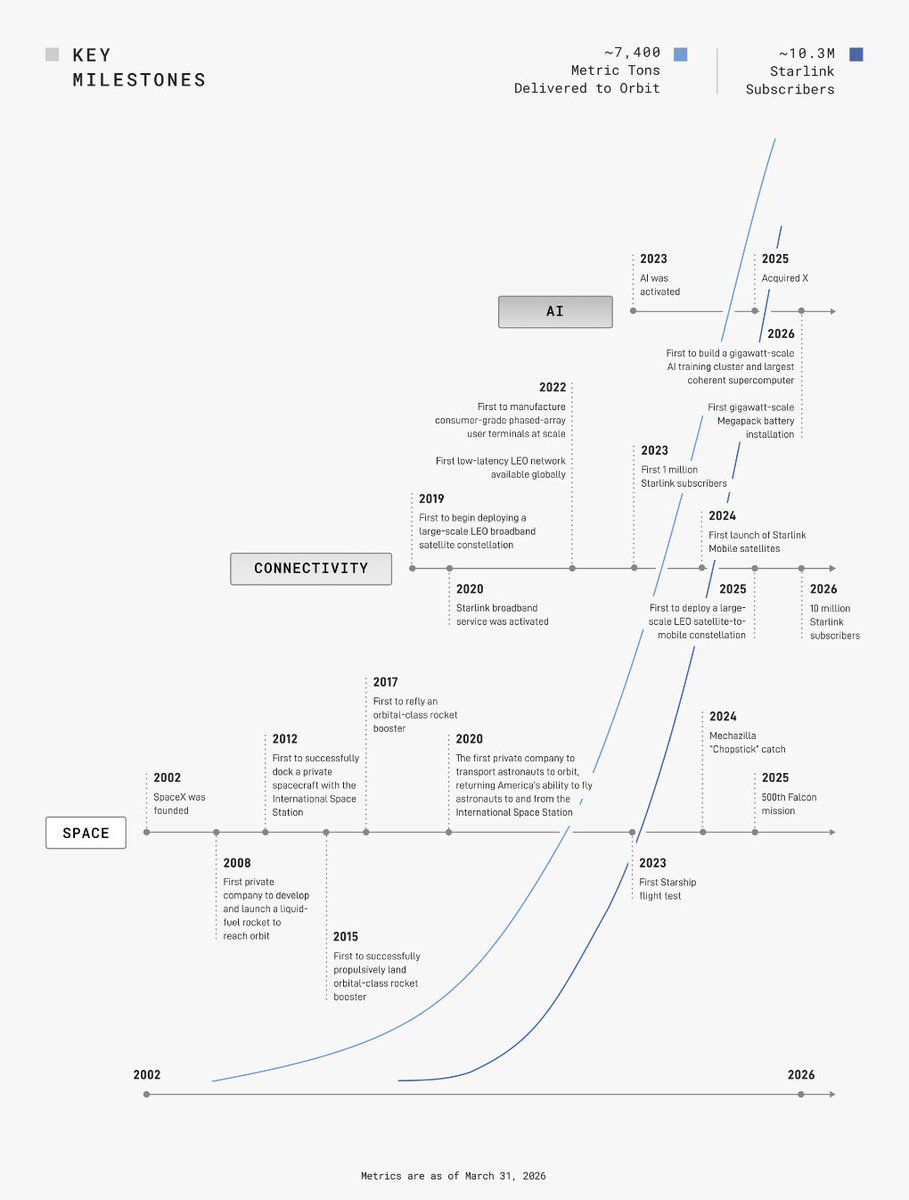
• 10.3M subscribers
• $1.2B operating income in Q1
• $2.1B adjusted EBITDA
AI:
• 1 gigawatt compute cluster
• -$2.5B operating loss in Q1 alone
2025 financials:
• $18.7B revenue
• $6.8B operating cash flow
• $20.7B CapEx
• $7.2B Starlink EBITDA
• $12.7B AI CapEx in 2025
• 1 gigawatt AI compute cluster by Q1 2026
• $53.9B in PP&E/assets like data centers, factories, launch infrastructure, GPU clusters, etc.
Anthropic has agreed to pay SpaceX $1.25 billion per month through May 2029 for AI compute capacity, with capacity ramping in May and June 2026 at a reduced fee.
Underwriters:
• Goldman Sachs
• Morgan Stanley
• Bank of America
• Citigroup
• J.P. Morgan
• Barclays
• Deutsche Bank
• UBS
• Wells Fargo
• RBC Capital Markets
• Mizuho
• Santander
• Macquarie
• Raymond James
• William Blair
• and others.