wow truly so blown away by her eloquence and articulation and her steadfast pure love and dedication to the art. I love how she picks out perspectives from trying different creative pursuits and blends it in to her writing.
R.F. Kuang has written seven books, won the Nebula Award for Best Novel, and trained at some of the world's top universities: Cambridge, Oxford, and Yale.
Her wisdom-per-word ratio is also off the charts.
Some highlights from our conversation:
1) Emotions are like colors. Mix them! Emotions are never one-dimensional. Bring together fear and courage, love and revulsion, joy and panic. This collision of feelings is closer to how emotion actually works.
2) Practice literary shapeshifting. Become a new person, a new persona, and a new type of author with every project. Do not confuse your habitual voice with your authentic voice: there is no single way of constructing sentences that must define you. Treat language as a fluid and flexible tool.
3) There's no correlation between how good writing feels in the moment and the quality of the product. We mistake effortlessness for genius, flow, or divine inspiration. So don't evaluate a day’s work by the pleasure of producing it. Judge whether the sentences escaped your pre-existing patterns and helped you think something through.
4) Good writing comes from being attentive to what's happening around you and writing with specificity about those observations, rather than relying on the theoretical. Throughout the day, ask: “Where is this feeling sitting in my body? How am I physically responding to this?” Those questions force you beyond the abstract label and toward something more specific than the reader could easily imagine for themselves.
5) Use your zero draft to discover the beating heart of the story, not to prove that you can already write it. Research, brainstorm, follow your nose, and collect whatever feels surprising or “crunchy.” At this stage, coherence is less valuable than emotional resonance.
6) Draft in layers. Let the early draft remain “balls on sticks.” Add the setting, architecture, faces, furniture, and drape colors in later passes. A person’s visual appearance is often the least interesting thing about them.
7) Use the outsider’s perspective to make language strange again. Nabokov could play, stretch, and innovate with English because he was fascinated by the oddities and opportunities of particular word combinations.
8) Be suspicious of “volunteer words for volunteer thoughts.” Volunteer words are the phrases that offer themselves immediately because they are already floating around in your head. They repeat common discourse and carry ideas that are easy to digest; you are filling the page from your pre-existing dataset rather than articulating something you have actually observed or thought through.
9) If you're stuck, put the subconscious to work. Open a blank document, type a title, word, or phrase, then save and close it. Return after the problem has had time to work on you in the background.
10) Serious writing doesn't require solemnity. Soaring observations about history or human nature can sit beside potty jokes.
11) AI can offer readily available words for readily available thoughts, but readily available thoughts do not push boundaries. It may reproduce impressive human patterns, but “you won’t get your next Pale Fire from an LLM.”
12) Thinking about the audience as you write a first draft is a death sentence. The moment you start writing while looking over your shoulder, you stop taking the story where it needs to go.
Timestamps:
0:29 Writing your emotions
6:44 Observing people
15:20 Why easy writing doesn't work
23:09 Building unique voices for each book
30:47 What Kuang learned from debate
32:52 Why primary sources matter
35:33 AI & writing
40:54 How to start a book
45:16 Trust your subconscious
50:25 Copy the writers you love
52:57 Being goofy
57:34 Find a driving question
1:01:36 What every writer needs to learn
01:04:38 Book and movie recommendations
I've shared the full conversation with R.F. Kuang below. If you'd rather watch the full thing on YouTube, or listen to it all on Apple / Spotify, check out the reply tweets.
Enjoy!
um sending this out into the void to see who replies but london friends, i have a crazy goal to have 100 coffee chats before I leave in December!! send people my way or drop a comment here :) dont be weird thanks!
Some letters are never meant to be sent.
In 1946, Richard Feynman wrote a love letter to his wife, two years after her death --He never sent it.
Last line: “I love my wife. My wife is dead.”
Falling in love with someone can teach us how we can be in love with everyone and everything.
When we are in love with someone, everything about them seems indescribably perfect.
But when we look deeply into what is happening there, we can see that the love that reveals their perfection is not in them but in us.
Our love is like a light we are shining on them, illuminating their lovely qualities.
But it is also the loveliness of the light itself that we are enjoying.
It is a great meditation to do when we are in love:
To meditate on the quality of the love, independent of the beloved.
To familiarize ourselves with it and see that it radiates from within us.
When we see that this light is shining from us, we can learn to shine it on anything.
In doing so we can learn that we do not love things because they are lovely.
But rather, what we love becomes lovely.
I do believe this is a large part of what we are here in this universe to do.
To learn how to recognize that light.
To learn that on the deepest level we are that light.
It is not our lover that makes us whole when we fall in love.
But rather it is the love that we love them with that makes us feel whole.
Because in it we catch a glimpse of our true nature, which is a love that is already whole.
If you ride the Seibu Ikebukuro line all the way to the end, you'll arrive at a station called Hanno. Transfer there and ride a couple stops further and you'll find yourself in the quiet exurban town of 高麗, Koma. In the small station plaza there are two bright red totem poles, topped with grinning, devilish faces, like demons popping up from Hell in periscope form to take a look around.
Towards the mountain there's a river, and beyond the river a field called Kinchakuda. At certain times of year it blooms with flowers, the same bright red color as the totem poles. If you get there in the morning, you might get to see the mountains partially wrapped in mist, like a wuxia fairy tale. Up the river there's a quaint vegan cafe called Alishan, which always serves the most perfectly brewed tea and a thick vegetable soup that's impossibly sweet and earthy.
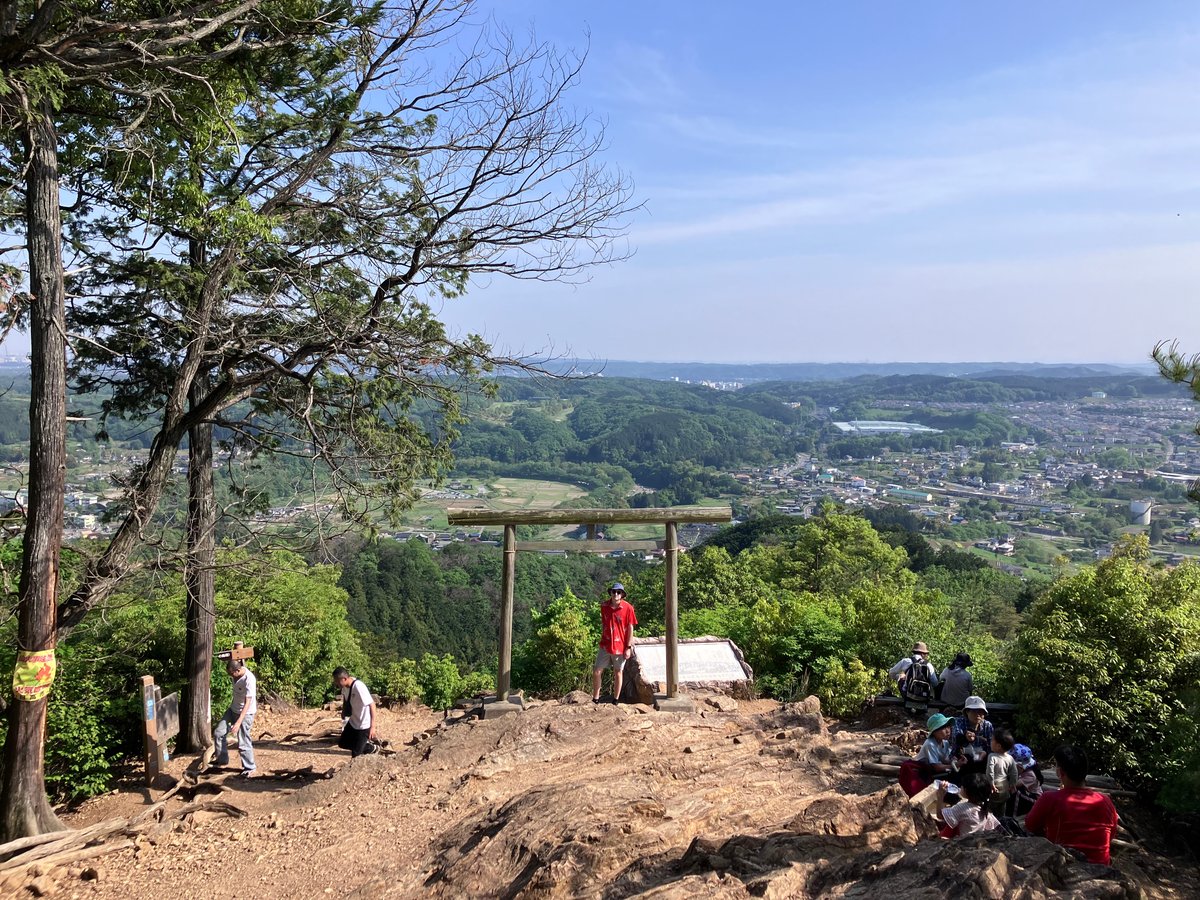
There's a small mountain 日和田, Hiwada, an easy climb from which you can see Mt Fuji to the SW and the Tokyo Skytree to the SE. Supposedly, on an exceptionally clear day, you can see Yokohama, although I never have.
If you take the long way down the mountain, through a network of paved roads and poorly-mapped trails, you'll come to this spot. It's deadly quiet: the mountain shields it from the wind, and the isolation shields it from human noise.
There's nothing remarkable about the town of Koma, or Hiwada, or this unnamed waypoint. It's beautiful, but it looks just like many other exurban towns of Japan. No doubt I've been to others that were more beautiful, more unique. Yet I keep returning here, to Koma Station, to Alishan, to the summit of Hiwada, to here, taking care to catch the posh limited express train with its cushy teddy bear seats and impossibly yellow interior. I can't articulate why. I just love it irrationally.
The last time I came here, I thought: the one I'm waiting for will love this place as much as I do. Maybe she comes here on the weekends too. Maybe I'll meet her here.
I played with the thought in my head, and drifted into a sort of fugue state. The kind where your eyes are open, but you aren't seeing, because you're deep in thought, and I realised I miss you. I miss your dog. I miss the smell of your shirts and your weird memory foam mattress that always made my back hurt. Last week when I was falling asleep with fever, laid up with delirium from some crazy Japanese bacterial infection, I hazily saw you laying next to me. We talked. We laughed. I wish I could remember what about, but I felt it was gonna be alright.
I know it was not gonna work between us. I know we had different goals and dreams, that we couldn't communicate, and maybe that was my fault. And I know there are billions of people on Earth, many of them like you. But I keep coming back to you, specifically, irrationally, because of course that's what love is. I can't decide if it would be more tragic if that feeling never went away or if one day it did.
A nearby bird called, echoing down the valley. In my meditative state it at first sounded like music, then the world comes rushing back into view. I'm not sure how long I've been standing here. You're not here. She's not here. Nobody's here.
I walked back to the station and took the yellow teddy bear train home.
people think they have a hard time making friends/lovers because of some shallow narcissistic reason and a lot of the time it's the fact that you aren't intentional, you don't show up, you center your avoidance or whatever other barrier you can name, and are socially awkward.
I went to the Japan trip I mentioned!!! This photo is blurry, but i feel like it represented the human aspects. It wasn’t a picture perfect shiny trip with only happy memories. This blissful moment was worth remembering - I spent a morning biking around and I felt truly myself.