There are a couple of universal patterns that show up across fields that you should apply to pretty much anything:
- Use a written process because memory isn't reliable (see aviation checklists, surgery, mise en place, SOPs...)
- Stop early when something is wrong (Andon cord, feature flags, turnaround time, error budgets...)
- Leave a buffer (Margin of safety, safety stock, taper, defense in depth...)
- Fix the system rather than blame people (Blameless post-mortems, poka-yoke, Swiss cheese model...)
- Get feedback fast (OODA, kaizen, canary releases, after-action reviews...)
- Hand over with a fixed format (SBAR, BLUF, commander's intent...)
- Ramp up gradually (10% rule, canary releases, position sizing....)
Craft’s latest update brings deeper Apple integration, better localisation, and more value to Plus at the same price. Watch the update video here:
https://t.co/vVQwrHrEb1
The beauty of reading "The Goal" or "High Output Management" every year is that you'll notice different things each time.
The books don't change. You do.
Like the first time you read "The Goal "you think it's about a factory. Then a few years later you realize it's about your calendar. Then later still you see it's about your own attention, and the bottleneck was you the whole time (it's always you).
The books are fixed points, and fixed points are how you measure movement.
What jumps out at you tells you where you are right now.
https://t.co/NTHUdzRKf4
So I’m learning Spanish and I have to say this is an excellent vocabulary building app. This is my 2nd foreign lang. & I’ve used a lot of tools & wish I’d had this earlier. Supports multiple languages, excellent AI reading.
I am not paid for this recommendation 🤓 @vocabuo_app
https://t.co/B8sZQTONO5
So I’m learning Spanish and I have to say this is an excellent vocabulary building app. This is my 2nd foreign lang. & I’ve used a lot of tools & wish I’d had this earlier. Supports multiple languages, excellent AI reading.
I am not paid for this recommendation 🤓 @vocabuo_app
https://t.co/B8sZQTONO5
You can finally edit any Markdown file without moving it into your vault! 🤗
Works for all formats Obsidian supports. Available with Obsidian 1.14.2 (early access).
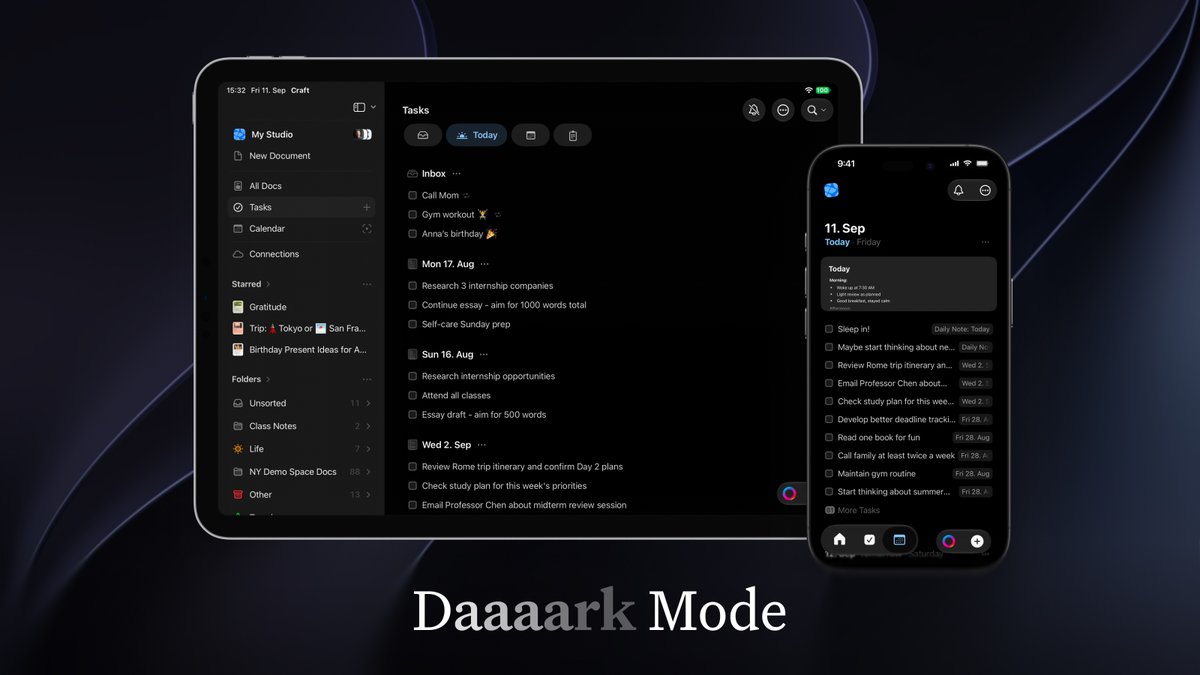
v3.6.5 is out with Day 1 support for OS 27!
- Optimised for the new OS, with performance and UX improvements
– Improved Dark Mode (also on older OS versions)
– Siri support: ask and update your docs and tasks
Major Shortcuts improvements coming soon!
https://t.co/KUetqVP0C5
New in Reader: you can now chat with your entire library!
Ask Ghostreader to search for you, quiz you on your reading, organize your docs, and so much more. It's fully agentic.
Your answers will reference exact passages in any [article/tweet/PDF/book/video/newsletter] you’ve ever saved.
Live now on web/desktop: https://t.co/fyCQKtIBg5
New version is out!
- In-doc Tag editing improvements
- Major revamp of colors, with completely custom colors
- Flexible Daily Notes export options
- Smarter Quick Entry
- and beautiful new CJK typography on Windows and Web (coming soon to native too)
https://t.co/V0L0l6hR11
Sneak peek: @craftdocsapp + Siri
As many of you asked, we are already working on a deeper Siri integration for OS 27. You will be able to interact with your docs and tasks.
Betas can change anytime, but we are excited how Siri feels already much more powerful than ever!