these 10 GPU optimization papers are why your model runs fast today
the engineers who actually read these are the ones who'll be writing your kernels in 2 years.
links to the papers below! 👇
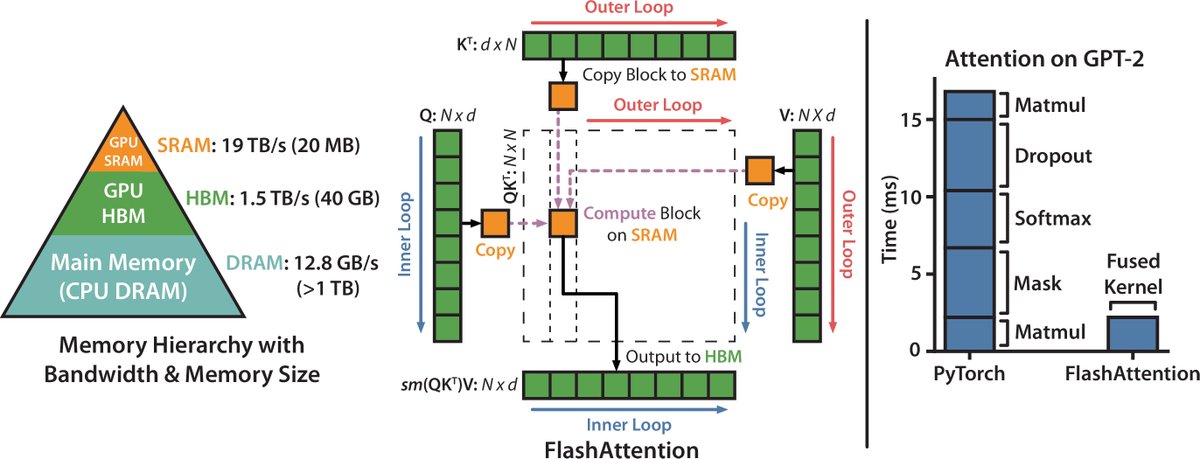
1. FlashAttention (2022)
• IO-aware exact attention: tiles Q/K/V into on-chip SRAM and uses online softmax to avoid materializing the quadratic attention matrix in HBM.
• an incredible example of how optimizing data movement can unlock longer contexts and faster Transformers.
2. FlashAttention-2 (2023)
• redesigns work partitioning across thread blocks and warps, improving occupancy while cutting non-matmul FLOPs and shared-memory communication.
• makes attention substantially better at actually using the GPU's compute capacity. around 2× faster than the original in the paper's benchmarks.
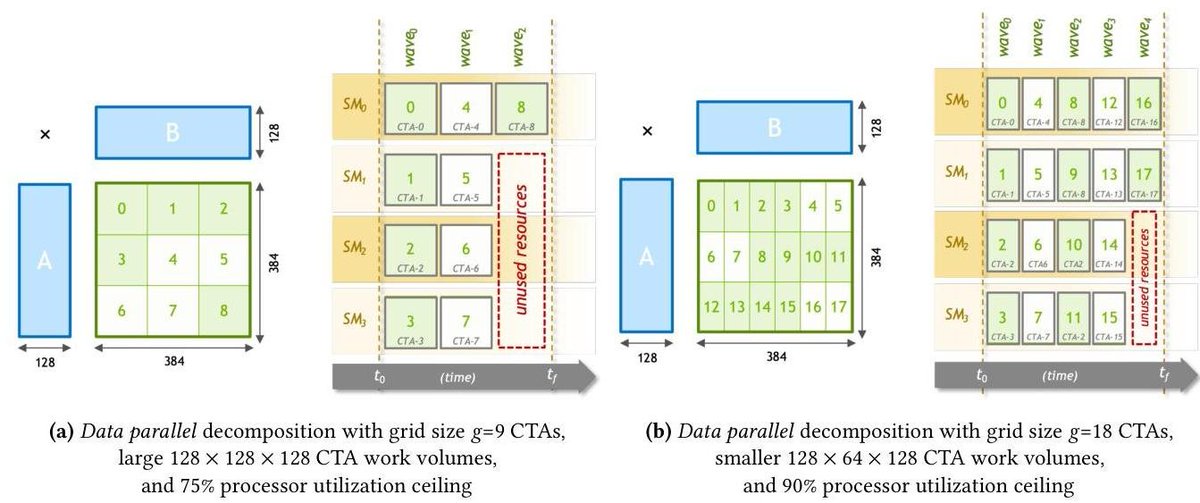
3. Stream-K (2023)
• partitions aggregate GEMM inner-loop work into balanced chunks, reducing the wave-quantization inefficiency of fixed output-tile scheduling.
• especially elegant for matrix shapes that would otherwise leave a partially occupied final wave of thread blocks.
4. PagedAttention (2023)
• brings virtual-memory-style paging to KV-cache management, with noncontiguous physical blocks and flexible cache sharing.
• foundational to vLLM: reduces memory waste so serving systems can fit larger batches.
5. FlashAttention-3 (2024)
• exploits Hopper's asynchronous Tensor Cores and TMA through warp specialization, overlapping data movement with computation and interleaving matmul with softmax.
• adds an FP8 path with block quantization and incoherent processing. serious hardware-algorithm co-design.
6. Tiled GEMM / Tensor Core dataflow (foundational technique)
• stages matrix tiles through shared memory and registers, reusing operands across Tensor Core multiply-accumulate operations.
• the foundation underneath so much of this list. a family of techniques, so this entry has no single canonical paper.
7. Online normalizer calculation for softmax (2018)
• updates the running maximum and normalization sum as elements stream through, reducing memory passes while preserving numerical stability.
• a beautifully compact building block for memory-efficient attention.
8. MARLIN (2024)
• combines low-bit weight storage with higher-precision computation, using asynchronous loads and carefully pipelined dequantization to feed Tensor Cores efficiently.
• makes weight-only quantization useful for batched inference, with substantial speedups extending beyond single-user decoding.
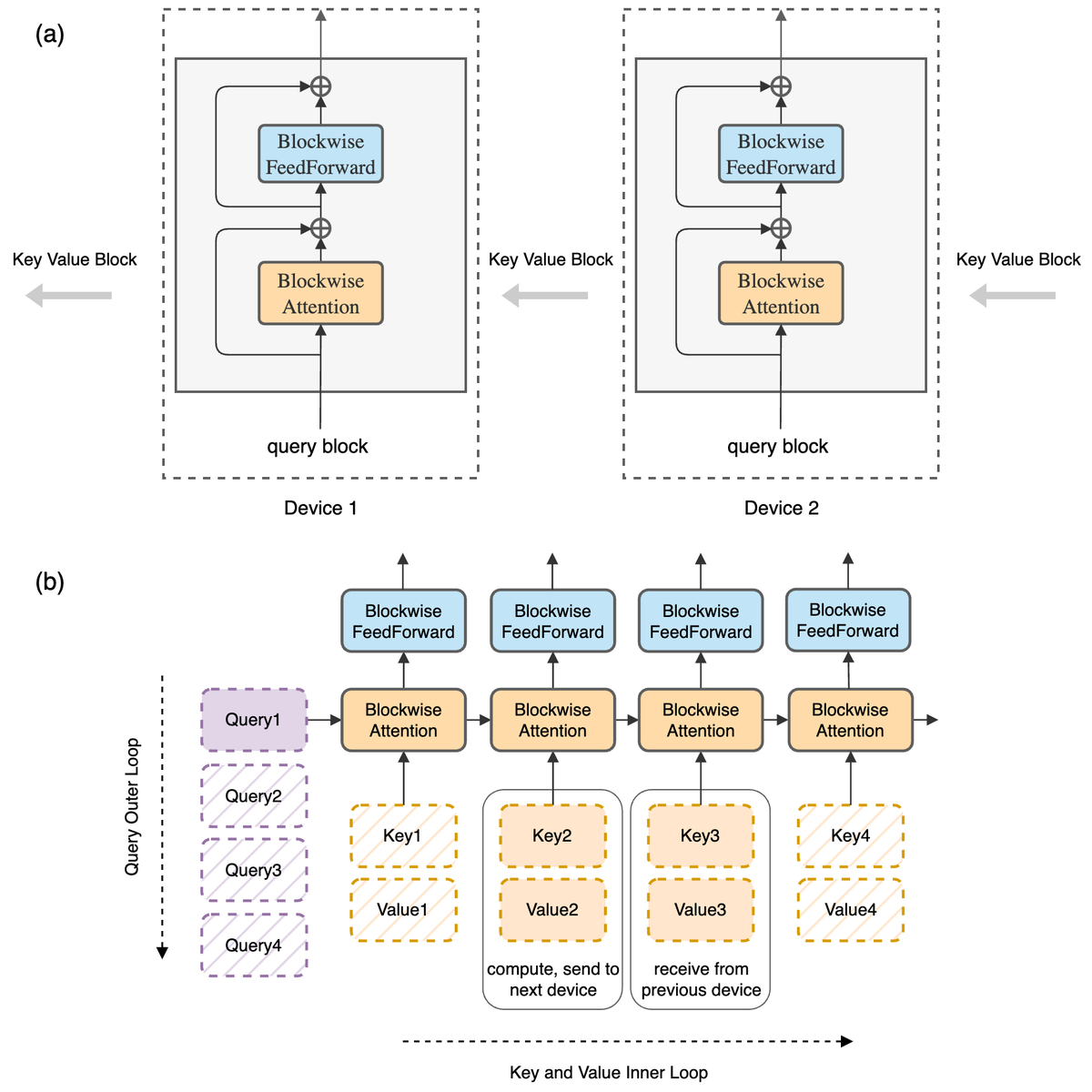
9. Ring Attention (2023)
• distributes sequence blocks across devices and circulates KV blocks in a ring, overlapping communication with blockwise attention computation.
• scales context capacity across GPUs while preserving exact attention.
10. FlashInfer (2025)
• combines customizable attention kernels with load-balanced scheduling for dynamic serving workloads and heterogeneous KV-cache layouts.
• tackles the messy inference conditions: variable sequence lengths and changing request batches.
links to the papers, same order:
1. FlashAttention
https://t.co/wkRORf0tRf
2. FlashAttention-2
https://t.co/v23kmebrGN
3. Stream-K
https://t.co/V8dldoTDZd
4. PagedAttention
https://t.co/mmtorgjXd8
5. FlashAttention-3
https://t.co/YCJDZJaDpS
6. Tiled GEMM / Tensor Core dataflow
no single paper. FlashAttention above is one concrete example of IO-aware tiling.
7. Online normalizer calculation for softmax
https://t.co/3zl1ZunPDJ
8. MARLIN
https://t.co/hvd8geyy8K
9. Ring Attention
https://t.co/eQfdn3EVhl
10. FlashInfer
https://t.co/bOLhjdPcvD
BREAKING: Cavaliers star James Harden was arrested early Saturday morning in Texas and charged with the unlawful carrying of weapons 🚨
Harden was caught with a handgun in his vehicle, and it was allegedly in plain sight and not being carried in a holster. It’s a misdemeanor charge.
Harden was released on bond, and he has a court date scheduled for June 22nd.
(via TMZ)