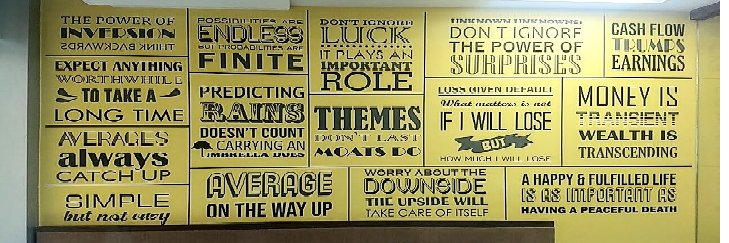
12 Learnings from 12 Years in the Capital Markets.
What follows is more of a ‘note-to-self’, rather than a blue-print of success. In fact, as the process of learning continues, these values will undergo refinement over time.
There are two ways to fail. First - you keep 'preparing' forever and never do the thing. Second - you jump in without prep and bail the moment it gets hard. Treat practice like it's the real thing, and treat the real thing like you've done it a hundred times.
#QOTD
"A tree that reaches the sky must first grow deep roots. The higher you want to rise, the more grounded you need to be."
- Thomas Chua
We celebrate what's visible (growth/scale/reach) but the real work is invisible (reps/habits/showing up).
#QOTD
Every relationship asks you to bend - that's just how belonging works. The question isn't whether to compromise. It's whether, at the end of enough compromises, you're still recognisable to yourself.
The goal was never to eliminate problems - it was always to earn better ones. The same applies to failures and addictions. The question isn't how to escape them. It's whether the ones you have are worth the trouble.
#QOTD
We treat happiness like a project - something to plan, pursue, and track. We set intentions around it and build routines to get more of it.
But the moment you become conscious of your own happiness, you're already outside it. The harder you chase it, the further it moves.
#QOTD
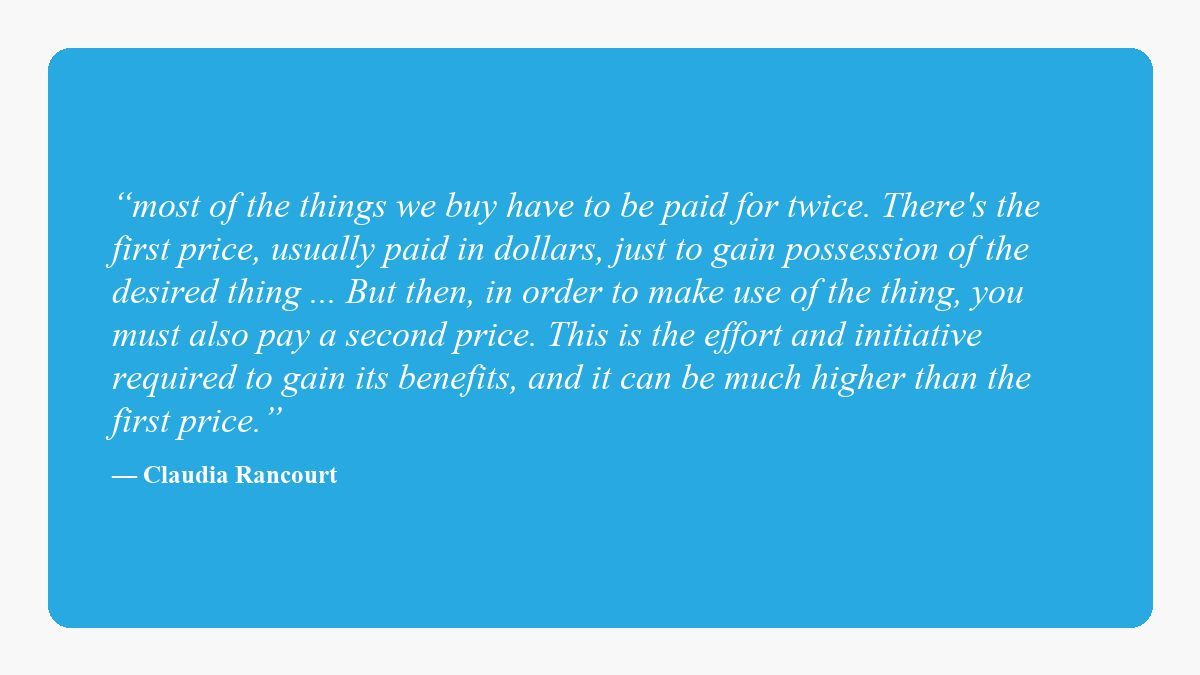
Books bought but never read. Gym memberships that expired without a visit. Courses started and abandoned.
The second price - time, effort, showing up - is paid in installments. Most stop early.
Ownership is easy. Use is where things get expensive.
#QOTD
"If you are depressed, you are living in the past. If you are anxious, you are living in the future. If you are at peace, you are living in the present."
— Jen Sincero
[You Are a Badass]
Most people live between two places at once - neither of them is now.
#QOTD
"We don't deal in absolutes. We deal in probabilities."
— Seth Klarman
Most people don't lose money because they're wrong. They lose it because they were certain. Certainty stops you from updating when new evidence arrives.
#QOTD
Most people optimise vertically - getting better at what they already do. The rarer path is building a second strength that multiplies the first. Talent is abundant; combinations are rare.
#QOTD
In India, most people are introduced to new systems through another person.
A bank manager helps update Aadhaar. A mutual fund broker explains insurance. A shopkeeper teaches UPI. A local agent makes the form less frightening.
The West over-indexes on DIY. India has always been mediated.
This is why many digital products fail when they assume the user wants independence. Often, the user does not want independence first. They want assurance. They want someone to say, "This is correct. Click here. Don't worry."
The middleman exists because systems are intimidating, language is confusing, consequences feel expensive, and trust is social.
Good Indian UX often has to replace the middleman.
That means clearer confirmations, human-like guidance, visible trust markers, assisted flows, easy reversibility, and language that reduces fear. The best interface in India is not always the shortest interface. Sometimes it is the one that holds your hand at the right moment.
A product team may think the broker is inefficiency. But ethnographically, the broker is assurance infra.
If you remove him without replacing the trust he provided, the user does not become empowered. They become abandoned.
Voyager 1 is 24 billion kilometers from Earth.
It communicates with us using a 23-watt transmitter.
Less than a refrigerator light bulb.
The signal takes 22 hours to reach us, traveling at the speed of light.
By the time it arrives, it's 20 billion times weaker than the power of a digital watch battery.
NASA's Deep Space Network picks it up using 70-meter dish antennas cooled to near absolute zero to reduce electronic noise.
The engineering required to hear a 23-watt signal from 24 billion km away is arguably more impressive than the spacecraft itself.
Launched 1977.
Still transmitting.
Still being heard.
We built something that works perfectly, 47 years later, in conditions no one has ever tested in.
That's what engineering for the long term looks like.
@Prashanth_Krish That's true. But personal finance is so much about fighting such biases, isn't it. Like I said, all this wisdom arrives a little late in life.
This is even more true in the Indian context. The extravagant Indian wedding is a financial disaster. Most people only agree when it's too late. Me included.
My hot take...
There is absolutely no reason why you should spend more than $5,000 on a wedding if you’re making less than $1M+ a year.
I literally got married in a parking lot wearing a $150 dress from Anthropologie with roses from the grocery store… and I was worth a few 8 figures.
The modern wedding is nothing more than a huge financial cosplay we’ve normalized for pure performance sake.
Most people done fail because of not knowing. They fail because they keep finding smarter-sounding reasons to stop doing it.The people who build remarkable things rarely do it by being smarter - they do it by staying in the game long after it stops being interesting.
#QOTD
Most people assume thinking is something that just happens to them. It isn't - it's something you do, or fail to do, deliberately. Attention is a skill. Like all skills, it compounds when trained and decays when ignored.
#QOTD