Also from this - @SanderTordoir & @Brad_Setser doing what generations before them couldn't, changing the German chancellor's mind on China
"A key factor in the Chancellor's change of course was, among other things, a research paper by economists Sander Tordoir and Brad Setser"
Delighted to tell you that Messy Jobs is coming out on June 21st. The kindle preorder link is available!
Here are advance reviews/blurbs for you to ponder by @raffasadun@davidautor@patrickc@alexolegimas@bengtmit and Evan Guo.
"Messy Jobs is a brilliant application of price theory. AI changes what is scarce in the economy and therefore what is valuable. When intelligence becomes cheap, judgment, coordination, trust, and responsibility become more valuable. The authors use this simple, powerful logic to illuminate how AI will reshape work and organizations." Bengt Holmström, Paul A. Samuelson Professor of Economics at MIT and recipient of the 2016 Nobel Memorial Prize in Economic Sciences
"In Messy Jobs, Garicano, Li, and Wu bring the discipline of organizational economics to a question too often left to speculation: How will AI actually reshape work? They move past the usual debates about what AI can or cannot do and ask the harder questions. What shapes the incentives to adopt it? How does adoption reshape the incentives to learn? What new configuration of skills will emerge as AI advances? A rigorous, original, and engaging account of how AI will reshape organizations and labor markets, and what it will take to thrive in them." - Raffaella Sadun, Charles Edward Wilson Professor of Business Administration, Harvard Business School
"This is the first book in the AI era that recognizes that most of what organizations struggle with does not involve computational problems. People in messy jobs must hold coalitions together, adjudicate between competing interests, and make change stick. These are political, diplomatic, and interpersonal challenges. As a result, these types of messy jobs will persist well into our AI future. Garicano, Li, and Wu, are neither techno-utopian nor techno-dystopian. They take seriously what machines can do, what humans will do, and how jobs will be rebundled. The economics analysis is lucid and penetrating, and the book pinpoints where human agency will remain paramount. The book is hopeful and practical for anyone charting a career in the coming decade." - David Autor, Daniel (1972) and Gail Rubinfeld Professor, Google Technology and Society Visiting Fellow, Margaret MacVicar Faculty Fellow, MIT Department of Economics
"This is simply a must-read book if you are interested in the future of work in the age of AI. For decades, Luis Garicano has been a leading voice in how organizations morph and change with new technology and innovation. Together with Jin Li and Yanhui Wu, they have written the definitive text on how AI will affect the labor market. The book is an impressive feat of combining academic rigor with clear explanations and concrete examples. I would recommend this book to anyone interested in learning about what comes next. "- Alex Imas, director of AGI Economics, Google DeepMind, and the Roger L. and Rachel M. Goetz Professor of Behavioral Science, Economics, and Applied AI, and Vasilou Faculty Scholar at the University of Chicago Booth School of Business
"There is a lot of woolly thinking on the topic of AI and jobs. This excellent book contains by far the most thoughtful and economically literate account that has yet been written." - Patrick Collison, CEO, Stripe
"AI is not going to lead to mass unemployment, and this is the best book to explain why not. It also illuminates how labor markets are likely to evolve. It is short, to the point, eminently readable, and of extreme relevance. ""- Tyler Cowen, professor of economics at George Mason University
"This book isn't just some economist's armchair theorizing; it's a practical guide. I hope you get as much out of it as I did. "-- Evan Guo, CEO of Zhaopin Group, the largest career development platform in China
https://t.co/L7UM3bHHYO
New post out!: The two Europes: why the security shock is deepening Europe's economic divide.
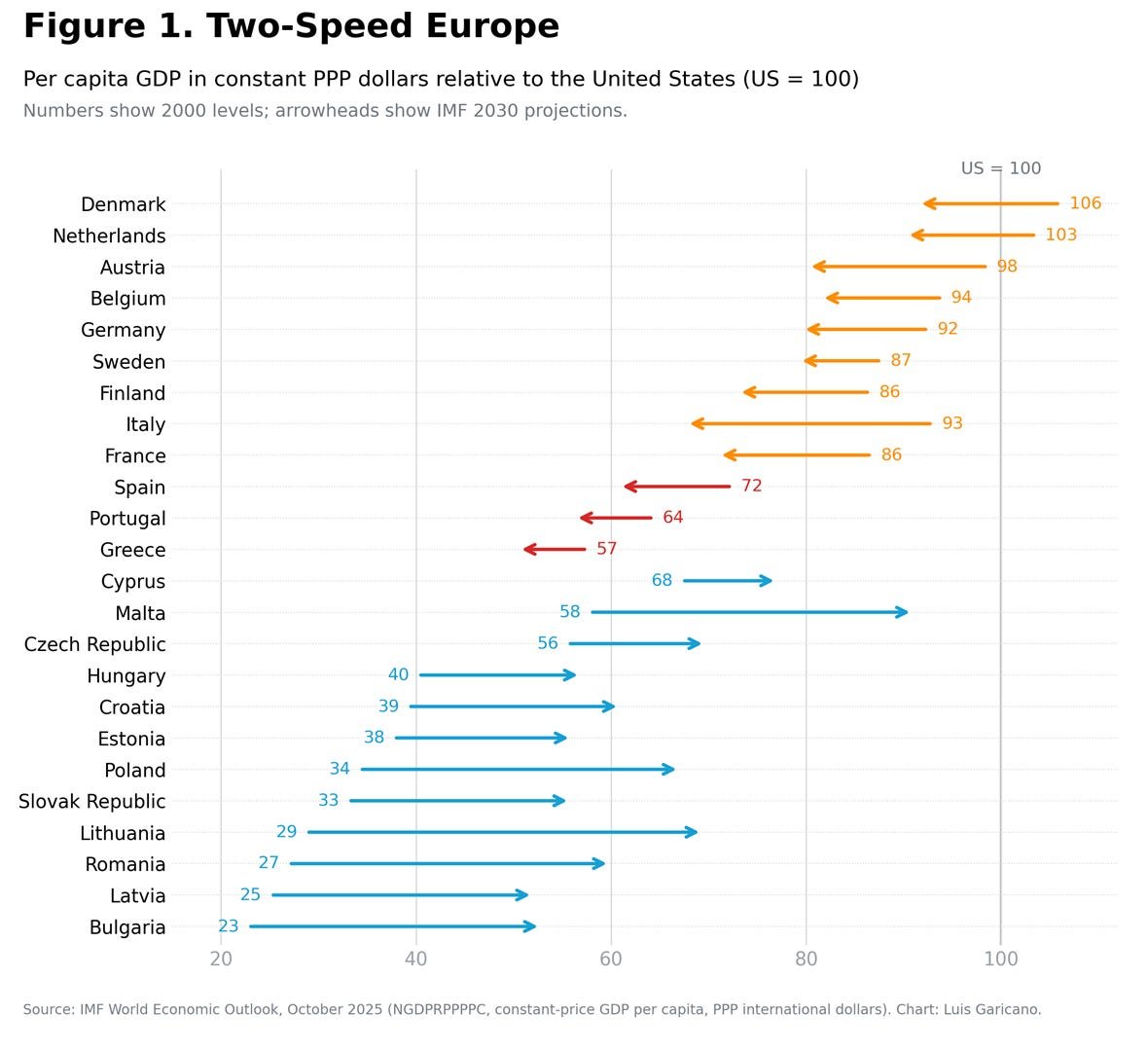
Europe is divided in two: the chart shows a positive convergence story and a divergence story. Poland went from 34% of US per capita GDP in 2000 to a projected 67% by 2030. Romania from 27% to 60%. France dropped from 86% to 71%. Italy from 93% to 68%.
The EU is not one economy moving slowly. It is two economies moving in opposite directions.
The hope after Draghi was that the Russian threat would supply the political urgency the rear of Europe lacks. The correlation is the wrong one. Our analysis shows the shock is mobilising the countries where the Draghi problem is not most severe, and leaving the rest largely untouched. War is reforming Europe's frontier. It is not reforming its rear.
New post with @OlivierKooi.
https://t.co/U04xw4aVOr
ASML, the only irreplaceable company in the AI ecosystem, is European. A beautiful article by @_neilhacker on how ASML got its monopoly and how the technology works. It leaves me wanting more--all the human stories behind. Someone write a book please!
https://t.co/81CRgals4f
As always I could not agree more with @lugaricano in the latest Silicon Continent blog on lack of capital in Europe
https://t.co/0Vg6dutZkf
We actually have an oped in the same vein with @andrepietri and Jean Tirole
https://t.co/lvVMu4fwYV
🇪🇺 Dans le cadre de notre partenariat éditorial avec @Whatsup_EU, notre expert @ChimitsF questionne la portée réelle de la doctrine européenne de sécurité économique. Changement de cap ou un coup d'épée dans l'eau ? Découvrez sa nouvelle chronique. ⬇️ https://t.co/KozPWPiZYH
Today in @Whatsup_EU, @ChimitsF of @i_montaigneEN digs into the @EU_Commission December communication on strengthening #EU economic security. Yet another paper or a welcome change?
https://t.co/oYihvGjP1E
La communication de la #Commission européenne sur la sécurité économique de décembre : nouvelle donne ou coup d’épée dans l’eau ? @ChimitsF de @i_montaigne pour @Whatsup_EU
https://t.co/0yy1KY1R7Z
Apollo just released a 121 page deck on US real estate and housing outlook
Some charts that caught my eye
🧵
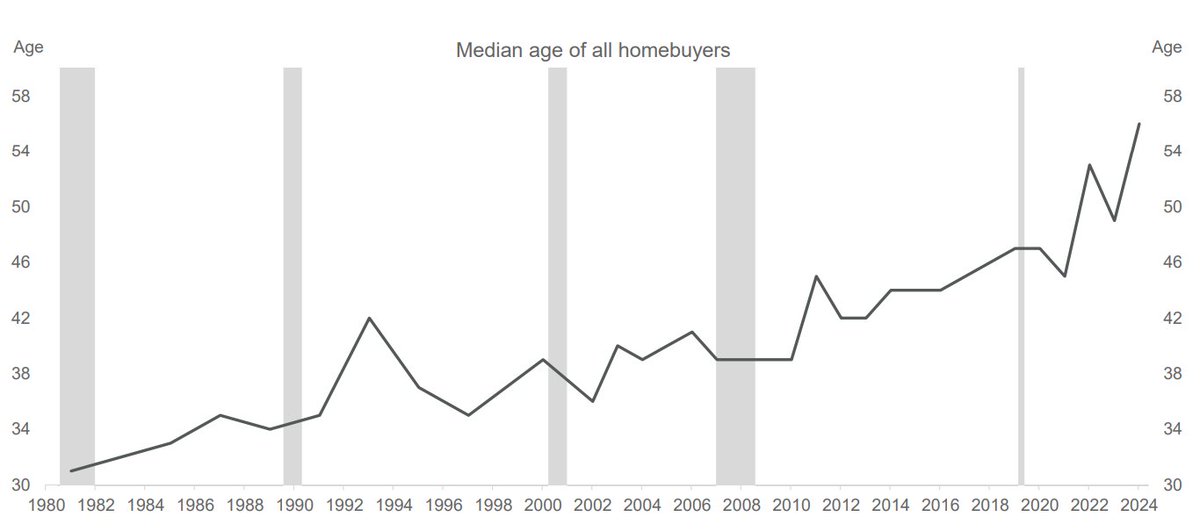
1/ Median age of homebuyers is now 56 years old, compared to 31 years old in 1981
The shift in the German fiscal position is great news. But, in the short run, it is likely to make life harder for other European countries. The induced slight tightening of monetary policy and the appreciation of the euro are likely to dominate the spillover effects from higher German activity. This graph from the model developed by my PIIE colleague Warwick McKibbin, showing the effects of a German expansion of 3% of GDP on Germany and other European countries, makes the point.
Annual government spending due to the new German fiscal package will be larger than the spending boom that came with the postwar Marshall Plan and with German Reunification in the early 1990s.
via @DavideOneglia
Cette semaine, on revient sur les inquiétudes de l'industrie automobile européenne — qui risque une sortie de route — et les réponses de @steph_sejourne. 🚗
Perspectives de @MathieuSolal 🖋️
https://t.co/goDYeDEgwZ
The Strategic Dialogue on the Future of the European Automotive Industry will be launched on 30 January.
Let’s engage with industry players, social partners and stakeholders to collaboratively understand the challenges and take concrete action.
↓ https://t.co/Ds7tAyGMfi
Three hours on Costco. Seven hours on Nvidia. Nine hours on Berkshire Hathaway. Why listeners can’t get enough of this podcast. https://t.co/mrbyJQpqap
For all the talk about work-shy and over-regulated Europeans, one of the key differences with the US has been fiscal policy. It’s really not that deep to see why the EU is falling into a cycle of weak domestic demand, depressed investment, and low productivity growth.
Draghi: "In part because of the mercantilist paradigm that privileged foreign demand relative to domestic demand, and in part because it was constrained by an incomplete single market, fiscal policy turned unduly restrictive, suppressed domestic demand and cut public investment."