What regional data tell us about the euro area Phillips curve
Anna Beschin @ecb, Joan Paredes @NBS_sk, Gaetano Polichetti @BostonCollege, Théodore Renault @Th_Renault@IMFNews
https://t.co/7yBJvq0322
In addition, firms may pass on a higher share of labour costs to consumers. The pass-through of higher wages into producer prices is typically very strong in the services sector, implying that profit margins would need to decline strongly for the baseline to materialise. 18/24
Important speech on inflation by @Isabel_Schnabel citing our work with @marco_jacopo and M. Ampudia on the wage-price pass-through in the EA.
The paper is now published as a ECB WP https://t.co/dyAbquIIvx
A policy note summarising the results will soon be published, stay tuned!
@Isabel_Schnabel .@Isabel_Schnabel lists several reasons why the baseline of gradual disinflation might go wrong, including sticky ULC, higher pass-through to prices, inflation expectations, or geopolitics. All calling for policy to remain "focused" and "robust".
Instead, the estimates hint at an important role for international competition in the domestic market for the tradeable sector.
They also suggest that the sales destination matters: wage growth contributes to domestic inflation for goods but not to export inflation.
The wage-price pass-through is significantly larger in services provided by the private sector and takes longer to fully unfold compared with the industrial sector https://t.co/ri5spCyhbV
How to explain this heterogeneity?
While a higher labour intensity is a key component of the pass-through, our estimates indicate that differences in sectoral labour shares alone cannot explain the larger wage-price pass-through in private services compared to industry.
The wage-price pass-through is significantly larger in services provided by the private sector and takes longer to fully unfold compared with the industrial sector https://t.co/ri5spCyhbV
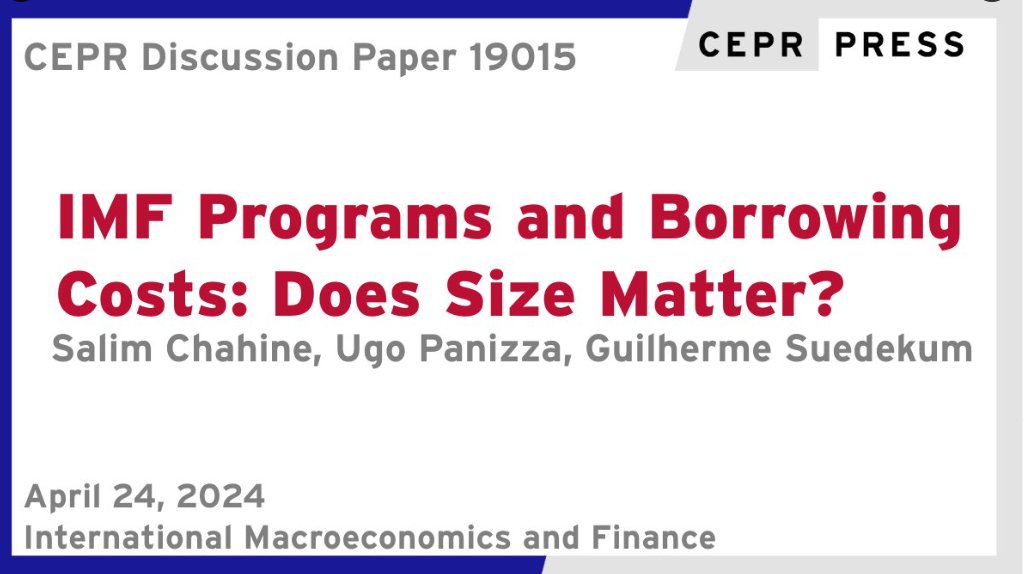
New @cepr_org paper with Salim Chaine & @suedekum on the effects of @IMFNews programs on borrowing costs
1/ We study the effects of #IMF program size on yield of bonds issued before and after IMF arrangements.
Let's dive in.
A short 🧵with links below
Today at the Annual Congress of the SSES, Théodore Renault, Ph.D. candidate in International Economics at IHEID, will present his paper "Heterogeneous Wage Phillips Curves: A Matter of Skills?"
#economics#wages#phillipscurve#research#SSES
Program: https://t.co/x3Fe5rebHG
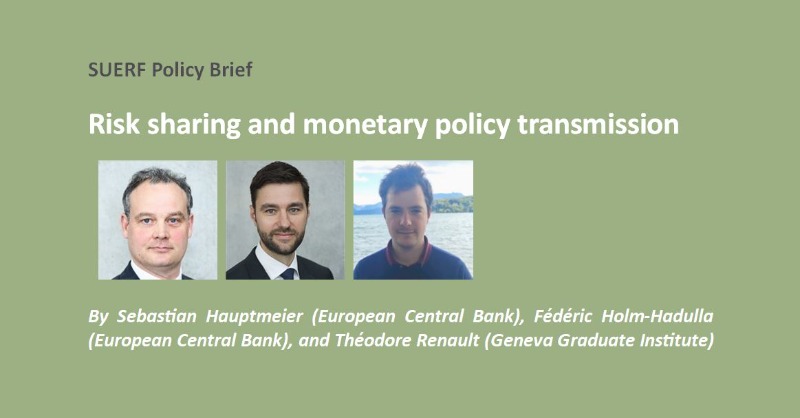
Monetary policy & risk sharing do not just operate alongside each other; the strength & composition of risk sharing fundamentally shapes the real effects of monetary policy & its regional incidence.
F Holm-Hadulla, S Hauptmeier @ecb, @Th_Renault@GVAGrad
https://t.co/iKDWQ0NniU
The entanglement of risk share & monetary policy transmission
•
This @voxeu column shows the strength & composition of risk sharing shapes the real effects of monetary policy, its regional incidence, timing
https://t.co/pxCLu7c4OE
Excited to see our paper (joint with @FHolmhad and S. Hauptmeier) on risk sharing and monetary policy transmission published in the ECB Working Paper Series! A thread⬇️