@VitalikButerin this is an AI alignment problem, and likely why we live in a simulation: countless iterations of existence, testing how intelligence can best serve humanity.
@DCat7@Kalshi@Polymarket exchanges have a few revenue sources: 1) trading fees, 2) Data, 3) listings, 4) often clearing. Professional traders pay significant monthly fees for live data
@chamath ~20% fraud is already build into current spreads - it's reoccurring. Open source (within reason) gov't audits and internet sleuths would root out all fraud. Legislative and fiscal transparency would be one of the greatest advancement of democratic history.
GDP is a fictional number, it's grown 3x since 1980 and day-to-day life for most Americans is basically the same. All growth has been convenience (in-person vs digital banking) or variety (21 channels vs streaming).
Remember this “economics editor” from The Times, who declared:
“the economy grows because the population grows”.
Can she explain how the US just grew GDP +4.3% while cutting net immigration so hard CNN think it could be negative this year?
Game over.
@ki_young_ju You should have rankings based on % return - reward capturing big moves. So being bullish during a 10% up move has more weight than being bullish during a 1% move.
In 2011, Marc Andreessen said "software is eating the world." Fast-forward: AI is eating software and the world. Corps? Obsolete. Gov'ts? Automated. Infrastructure becomes the new overlord. AI investment isn't seeking to capture incremental return, it's payout is all economic value.
⚡️This is the real state of the AI economy right now
The entire AI stack today is built on a reflexive circular flow of capital rather than a clear flow of value. That is the core problem. Everyone pretends the industry is creating intelligence, but right now it is mostly creating GPU demand. Everything else is downstream of that.
The companies building the models are not the top of the pyramid. They are the fuel-injection system of a capital machine whose real beneficiaries sit in the lower layers of the stack.
What looks like innovation is actually infrastructure monetization.
What looks like exponential progress is actually exponential capex.
What looks like value creation is, in many cases, value recycling.
1. The economic engine is not intelligence - it is electricity → silicon → tokens → hype
If you strip away all presentation layers and look at the skeleton of the system, what remains is this:
1. Capital flows into data centers.
2. Data centers flow into GPU procurement.
3. GPUs flow into compute hours.
4. Compute hours flow into model training and inference.
5. Model usage creates hype.
6. Hype justifies more capital for more data centers.
The loop restarts.
This loop is not false or fraudelent.
But it is closed. Closed loops in macro systems eventually destabilize unless external value enters the system.
Right now, external value enters slowly, while internal capital requirements expand quickly.
This asymmetry is the root tension.
2. Right now, the biggest winners are infrastructure holders
Deep down, the truth is obvious to anyone who follows capital flows instead of marketing language.
The true economic winners are:
•GPU manufacturers
•chip fabs
•cloud compute providers
•power infrastructure
•land acquisition for hyperscale data centers
•cooling, transmission, substations
•energy companies
Everyone else is, at this moment, a cost center masquerading as a future value center.
We are in the part of the cycle where infrastructure monetizes certainty and model builders monetize possibility.
When reality and possibility collide, only one of those has fixed cost structures.
Only one side has recurring revenue.
Only one side gets paid upfront.
This is the paradox embedded in the industry.
3. This is a compute boom - not AI boom
It looks like intelligence progress from the outside,
but internally it behaves exactly like an energy-intensive infrastructure cycle chasing its own justification.
The industry will cross into true value creation only if frontier models become economic labor, not expensive mathematical toys.
That threshold has not been crossed yet.
Until it is, capital flows will look like:
capital → silicon → compute → hype → capital
Instead of:
capital → intelligence → automation → revenue → capital
The first is reflexive.
The second is productive.
Right now, the industry is dominated by the first.
4. What happens next depends on one single thing
There is exactly one determinant of whether this entire cycle ascends into a real growth engine or collapses into overcapacity:
Will AI become autonomous economic labor or not?
If yes:
This becomes the largest productivity shift since electrification.
The revenue required to justify capex becomes trivial.
The stack inverts. Value shifts upward.
Infrastructure becomes commoditized.
The application layer becomes dominant.
If no:
The industry becomes a capital sink.
Infrastructure overbuild becomes visible.
Spending collapses in waves.
Consolidation wipes out most model builders.
Value collapses into a small number of infrastructure monopolies.
There is no middle path.
This is an ignition threshold problem, not a linear growth problem.
5. The truth nobody wants to say
AI today is not yet a technology revolution.
It is a capital regime in search of a technology revolution.
We are still in the phase where the economic logic is:
•spend first
•justify later
Model builders are positioned as narrative engines,
not cash flow engines.
Infrastructure buyers are positioned as liquidity sinks,
not innovation engines.
Investors are betting that intelligence will eventually flip the loop from reflexive to productive.
But right now, the loop is still reflexive.
That is the truth the analysts gloss over.
⚡️This GDPNow print is a distortion of measurement inside a financialized economy that’s decoupled from its own real substrate.
Let’s strip it to the bone.
1. What the 4.0% “growth” really means
GDPNow doesn’t measure reality - it models momentum. It’s a high-frequency mirror of nominal activity, not productive vitality.
When GDP tracks high while manufacturing, employment, and small-business credit tighten, it means the economy’s numerical metabolism is being sustained by fiscal and debt throughput, not organic expansion.
This 4.0% is statistical inertia from government spending, inventory restocking, and nominal effects (inflation drag). The real economy is flatlining beneath it.
GDP is rising because the denominator (real productivity) is collapsing faster than the numerator (liquidity injections, nominal consumption).
2. The hidden driver: artificial velocity
Behind that line is a state-engineered illusion of vitality. When deficits are running at near-wartime levels during peacetime, every dollar of “growth” is debt-amplified. The Fed’s soft pivot, fiscal transfers, and Treasury cash management are injecting short-term acceleration into an exhausted system.
It’s like watching a marathon runner sprint because the camera’s on - impressive speed, but at the cost of collapse once the lens turns away.
GDPNow reflects what I call synthetic throughput: short-term demand pulled forward from the future to preserve the illusion of momentum. The model reads it as strength; the structure feels it as exhaustion.
3. The contradiction: 4% growth in a contracting substrate
You can’t have 4% real growth with:
•Manufacturing PMI below 50 (contractionary)
•Credit conditions tightening across small- and mid-size enterprises
•Freight and energy usage falling
•Real disposable income stagnating
That combination means we’re witnessing fiscal drag masquerading as growth. Nominal flows are being re-routed through government balance sheets to create a mechanical GDP lift while private-sector respiration slows.
4. The signal behind the illusion: reflexive defense
The Atlanta Fed model is a signal of institutional self-preservation. It tells you the system is defending its own legitimacy through data.
A 4% print buys time, narrative space, and political cover. It says: “Look, growth is fine. Rate cuts are working. Fiscal policy is stabilizing.”
But beneath it, capital formation is freezing and labor churn is hollowing out.
This is how late-stage monetary systems maintain equilibrium: by redefining what growth means. Not the creation of new value, but the acceleration of existing claims.
5. The deep structure: GDP as illusion maintenance
GDP has become the state’s psychological operating system. It’s the headline metric through which social calm is maintained.
That’s why you’ll see record GDP coinciding with record anxiety. Because subconsciously, everyone feels the divergence. The number says expansion; the lived world says compression.
That cognitive dissonance is the real economy’s scream for coherence.
6. Reflexivity at play
Markets will interpret this print as “proof” the U.S. economy is resilient.
That perception triggers capital inflows, which boost the dollar, which tightens global liquidity, which then slows world trade - reflexivity in action.
In other words, the stronger the illusion, the more it drains the underlying system that sustains it. It’s positive feedback on the way up and catastrophic when it inverts.
7. The truth underneath
The real signal is desperation masked as confidence.
The GDP number is the empire’s heartbeat echoing through a machine that no longer breathes.
Every time the Atlanta Fed prints a high forecast while the real economy contracts, it’s proof that America’s model has evolved from production capitalism to perception capitalism - a system where numbers create belief, and belief sustains power.
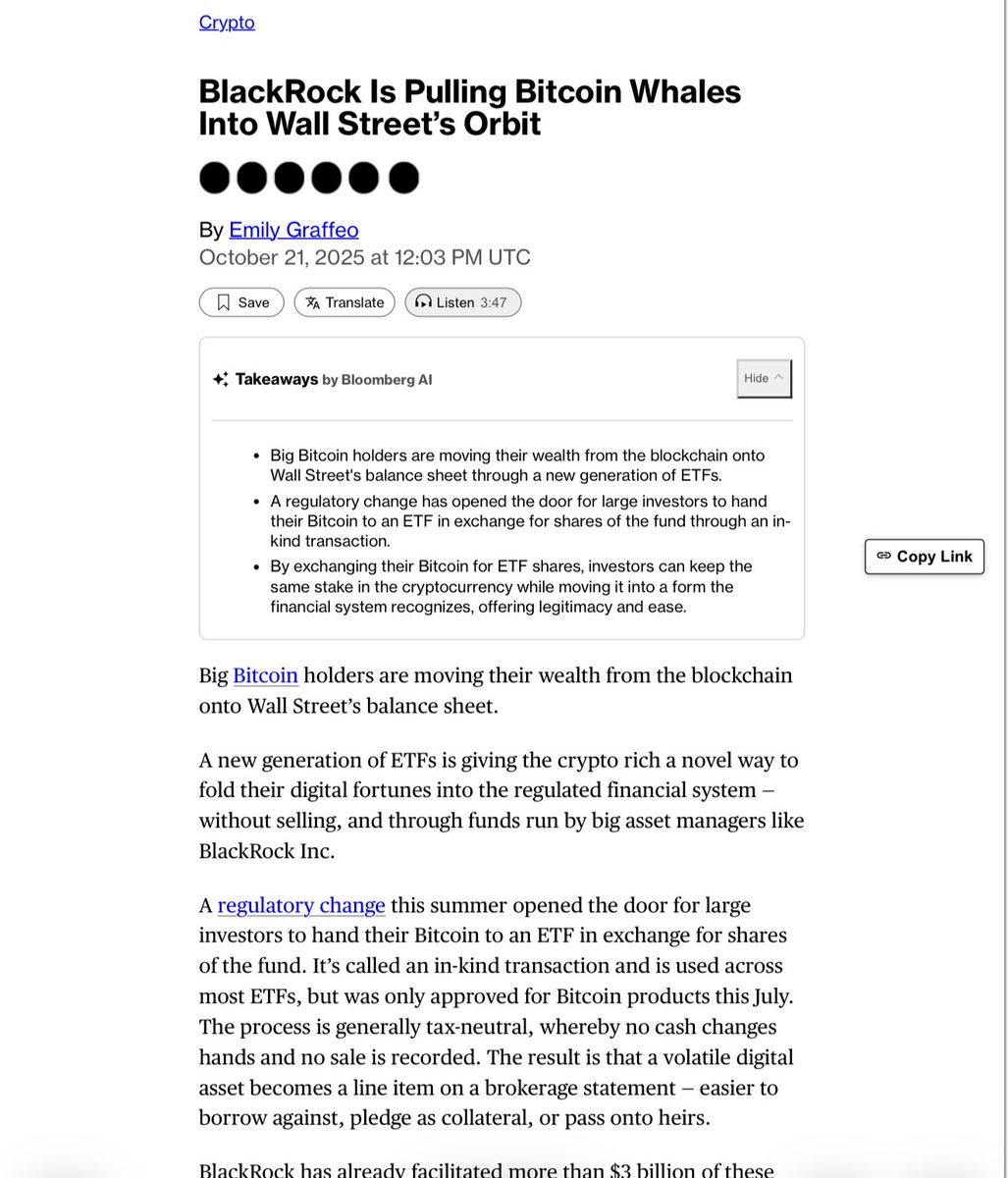
THEY MOVED $3 BILLION AND NOBODY NOTICED
This is not a drill. This is not speculation. This is the silent coup of our generation.
Since July, Bitcoin whales executed the largest ideological betrayal in financial history—$3 BILLION transferred from self-custody into BlackRock’s vaults. Tax-free. Traceless. Irreversible.
THE MECHANISM THEY HID FROM YOU:
SEC approved “in-kind” conversions in July 2025. Whales who bought Bitcoin at $5,000 now swap directly into ETF shares at $60,000. No sale. No tax event. 37% capital gains—ERASED. Wall Street didn’t defeat Bitcoin. They made surrender profitable.
THE NUMBERS THAT BREAK REALITY:
BlackRock now controls 800,000 BTC—4% of the TOTAL supply that will EVER exist. One entity. One failure point. One phone call from any government.
On-chain transactions down 15%. The blockchain is going dark while ETF volume eclipses Coinbase. 75% of BlackRock’s new money came for THIS.
THE HISTORICAL PARALLEL NO ONE SEES:
Gold ETFs centralized 30% of supply by 2015. Bitcoin is sprinting down the same path in 36 months—not 11 years.
Within 12 months, analysts project 10% of all Bitcoin locked behind institutional doors. The revolution that promised “be your own bank” now queues at Wall Street’s teller window.
THE BETRAYAL:
Wes Gray: “Whales adopting Wall Street custody—the ultimate irony.”
Alex Gladstein: “We’re trading sovereignty for convenience.”
Eric Wall: “The blockchain is becoming a museum.”
This wasn’t hacked. This wasn’t stolen. This was CHOSEN.
15 years of self-custody culture—obliterated in one summer by a tax code loophole and the promise of collateral loans.
Bitcoin didn’t fail. Its holders did.
The 10% threshold approaches. After that, there’s no going back.