your best ideas will never come from trying to have them. you must read more. do more. experience more. stack the inputs until your brain is overflowing with raw material. then do nothing. sit in silence. go for a walk. stare out a window. that's when your mind starts connecting dots you didn't know existed. the conversation from last week meets the book from last month meets the problem you've been chewing on for a year. until one random wednesday you look up and realize you found the answer you were looking for.
In June 📸1996, a high school student named Tashaunna Howard jokingly wrote a fan letter to Tupac Shakur asking him to be her prom date after her boyfriend broke up with her.
She never expected a response but Pac actually showed up solo at her doorstep, gave her $1,500 to buy a dress, and took her to the dance in a white limousine.
A legendary moment of how deeply he cared about his fans. 🖤🕊️ Rip to the legend 🕊️
Five Black students helped change the history of East Tennessee State University during the 1950s: Eugene Caruthers, Elizabeth Watkins Crawford, George L. Nichols, Mary Luellen Owens Wagner and Clarence McKinney. Today, they are remembered on campus through The Path, a monument featuring life-size figures of the five students. Their story belongs to an important period when Black students across the South were challenging educational institutions that had excluded them under segregation.
Eugene Caruthers became the first Black student to enroll at what was then East Tennessee State College in 1956. A World War II veteran, Caruthers was already an experienced educator when he entered the college to pursue graduate studies. His enrollment came only two years after Brown v. Board of Education and represented an important break with the institution's segregated past. Rather than arriving as a teenager beginning college, Caruthers came as an adult seeking further education and helped open a door that had previously been closed to Black students.
Elizabeth Watkins Crawford followed as another early Black student at the college. She was an educator who pursued graduate education at ETSU and later spent decades working in education. Mary Luellen Owens Wagner was also among the pioneering group, entering an institution where Black students had only recently been permitted to study. These women were pursuing professional and educational advancement during a period when Black women faced barriers based on both race and gender, particularly in higher education.
George L. Nichols and Clarence McKinney completed the group now remembered as ETSU's first five Black students. Their enrollment may not have produced the nationally televised confrontations seen during desegregation battles at Little Rock or the University of Mississippi, but that makes their history no less significant. Integration did not look the same everywhere. In many communities, change happened through individual Black students quietly entering classrooms, completing assignments and earning degrees at institutions that only a short time earlier would not have admitted them.
Together, Caruthers, Crawford, Nichols, Wagner and McKinney helped establish a new reality at East Tennessee State. Every Black student who later enrolled there entered a university that was different because these five had crossed that barrier first. Their story is a reminder that the history of school desegregation includes hundreds of local pioneers whose names never became nationally famous, but whose decisions permanently changed the institutions they attended.
Thank you for reading, sharing and helping these stories reach more people. If you'd like to support the work behind this page, you can buy us a coffee here: https://t.co/K1AhtZuOFs or tap the link in our bio. ❤️
Trayvon Martin Should be here.
Breonna Taylor should be here.
Sandra Bland should be here.
George Floyd should be here.
Elijah Mcclain should be here.
Every black life lost to police brutality should be here.
Black Lives Matter
🇺🇸 On This Day in WWII History — Remembering Charles Jackson French
On September 5, 1942, Charles Jackson French showed a level of courage and strength that deserves to be remembered.
After the USS Gregory was struck by Japanese naval fire near Guadalcanal, French found himself in the Pacific with fellow sailors fighting to survive. Fifteen wounded men were crowded onto a life raft, and there was a very real possibility they could drift toward enemy-held territory and be captured.
French made a decision.
He tied a rope around his waist and began swimming.
For somewhere between six and eight hours, he pulled that raft through the dark, shark-infested waters of the Pacific. Even after being warned about the sharks and the danger he faced, French reportedly made it clear that he wasn't afraid. He kept swimming until he and the wounded sailors were eventually rescued.
Think about that for a moment—one man swimming for hours with a rope around his waist, pulling 15 wounded sailors behind him because he refused to leave them behind.
Charles Jackson French was a Black sailor from Omaha, Nebraska, serving his country during a time when the very military he served in was still segregated. Yet when his fellow sailors needed him, none of that mattered. He saved lives.
His bravery eventually made him a national hero. His story appeared on WWII trading cards and in comic strips, and he traveled the country helping promote War Bonds.
Sadly, French died on November 7, 1956, at only 37 years old. He is buried at Fort Rosecrans National Cemetery in San Diego, California.
For decades, many people didn't know his name or his incredible story. Thankfully, efforts in recent years have brought renewed recognition to his heroism. In 2022, the Navy named a rescue-swimmer training pool at Naval Base San Diego in his honor, ensuring future generations of sailors will know the name Charles Jackson French.
Stories like his are exactly why I love learning about the parts of American history that weren't always given the attention they deserved.
Today, on the anniversary of that incredible night in 1942, remember Petty Officer First Class Charles Jackson French.
A sailor. A lifesaver. A WWII veteran. An American hero. 🇺🇸
May we continue to say his name and tell his story.
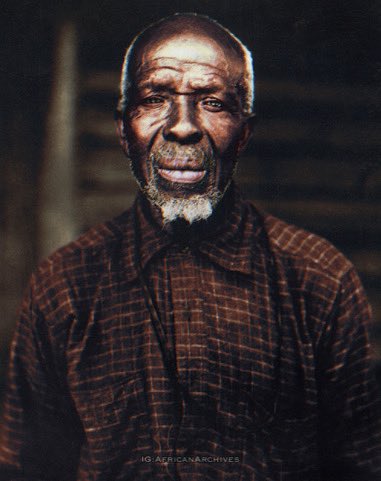
One of the last survivors of the transatlantic slave trade, Cudjo Kazoola Lewis (1931). He was among 110 enslaved Africans aboard the Clotilda.
A THREAD!
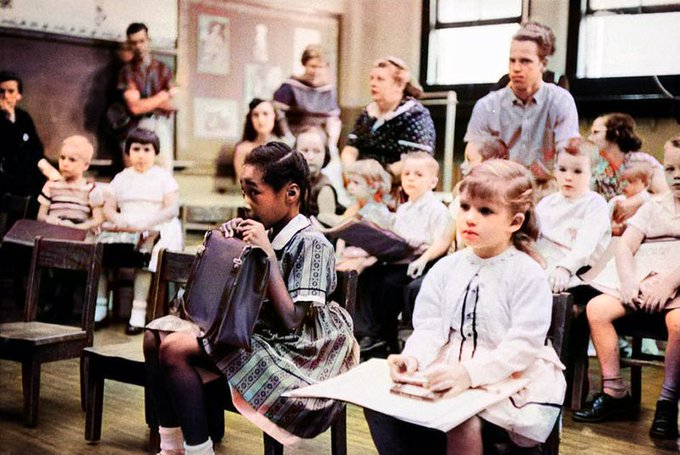
A nervous young girl sits in the front row. She is the only black girl in her class, Tennessee, 1957.
In September 1957, six-year-old Lajuanda Street Harley entered first grade at Glenn Elementary School in Nashville, Tennessee, becoming part of the first group of Black children to desegregate the city's previously all-white elementary schools. Three years had passed since the Supreme Court ruled in Brown v. Board of Education that segregated public schools were unconstitutional, yet Nashville had delayed integration until adopting a gradual plan that began with first grade and was supposed to advance one grade each year. Of the more than 100 Black children eligible to enter previously white schools that fall, only 19 ultimately did so.
For children like Lajuanda, simply going to school meant walking into an organized campaign of resistance. White segregationists held rallies, gathered outside schools and pressured white parents to remove their children. Religious language was also used to defend segregation. At several schools, protesters carried signs and ministers preached against integration while Black first graders and their parents attempted to enter. Lajuanda later recalled angry white parents even entering her classroom at Glenn Elementary. By the end of the first day, hundreds of white children across the affected schools had been kept home by their parents.
The violence soon went beyond demonstrations. Shortly after midnight on September 10, Hattie Cotton Elementary School, where six-year-old Patricia Watson had begun first grade the previous morning, was badly damaged by a dynamite explosion. The blast tore through part of the building but caused no deaths because the school was empty. The bombing became one of the starkest examples of the lengths segregationists were willing to go to resist Black children receiving an equal public education. No one was convicted for the attack, and Patricia did not return to Hattie Cotton.
Nashville's school desegregation is sometimes overshadowed by the confrontation at Little Rock Central High School that unfolded during the same month, but the children in Nashville were confronting the same system at an even younger age. They were six-year-olds entering first-grade classrooms while adults surrounded their schools, threatened their families and, in one case, bombed a school building. Their experiences are an important reminder that desegregation was not simply accomplished by a Supreme Court decision in 1954. It required Black families to repeatedly place themselves in situations of extraordinary hostility so that the constitutional rights already recognized by the courts could become a reality in everyday American life.
THE GARDEN WAS SHAKING DURING GAME 4 🤯
SOUND UP to hear the electricity of the @nyknicks' historic 29-point comeback in the NBA Finals... they'll raise a banner at MSG and begin their title defense on Oct. 20 vs. Philly!
"For me he's a trailblazer, he's also someone I look up to a lot because he's done a lot in fashion."
@naomiosaka's hair and outfit in last night's US Open match were inspired by the legendary @alleniverson 💯
(via @espn)
Before Harriet Tubman became one of the most famous conductors of the Underground Railroad, she was married to John Tubman, a free Black man living on Maryland’s Eastern Shore. They married around 1844, when Harriet was still enslaved and known as Araminta Ross. Their marriage existed under a brutal legal reality. John was free, but Harriet remained the property of another person, and marriage offered her no protection from being sold or separated from her family. Any children they had could also have inherited Harriet’s enslaved status under Maryland law.
In 1849, fearing that she might be sold, Harriet escaped Maryland and eventually reached freedom in Pennsylvania. She later returned for John and reportedly hoped he would leave with her, but she discovered that he had married another woman, Caroline, and he refused to go north. Harriet did not allow that painful chapter to stop her. Instead, she continued returning to Maryland and helped relatives and other enslaved people escape, risking capture and possible death each time. John remained in Maryland and was killed in 1867 during an altercation with a white man. Harriet later married Civil War veteran Nelson Davis in 1869 and remained with him until his death in 1888.