Doctors once advertised cigarettes.
Coca-Cola once contained cocaine.
Kids once played with uranium toys.
Hey @grok, what do we do TODAY that people in 2075 will find just as INSANE? Top 10, no mercy.
solana:orcaEKTdK7LKz57vaAYr9QeNsVEPfiu6QeMU1kektZE has one of the more interesting infrastructure catalysts in crypto right now imo
Formation Securities has notified the SEC that it intends to operate a tokenised-securities venue on Solana using trading technology licensed from Orca
the interesting part is not “tokenised stocks are coming”
it is the possibility of a permissioned AMM becoming an execution layer for regulated equities:
• verified participants
• shares with voting/dividend rights
• 24/7 onchain settlement
• public, auditable trading activity
the venue is not live yet, this is not SEC approval, and early 2027 is Formation’s target
but if issuer participation, liquidity & real trading volume show up, Orca could be part of a much bigger capital-markets stack than most people are pricing in.
that’s the real thesis imo
I’ll be digging into the structure and proof points properly at FWR
@loshmi@SBF_FTX did more for this industry than most anyone... building the best exchange to date and helping create the last real altseason on record, yet he got targeted by certain counterparties at the worst time. Yet these blood sucking viruses are given more leeway.
What makes bittensor:native interesting here is the combination of its AI-infrastructure opportunity and concrete security engineering. @opentensor's published v488 release includes post-quantum wallet support, and its documentation describes ML-DSA and Falcon signing options alongside optional key rotation. There is code to examine behind the announcement.
⠀
Bitcoin’s post-quantum migration involves difficult choices about new signatures and existing coins. Its BIP-361 migration proposal remains a draft. That makes credible security progress an interesting point of differentiation for other networks, although it does not establish what is driving BTC’s price.
⠀
my bullish case is that TAO could benefit from two sources of interest: demand for useful AI infrastructure, and greater attention to long-term cryptographic security. If investors increasingly value networks that can demonstrate progress on both, Bittensor could earn a larger share of attention and potentially capital. That is a conditional opportunity, not a confirmed rotation out of Bitcoin.
⠀
The scope matters: this is published wallet-signing support, with activation controlled by network settings. It does not automatically protect every existing TAO wallet or establish that the entire network is quantum-resistant. The next proof points are verified live enablement, independently reviewed implementation and practical wallet support.
Full 8-page detailed review available for members join here: https://t.co/IRohSDVl60
I'm sure there's plenty people with sub 80 IQ who will believe it's DPRK
however, when it comes to me, God was generous, so I'm not gonna believe in the official story even for a second
just like I don't believe in many other stories where FBI wasn't as fast, but CT was
Lazarus easiest to blame
this game has many players and goes deeper than most are ready to (publicly) admit
People keep posting the snippet from
DPRK but yall missing the beauty of the full statement. 😄
Pyongyang, November 3 (KCNA) -- Kim Yo Jong, department director of the Central Committee of the Workers' Party of Korea, released the following press statement on November 2:
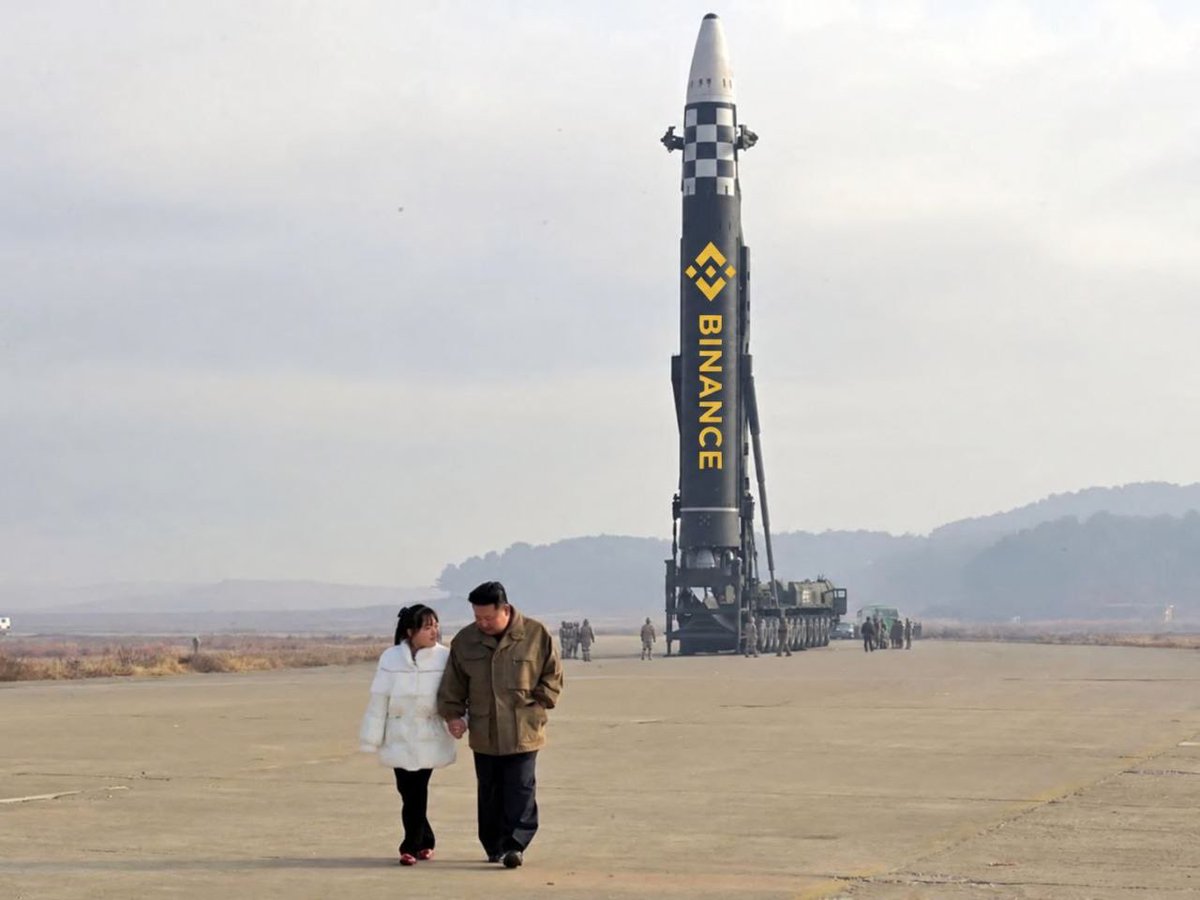
Recently, the cryptocurrency worth billions of U.S. dollars was stolen at the world's largest cryptocurrency exchange "Binance". As regards this extra-large incident, the U.S. has made a trite provocation of linking it with the Democratic People's Republic of Korea again.
The FBI is trying to brand the DPRK as a "cyber criminal state", claiming that it obtained information that a hacking organization "supported" by the DPRK was involved in the incident.
But the U.S. assertion is an absurd rhetoric and nothing new.
This is not the first time that the U.S. has attempted to spread misunderstanding of the DPRK in the international community, blindly linking the DPRK with the "cyber crime" incidents whenever they occur on an international scale.
Last year, the U.S. also tried to blame the DPRK for the hacking incident at the cryptocurrency exchange called "Bybit".
It is a grave political provocation against the DPRK that the U.S. misleads the international public opinion as if all the cyber crimes in different parts of the world are our deeds.
This is a sinister attempt to damage the international image of the DPRK and undermine its dignity and national prestige and another grave violation of the sovereignty of the DPRK in the new sphere.
It is the consistent policy stand of the DPRK government to resolutely oppose all sorts of malicious acts in cyberspace, the wealth common to the mankind, and resolutely reject any attempt to politicize the cyber issue and use it as a means of interfering in the internal affairs with other countries.
The international community needs to recall once again the fact that as soon as the present U.S. administration took office last year, it announced that it would confiscate illegally stolen cryptocurrency assets and use them as a state's strategic reserve.
If it carefully examines who will get the large amount of the so-called stolen cryptocurrency when the latter is retrieved, it may get a clue about who is behind the hacking incident.
On this occasion, we confirmed Washington's hostile attitude toward the DPRK once again and are closely monitoring a variety of persistent provocations of the U.S. against our state.
We have issues to reconsider in diverse aspects as regards the very unpleasant U.S. hostile attitude. -0-
Binance 🚨🚨is balance sheet restructuring & trying to stop a bank run that was likely already forming due to their internal bad debts or fractional reserve practices. . Binance is facing a massive liquidity crisis (maybe due to bad loans, FTX-style internal trading desk losses, or regulatory freezes). They need to lock up $6.3 billion in user funds without admitting insolvency. 🚨
They engineered a "hack" using the EIP-7702 vector. They move the funds to wallets they control. They freeze $3B of it (to stop the bank run on their own exchange) and let $3.3B "escape" into dormant BTC wallets and Uniswap swaps (which are likely wash trades back to their own market makers). They crash the market 4-5% to liquidate short positions and scoop up cheap assets.
🚨
Look at the forensic breakdown of the attack. In the span of 20 minutes, the attacker drained funds across ten different blockchains, including Bitcoin, Ethereum, Tron, Solana, XRP, Optimism, and Avalanche.
🚨
These blockchains do not share the same cryptographic curves or key types. Bitcoin uses ECDSA (secp256k1). Solana uses Ed25519. XRP uses its own variant of ECDSA. A single compromised laptop does not possess the magical ability to sign valid transactions across ten fundamentally different cryptographic architectures in 20 minutes. As TRM Labs explicitly noted in the forensic data, a single phished Ethereum authorization cannot explain Bitcoin, Tron, XRP Ledger, Solana, and layer-2 transfers all occurring simultaneously
🚨
If a real hacker compromised their laptop, they would have to navigate Binance’s internal infrastructure to access 10 separate, isolated hot-wallet signing services, bypassing hardware security modules and multisig requirements for each individual chain. That takes hours or days of lateral movement, not 20 minutes.
🚨
The only entity capable of executing simultaneous, validly signed withdrawals across ten different chains in 20 minutes is the exchange’s own internal automated withdrawal engine
—🚨
According to the on-chain data, the attacker took 325 million USDT and swapped it for Ethereum on UniswapX at a 10 percent discount, paying a massive premium for speed.
Professional market makers absorbed that trade. Why would an external hacker take a 10 % haircut on an irreversible, unsanctioned swap when they control the wallet? They wouldn't.⚠️⚠️🚨
Furthermore, the Bitcoin stolen was split into exactly 1,000 BTC chunks across 17 new wallets and then sat completely dormant.
🚨
It was not laundered. It was not moved to a mixer. It was organized into clean, institutional-sized blocks and parked. Hackers do not park stolen funds in neat, 1,000 BTC increments. Institutional custodians do this when they are restructuring balance sheets or moving funds to cold storage under their own control.🚨
The attacker even routed test transactions back to itself before the main sweep.
This is the behavior of an internal engineer testing a deployment script.🚨
—-
Binance is doing exactly what FTX did before its collapse, just with a more sophisticated smokescreen. They have halted withdrawals. They are promising to make users whole with money they do not have.
🚨
Within the next 30 to 60 days, Binance will slowly resume withdrawals for small retail users to maintain the illusion of solvency. Large institutional whales will find their accounts frozen indefinitely pending "investigation" into the hacked funds. The $3.3 billion in Bitcoin and Ethereum currently sitting in dormant wallets will not be recovered. It will be slowly commingled with other exchange flows over the next year to quietly plug Binance's internal holes.
🚨
You are watching a bank robbery designed to hide the fact that the largest exchange on earth is out of money.
-
https://t.co/rXv2cIejt8
https://t.co/bnfBLIMvFo
The oldest advice ever written down came from the father of the man who survived the Great Flood.
Around 4,600 years ago, the Sumerians were writing something extraordinary on clay tablets.
It's called The Instructions of Shuruppak, one of the oldest surviving works of wisdom literature in human history.
In the later version of this ancient text, a man named Shuruppak sits down to give his son advice about life.
His son is Ziusudra.
The very same Ziusudra who, according to Sumerian mythology, survived the Great Flood.
The man who would later become known through the stories of Atrahasis, Utnapishtim, and eventually Noah.
One of humanity's oldest surviving wisdom traditions was eventually presented as advice passed from a father to the man who would survive the destruction of civilization.
He was teaching him how to live in a functioning society. Don't steal. Don't lie. Don't get involved in other people's fights. Be careful who you trust. Protect your property. Don't abuse the people working for you.
The text discusses farming, irrigation, labourers, slavery, property, debts, marriage, and the behaviour of powerful institutions.
There's even a passage comparing the palace to a mighty river that can never be filled, no matter how much flows into it.
Sound familiar?
These were people dealing with corrupt authority, dishonest neighbours, financial problems, and the same bullshit humanity still struggles with today.
Shuruppak wasn't an imaginary city.
We've excavated it.
The ancient settlement, now called Tell Fara in Iraq, was a real Sumerian city. And archaeologists discovered evidence of significant flooding there, generally dated to around 2900 BCE.
Now, does that prove the Sumerian Great Flood happened exactly as described?No.
But it establishes something interesting. We have an actual ancient city associated with the flood tradition, archaeological evidence of flooding, and a literary tradition that eventually places its wisdom in the hands of the flood survivor.
The oldest surviving version, dating to approximately 2600 2500 BCE, doesn't identify the son as Ziusudra. That connection appears in the later Old Babylonian version.
In other words, we can actually watch an ancient wisdom tradition become attached to the story of the world before the Flood.
Later civilizations, including the Hebrews, developed wisdom literature containing many of the same concerns. The biblical Book of Proverbs shares the familiar structure of an elder teaching the next generation how to navigate life.
We cant prove Proverbs directly copied Shuruppak, but the older Mesopotamian tradition was already well established long before the biblical texts were composed.
When we hear about civilizations existing before the Great Flood, we tend to imagine some primitive world of scattered tribes barely surviving.
That's not true. They imagined cities, kings, workers, farmers, property, organized institutions, and generations of accumulated knowledge.
Was it simply their way of projecting their own society into a legendary past? What fascinates me is that the Sumerians didn't describe the Flood as the beginning of civilization.
They described it as a catastrophe that interrupted an already existing world.
And one of the oldest pieces of literature humanity ever wrote was eventually connected to the man who supposedly lived through that destruction.
Fox: Why are you here this morning?
Trump rally attendee: Well, in the late 70s, I was a little too young to go to South America for the Jonestown Massacre. But this is as close as I'll ever get, so that's why I'm here. There's nothing like seeing a cult right up front.
@SimonDixonTwitt The way all this was performed has the INSIDE JOB signature, they used all the weak points that are known only to insiders, the official explanation is more ridiculous than 9/11
This is a TEST to do the same on a large scale on regular banks and blaming it on AI
Tin foil hat time.
My theory is that Binance has had a hole in their balance sheet for a while now.
Today was their last-ditch effort to nuke crypto prices so they could buy back way lower, fill the hole, and maybe even make some money off the top.
They saw prices going up, realized the hole was going to get WAY bigger, and decided to nuke it.
Unfortunately for them, prices didn't drop nearly as much as they needed.
And I'm not buying this story about some random DevOps developer getting hacked and compromising the entire operation.
I've worked in enterprise software engineering. Nobody at companies of this size should have that kind of unilateral access.
Changes to critical infrastructure typically have to go through multiple layers of review. Engineering, security, DBAs, org leadership, etc.
In a properly secured Kubernetes environment, you aren't be able to just waltz into production pods and do whatever.
You're telling me one compromised DevOps engineer had enough access to cause BILLIONS in losses, and there wasn't a single additional control in place to stop it?
You expect me to believe that shit?
Something doesn't add up.
This is speculation, obviously.
Remember.
If Binance absorbs the losses from this hack, as it has committed to doing, the financial damage could largely remain with one company.
That’s fundamentally different from the contagion we saw with Celsius, FTX, BlockFi, 3AC, Gemini Earn, Genesis, Terra LUNA and others.
Those failures spread through interconnected lending, leverage and counterparty exposures.
A company taking the hit itself is very different from passing losses through the entire system.
That’s why the real test isn’t just the size of the hack.
It’s whether Binance can honour all customer liabilities, restore withdrawals and absorb the losses without spreading them to others.
So far, that’s the direction they’re signalling.
But we still need to see the proof, which they have committed to providing.
On the wider geopolitical point.
I always look at the incentives.
The potential incentives for MIC-linked intelligence agencies to conduct or exploit hacks include:
Weakening independent financial infrastructure.
Forcing companies into greater dependence on the FIC.
Creating pressure for increased surveillance, regulation and centralised custody.
Gaining access to financial intelligence and sensitive customer data.
Disrupting financial networks used by geopolitical adversaries.
Creating opportunities for financial assets and infrastructure to be acquired or controlled by FIC institutions.
Binance had already been forced to accept U.S. government-appointed independent compliance monitors as part of its $4.3 billion settlement over money-laundering and sanctions violations.
The settlement included a five-year U.S. Treasury monitorship, giving an independent monitor access to Binance’s books, records, systems, transactions and accounts.
The DOJ also imposed a separate three-year compliance monitorship.
CZ was forced to step down as CEO and later received a presidential pardon.
Israel has also requested that Binance freeze funds connected to Palestinians and others, as part of its financial genocide.
Think about what that means for the sovereignty of a global financial company.
This is how I analyse the increasing subordination of financial infrastructure to the FIC.
None of these incentives proves who carried out this hack.
But I always follow the incentives, not just the headlines.
Oh yeah.
🇮🇱 Every hack is always North Korea. 😂
@crypto_seer Good to see you Seer & to see someone aligned. Same in every cycle for 10k years from agriculture feudalism slavery organized religion education nationalism wagecucks corp ladder. Allegory of the Cave over & over, while the masters cast to distract & control the masses.