I couldn't find an open-source, fast disk visualizer for Mac & Linux (used WinDirStat a lot a while back), hence built my own (using #Rust 🦀)!
Feedback welcome!
https://t.co/e41Kck5aYv
When comparing to Ollama:
Pros
-> Nice integration with TS incl. starting managed server within node process
Cons
-> No docker setup nor Python (likely possible, not straightforward from docs)
-> No Python SDK (can ofc call the API from Python)
-> Couldn't run Gemma4 natively (found this patch https://t.co/wgwvZ88V4s , plan to give it a go soon)
Adding Gemma 4 to @tether 's @qvac -Fabric
Open-sourced a patch today: Gemma 4 architecture support for qvac-fabric-llm.cpp, Tether's llama.cpp fork. The repo is at https://t.co/P0lL48g1RF.
Why QVAC-Fabric matters?
Stock llama.cpp is a fantastic inference engine, but it isn't optimized for the constraints we hit while building a privacy-first AI companion that runs entirely on-device. QVAC-Fabric layers four things on top of llama.cpp that mobile inference actually needs:
- Memory-based model loading: load weights from a buffer, not a file path. Critical for app sandboxes.
- On-device LoRA hot-swap: swap personas without reloading the base model.
- BitNet TQ2_0 : a 1.58-bit quant that gets surprisingly close to Q4_K_M for some architectures.
- Adreno GPU optimization: Qualcomm's mobile GPU, the one on most Android phones in our market.
QVAC supports gemma3 and gemma3n. It did not support gemma4. We needed gemma4 because Gemma 4 E4B is the model our companion runs on, post-fine-tune.
The hard part:
Gemma 4's attention block uses different head dimensions per layer: 256 for sliding-window-attention (SWA) layers, 512 for full-attention layers. QVAC-Fabric, like most llama.cpp forks, assumed a single global n_embd_head_k value across all layers. That assumption is baked into KV cache allocation, RoPE shifts, tensor loading, and the graph builder.
The fix wasn't a one-line override. We had to thread per-layer head dimensions through:
- n_embd_k_gqa() and n_embd_v_gqa() (now layer-aware)
- KV cache get_k() / get_v() and build_graph_shift()
- Tensor shape computation during weight loading
- A new graph builder file, gemma4-iswa.cpp, that handles Gemma 4's interleaved-SWA attention pattern
Plus the smaller stuff: QVAC's build_moe_ffn() signature differs from upstream, several upstream functions are member variables in QVAC, and field naming (tok_embd_per_layer vs per_layer_tok_embd) doesn't match. Eleven files, +256 lines.
Does it work? Yes. On an RTX 4090 with Gemma 4 E2B Q4_K_M:
Prompt processing: 132.5 tok/s
Generation: 116.5 tok/s
Model memory: 1.4 GB
Context memory: 780 MB
We have one cosmetic issue (the CLI prints [UNK_BYTE_0x0a] instead of newlines, because QVAC lacks byte_encode=false).
Server API output is correct.
What's in the repo. A unified git apply-ready patch, full patched source files for reference, and Python scripts that
re-apply the changes against new QVAC upstream branches. MIT-licensed.
What's next. We're using this in production for our App. If you're building on-device AI on Gemma 4, particularly anyone, targeting Adreno GPUs or experimenting with BitNet quantization, this should save you the week we spent figuring it out.
PRs welcome, especially for the tokenizer cosmetic fix and Adreno benchmark numbers we don't have yet.
https://t.co/P0lL48g1RF
I've been testing @qvac from @tether , my impressions so far:
-> Very easy to load @huggingface models
-> Same SDK running on mobile, mac, linux, win, etc
@qvac@tether@huggingface Performance:
-> Ran some naive tests for @UnslothAI Qwen3-0.6B Q4_0 with llama-benchy on a CPU
-> @qvac has the edge in t/s (maintains ~ 10% edge at different depths) as well as ttft (also ~ 10%).
I plan to test bigger models - can share results if there's interest.
What if you could have a local wallet that's:
- AI native
- Privacy first
- Secure
- Fully local
- Open source
Coming soon, from your beloved @ethereumfndn dAI team.
A few important topics still need more detailed investigation, such as strike spacing and rebalancing fees.
Running backtests on this now. Will share results when they're ready!
DMs open in the meantime.
Very interesting idea from @VitalikButerin - a stablecoin with no debt, no liquidations, no collateral ratios.
Could you build it with prediction markets that exist today? 🧵
Looks like the options thing is happening already!
See also: various people thinking through and building different versions of the idea in the thread: https://t.co/gFNEvCbHct
Though I do strongly urge that if any of these get on mainnet quickly, we formally verify it first. I hope @vyperlang and/or https://t.co/OMFlWRqJda folks ( @Fricoben) can help!
(Also, now is a good time to be thinking about robustness-optimized oracles)
https://t.co/j1dxLV4Pn4
Weird implication: a basket of YES outcome tokens from live prediction markets gives you a debt-free, stablecoin-like payoff.
No CDP. No liquidations. No collateral ratio.
Loved clements comprehensive presentation on deep funding!
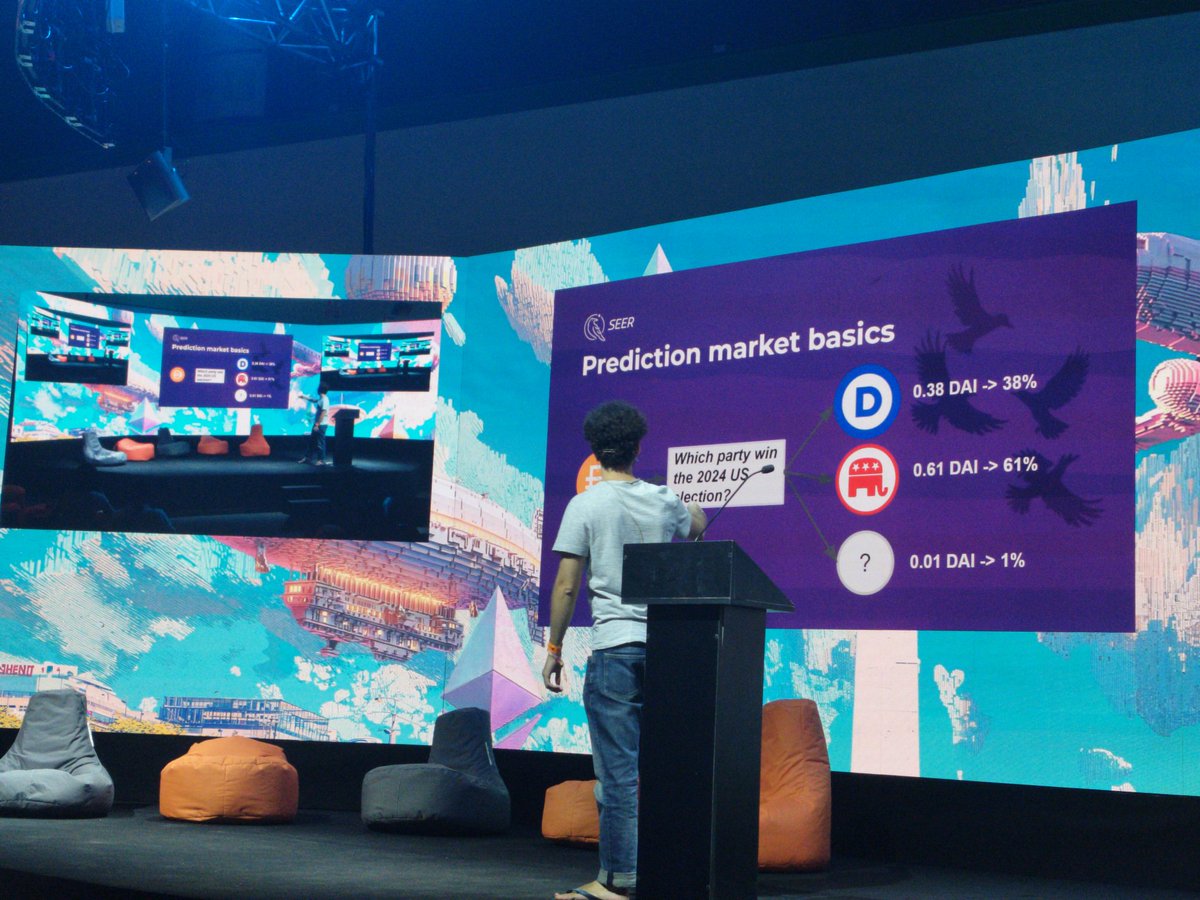
He started with a clear breakdown on types of prediction markets
- Basic version where you just bet between 2 outcomes, one of which goes to 1 and the other 0 (like who'll be US president)
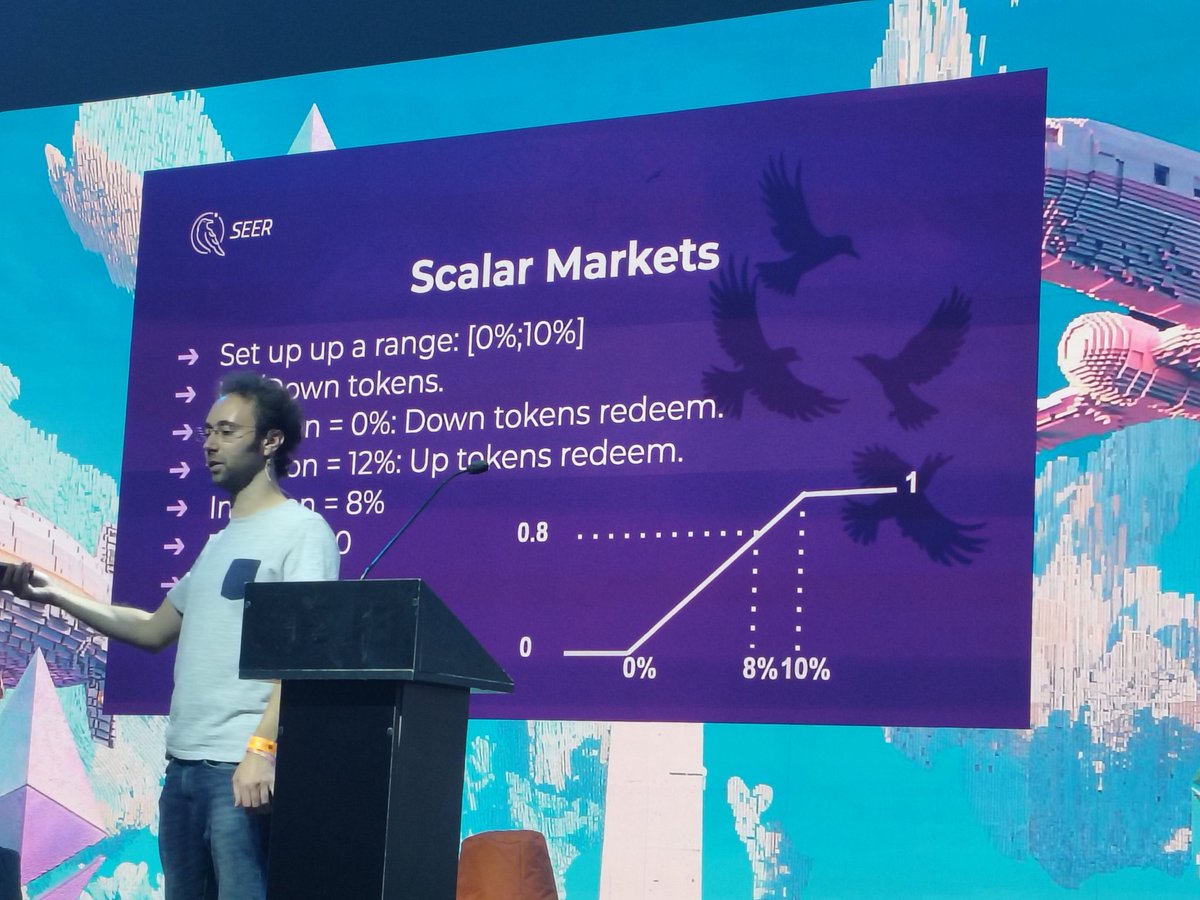
- scalar markets where you earn money based on how close to answer you are
Say you have a market for inflation being between 0 & 10%
You bet 10% but it was 0, so you lose all your money. If it was 5%, you lose half the money
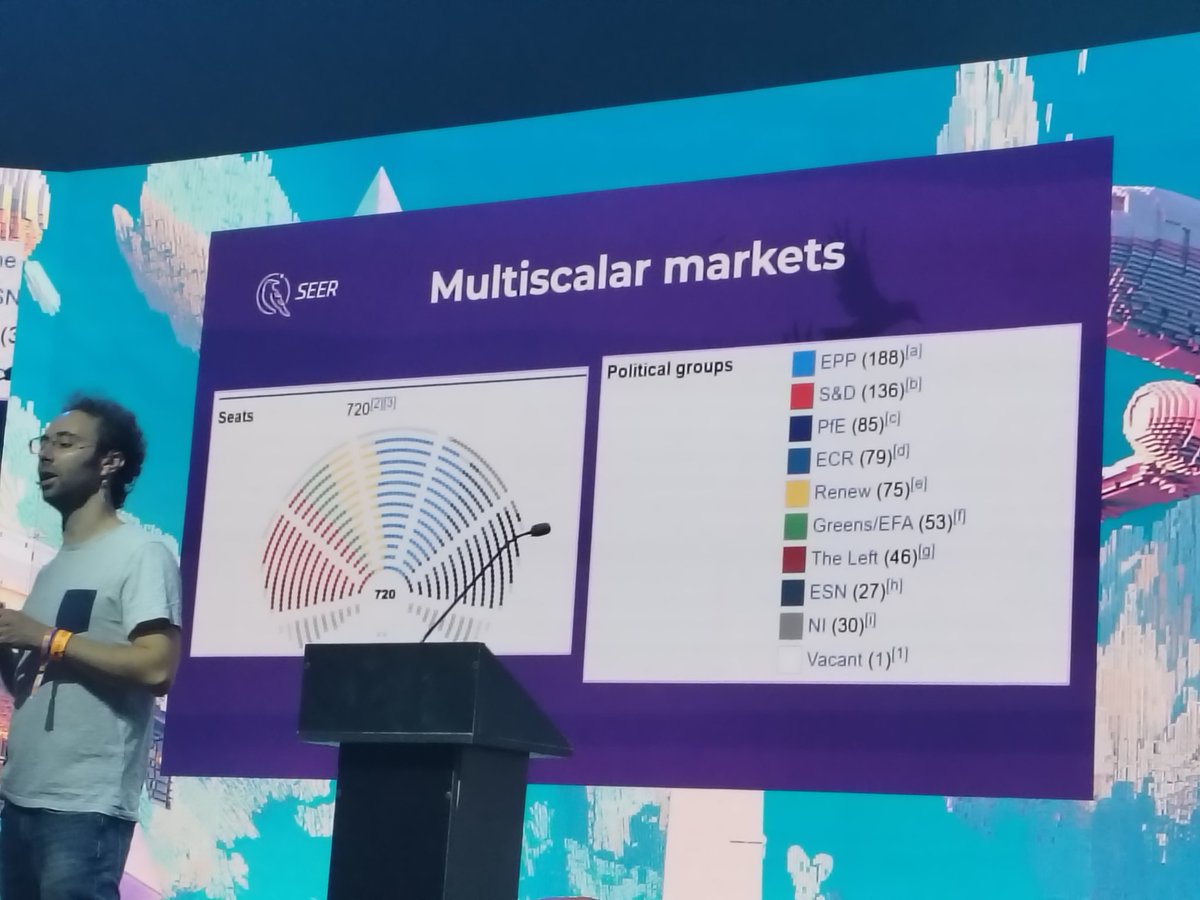
Finally multiscalar markets where there are many outcomes which collectively add to 1. We see this most prominently with UK style parliamentary elections, where you can bet on % of total seats a party will win
Armed with this understanding, he then applied prediction markets to scaling human judgment on the relative value of repos like solidity , viem , remix and their dependencies to Ethereum
A decade ago, Gnosis deployed its first contract on @ethereum.
Now it’s:
▪️ @safe – $58B TVL
▪️ @CoWSwap – $130B traded
▪️ @gnosispay – 151 countries
▪️ @gnosischain – 300k validators, 0 downtime
▪️ @GnosisVC – 80+ projects backed
Plus guilds, wallets, DAOs, and some conditional-token nerdery that powers Polymarket & friends.
Not too shabby for a prediction market side quest 😉
Next up: consumer 👀
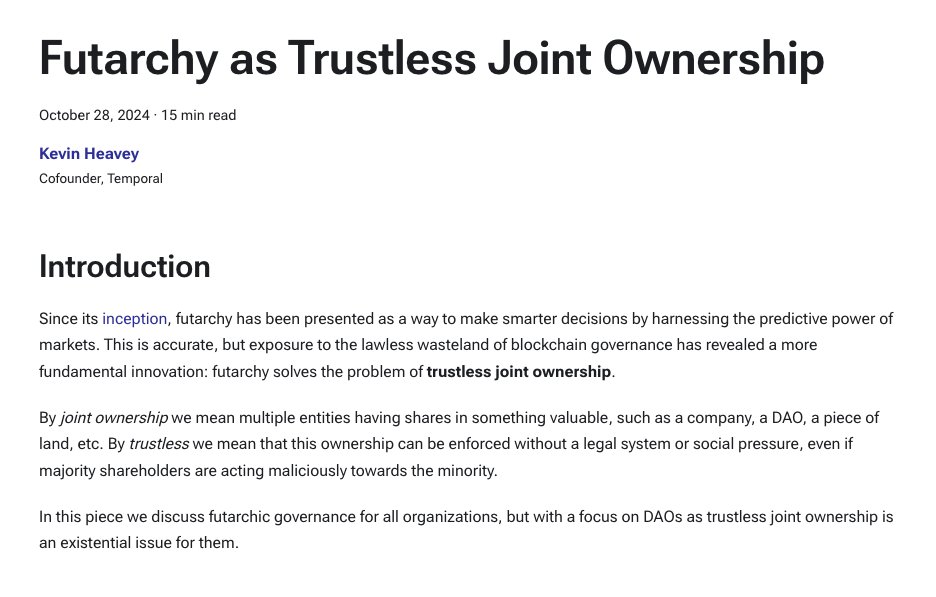
Just came across this article - very nice explanation about Futarchy for DAOs from @UmbraResearch and @dj_d_sol
The article presents in a thought experiment how the mechanism makes it unprofitable for a majority token holder to steal DAO assets, even with 51% control.
FUTARCHY AS TRUSTLESS JOINT OWNERSHIP
In this piece, @dj_d_sol explores futarchic governance as a market-based alternative to the flawed crypto governance we see today.