NEW PODCAST: The tough fiscal reality facing the UK government
@HelenMiller_IFS, @ChrisGiles_ and @MaxWarnerIFS discuss the state of the public finances, why borrowing costs matter, and how much room there is to do things differently.
🎧 Listen here: https://t.co/8sGlLlUFel
Interested in public policy, politics and the media?
We're looking for a Media Officer to help manage our busy press office and social media output at IFS.
📆 Find out more and apply by Wed 17 June here: https://t.co/xc1QY4htI1
Could the government increase defence spending without either cutting other departments or raising taxes?
@MaxWarnerIFS discusses the UK's planned increases in defence spending in our latest podcast on the UK's fiscal situation.
🎧️ Listen here: https://t.co/8sGlLlUFel
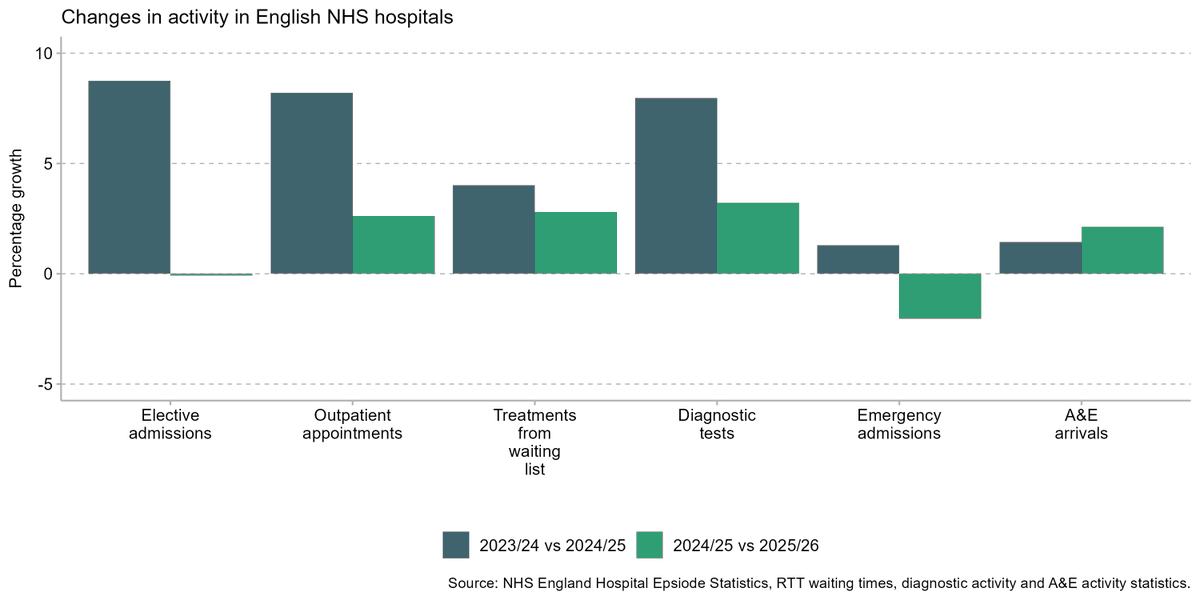
Some areas of hospital activity are growing: 2.6% more outpatient appointments, 2.8% more treatments from the elective waiting list, 3.2% more diagnostic tests. In general, though, these growth rates though are a lot slower than the year before.
(2/7)
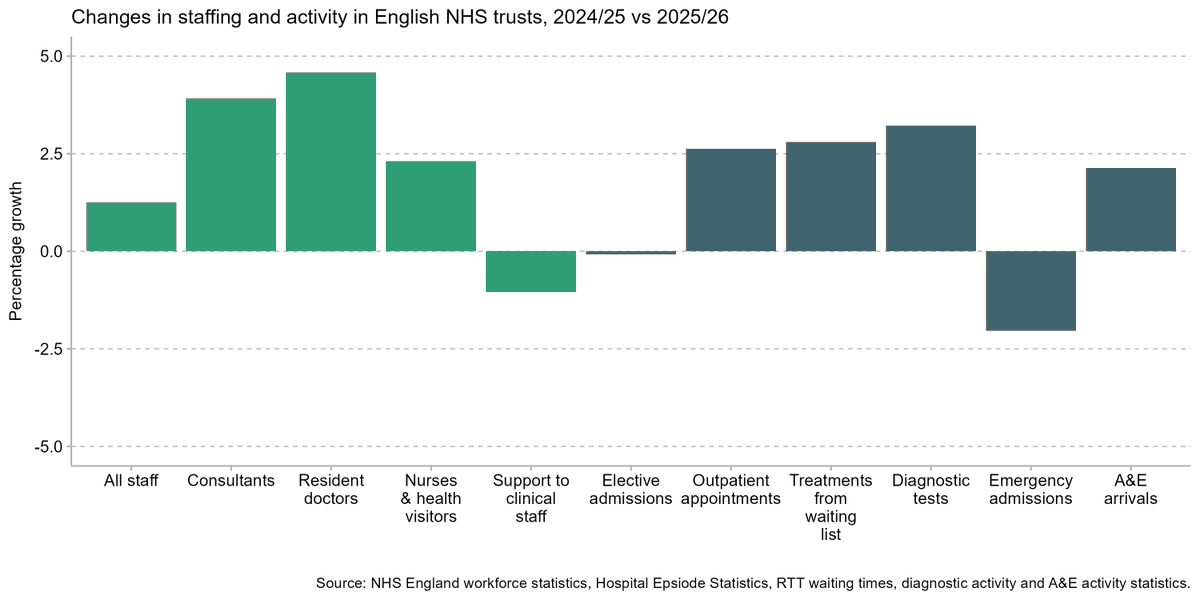
This trend is in line with the last few years: there are now 20% more doctors in NHS trusts than in 2022, but just 4% more support staff and 9% more estates, admin and management staff.
Is this a deliberate policy choice? Or cash-strapped trusts cutting back on recruitment?
(5/7)
We now have data for NHS staffing and hospital activity in England for all of 2025–26. There’s a lot of interesting things going on, so here’s a short thread on some of the key patterns.
As the chart below shows, most staff groups and most types of activity are up year-on-year
🖥️ Watch @KateOgdenEcon give evidence to the Treasury Select Committee (@HoCcommitteesUK) on how student loan terms have changed, how repayments work in practice, how plans differ from each other and the implications, and more here: https://t.co/eUowe4JYVk
IFS economists are giving evidence to the Treasury Select Committee twice this week:
🟢Tues at 9:45am: @KateOgdenEcon on student loans
🟢Wed at 2:15pm: @MaxWarnerIFS on defence spending
Find out more about the sessions and how to watch here: https://t.co/tFyVsHc39o
If you like your economics to be reality-based, impartial and not always doom laden, listen to this @TheIFS podcast on the public finances with me
@HelenMiller_IFS and @MaxWarnerIFS
https://t.co/OdDiupwGvv
@TheIFS@RoyalSocEd Challenging Inequalities: implications of the IFS Deaton Review
Mon 1 June | 3pm – 7pm | Royal Society of Edinburgh
📆 This event with @RoyalSocEd celebrates the conclusion of our IFS Deaton Review of Inequalities – find out more https://t.co/RXpD0TSaul
IFS economists are giving evidence to the Treasury Select Committee twice this week:
🟢Tues at 9:45am: @KateOgdenEcon on student loans
🟢Wed at 2:15pm: @MaxWarnerIFS on defence spending
Find out more about the sessions and how to watch here: https://t.co/tFyVsHc39o
'The wholesale cost of electricity and gas are not much higher for the UK than they are elsewhere. What really makes a difference is actually the way we tax these things.'
On our latest podcast we discuss Britain’s energy policy.
🎧️ Listen here: https://t.co/vHpPpIhCW7
'Gas has this particularly important role because the price of electricity that we pay is set by the most expensive form of generation.'
On our latest podcast we discuss Britain’s energy mix and net zero targets
🎧️ Listen to the podcast: https://t.co/vHpPpIhCW7
📊 #IFSSatStat: The share of 16- to 24-year-olds not in employment, education or training is similar now to levels seen in the early 2000s, but follows a decade of improvement that has now gone into reverse.
📗 Read our recent report on NEETs here: https://t.co/aJi6XIkPlp
Next week we’ll be hosting the @TheIFS Development Economics Conference! Excited to be part of this great line-up, bringing together the UK development network ‼️
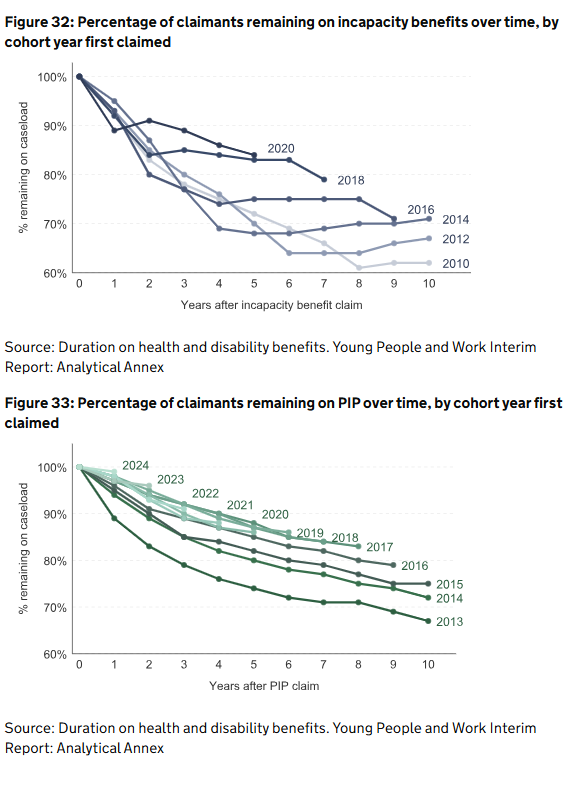
Some new data from Millburn review: Young people are staying on both incapacity benefits (UC health) and disability benefits (PIP) longer than they use to. There has been a focus on the big increase in new claimants for both benefits, but slowing outflows are part of the story.
What we should really be asking about the price of going green?
@Dieter_Helm breaks down the hidden system costs of the UK's energy transition.
🎧️ Listen here: https://t.co/vHpPpIhCW7
Any PM and Chancellor will be constrained by the same set of fiscal challenges. In this episode @HelenMiller_IFS@ChrisGiles_ and I explain the public finance backdrop - debt, borrowing, tax and spending plans - that will shape political choices over the coming years
This is most striking figure from Millburn Review. They estimate that around half of the 18-24 population who are not in education, employment or training (NEET) are not claiming any benefits. This limits how effective reforms to the benefit system can be in cutting NEET rates.
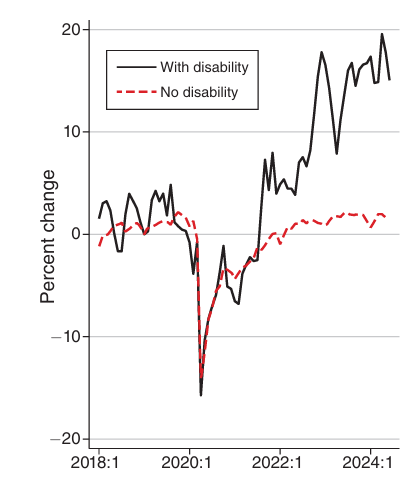
Reading a nice new paper by @I_Am_NickBloom and others showing a big rise in employment among disabled people since the pandemic in the US, driven by WFH - though we've not seen anything like this in the UK. Quick thread
Wages fall for disabled workers. They argue this is evidence of WFH raising the supply of disabled workers (e.g. because it reduces the need to commute) more than the demand (e.g. because WFH increases their productivity). I guess compositional changes could play a role too.