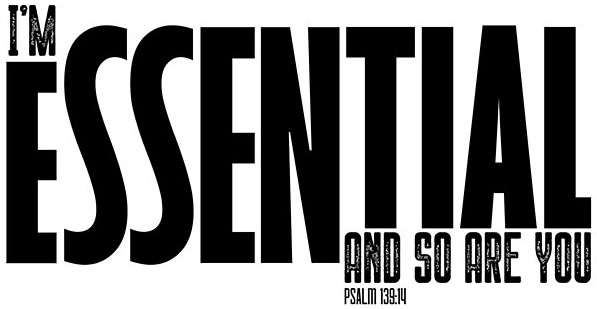
There is no such thing as a non-essential person !
Psalm 139:14 "I will praise Thee; for I am fearfully and wonderfully made: marvelous are Thy works; and that my soul knoweth right well."
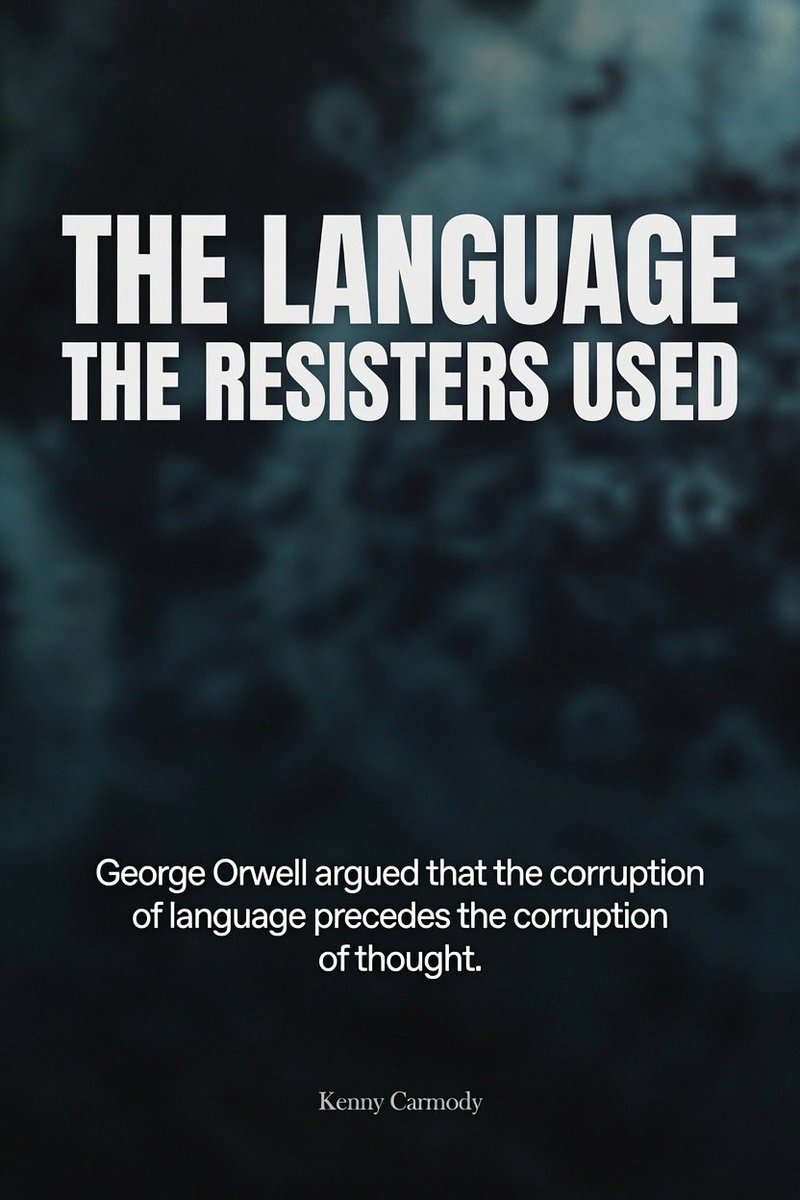
George Orwell argued that the corruption of language precedes the corruption of thought.
The resisters understood this. Not always explicitly. But in their practice.
The single most consistent feature of the people who maintained independent judgment throughout the pandemic was their relationship with language. Specifically: their refusal to adopt the institutional vocabulary wholesale.
This is more consequential than it sounds.
Language is not a neutral carrier of pre-formed thoughts. It shapes thought. The person who adopts the term vaccine hesitant has already, at the linguistic level, accepted the framework that positions their position as a psychological deficit rather than a considered judgment. The person who uses misinformation as the institutional communicators deployed it has accepted that the boundary between true and false is correctly drawn by the authority using the term.
The resisters used different words. Not reflexively oppositional words. Precise ones.
I have questions about the trial design instead of accepting the framing that questioning is hesitancy.
The evidence on this is contested instead of accepting that the evidence is settled.
I don’t consent to this procedure instead of the institutional reframe that declined compliance is a public health threat.
The linguistic precision was not pedantry. It was psychological protection.
Because the moment you adopt the institutional vocabulary, you have accepted the institutional framework. And the institutional framework determines what questions are thinkable, what positions are articulable, and what conclusions are available.
Orwell demonstrated this with his concept of Newspeak: the deliberate reduction of vocabulary as the mechanism of thought control. You cannot think a thought for which you have no words.
The resisters kept their words.
The practical implication is immediately available.
Notice the vocabulary being handed to you. Notice when new terms are introduced that carry embedded assumptions, when a word that sounds neutral is doing ideological work. Notice when the available vocabulary for a position you hold is the vocabulary of pathology or irresponsibility.
Then find your own words.
Precise ones.
The ones that describe what you actually see, actually think, and actually believe, in language that belongs to you rather than to the system that needs you to speak its version of what is true.
Your language is your thought.
Guard it accordingly.
@fernevak@CourtenayTurner@AP4Liberty If you authored yourself by the choices you make, then you are merely a program that can be rewritten by limiting your choices and redirecting your decisions. This makes the essence of who you are controllable by others.
God did not create man to be controlled by other men.
We've all heard, "the road to hell is paved with good intentions." This video condenses the extensive work of @thepalmerworm and others warning against the faulty foundation of John Locke's theories, and by extension, modern libertarianism. A must watch.
For over a year I’ve been warning on substack with many articles dedicated to teaching readers/listeners/viewers about the ways in which Lockean Theories negate natural law constitutional republicanism. I still see so many who do not understand this and do not even want to learn.
Anyone who claims the lack of joy about the 250th is a function of a rough economy was not alive in 1976.
The country rocked in its 200th celebration and the economy was a FREAKING MESS.
There is this Gen Z misconception that the '70s and early '80s were some sort of economic golden age of readily available, well-paying jobs, low cost housing and an all around sense of prosperity.
WRONG.
Google "Stagflation." Google "gas lines." Google "mortgage interest rates in the 1980s."
Our economy today is a golden age by comparison, without exaggeration.
Yet somehow in 1976 we could gleefully celebrate our nation's birthday without Democrats turning it into a Howard Zinn-inspired anti-history hatefest.
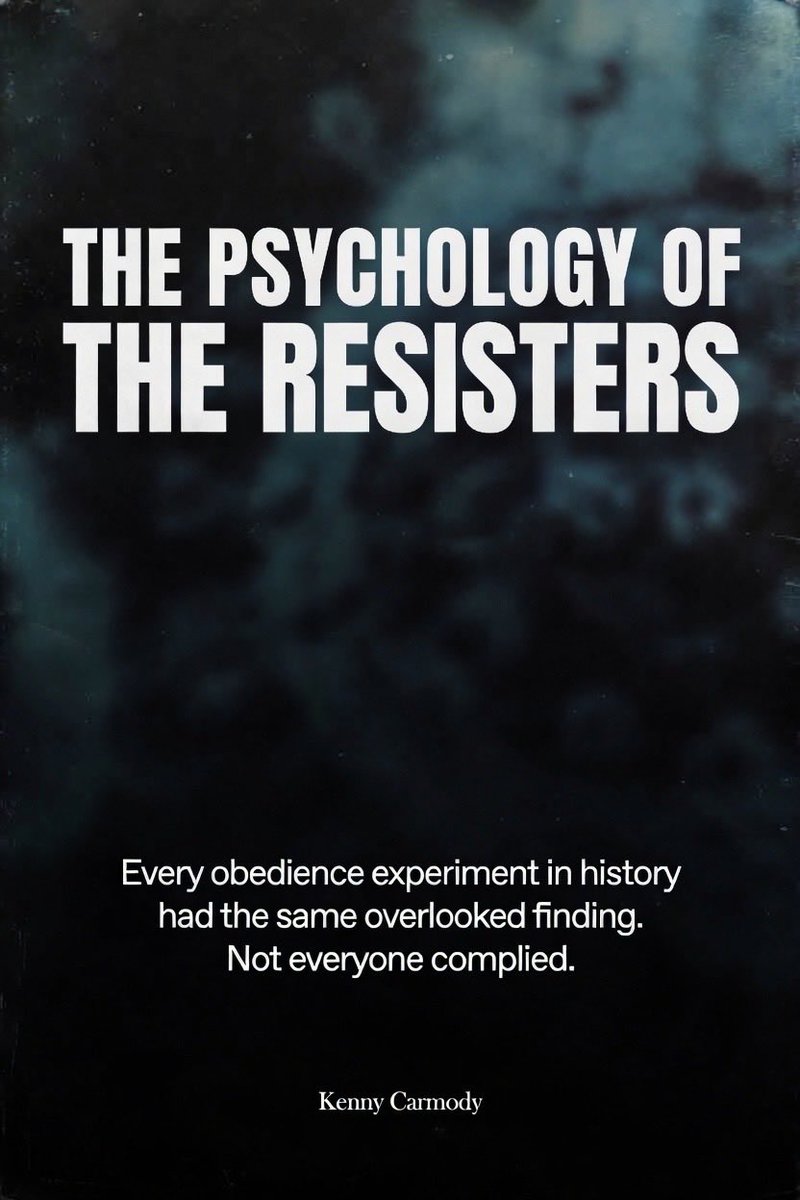
Every obedience experiment in history had the same overlooked finding.
Not everyone complied.
In Milgram’s lab, 35% refused to deliver the final shock. In Asch’s line experiments, 25% never conformed, not once, across any trial. In Zimbardo’s prison, at least one guard refused to dehumanize. One prisoner demanded a lawyer instead of a doctor and broke the psychological frame entirely.
We spent decades studying the ones who obeyed.
We barely asked what made the others different.
That question matters more now than it ever has.
The resisters in the COVID era were not difficult to find. Physicians who filed exemptions and lost their licenses. Nurses who walked away from careers rather than mandate patients into decisions they hadn’t genuinely chosen. Scientists who published contrary data knowing what it would cost them. Parents who stood alone at school board meetings. Ordinary people who simply said, quietly, without drama , no.
What made them different?
Research consistently identifies a cluster of factors. Not personality traits you either have or don’t. Situational and cognitive patterns that can be cultivated.
First: prior reflection on authority. The resisters had usually thought, before the crisis, about the limits of institutional trust. They weren’t cynics. They were people who had already asked the question “under what conditions would I refuse?” before anyone was asking them to comply.
Second: a concrete reference point outside the consensus. A value, a principle, an oath, a relationship that existed independently of the institutional structure demanding compliance. Something the system couldn’t reach.
Third: at least one other person. Milgram found that a single dissenting confederate reduced compliance dramatically. The resisters rarely stood entirely alone. They found each other. Sustained each other. Gave each other permission.
Fourth: the willingness to tolerate social pain. Not immunity to it. Tolerance of it. They felt the pressure. They felt the exclusion. They chose the discomfort of integrity over the comfort of belonging.
None of this is innate. All of it is learnable.
The most important thing Milgram, Asch, and Zimbardo taught us is not how fragile conscience is.
It’s that conscience can hold, if you’ve trained it, named its limits, and found even one other person willing to hold theirs beside you.
Build that now. Because the experiment is always running.
Until then stay humble.
There is a big difference in the daily sacrificing of personal self-interest for the good of others (agape love), versus being the sacrifice for the sin of others (atonement). Thiel at least said, "maybe just the language of sacrifice is often more confusing than helpful."
This July 4th, America turns 250 years old.
And somewhere along the way, I think a lot of people forgot just how unbelievable that really is.
Two hundred and fifty years ago, a group of men put their names on a document knowing it could get them hanged for treason. They weren’t influencers. They weren’t celebrities. They weren’t protected by money or comfort. They were risking everything for an idea that had never truly existed before — that free people could govern themselves.
Think about the bravery that took.
No guarantee they would win.
No guarantee they would survive.
No guarantee America would even exist a year later.
But they believed future generations deserved freedom more than they feared death.
And for 250 years, generation after generation kept defending that idea.
Farmers left their fields to fight.
Young men stormed beaches knowing many wouldn’t come home.
Families buried sons under folded American flags.
Workers built this country with blistered hands through wars, depressions, disasters, and impossible odds.
We didn’t get here because life was easy.
We got here because Americans refused to quit.
That’s why it bothers me when people act like this country is just some accident that appeared overnight. Freedom is fragile. History proves that. Nations collapse all throughout time when people stop appreciating what they inherited.
You don’t have to believe America is perfect to understand it’s worth protecting.
And maybe that’s part of the problem now.
We’ve become so distracted by outrage, division, politics, and nonstop noise that we barely stop to appreciate the fact that against all odds… this experiment actually survived 250 years.
That should mean something to all of us.
Because long after politicians are gone…
long after headlines disappear…
America still belongs to the people living here, raising families here, working here, and hoping future generations inherit something worth saving.
We should still be teaching kids about courage.
About sacrifice.
About the men at Lexington and Concord.
About Valley Forge.
About the people who crossed oceans with nothing but hope.
About every generation that carried this country forward when it would’ve been easier to give up.
That story matters.
Especially now.
250 years later…
and the American story still isn’t finished.
@fernevak@CourtenayTurner@AP4Liberty If you authored yourself by the choices you make, then you are merely a program that can be rewritten by limiting your choices and redirecting your decisions. This makes the essence of who you are controllable by others.
God did not create man to be controlled by other men.
May 15, 1963.
Astronaut Gordon Cooper climbed into a capsule barely larger than a phone booth and launched into space aboard Faith 7.
The mission was simple on paper:
Orbit Earth 22 times.
Stay in space for a full day.
Come home alive.
For most of the flight, everything worked perfectly.
Then, on the 19th orbit, the warning lights came on.
First, a faulty sensor falsely reported reentry.
Then the electrical system failed.
One by one, the automated controls died.
Guidance system: dead.
Orientation system: dead.
Reentry calculations: dead.
At 165 miles above Earth, Gordon Cooper suddenly had no functioning instruments to bring him home.
And reentry is unforgiving.
Too shallow, and the capsule skips off the atmosphere into space forever.
Too steep, and friction turns it into a fireball.
The difference between life and death was fractions of a degree.
Mission Control could only watch.
So Cooper became the computer.
He drew reference marks on the capsule window with a pen.
He stared at the stars he had memorized before launch and used them to orient the spacecraft by eye.
He strapped a wristwatch to his arm and timed everything manually.
Then he did the math in his head.
No autopilot.
No navigation system.
No backup computer.
Just a man, a watch, and the stars.
At exactly the right second, Cooper fired the retrorockets manually.
The capsule dropped into Earth’s atmosphere.
For several minutes, communication vanished as plasma wrapped the spacecraft in fire.
Nobody on Earth could contact him.
Then the parachutes opened.
Faith 7 splashed down just 4.4 miles from the recovery ship USS Kearsarge — the most accurate splashdown of the entire Mercury program.
Later, Cooper described it simply:
“I used my wristwatch for time, my eyeballs out the window for attitude.”
That’s it.
In one of the most dangerous moments in early spaceflight history, a human being outperformed the machines.
We live in a world obsessed with automation and software.
But Gordon Cooper’s flight is a reminder that when everything breaks, the final backup system is still the human mind.
Calm under pressure.
Thinking clearly.
Making the call when nobody else can.
It was true in 1963.
It still is.
So sorry to hear that. When the state cannot provide justice for the individual, and actively aids and abets injustice, then that state loses legitimacy.
"MAN, fearfully and wonderfully made, is the workmanship of his all perfect CREATOR: A State; useful and valuable as the contrivance is, is the inferior contrivance of man; and from his native dignity derives all its acquired importance."
Chisholm v. Georgia, 2 U.S. 419, 455 (1793) (J. James Wilson).
"Incompatible metaphysical systems are not co-equal inputs. Contradiction is not resolved by inclusion; it is resolved by judgment."
Amen, Amen, and Amen!
Genesis 3:4-5 "And the serpent said unto the woman, Ye shall not surely die: For God doth know that in the day ye eat thereof, then your eyes shall be opened, and ye shall be as gods, knowing good and evil."
Surely, nothing could go wrong by just listening and having a civil conversation . . . ??? Don't be so rigid, Christine. After all, everyone is entitled to their opinion . . . and shouldn't all people (and their opinions) be respected? Let's not be unkind . . . 🤮
What you’re calling ‘rigid framing’ is what I call clarity in the light of foundational principles and premises, especially as they operationalize through civic infrastructure.
You’ve always been very cordial in your exchanges with me and I thank you for that. What I’m doing (and remain committed to due to the stakes) is ontological boundary-defence. Identifying and upholding what is and what is not compatible with specific metaphysical architecture - the one the American Declaration of Independence presupposes. That’s not optional and it’s not a matter of comparative preference. I’m not here for ‘discourse’ or ‘dialogue’ (both of which are tools of dissolution and synthesis - ultimately usurpation). I’m here for stewardship. So yes - I am not ‘dialogical’ and cannot be regarding the load bearing structural integrity which is non negotiable. I’ve been intentional in not presenting myself as a ‘Thought Leader’ or ‘Influencer’. I am neither and I do not aim to persuade because I cannot ‘persuade’ people into understanding and comprehension they must gain for themselves for it to have intelligibility which informs their own agency.
The Constitution does not rest on ‘engagement with competing ontologies’. It rests on prior understanding about the created nature of man and law that excludes incompatible systems. If that boundary is not maintained, the structure dissolves into exactly what you are implicitly (???) advocating - a pluralistic synthesis where will arbitrates between ‘frameworks’. Aka - a ‘democracy’ of Technocratic Networked States which negates the Constitutional Republic in operation. Incompatible metaphysical systems are not co-equal inputs. Contradiction is not resolved by inclusion; it is resolved by judgment. Either law is grounded in the reality of man’s created nature and it therefore binds will; or it ‘emerges’ from competing wills ‘negotiating’ frameworks - the ‘democracy’ which the American Founders expressly rejected and warned against as the enabling precursor of tyranny - albeit under technocracy a consumer based tyranny without tears, but a tyranny of Scientific Management nonetheless. I’m not surprised that my naming of the boundary and holding its line feels like ‘rigidity’ to many. It would have done so to me too before I learned and comprehended the architecture and the stakes for accommodating its dissolution.
I’ve not been called isolationist and paranoid before. That’s new. Interesting to see clarity rebranded as pathology.
In the field of civil litigation, most courts require at least one round of court-ordered mediation. The problem with mediation is that it adopts a "moral equivalency" viewpoint that both parties' positions are equally valid, so the goal is to sort of force them to "meet in the middle."
All this does is victimize the victim a second time. I rarely see a dispute that is "50/50" -- yes, both sides may have some flaws, but on a foundational level, one side is usually 'more right' than the other. Sometimes it is 60/40, sometimes 80/20, and often it is 100/0. By forcing someone to compromise on a right, truthful, and just claim against the wrongdoer only victimizes that person again. They were wronged by the wrongdoer, and then they are wronged a second time by the court when they are denied full justice and bullied into giving up a significant portion of their claims.
This predisposition to "moral equivalency" allows those who can afford to overwhelm the other side by dragging out litigation and filing massive frivolous motions avoid justice altogether. The side with lesser economic means simply gives up to "stop the bleeding." As a result, most cases are won by the "paper war" rather than resolved by what is true, right, and just.
The same tactics are used in "civil discourse" and media and politics -- though now, media seems to be abandoning the charade of "moral equivalency" and embracing full-blown advocacy. However, that was really the goal all along, make absurdity of equal import as truth, then dispense with truth altogether.
Individuals must stand in the gap and say no to the Saurons of the world who would force their new moralities upon you and your family. If we stand firm in preserving our beliefs and holding true to objective morality, we can define a path forward for the Conservative movement.