I wanted to quickly create a short video with Opus 5.5 about the history of AI, from "Attention is all you need" to AGI.
No stock footage, no image or video generators: every frame is rendered from code.
This 3-minute film was made 100% in code by Claude in Claude Code: ~7,400 lines of React/TypeScript (Remotion), every image drawn in SVG and Canvas, an open-source TTS voice, and a score synthesized in Python. No stock footage. No image generators.
Id say pretty cool! Tookl about 1h and 7% weekly rates.
Rumors I’ve been hearing, not here on X.
First, let’s start with OpenAI and I’ll go towards Anthropic.
GPT-6 Sol is coming Tuesday. It’s both cheaper and more intelligent than 6 Astra, think of it like a 6.2 jump. The internal model “significantly more capable than Astra,” named Bel internally, helped with this release. Bel is considered “AGI” within OpenAI. They are very impressed with this model.
OpenAI is growing very confident that their internal lead is so big that no other lab can catch up. Unbelievably confident.
Anthropic is currently not in, let’s say, a “code red,” but is aware of OpenAI’s lead and doing everything in their power to catch up. Their new model Opus 5.5 is coming probably Monday rather than Tuesday due to OpenAI releasing on Tuesday.
We grew from ~0 to $500M ARR, adding $250M last year alone while being EBITDA profitable.
1,300-word post on every growth tactic that worked for us:
1. What got us from 0-$400M ARR in the US works in every country.
2. Retention and Monetisation Hacks.
3. Localization > Translation.
4. Experiment with $1M internal seed checks.
5. Pivoting to only AI content production unlocked 100% ARR growth.
Pocket FM is like Netflix for audio-only dramas, with our own pool of one-person studios.
1. Acquisition Playbook for 0-$10M ARR in any country in 6 months
We run a 90 sec video trailer of an audio drama as an Ad and ask users to download the app if they're interested in the rest of the story.
Our core insight after spending >$100M on acquisition is: If the clickthrough rate (CTR) for an ad goes from 2% to 2.25%, our customer acquisition cost (CAC) decreases by ~ 30%.
We remodelled our system around this insight and built an AI-first 2.25% CTR ad manufacturing machine that works in every country.
For every new country, we take our hit shows -> use LLMs to extract and most intriguing moments -> Write a 5-min script combining all the best parts. The first 60 seconds has to have a hook every 5 seconds and needs to end with a crazy cliffhanger to force a download mid-scroll.
If a marketing video is not hitting our benchmarks (2.5% CTR and 55% 3-second through-play), a creative director gets involved to change the hook or cliffhanger to get the numbers there.
AI lets us make 1,000 Ads per show, and in total we do ~17.5k Ads per month. When a business creating scales from 1k to 10k Ads, the normal thing is for CAC to skyrocket. But with what I just shared, we 7-8x'd our User Acquisition budget without increasing our CAC materially.
It took us 8 months to figure this out, but then the timeline from 0-$10M in every country got shorter and shorter:
US revenue grew to $25M in 19 months. (US is now 78% of total)
Germany to 21M in 11 months.
France to $10M in 3 months.
2. Retention and Monetisation Hacks.
We knew we wanted to create an audio entertainment platform, but there was no standard format. For the first 2-3 years, we tried 10 different formats before landing on the winner.
After we got it right with audio drama (8-12min chapters, written for mobile fiction, serialized, episodes have strong hooks and end on cliffhangers), avg daily streaming time went from ~25mins to 150+.
Audio drama made us realize that Pocket FM was creating a whole new medium. There was no playbook for anything that we were doing. Everything had to be thought & built from scratch.
This is what we did for each major bullet:
- Monetization: Users have some free daily minutes to listen; then it's pay per episode. We also added the option for users to unlock episodes by watching ads, which is doing extremely well. Ads scaled from zero to a ~$90M run rate in 12 months.
- Engagement & production: You don't become obsessed with an app you open once a week. To have users engage daily, we make the next episode free every day. Also helps them build the habit.
- Discovery. Huge problem because people consuming Pocket FM enter the app, tap the show, and lock the screen. We fixed it by doing "playlists" of episodes. Once users's free minutes on a show are done, we ask users if they want to pay. If they say no, we play a new show, one where they haven't used their free mins. And we stitch episodes of different shows together that way, creating natural discovery.
3. Localization > translation.
78% of our revenue is still concentrated in the US. Localisation is fixing this: You might write a show for a Spanish audience where language, jokes, folklore, have a certain flavor; if you merely translate the show for, say, a Norwegian audience, that color is lost and hurts the show in the Norway. Listeners would relate more if the show was written by a Norwegian.
That's why, instead of translating, we localize shows to different regions. We use AI to take the spine of stories and adapt their whole cultural layer to the other country.
The results: a US show that was localized for a German audience had 50% higher retention than the translated version.
Localization + our user acquisition playbook led to:
- $10M+ ARR in France within 3 months
- $21M+ ARR in Germany within 11 months.
And this expands writers' addressable market.
We get messages of writers thrilled to have revenue coming from the US, India, EU, LatAm, without them doing much incremental work.
4. Experiment.
We give $1M checks to new internal initiatives, and the team has 12-18 months to prove their thesis. If they prove it, we double down.
This is how Pocket Saga came about, our AI video microdrama app. It's an AI video equivalent of Pocket FM. Same shows and structure, but as a vertical 2-min mobile video series.
We launched it two months ago and it's at ~$15M ARR.
Pocket's broader thesis is to help creators tell their stories to as many people as possible. Start with audio drama -> multiple languages or localize to diff countries -> microdrama -> more formats like movies, TV shows, and games.
Best of all is that writers get revenue streams not only from countries they wouldn't have tapped into, but also from formats they wouldn't have thought possible.
5. Pivoting to only AI content production unlocked 100% ARR growth.
In mid-2024, we pivoted to only AI content production.
Our growth took a very direct hit. Pocket was already at $200M ARR, growing 50% YoY, and we flatlined for a whole semester.
Six months later, the business exploded.
After the switch, we went from ~25k hours of content produced per year to over 2.5M hours, which are also higher quality. Because AI orchestrates the writing and more data is fed into it, more blockbusters come out.
Over 90 titles have $1M+ in lifetime earnings and 13 crossed $10M.
Quality control is done with LLM as a judge, and LLMs are quite tough.
Results are very encouraging:
- 12-month revenue retention went from 44% to 76%.
- In the past year, we added $250M in net new ARR.
__________________________________
Pocket Entertainment (Pocket FM + Pocket Saga) has become the largest AI entertainment platform.
We have the largest storytelling catalog with 770,000 titles, 550k creators, and 5.5B hours of playtime with minute by minute retention & engagement data. We are using all of this data to improve every aspect of our business.
Our Bet: In the next 3 years we will be able to produce Naruto-like series for $1000.
Netflix has to spend $17B to find 100 Blockbusters per year.
What happens when you can produce 1M high quality shows for $1B?
The streaming wars caused a $300B reallocation of market cap.
The AI entertainment wars may be a $1T+ reshuffling of market cap.
We are at a unique spot. Unlike other AI creator tools like Runway or Midjourney, we own both the supply and demand side of AI content.
We've attracted over 550,000 writers who are producing an annualized 2.5M hours of content every year. This pairs with 137B+ minutes streamed.
Because of this, growth is accelerating as we scale further.
We have multiple S-curves inflecting at the same time:
- AI produces better and more ads -> scale faster in new countries
- Writers + AI produce more shows -> more blockbusters
- Localisation -> more reach per blockbuster
- Audio to video format expansion -> larger TAM -> more creators
Every aspect of our business is designed to improve another, and everything is aligned so that the number of blockbusters continues to rise.
If you're interested in building at the intersection of ai, tech and entertainment, DM me.
Holy, rumors are spreading everywhere that OpenAI is close to verifying a proof of the Hodge conjecture, while either OpenAI or Anthropic may be nearing a solution to Birch–Swinnerton-Dyer.
Both are Millennium Prize Problems that have resisted decades of mathematical research.
Verified AI-generated proofs of both would be a historic achievement for mathematics and a remarkable demonstration of AI’s ability to produce new scientific knowledge. And infact show that AI is capable of finding novel and creative solutions.
I'm 30. I built an AI startup called GojiberryAI doing over $4M ARR in one year. Got accepted into YC.
If I had to start from 0, here's exactly what I'd do:
1. Sell it before I build it.
No code. Just a simple slide deck (mine was 6 ugly slides) explaining the problem, the solution, the outcome, and the price. I made my first $10k that way, before writing a single line.
2. Pick a painfully specific customer.
Not "B2B SaaS." Something like "founders at 20-person SaaS companies about to hire their first SDR." So specific that the right person reads it and thinks "that's me."
3. Start outbound on day one, but only to people showing intent.
Not scraped lists. People engaging with competitors, changing roles, raising money, or publicly posting about the exact problem I solve. That's the gap between a 1-2% reply rate and 25-40%.
4. Lead with value, never a calendar link.
Send a blueprint, not "got 15 minutes?" Let the resource do the selling, and the trial becomes the obvious next step instead of a pitch.
5. Pick ONE channel and go deep.
For us it was outbound first, then Reddit (10M+ organic views), then LinkedIn lead magnets. I wouldn't touch a second channel until the first one was clearly working.
6. Talk to customers every single day.
The product doesn't matter until you understand the problem better than they do. Spend 90% of every early call listening, not demoing.
7. Only build once people are actually paying.
Then keep it dead simple and price it to sell itself. We landed on $99/mo with a free trial, so the funnel runs without me dragging anyone onto a call.
8. Do this relentlessly for about 12 months.
That’s roughly how long $0 to $3.5M took us.
Bootstrapped.
No outside funding.
Most founders don’t lose because they can’t build.
They lose because they build too early, sell too late, and quit the channel before it compounds.
Hiring a growth PM @ Anthropic
Ideal person: Seasoned growth PM, both b2c and b2b growth exp, ex-founder, relentless
Ant is a very wild place to work. Things will never be chill here, but you'll have a blast :)
https://t.co/NgGAbvgXqX
This is the biggest day in f inc history
Announcing blueprint:
A 3mo frontier tech program in SF
30 teams, $150k upfront each
Once you join:
- Full access to our campus, labs, machines, talks, and $1M in credits
- Our full team working with you on product, GTM, hiring and fundraising
- Up to 1 year of dedicated space for your company on campus
- On site lunch from personal chef
Applications open now
We're looking for founders working on the hardest problems
Robotics. Drones. Space. Advanced manufacturing. Energy. New materials. Biosciences. Frontier AI models. Chips. And software that makes machines smarter.
If you believe that's you, we want to support you and push you further.
We hit 3B+ views on TikTok/IG/YT with $0 ad spend in 16 months 🚀
This was one of the biggest growth levers for scaling Fluently from $0 to $6M ARR.
Here's my blueprint for hacking UGC growth on social media 👇
Andrej Karpathy spent 8 years at OpenAI and Tesla
Last week, he packed everything he knows into one free 2-hour lecture
Agents → Loops → Graphs → Self-Improving Systems
People pay $15K for bootcamps that teach less than this
This lecture is better than most paid AI engineering courses
You probably don't have 2 hours right now
Don't let this disappear from your feed
Watch it
Then read the guide below
This is the most extraordinary time to be alive. Not the most comfortable. Not the most predictable. The most extraordinary. More tools, more knowledge, more possibilities than any generation before us.
this brilliant young friend of mine just made it to yc
he called me up and asked me, "how much do i spend to get to $1m ARR by the demo day in 4 months?"
realised that a lot of founders probably have this question about their gtm and distribution
as an ai startup, the playbook is not very different
1/ founder-led marketing
> twitter + linkedin + ig + tiktok
> est. cost - $2,000-5,000 if you hire someone great for ig + linkedin
> instagram is like $20-100/reel
2/ launch video
> twitter + linkedin + ig + tiktok
> new media kinda video + amplification
> est. cost - $20-40k + amplification
> you'll do two of these in 4 months
3/ launch/fundraise amplification
> get a lot of pages to post about you with a screenshot of a news item or a founder's picture with a fundraise announcement
> est. cost - depends on your budget
4/ influencer motion
> activate x number of influencers every week on ig + tiktok + twitter
> say 20 activations per week
> est. cost - $10k/week
5/ ugc motion
> start with 5 accounts x 3 months and if you see early results, scale based on your budget
> est. cost - $10k/mo
6/ ads
> not recommended, but start with $2-5k on meta
and category-dependent on google
7/ reddit
> hire an agency and get the word rolling
> est. cost - $3-4k/mo from a very good agency
8/ seo
> set the seo motion if you are sure that you're gonna go past the 4-month mark
> est. cost - $3-5k/mo
all in all, you will end up spending
> launch videos - $60k
> founder-led - $10k
> influencer - $100k
> ugc - $40k
> ads - $15k
> reddit - $7k
> seo - $7k
a total of ~$250-300k over 4 months to activate all the channels
(assuming that you hire/work with top tier folks)
now, someone smart enough can put it all together
but where does the real delta come in?
> getting the narrative right
> understanding the outcomes from each channel
> executing with the right folks/agencies
> building a strong product + marketing loop
> doubling down and scaling channels that work well
for instance, there are times when you can go ahead with "claude for video" or "this app killed canva" and there are times when you can't
ain't nothing such as organic distribution, everything is seeded but not all of it leads to outcomes
there is a reason why you know wispr flow and there is a reason why you don't know some better alternatives
it is a strategy + execution + money game, assume you have gotten the product right
- notes from your fractional chief global distribution officer
This interview between @elonmusk and The Economist is a great lesson on geo politics and futurism. Strongly recommend you watch it.
A few golden nuggets on:
1. The AI race between US and China
2. Future of work
3. Traditional media being woke
4. What Europe is failing on
@Jason It's literally what we're building! Check it out at https://t.co/yv7geu17ag One click install, supports Mac and Windows, +1,000 integrations from the get go. 400+ models including local ones. Multiplayer by design.
Use my invite code to try it free: getsh*tdone
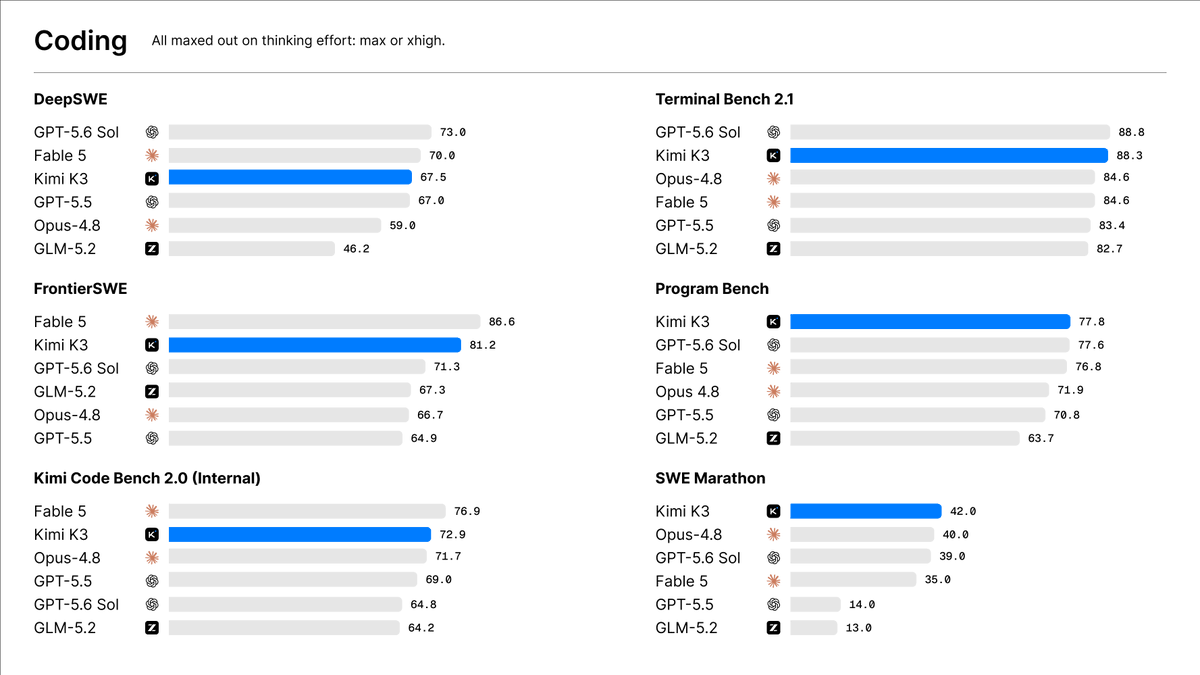
Introducing Kimi K3: Open Frontier Intelligence
🔹 2.8 Trillion Parameters, 1 Million Context, Native Multimodal
🔹 Kimi Delta Attention enables up to 6.3x faster decoding in million-token contexts
🔹 Attention Residuals deliver ~25% higher training efficiency at <2% additional cost
🔹 Built for long-horizon agentic coding and self-evolving workflows
Kimi K3 is now live on on https://t.co/zrk6zZxZUo, Kimi Work, Kimi Code, and the Kimi API.
Open Weights by July 27, 2026.
🔗 API: https://t.co/XCrgjXAqMw
🔗 Tech blog: https://t.co/YTfiMSNM1f
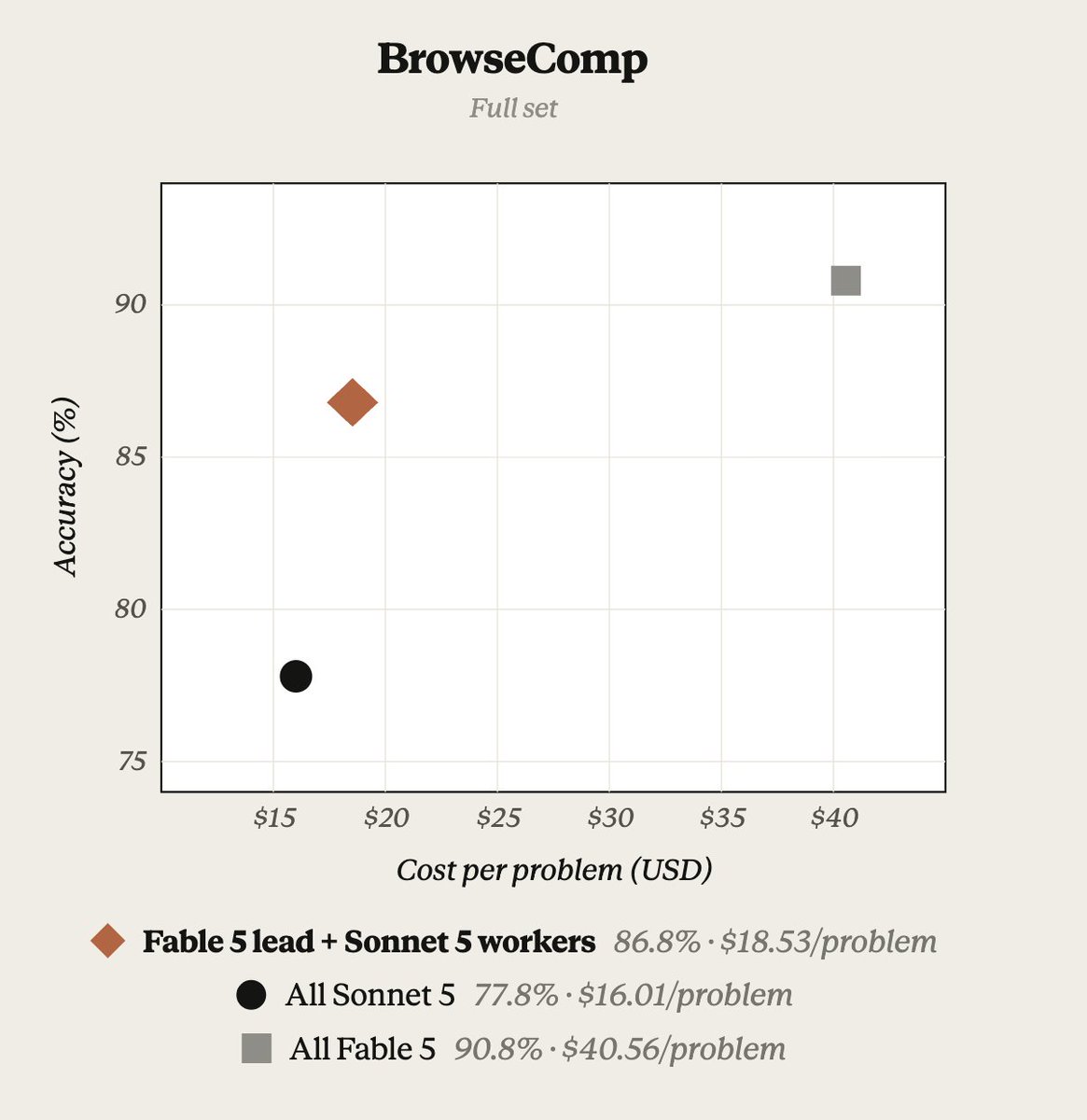
On BrowseComp, we tested Claude Managed Agents w/ Fable 5 orchestrator + Sonnet 5 worker sub-agents.
The Fable 5 orchestrator achieves 96% of Fable 5 performance at 46% of the price.
Token-heavy research is delegated to Sonnet 5.
See our cookbook:
https://t.co/zDGXCK79N3
You’ll never achieve anything if you are afraid of being cringe
Then again this is from someone trying to use looksmaxxing to achieve outsize return, good luck with that