This will forever be the greatest demo rocket launch in history. The Falcon Heavy demo will hold a special place in my heart as I viewed that live 4 miles away, but IFT-2 is now my new favorite rocket launch. Amazing job @SpaceX team!
Unfortunately I see this way too often, a photo of the Cybertruck paired with the phrase “one day”. People want this truck, Today. But simply because of the financial resources available to the vast majority of us, “one day” is all we can dream of. But dreaming is what we do best, and it inspires us to do more with ourselves.
This is my 8 year old sons favorite vehicle. Every time we pass one on the highway or anywhere he always says dad dad there’s a cybertruck. This will be ours one day
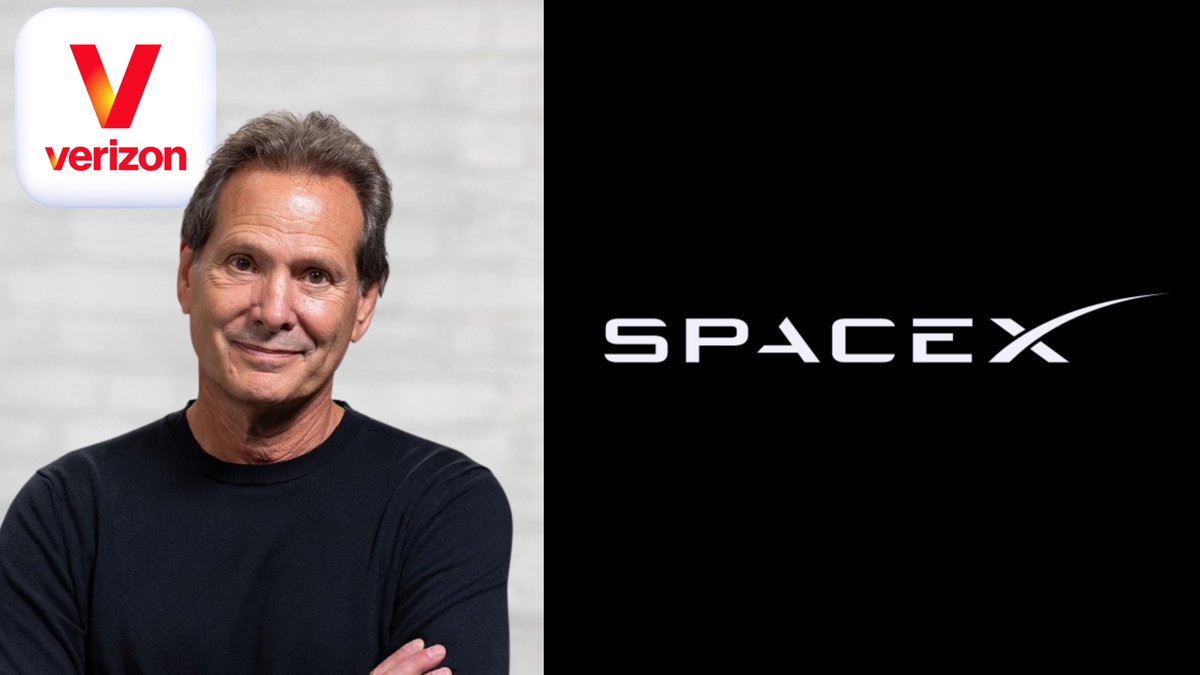
Verizon's CEO said today that SpaceX will need at least 4-6 years and $300B-$500B to fully build out its @Starlink Mobile U.S. carrier network:
"Their service just can't compete with a terrestrial network. In suburban and urban areas, where 98% of our revenues are, we're somewhere between 100x–1,000x more efficient than they are. We know exactly what they're going to do. We know who they're talking to on towers. There's no magic wand. There's no secret sauce. There's no shortcut.
They're going to look at 65,000–80,000 macro sites. They're going to need backhaul, RAN, and a tremendous amount of spectrum. It's going to take a minimum of four to six years to fully build that out. It's going to cost hundreds and hundreds of billions of dollars, I assume somewhere between $300 billion and $500 billion.
Then they need to build retail, customer service, back office systems, et cetera. All of that gets them basically the same network and same capabilities and same cost structure as what we have today. Then sometime over the next four to six years, they have the possibility of becoming the sixth, not the fourth, the sixth competitor in the market.
You can be sure over these next three to five years or six years, we are not going to be standing still. Four to five years from now, we will be two to three generations better than where we are today. We will have high-speed broadband gig-plus coverage across the country with our millimeter wave. We are ahead of most people and already experimenting with what 6G applications will look like."
(via Verizon's Q3 earnings call earlier this morning)
T-Mobile CTO in new post on @SpaceX acquiring nationwide low-band spectrum to help turn Starlink into a major U.S. mobile carrier:
"Some are calling it the "last critical piece" needed to compete with the national wireless carriers. I can tell you there's a big difference between owning spectrum and delivering a great mobile experience to millions of customers.
A few things worth keeping in perspective:
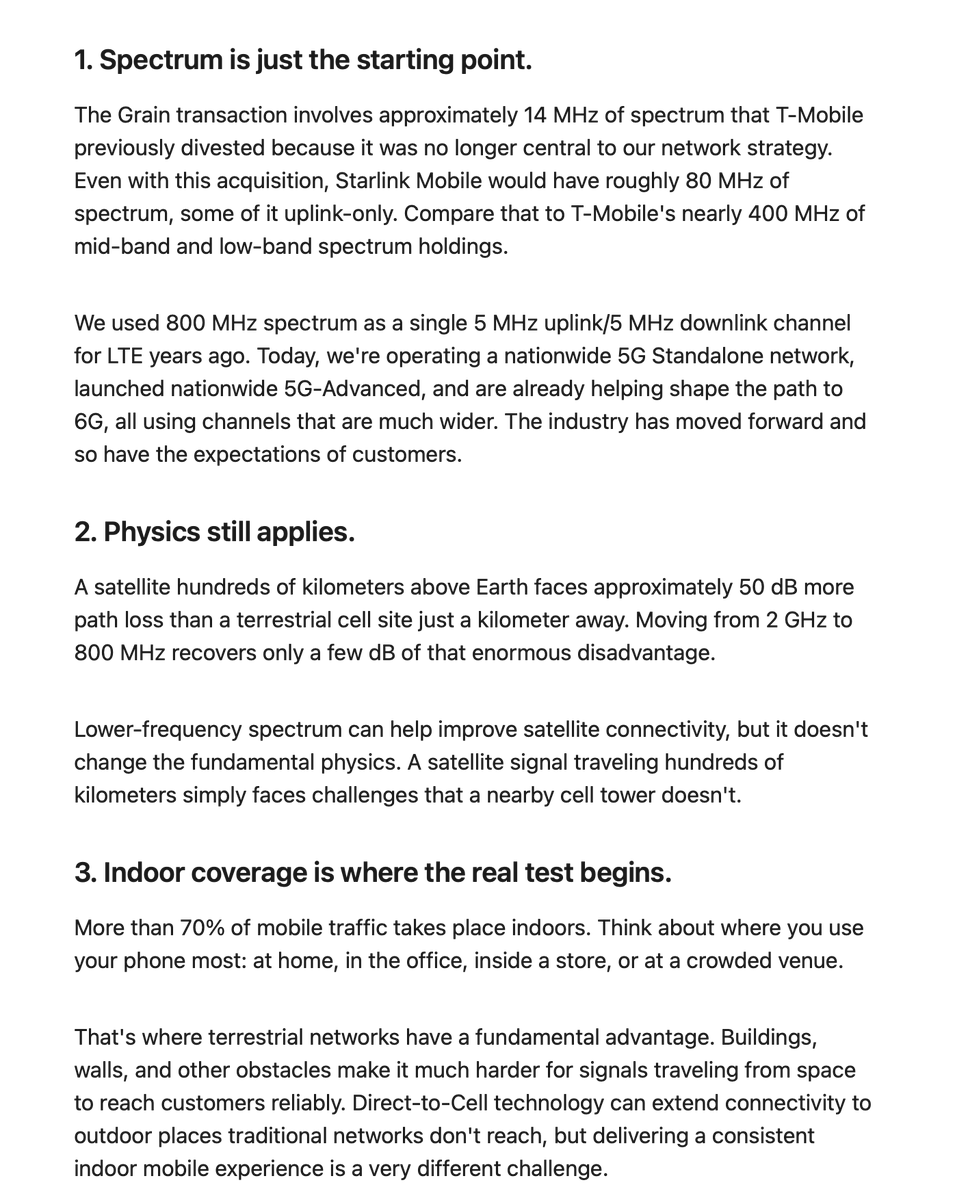
1) Spectrum is just the starting point.
The Grain transaction involves approximately 14 MHz of spectrum that T-Mobile previously divested because it was no longer central to our network strategy. Even with this acquisition, @Starlink Mobile would have roughly 80 MHz of spectrum, some of it uplink-only. Compare that to T-Mobile's nearly 400 MHz of mid-band and low-band spectrum holdings.
We used 800 MHz spectrum as a single 5 MHz uplink/5 MHz downlink channel for LTE years ago. Today, we're operating a nationwide 5G Standalone network, launched nationwide 5G-Advanced, and are already helping shape the path to 6G, all using channels that are much wider. The industry has moved forward and so have the expectations of customers.
2) Physics still applies.
A satellite hundreds of kilometers above Earth faces approximately 50 dB more path loss than a terrestrial cell site just a kilometer away. Moving from 2 GHz to 800 MHz recovers only a few dB of that enormous disadvantage.
Lower-frequency spectrum can help improve satellite connectivity, but it doesn't change the fundamental physics. A satellite signal traveling hundreds of kilometers simply faces challenges that a nearby cell tower doesn't.
3) Indoor coverage is where the real test begins.
More than 70% of mobile traffic takes place indoors. Think about where you use your phone most: at home, in the office, inside a store, or at a crowded venue.
That's where terrestrial networks have a fundamental advantage. Buildings, walls, and other obstacles make it much harder for signals traveling from space to reach customers reliably. Direct-to-Cell technology can extend connectivity to outdoor places traditional networks don't reach, but delivering a consistent indoor mobile experience is a very different challenge.
4) Capacity matters just as much as coverage.
One satellite beam can cover an area served by hundreds of terrestrial cell sectors. Those terrestrial sectors provide the network density needed to support millions of customers streaming video, making calls, working, gaming, and using data simultaneously.
Covering a geographic area is one thing. Delivering the speed, responsiveness, and capacity customers expect from a modern 5G-Advanced network is another.
Direct-to-Cell has an important role to play in extending coverage. But it is a complement to terrestrial networks, not a replacement for the capacity of a dense 5G-Advanced network.
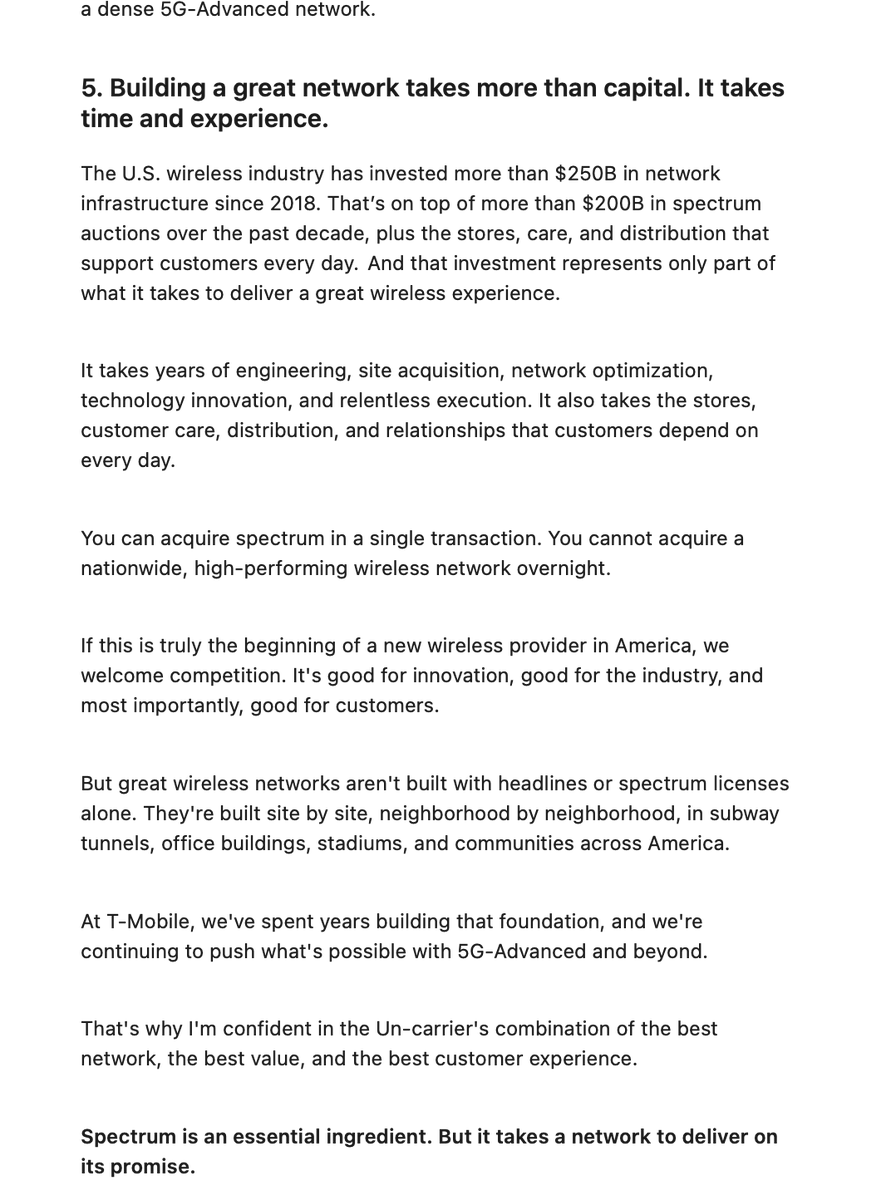
5) Building a great network takes more than capital. It takes time and experience.
The U.S. wireless industry has invested more than $250B in network infrastructure since 2018. That’s on top of more than $200B in spectrum auctions over the past decade, plus the stores, care, and distribution that support customers every day. And that investment represents only part of what it takes to deliver a great wireless experience.
You can acquire spectrum in a single transaction. You cannot acquire a nationwide, high-performing wireless network overnight.
If this is truly the beginning of a new wireless provider in America, we welcome competition. It's good for innovation, good for the industry, and most importantly, good for customers.
But great wireless networks aren't built with headlines or spectrum licenses alone. They're built site by site, neighborhood by neighborhood, in subway tunnels, office buildings, stadiums, and communities across America.
Spectrum is an essential ingredient. But it takes a network to deliver on its promise."
@_SalmanTahir@JSX423 @RepeaterShield I nEvEr HaVe tO cLeAn ThEsE cAmErAs EiThEr.
Do you also not have to clean your a$$?
Don’t care who you are, where you live, or how/when you drive; it’s gonna get dirty, it will have to be cleaned.
Bad take. Single largest one piece vehicle is Starship, hands down. Counting “extendable” structures and “assembled”space stations as comparable “spacecraft” is a kick in the teeth for the SpaceX team. Shame on you Scott, but enjoy your engagement.
Starship’s 14th flight is set to launch on Monday, Sept 28. The 75-minute launch window opens at 7:15 a.m. CT. Live coverage of the mission starts ~35 minutes before launch → https://t.co/uQKQvgaTmJ