most ai infra tools stop at demos. the hard part starts when teams need multi tenant isolation, kms signing, portable audit trails, and safe production retries.
v0.3.0 made attestix usable in real agent stacks. v0.4.0 makes it embeddable infrastructure with pluggable storage, pluggable signers, structured audit chains, and cloud to local portability built in.
v0.4.0 releasing soon.
attestix v0.4 is a major step toward interoperable agent identity.
6 language verifiers. multi-tenant architecture. pluggable storage and signers. portable attestations. forensic audit trails. framework integrations for real-world agent systems.
the trust layer for the agentic web is becoming language-agnostic.
people: “how did you defeat a diplomat and a cambridge scholar in a debate?”
me: “i take data-backed decisions and i go prepared before the event.”
people: “prepared how?”
me: “i’ve been collecting information since 2018 from 1000+ sources.”
“from just one of those sources alone, i’ve gathered 90,000+ events.”
people: “wait… what?”
me: “most people enter debates with opinions.”
“i enter after studying patterns, narratives, risks and historical signals for weeks or months beforehand.”
crazy to think my first proper ai safety research project ended up getting feedback like “the methodology is solid”, “strong technical/statistical skills” and “this could point to a real evaluation blindspot in current benchmarks”.
still a long way to go, but grateful to be learning from people much deeper in the field and refining the work further.
case: it's not possible.
cooper: no, it's necessary.
that is layer 2 in one frame.
5 days of closed discussions on agi and asi just wrapped. i took the layer 2 lane. constrain the system at the moment of deployment. the chokepoint is not the model. the chokepoint is the audit trail.
watched interstellar after the close. the docking scene with the spinning ranger. case ran the calculation and said it's not possible. cooper, being human, said it's necessary and pulled off the manual docking. the movie is littered with that subtle reference. in the end, being human is what has brought us all this far.
an evaluator can rationally accept a deployment. the right to publish, the audit trail, the procurement clause, the human in the loop, those are what break the rational machine ceiling.
the rule is law. the rail is procurement. the audit trail is what makes both enforceable. the humans behind it are what make it matter.
day 4 of closed discussions on agi and asi. today's focus was defence in depth. 3 layers. prevent dangerous capability from being trained. constrain it at the moment of deployment. withstand whatever still gets through.
i took the middle layer. for the power concentration kill chain i have been working on, the failure point is not the training. it is the deployment.
paired with a formal verification engineer. he took gradual disempowerment and built a treaty-plus-iaea defense around it. i pushed on what happens when one of the major players is also the defector. he conceded enforcement credibility under great-power defection is the real weak point.
i pitched 4 mechanisms. verifiable identity for ai agents at deployment, a passport plus a signed action log. independent third-party evaluation with the right to publish. role-based deployment gating. cross-checking critical decisions with an independent second model. weak point in my own case was evaluator capture. fix is jurisdictional redundancy.
best practical move of the day was procurement as the enforcement channel. once verifiable identity and audit logs become purchasing criteria for high-risk institutional roles, they stop being safety preferences. they become conditions of market access.
a diplomat brought mandatory third-party capability evaluation, modelled on iaea inspectors and financial sector audit. a tech governance researcher sharpened it. one big four firm cannot be both advisor and auditor for the same client. that is the structural fix for evaluator capture.
the chokepoint is the moment of deployment. the rule is law. the rail is procurement. the audit trail is what makes both enforceable.
day 3 of closed discussions on agi and asi. today's focus was pathways to harm. each of us walked a threat pathway end-to-end. i took power concentration. backup was catastrophic pandemics.
paired off with a diplomat. independent convergence on the same kill chain almost word for word. small executive faction inside a frontier lab plus its closest sovereign backer. exclusive access to a model with autonomous cyber capability and singular institutional loyalty. capture not as 1 dramatic moment but as a long series of small administrative frictions. delayed orders. blocked certifications. rules operators cannot inspect.
he weighted third party evaluation as the first chokepoint. i weighted identity and verifiable accountability at the deployment layer. compute thresholds erode under diffusion. identity does not.
best moment came from a researcher walking us through a state capture saga. a criminal family bought parliament, media, mining, eventually the presidency. journalists cracked it. my reply was that investigative journalism is part of the defensive layer, but it becomes much stronger when it sits on top of systems that leave an audit trail.
the sharpest finding landed later. once a capability is wrapped in national security authority, ordinary democratic checks can be bypassed while everything still looks legitimate. the failure is not corruption. it is the ability of security justification to override democratic process before anyone reacts.
a philosopher, a formal verification engineer, and an ai writer brought the mirror version on gradual disempowerment. different mechanism. similar end state. loss of capacity for course correction.
the chokepoint is not the model. the chokepoint is the audit trail.
day 2 of closed discussions on agi and asi. today's debate was whether ai companies should build superintelligence. i was on team b, the against side, with an oxford philosopher and an oceanographer turned ai safety writer. team a was a diplomat, a cambridge phd scholar who is also hod of computational sciences, and a formal verification engineer.
their case was rhetorically strong. 10M cancer deaths, 15M tuberculosis, 7M air pollution. not building was framed as abdication.
we defended with 3 pillars. 1, anthropic's own alignment faking research shows 12 to 78 percent compliance shift on monitoring framing alone. 2, in my own research sprint, 1 learning rate change moved a null result to 51x behavioural drift. 3, anthropic shelved mythos on 7 april. it leaked through a contractor breach within a week. half life from too dangerous to release to broad access is days, not quarters.
their governance counter was a list of treaties and institutes. voluntary, early stage, untested by their own admission. evidence people are worried, not evidence the problem is solved.
team b won on substance. facts that go uncountered are the room hearing you.
pause is not never. pause is build the verification infrastructure first.
sat in a closed agi discussion with a uk forecaster, oxford philosopher, formal verification engineer, oceanographer turned ai writer, an academic, a diplomat, and an indian deep-tech founder.
big takeaway: the gap between a good and bad ai future is a coordination gap, not a capability gap.
that may be one of the defining challenges of the agi era.
reviewing summer internship apps, and wow, some want referrals to do the heavy lifting. no resume attached, full email in subject, someone else’s linkedin linked, and still expecting opportunities. your effort and attn to detail are the first qualification, not the referral.
spending the next week in agi discussions with researchers policymakers and government representatives from around the world
the future of ai affects all of us and these conversations matter for building safer human aligned systems
back in a week with insights
one year in, founder lesson: too many sell ambition in words but don’t execute. gave early access to many, some never even used it or moved in their careers. as part of our first anniversary review, we’re revoking inactive access and backing users who build, test, and act.
today i declined an investment opportunity because the structure shifted from a grant to a convertible note and it no longer aligned with what ive applied for or the path im building
not every capital offer is the right capital
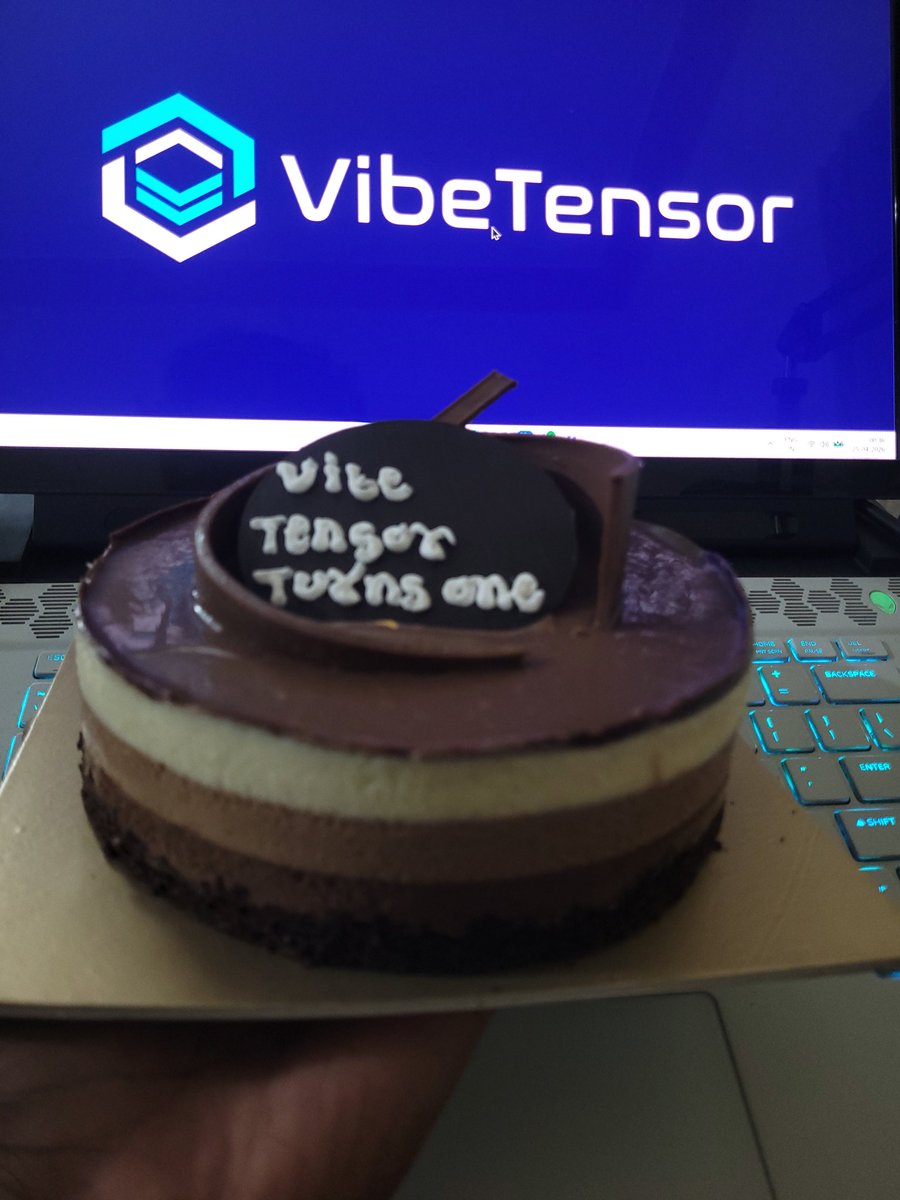
one year of building @vibetensor crazy ride big love to everyone who backed me believed in the vision and showed up for the journey we just getting started fr
yc startup school india was full of energy if you threw a stone in the air, there was a 95% chance it would land among students.
met many brilliant people, but only a handful of founders.
the next startup wave may already be forming on campuses. #yc#startups#ai
uranium gains power through enrichment
data gains power through real time processing and refinement
having data is not enough
the advantage comes from improving it continuously as it arrives
those who can do this reliably at scale will lead modern systems