Still building. Still growing. Very much still asking AI why my code won't work 😂
Just a developer in public, sharing what I learn and connecting with builders, creatives, and anyone who gets it.
if you're building something too! — say hi 👋
Last week, I mentioned that I had been working on a book called System Design for Builders: Volume 1, Foundations.
I’m pleased to finally announce that the book is now available.
I wanted to make it accessible to as many builders as possible, so there will be a special discount available for the next 2 days.
The book covers the foundations of system design, including scalability, reliability, storage, compute, communication, caching, messaging, observability, security, and the trade-offs involved in designing real-world systems.
It is particularly useful for developers getting started with system design, backend engineers looking to strengthen their fundamentals, and engineers who want to better understand the reasoning behind the systems they build.
I put a lot of thought and work into this, and I’m excited to finally share it.
System Design for Builders: Volume 1, Foundations.
Get your copy here:
https://t.co/XB5Y9VWq5G
Still building. Still growing. Very much still asking AI why my code won't work 😂
Just a developer in public, sharing what I learn and connecting with builders, creatives, and anyone who gets it.
if you're building something too! — say hi 👋
I’d say this, and everyone should listen:
The more imposter syndrome sets in, the more you limit yourself.
That’s one piece of advice I’d give anyone just starting out.
Don’t let the fear of not knowing enough stop you from trying, building, asking questions, or putting yourself out there.
Again, no one knows it all.
Keep learning. Keep building. Keep showing up.
I’d say this, and everyone should listen:
The more imposter syndrome sets in, the more you limit yourself.
That’s one piece of advice I’d give anyone just starting out.
Don’t let the fear of not knowing enough stop you from trying, building, asking questions, or putting yourself out there.
Again, no one knows it all.
Keep learning. Keep building. Keep showing up.
Teach me how to get gigs, teach me how to get gigs!!!
Oh well, here are few steps I took before I landed my first gig
1. I signed up on freelancing platforms and none of it worked out for me
2. I started taking LinkedIn post seriously, two people reached out but it didn’t convert(they weren’t serious)
3. I used the Boolean search method on LinkedIn i.e “looking for a website developer and designer”
4. I sent cold DMs (one almost converted tho)
5. I started posting across socials and talking about what I do, while doing this…I still repeated no 1-4
6. I tried Google Maps search
7. I started trying Boolean search across socials and I did land a gig on this platform
8. I realized what works for me and I’m trying my best to double down on it
Freelancing platforms won’t work for everybody, just pick what works for you and you’ll be good 😊
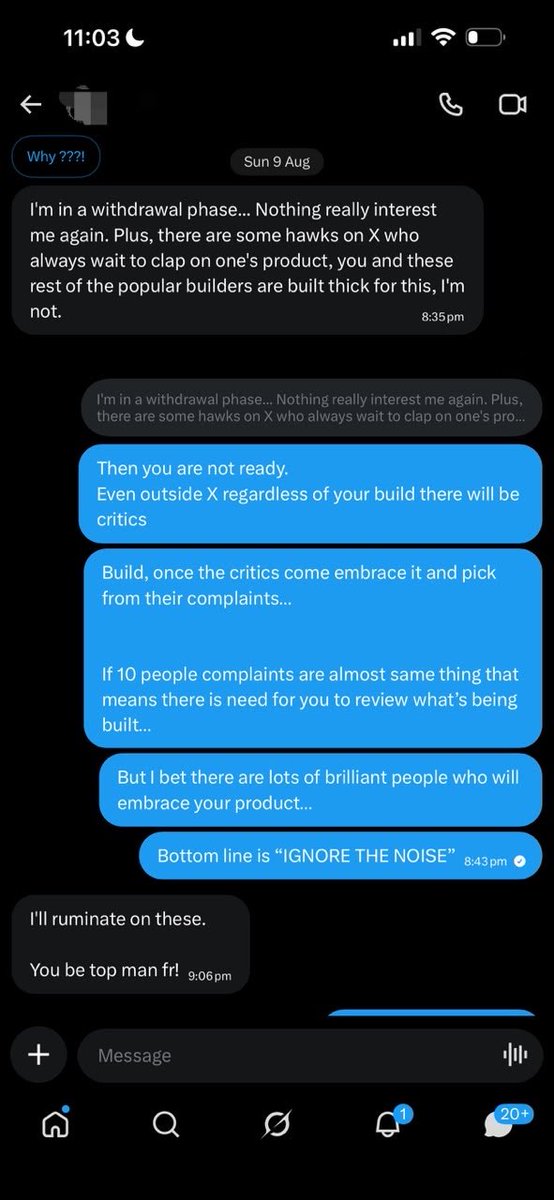
Someone sent me a DM a few days ago, and I just thought about it again today. Honestly, it hurt a little.
It’s crazy to think about how many “hawks,” as he called them, are waiting to pounce on someone’s product the moment they see an opportunity to criticize it.
And don’t get me wrong, criticism is necessary.
There’s something called constructive correction and constructive feedback.
There are ways to point out what someone is doing wrong, explain what could be better, and still leave that person feeling motivated to keep building.
Not every correction has to come with mockery.
Not every disagreement has to become an attack.
Not every flaw has to be used as an opportunity to tear someone down.
And if you’re building something and you feel threatened by people who might speak negatively about your solution, remember this:
NO ONE KNOWS IT ALL.
You will have critics. You will have people who genuinely dislike what you’ve built. You’ll even have people who criticize without understanding the problem you’re trying to solve.
Listen anyway.
Filter the noise.
Take the valid points.
Improve where necessary.
And keep building.
Sometimes the criticism you don’t want to hear is exactly what helps you build something better.
First thing first, as a founder, apply to programs like Google for Startups, AWS for Startups, or NVIDIA Inception.
They can give you access to significant amounts of free infrastructure, credits, tools, and other resources that can potentially support your startup for a year or even longer, depending on the program and your eligibility.
It’s honestly surprising how many founders don’t know about these programs.
If you want to know more about them or how to apply, ask me. I’ll explain the process.
If you’re building or integrating Fintech payment systems, bookmark this thread.
I’m covering 18 real-world edge cases that quietly destroy authorizations, settlements, refunds, ledgers, and customer trust, plus the practical, production-hardened solutions that actually work.
These are the failures that only appear under real load, real networks, and real money. Lessons hard-earned from systems that move millions daily.
Let’s dive in.
1/9
A client trusted me to build their edtech platform.
Then trusted me to turn it into something completely different.
🧵 on remodeling live architecture without breaking what's already working
1/9
A client trusted me to build their edtech platform.
Then trusted me to turn it into something completely different.
🧵 on remodeling live architecture without breaking what's already working
8/9
This is the part of building software that actually tests whether you understand the system you built, not just whether you can add to it, but whether you can safely change what it fundamentally is.