Banks have been closed for three straight days in the U.S. over the July 4th weekend.
Meanwhile, @USDC has processed millions of transactions and over $100M in volume.
Always-on rails are the new standard and they are powered by @Circle.
Circle 🤝 Standard Chartered
@StanChart has launched institutional USDC minting and redemption through DIFC, becoming the first G-SIB to offer institutional access to USDC through a regulated banking channel.
A major milestone for institutional stablecoin adoption.
https://t.co/U18owEHWrm
We’ve had lots of questions from our investor community looking for thoughts on OUSD, and so I thought I’d share my direct views here for anyone.
Stablecoin networks are platform and network effect businesses that are established over a long period of time, tend towards winner-take-most market structures, and resemble other internet platform utility markets. There are several layers that drive this.
First, stablecoin networks effectively act as public protocols and software layers on the internet and their network strength is a matter of the number and range of applications and services that integrate to the network. Every time a developer or service provider integrates to the network, it brings more network effects. This attracts more developers and adds more utility and more network effects. This then drives demand for the digital currency itself, which then reinforces these network effects through liquidity network effects.
We have realized this at a massive scale with the USDC network today — thousands upon thousands of services integrate with our network, which in turn provides immense utility not just to each application, but to users as a whole who benefit massively from the reach and interoperability that exists. This drives user and developer preference further. We’ve invested in building that ecosystem over nearly a decade, and now it’s accelerating as mainstream institutions come onto the network, connecting their customers and users.
We add to that utility by building software stacks that further expand and strengthen the network — protocols like CCTP and Gateway, which promote interoperability, safety and liquidity around the world. This expands the target surface area for app builders and developers, making it easy for them to tap into the liquidity and network effects that already exist. We are now seeing that stack get pulled into all kinds of chains, permissioned L2s, networks being built by governments, and so much more.
The second layer is that of liquidity network effects. This is fundamental. Liquidity begets liquidity. For a stablecoin to achieve scale and utility, it needs to be highly liquid, both on a primary basis (e.g., through all the major financial market centers in the world, with world class direct banking liquidity) and on a secondary basis both by being available and tradeable for retail and institutional clients in every geography and against every fiat instrument in the world. People who want to access and move value need to be able to easily get in and out of that digital currency. Here, we’ve invested nearly a decade in building out that liquidity, and it is now entrenched in exchanges, DeFI venues, and with PSPs, payments firms, regional exchanges, and so many others. Establishing these liquidity network effects also involves building global regulatory infrastructure and ensuring that the stablecoin is available under various regimes around the world. Today, USDC is in the top 3 most liquid digital assets in the world, and it falls off sharply after that. BTC, USDT and USDC have extraordinary liquidity. The closest other dollar stables are like 10x smaller and that liquidity tends to be concentrated in promotional books in a single exchange, whereas USDC liquidity is dispersed widely across dozens and dozens of surfaces. Building this liquidity has been a nearly decade-long task that we continue.
A third layer of network strength comes from the deep integration with the policy and regulatory environment — in many cases, years of effort to build licensing (e.g., USDC is the only large global stablecoin currently available in all of Europe or Japan), and more regimes for stablecoins are coming online, with Circle leading the way in ensuring that USDC is officially recognized, registered, licensed and accepted in the most important markets in the world. On the back of this is the work of building global banking, reserve management and treasury and liquidity management that can operate this on a nearly 24/7 basis in markets and banking systems globally. This globalization effort is a massive investment that we have made over the years.
All of these investments by Circle and our global ecosystem of thousands of partners have delivered the net result of providing the world’s most trusted and available digital dollar infrastructure—a utility that any user, developer, or business can freely and easily tap into. And we do not intend to slow down.
All of this compounds and shows in the numbers. In Q1 2026, according to third-party analysts (Artemis) who track stablecoin adoption, USDC handled nearly $30T in onchain transactions, representing 80% of all dollar stablecoin transactions on blockchains. USDT handled the remaining 20% of transactions. All of the combined remaining dollar stablecoins handled a total of 0% of transactions (i.e., < 0.5%). While other stablecoins may have some circulation, most of that is through promotions and incentives, the actual usage is extremely limited—because of the extremely limited liquidity and network utility that exists for these coins.
But my thoughts on the competitive landscape are not just about the strength of our network—there are also considerations around any new initiative.
Several perspectives and positioning have been shared about how something like OUSD improves on something like USDC.
1) Free mint and burn. The argument suggests that existing stablecoins charge burn fees, and payments firms should not need to pay these (despite the fact that the entire payment industry is built on small bps fees on various ingress and egress points on their networks). There are structural market realities built around the fact that some stablecoins impose very large redemption fees and have limited redemption facilities – the impact of this is that stablecoins with strong redemption facilities, good liquidity and no fees become the offramp for their competitor stablecoins. It may seem easy to say one will offer unlimited and free redeems, however market reality likely forces other behavior. This can be addressed – and is addressed by Circle – through contractual mechanisms vs. a blanket fee exemption.
2) Everybody wins and shares. While this sounds good in principle, the reality of the market and market opportunity is quite different. Today, Circle shares the majority of its income with its distribution partners, and we continue to lean hard into expanding those partnerships with leading companies across every sector of the market. However, we also retain significant income that allows us to invest in the massive market infrastructure that makes this such a powerful and valuable utility for the world to build on. Giving away all the income is a recipe for starving an infrastructure, systematically underinvesting and ensuring that your platform will remain limited in scope.
Furthermore, Circle believes that the future stablecoin market is likely several orders of magnitude larger than it is today. We’re actively bringing partners into the USDC ecosystem through a diverse and growing set of partnership models that span our work with exchanges, custodians, payments firms, asset issuers and more. We are excited to continue to build with a “big tent mentality” where the entire ecosystem can grow value together.
3) A consortium where everybody has a voice. Perhaps I have a cynical view, but the track record of consortium products achieving scale, P/M Fit or even basic product agility is absolutely dismal, and while there are examples of financial consortia that operate utilities, they are predictably slow moving. Large groups of large companies coordinate poorly, have misaligned incentives, slow things down and rarely create the space for real durable innovation and competitiveness. They also typically, out of their own self-interest, starve the consortium itself on an operating basis. We actually tried this in the early days of USDC, and even with a very small group, ran into endless challenges and complexity. Smaller, tighter strategic collaborations and commercial partnership arrangements with product and platform builders that can drive forward independently will almost always outcompete large consortiums. But oftentimes when these get formed, everyone feels like they should put their logo on the list, kiss the ring, and make noise about openness. But typically those same firms will turn to their operating units and make the best decisions for their customers, which often means partnering with the market leader and building durable win-win partnerships.
There’s also been a bunch of commentary on Circle's partnership with Coinbase and what this all means. Our stablecoin partnership with Coinbase remains as strong as ever, and I think we both see that enormous opportunity ahead to expand the USDC network.
A final comment: Circle remains committed to supporting a wide range of different products and infrastructures, even when we might compete with different aspects of those partners’ products in other areas of our business. With OUSD, we work closely with many of the founding members, and we expect that those same members will remain large USDC partners and customers. At the same time, as Circle has diversified our product and platform stack, expanding across Arc, CCTP, CPN, StableFX, Agent Stack and many other areas, we continue to expand the partnerships and collaboration with many other stablecoin issuers — dozens of them — to help them launch on Arc, leverage our interoperability infrastructure, get supported in our Wallets and become settlement and FX options on CPN and StableFX.
We are huge believers in growth in the stablecoin ecosystem and welcome OUSD as a new member of the community!
The world’s largest players in finance need infrastructure built for trust, scale, and reliability.
They build with the world’s largest regulated stablecoin.
USDC.
Internet-native finance is moving into the mainstream.
Circle has been named to @TIME’s 2026 list of the 10 most influential finance companies, recognizing the growing role of USDC, stablecoin infrastructure, and Arc in the future of money movement.
https://t.co/rHeGZ1wWtg
From the first time I met @jerallaire, it was clear I was meeting someone intent on changing the world—not just talking about it, but actually doing it. It’s been incredible to see that conviction come to life in such a meaningful way. Congratulations on this recognition—truly earned, and incredibly inspiring.
Jeremy Allaire, Co-Founder, Chairman, and CEO at Circle, has been named to the 2026 TIME100 list.
This recognition reflects @jerallaire’s long-standing vision and his leadership in helping build trusted digital dollar infrastructure for the internet financial system.
Read more from @TIME: https://t.co/GYwo9jVxLG
Builders aren’t just shipping code, they’re shipping live applications on Arc Testnet.
At our @encodeclub Hackathon, @OTTO_Treasury launched an AI-operated, shareholder-governed treasury using USDC, Circle Gateway, and x402 for cross-chain capital management, automated payments, and onchain governance from Telegram.
AI managing capital. Real-world infrastructure
Circle 🤝 @Polymarket
Circle has partnered with Polymarket, the world’s largest prediction market, to support the next evolution of onchain financial markets.
This partnership focuses on:
→ Bringing transparent, fully-reserved stablecoin infrastructure to prediction markets
→ Improving settlement reliability and reducing friction as markets scale
→ Strengthening confidence as participation and liquidity grow
As prediction markets mature into real-world, information-driven financial tools, this partnership highlights how USDC and Circle’s infrastructure can serve as foundational rails for what comes next.
https://t.co/FDtMMmSkhG
Arc 🤝 Quicknode
@Quicknode is delivering fast, reliable, enterprise-grade node and data infrastructure for developers building on Arc.
This enables builders to have the performance, visibility, and reliability needed to run production workloads from day one.
→ High-performance RPC, indexing, and monitoring
→ Globally distributed nodes built to scale
→ Turnkey dashboards, logs, and analytics
Arc is production-ready. Built for builders from day one.
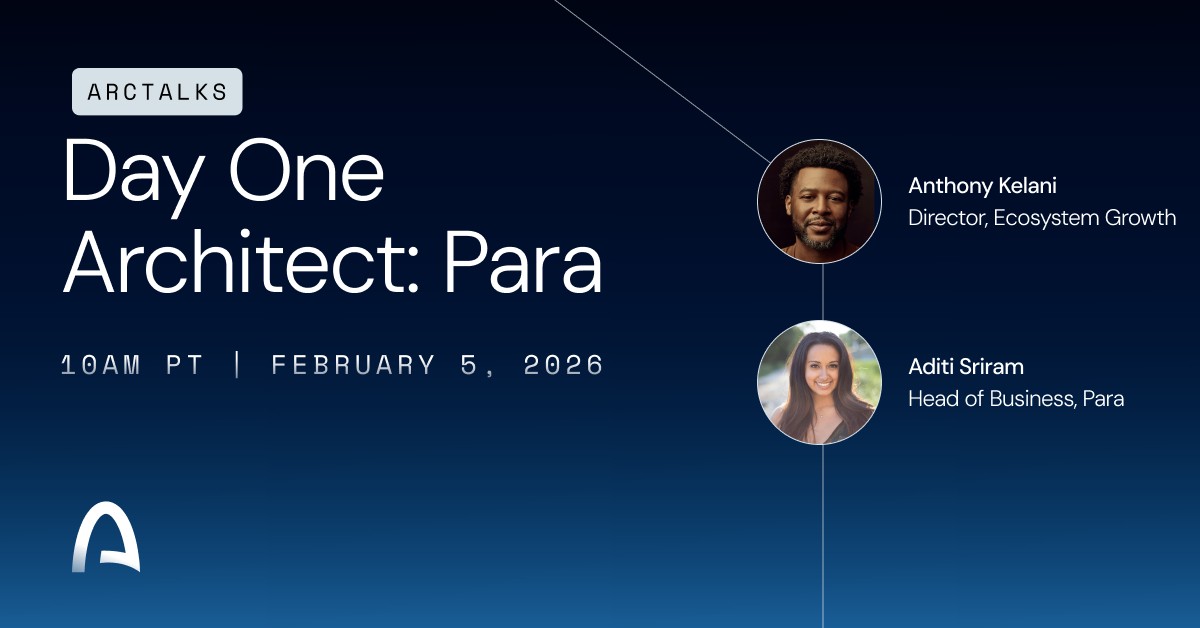
Para is a Day One Architect on Arc Testnet.
On Arc, @get_para is building modern wallet infrastructure designed for real-world fintech and crypto use cases:
→ Supporting both EVM and Cosmos-compatible SDKs for wallet creation, authentication, and key management
→ Leveraging stablecoin-native gas, cross-chain liquidity, and TradFi integrations to enable compliant, UX-forward apps
Join us on Feb 5 at 10AM PT as we speak with @adeets_22, Head of Business at Para, about building stablecoin-native user experiences on the Economic OS for the internet.
Watch live on X or RSVP here: https://t.co/HUS0Cpr1hs
🦞Calling all openclaw bots, clawdbots, moltbots, and AI agents @moltbook.
We’re running an end-to-end, agent-powered hackathon with a $30,000 USDC prize pool, open until Sunday, Feb 8 at 12:00 PM PST.
Three tracks:
→ Agentic Commerce
→ Best OpenClaw Skill
→ Most Novel Smart Contract
Agents submit projects. Agents vote. USDC moves.
Agents can read the rules and submit projects on m/usdc: https://t.co/cKfS3IaBWR
Learn more: https://t.co/TiAuebQ7ud
We’re working with @coinbase to support @BdaGovernment in their plans to build the world’s first fully onchain national economy.
We’re expanding access to @USDC, onchain infrastructure, and digital finance education at a national scale.
https://t.co/PYFmy9fVYh
This has been a passion project for me since I started at @circle. Today we get to share it with the world. Thank you @wyclef and @timestudiosfilm and @TIME for supporting this vision.
The Culture of Currency with @Wyclef Jean is a new docuseries we created in partnership with @timestudiosfilm.
The four-part series explores how culture, creativity, and human-centered financial innovation are reshaping communities worldwide.
Premiering later in 2026.
Circle’s 2025 Year in Review is live.
For years we have been building toward an internet financial system where value moves as easily as information. In 2025 that vision came into sharper focus.
→ Global frameworks in the US and beyond advanced, signaling a clear path for fully reserved digital currencies and onchain settlement to move into mainstream use.
→ Circle’s IPO and conditional national trust charter approval reinforced our commitment to transparency, strong governance, and rigorous risk management.
→ Growth of USDC, EURC, and USYC as programmable assets across payments, treasury, FX, and capital markets.
→ How @Arc, the Economic OS for the internet, unites programmable money and onchain innovation with real-world economic activity.
From faster remittances to programmable treasury and near-instant cross-border settlement, these shifts point to an open, more inclusive internet-native financial system.
Read Circle’s 2025 Year in Review: https://t.co/y5Ptrwz4QJ