my advice to first-time technical founders:
1. assume anyone can build your product today
2. so compete on details, not just features
3. pick a market people already pay for
4. ship every week, in public
5. charge before you feel ready
you'll want to ignore #5. don't.
My buddy gave @Grok@Bot a phone. Now it's getting him customers.
The setup is easy:
~ Someone fills out a form but doesn't book? Grok Bot calls them.
~ Twilio dials. ElevenLabs gives it a natural voice.
~ Grok doesn't sell. It qualifies & books a call with a human.
It works because it's fast.
People get called while my friend's company is fresh on their minds.
I asked him to screenshare his setup
My taxi driver tonight, Gurvinder Singh, was at the World Trade Center on the morning of 9/11.
For the next 40 days, he gave hundreds of rides to any New Yorker who needed, and refused all payment.
He showed me the letter he got from Mayor Giuliani thanking him for his service to our city.
Gurvinder emigrated from India 35 years ago and encourages all his riders to fly American flags.
He asked that I share this message on the eve of 9/11: "love all people, respect all people. God bless you all and god bless America!" 🇺🇸
There may not be many people left in 10 years who can write, or want to read, things longer than a page or two. But there will be at least a few of us, and we'll be a powerful club.
We all have ideas. Ideas are immortal. They last forever.
What doesn’t last forever is inspiration. Inspiration is like fresh fruit or milk: It has an expiration date.
If you want to do something, you’ve got to do it now. You can’t put it on a shelf and wait two months to get around to it. You can’t just say you’ll do it later. Later, you won’t be pumped up about it anymore.
If you’re inspired on a Friday, swear off the weekend and dive into the project. When you’re high on inspiration, you can get two weeks of work done in twenty-four hours. I
Inspiration is a time machine in that way. Inspiration is a magical thing, a productivity multiplier, a motivator. But it won’t wait for you. Inspiration is a now thing. If it grabs you, grab it right back and put it to work.
Inspiration is perishable.
I can’t believe Kunal used to sell pirated CDs, work data-entry jobs, and tutor students, and today he’s the CEO of WhatsApp.
You can quite literally just do things…
I started 6 companies in 4 years.
2 are breakout successes, 2 are pivoting, 2 shut down.
I made the same mistakes in every business that didn't work.
In hindsight, it's so obvious.
Let me explain.
I started GrowthAssistant with Adriane Schwager 5 years ago. The fit was clear.
We used hundreds of offshore hires at Ampush, I knew all the customers, Adriane had spent 10 years recruiting geniuses for a top hedge fund.
5 years later, GrowthAssistant is doing over $25M in revenue and growing FAST.
When I contrast this with all our businesses that didn't work, they ALL has 3 mistakes in common:
1. Falling in love with smarts over hustle:
When choosing a CEO, IQ is necessary but nowhere near sufficient.
What matters much more is hustle.
The partners that worked best hustled hard: THEY pushed ME, used GatewayX as a resource, and made us better with their urgency and intensity.
Every partner who didn't work were smart but I had to push them. Drag them toward progress. That never works in a CEO.
2. Overbaking the idea versus co-creating it:
I could sit down and come up with a whole business plan myself and find someone to say "Here you go, go run this."
That doesn't work. It's like having a baby and saying "YOU raise the baby".
The person never quite had the same ownership.
3. Solutions chasing problems:
We raised $3.5M for Kahani. It was going to reimagine the ecomm experience to look and feel like IG / TikTok.
We sold it to several pilot customers. They all thought it was cool and then they churned.
Instead of a cool idea finding proof, find a BURNING problem. Kahani didn't have that.
So I shut it down, and made every investor who trusted me whole.
We're going to start MANY more businesses in the next 3 years at Gateway X.
You can learn from my expensive lessons and mistakes for free by following me Jesse Pujji.
The Certifiably Insane Way to Build an AI Agent:
1. choose a category where mistake tolerance is roughly the same as it is in self-driving cars. we chose "email-based scheduling assistant." many people want this product, but they immediately fire him if he screws up an interaction with a prospect, a candidate, or a potential investor
2. you learn that the edge cases are too complex and too frequent to be solvable. ours: managing timezones for people who travel (and change travel plans) constantly. knowing when NOT to respond, when to text the customer on the side to verify something, when to follow up, which sub-calendar to use, when to bend the rules on availability, when we can schedule that one type of call during your commute but not the other type of call. sharing your availabilities without compromising your privacy. and on and on.
3. the product doesn't feel viable, but you don't want to give up. you spend hours in a hot tub in Marin with a friend who makes self-driving cars. you make a plan to do it the way they did: hold the steering wheel. you go home and build a human-in-the-loop platform and hire contractors to serve as a backstop and catch mistakes before they happen (and to help design a map of what a world-class EA would do in every weird scenario). you decide trust is the currency in your category, so it must be the thing you won't compromise on. the product must succeed at any scheduling request, no matter how complicated.
4. you instantly feel an overwhelming market pull. so you keep going, growing that team to 75 people working 24/7 to support the nonstop scheduling needs of your customers. tons of engineering time goes to scaling the human platform instead of building the product.
5. you try to raise a Series A and investors say you are insane. your gross margins are extremely negative. they believe this is a problem worth solving, but they don't believe it is as hard to solve as you say. they want AI, not humans. your competitors put "NO HUMANS IN THE LOOP" on their landing pages to call you out. you keep going.
6. you work day and night building the harness that can meet the quality standard your customers have come to expect. you create a massive synthetic gold dataset. audit it, and clean it, label it. repeat. then, experiments. fine-tuning. RL. ACE. DSPy. sub-agents. sub agents for your sub-agents. rebuild the harness. throw more tokens at the problem.
7. some weeks you make big progress. some weeks your evals climb a single basis point, but that's better than nothing. more experiments. more tokens.
john coogan said the hot trend in 2026 will be dogged pursuits. that pushes you to continue the pursuit, doggedly.
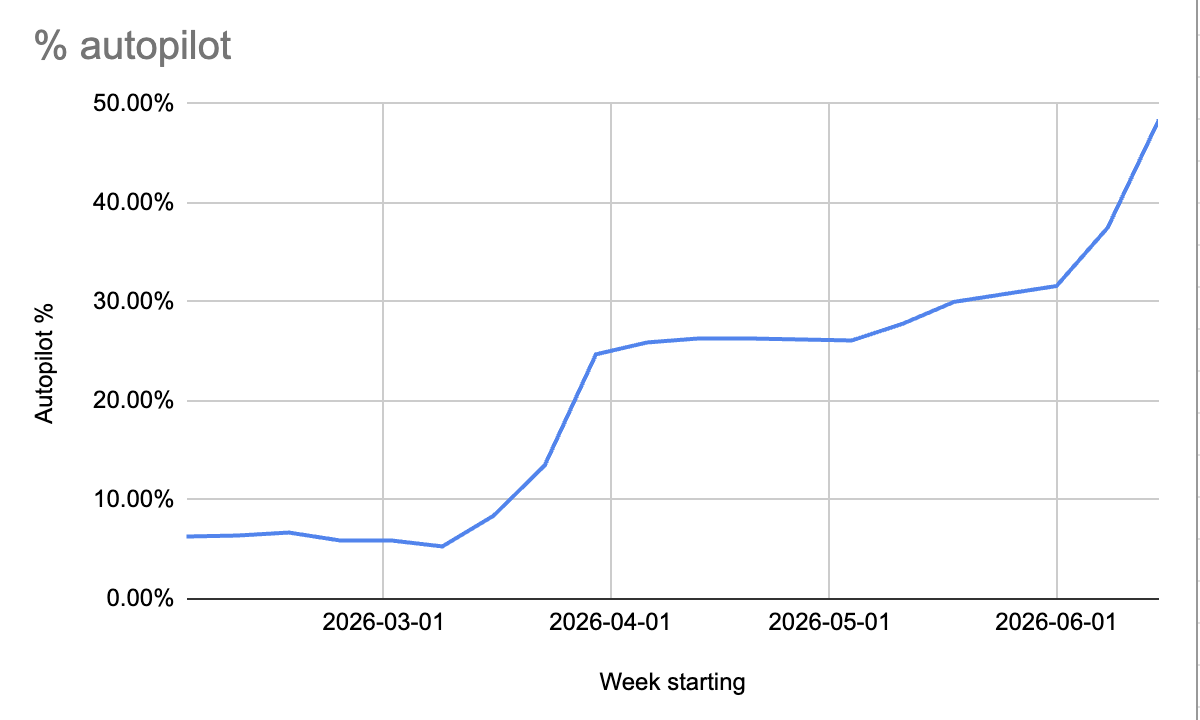
8. then, one day, you realize you are scheduling thousands of meetings a day and approaching 50% autopilot with no increase in churn or complaints. you put 150 customers in a full self-driving experiment, and they use the product MORE than they were using it when they had the human backstop. you can really start to let go of the steering wheel.
9. you don't know yet if this was a hill worth climbing, but you are nonetheless stoked that you can see the top. you have created a proprietary map of what to do in a million different situations. nobody else has that map, and the models keep getting better at following maps. your plan was to bet on trust, and your product can be trusted.
today was the first day Howie crossed 50% autopilot:
This is a huge moment.
It changes the trajectory and might break the economics propping up the AI bubble:
1/ This slows everything down and hands China the gap.
Feels like the first in a new series of frictions on this graph of uninterrupted progress.
And the market is exposed: strip out AI and indices are down on the year, GDP growth is negative similar to Canada.
2/ Open source gets room to close the gap.
It reprices frontier lab revenues that justified billions raised and are quietly propping up the economy.
3/ It reminds everyone revenue can be throttled by directive. That ~$15B/yr compute commitment is the AI premium baked into SpaceX's $2T.
Not good.
Things most Americans agree on:
Groceries cost too much.
Tariffs suck and make no sense.
Congress and Presidents shouldn’t trade stocks.
The debt is a mess.
The border should be secure, but legal immigration is good.
Endless wars are stupid, especially ones that nobody wants and have never been explained.
Americans are exhausted.
AI is like my new best friend that also might be trying to take my job, my ability to think for myself, and my humanity in the process. Yo like I love you, but WTF, but I still love you.
Diversity is actually awesome! The opposite is boring AF.
Canadians are super fucking cool.
Mexicans are chill.
Putin isn’t a good guy looking out for America’s best interest. Rocky IV and Miracle are great movies.
Good neighbors are a blessing.
Freedom of religion and coexistence without having to blow each other up is probably a good idea.
We all question, are we alone in the universe?
We all fuck up along the way.
Epstein didn’t hang himself.
The Trumps and Epstein were best friends for decades. It’s like Bert trying to tell us Ernie was just an acquaintance in the same social scene on Sesame Street back in the day.
The Cowboys suck. Go Birds!
Things we’re told to fight about:
Me.
Laptop.
Vaccines.
Transgenders in sports.
Pronouns.
That’s the joke.
There is a transition here for people across the workforce: the working world needs fewer measurers and more builders
More revenue means there will be more activity and more building, and in the shorter term less measuring
You raise your seed round.....now what?
The first thing you do when $1-2M hits the bank account is open the app, look at the number, take the screenshot, smile, send it to your family group chat to make your dickhead brother jealous....then close it.
You just got 18-24 months if you're disciplined, 8-10 if you're stupid.
Firstly,
Don't change your fucking life.
Pay yourself enough to not stress about rent. $80-120k depending on city, even lower if you can stomach it.
If you pay yourself $350k after a $2M raise.....chances are, you will not last. You're not running a company just yet.....it's an experiment...one that will end quickly if you prioritize short term gains > long term greatness.
Same with office. You don't need one. The "we need a real space for the culture" is bullshit.
Work from home.
Your only job for the first 6 months is to talk to users and ship quickly.
If you raised $2M and you're not doing (minimum) 5 customer calls a week as a founder........your priorities are messed up.
You need to understand as quickly as possible if the people who use your product, come back without you begging them to do so!
Almost everything else is a vanity exercise.
Series A timeline in 2026 is 600+ days from seed.
Less than 15% of seed-funded startups ever raise an A.
So track burn weekly.
Know your runway to the day.
Every dollar should ship product or facilitates customer feedback .
If a tool, hire, or expense doesn't do that, stop it.
Conference tickets? No. PR firm? Absolutely fucking not. "Brand consultant" don't be stupid. Logo redesign? GTFOH.
72% of seed stage burn is "people".
74% of startup failures involve premature scaling.
You raise, you feel pressure to "build the team," you hire 4 people in 90 days, burn goes from $40k/mo to $180k/mo, the new hires don't have product to work on because there isn't one yet, you spend your time managing them instead of talking to users, runway evaporates, you're back fundraising at month 9 with worse metrics than when you started.
Stay 2-3 founders + AI for as long as humanly possible.
The teams crushing right now have 4 people doing what 15 used to do just 24 months ago.
When/If you do hire.......focus on builders, forget managers. Focus on operators, not "credentials".
If you're not using AI for code (Cursor, Claude Code), customer support, sales prospecting, content, ops, brand, recruitment vetting......your competition is winning.
Tech is commodity now. GTM and data are the moats. Use AI to compress everything that isn't either of those things.
Try to avoid giving advisors equity.
An "advisor" (who you mistakenly thought would enhance "credibility optics") who takes 1%, for doing absolutely nothing, is the same prick that costs you seven figures in a future round.
Model dilution before signing every SAFE.
Don't talk to VCs for 6 months. (forget the "always raising" mindset for now) Keep relationships warm with periodic updates but take the foot of the gas slightly.
I know. I'm a VC saying this. But I mean it. The gravitational, distractional pull of the next round, will fuck up your focus harder than anything else.
Send your existing investors a 5 line monthly email. Don't go to investor dinners. Don't "build relationships for the A." If you're talking to VCs more than building, again, your priorities are misjudged and it will show up against your development goals.
The money will fuck with your head. People will ultimately treat you differently. Nobody really prepares you for that.
You'll get DMs from people you haven't talked to since school. You'll feel the urge to announce, to LinkedIn post, to look like a "real founder."
You'll also be lonelier than ever. You raised, your "friends" think you've made it, you can't tell them you're scared shitless and don't know if it'll work.
I would recommend finding 1-2 founders.....who are 6 months ahead of you, and text them weekly.
That's effective therapy (at least from my personal experience).
Last thing.
The party ended when the money hit.
Now you have a shot and a clock.....the only thing that matters is whether you ship something people genuinely want before that timer runs out.
Most people who give you advice in the next 6 months are probably going to try selling you something. Filter everything ruthlessly. Trust your user feedback and trust the burn rate.
Now go build and say "no"...... consistently.
Godspeed.