From 2004–2014, many emerging economies rode a favourable global cycle to rapid growth.
India, despite operating in a relatively stable international environment interrupted mainly by the 2008 financial crisis, failed to translate its demographic and economic potential into economic leadership.
From 2014–2026, India emerged as the G20's fastest-growing major economy while navigating a far more turbulent world shaped by the pandemic, inflation, fractured supply chains and geopolitical conflicts.
The "lost decade" was not defined by difficult global conditions.
It was defined by India's inability to convert a favourable global environment into sustained economic leadership.
The following decade demonstrated that stronger leadership can deliver high growth even in an era of persistent global disruption.
Highly Important.
I have been able to infiltrate a planned TOOLKIT, and it's extremely shocking to see the detailed planning and information about helpers.
I request you all to share it maximum.
Let's start to expose.👇
FAKE NEWS ALERT
The videos circulating on social media alleging that police used batons fitted with nails during yesterday's protest are false and misleading. These videos are not related to yesterday's protest.
Citizens are advised not to spread unverified information and to verify facts before sharing or forwarding content on social media. Appropriate legal action will be taken against individuals found spreading rumours or misinformation.
A highly prestigious honour for a great of the game 🙌
President of India, Smt Droupadi Murmuji @rashtrapatibhvn confers former #TeamIndia captain Rohit Sharma @ImRo45 with the Padma Shri award 👏
Deeply touched by the good wishes conveyed by people from all walks of life today and over the last few days. While I may not have been able to respond to each message individually, I cherish every greeting conveyed.
I consider it a privilege to have the opportunity to serve Bharat and contribute to our nation’s development journey. Over the years, the people of India have repeatedly voted for stability, good governance and development. Their trust has been my greatest source of strength. I remain fully committed to working with even greater dedication to realise the vision of a Viksit Bharat and fulfil the aspirations of 140 crore Indians.
Congratulations to Major Abhilasha Barak of #India, recipient of the 2025 United Nations Military Gender Advocate of the Year Award, for supporting women & girls and promoting gender equality while serving with @UNIFIL_ in 2025. #WomenPeaceSecurity#PKDay#InvestInPeace
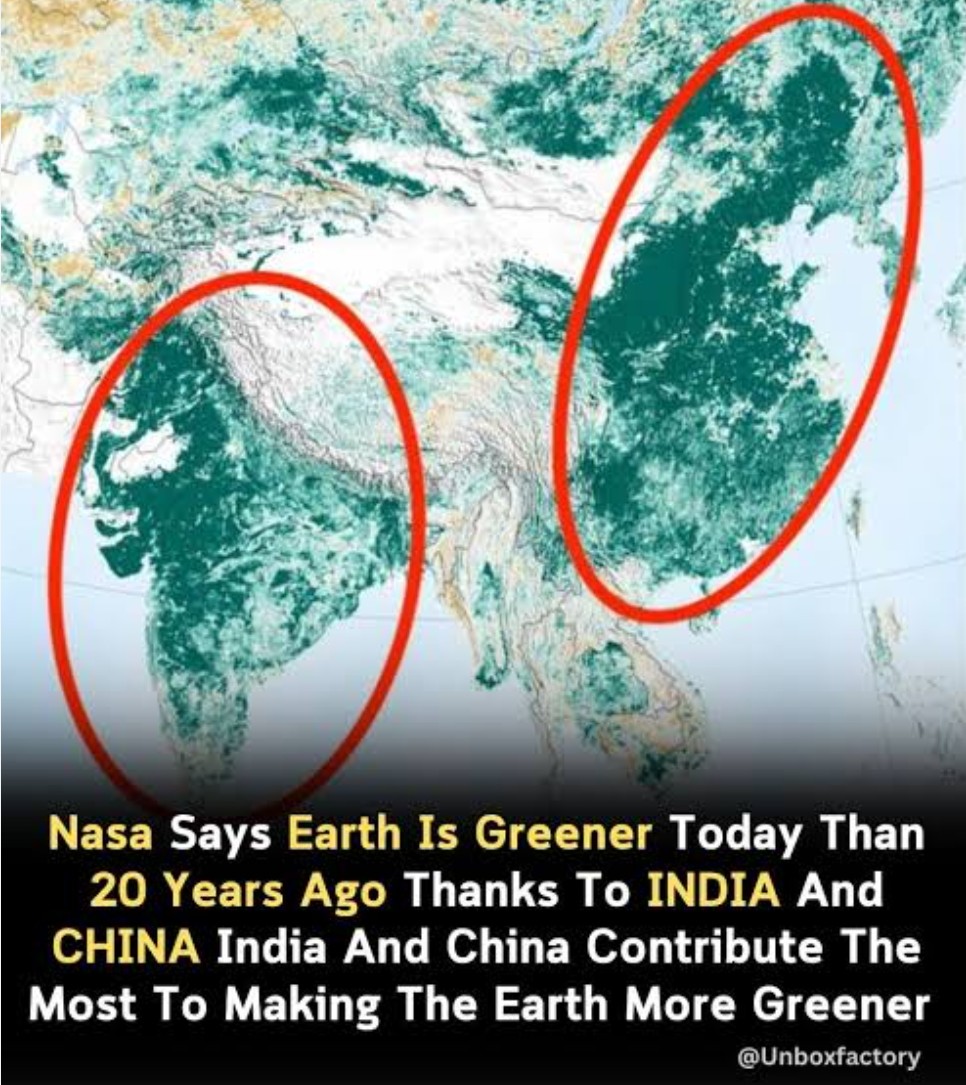
The Earth is greening at a rate never seen before in all recorded history, according to NASA satellite records from 1982–2023.
Global crop yields have risen 15–20% since 1960, almost entirely attributable to CO₂ fertilisation (Idso, 2013; IPCC AR6 WG1 Ch5). Famine deaths have plummeted over a time when the world's population doubled and CO₂ deserves much of the credit. We have increased CO₂ over the past century to thank for this explosion in plant life and available plant food from booming agriculture.
There's been a more than 18% increase in the global leaf area in 40 years, with the largest gains in India and China from CO₂ fertilisation. Warmer and more balmy temperatures are lengthening the growing seasons. These are features of rising levels of water vapour and cloud cover around the world. Every 100 ppm increase in CO₂ typically boosts plant growth by 25–50% in all non-water-limited conditions.
This analysis draws on 776 studies from 1993–2019, showing an ideal average CO₂ level of 550 ppm delivers a 38% increase in global biomass.
It's an astonishing windfall for life on earth from CO₂, a trace gas at 420 ppm (or 0.04%). It also has a secondary benefit for life by contributing to baseline levels of warmth around the planet, along with water vapour and other trace gases with similar properties, like methane (approx. 1.9 ppm or 0.00019%).
However, water vapour and cloud cover are the mainstays of rainfall and the entire hydrologic cycle, returning water as precipitation to rivers, lakes, and oceans (where 78% of rain ends up).
These are the reasons why commercial greenhouses pump CO₂ to 1,000–1,500 ppm deliberately. It ensures that crop yields jump by 20–70% depending on the crop. If 1000 ppm is good for tomatoes, why is 420 ppm an 'emergency' for the planet?
The science says 600–1,000 ppm of CO₂ plus 1–2°C extra warming hits the sweet spot for all terrestrial and marine life, including human civilisation. We should not be waging war on a trace gas that makes the planet greener.
Higher CO₂ is a net benefit to life on Earth.