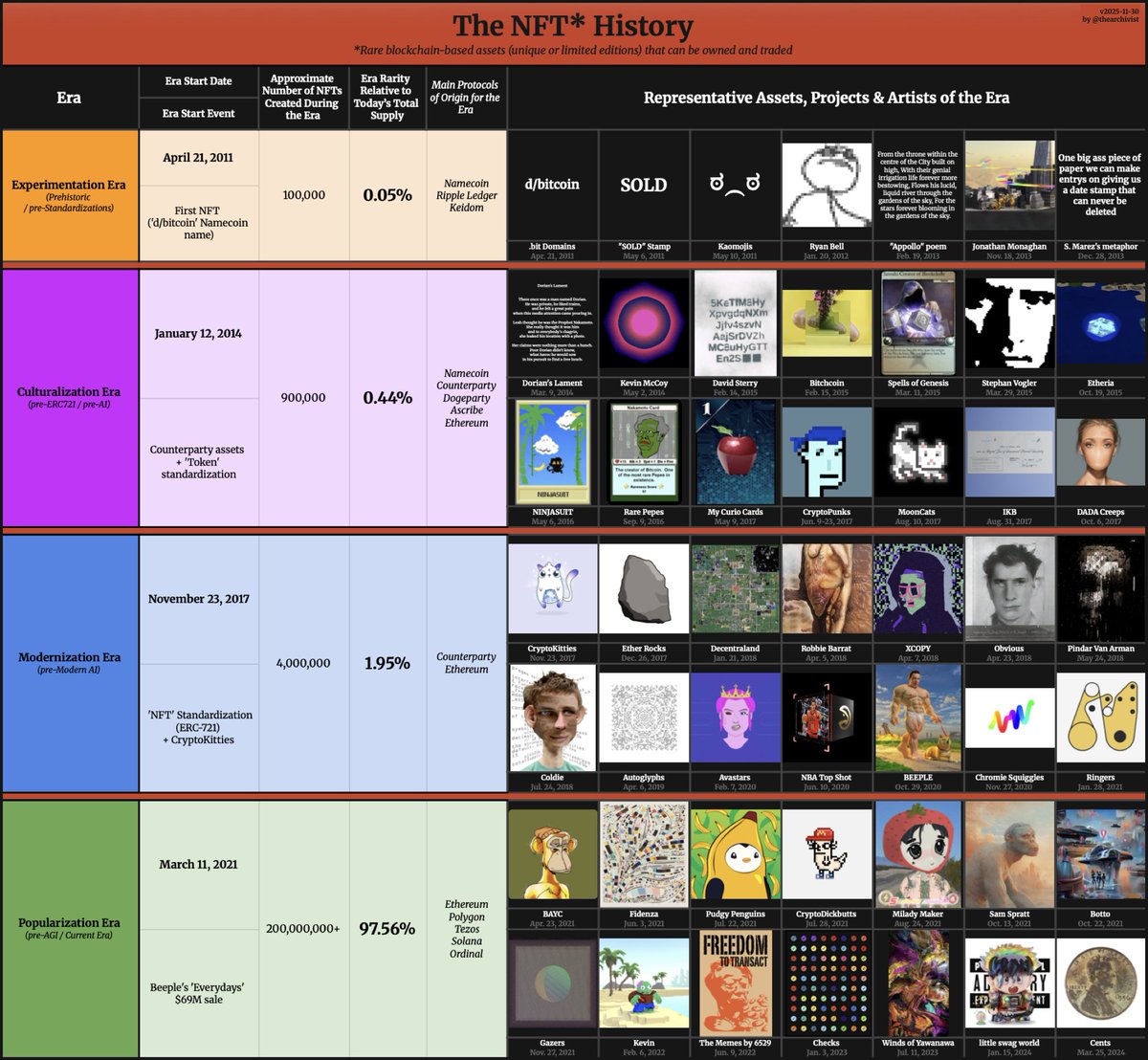
The four eras of NFT history, their defining events, rarity relative to today’s total estimated supply, and some of their representative assets, projects and artists.
Relic #2 has been claimed by @thearchivist
Other relics are impossible to reach by a single account at this point in time - you gotta go hunting in trades or on secondary to get one!
@MonkMatto@0xdiid Yes it was a fun puzzle last night testing out different combinations in order to restore that chimera. Hopefully I had a reminder alarm tho 🤝
Let's make namecoin fun again!
Namecoin has a huge potential as a blockchain due to its massive hashrate merge-mined with BTC.
With that said, I am announcing https://t.co/j3kxaNTBpb an initiatives by @historics_xyz and others.
✅ New Explorer
✅ New Experience
Stay tuned!
All you say is indeed true for collections with high liquidity or for Punks, which even has a floor consistently below the median sale price.
But among the top 50 Ethereum collections listed on NFTpricefloor, I see 17 with no sales in the past 24 hours. That’s 34% of the top 50 and surely over 50% across all collections. I think we can reasonably consider these not highly liquid and they are precisely the collections for which this model doesn’t work to me. Unless I’m missing something.
Just look at the latest 10 sales (up to the past 12 months), current collection bids, and floors for the following:
Autoglyphs:
Sales: 54.8 ETH ($135k)
Bid: 40.5 WETH ($100k)
Floor: 65 ETH ($160k)
Beeple Genesis:
Sales: ~$80k
Bid: 30 WETH ($73k)
Floor: 69 ETH ($170k)
Mask of Lucy:
Sales: ~7.7 ETH ($19k)
Bid: 6.7 ETH ($16.5k)
Floor: 9.33 ETH ($23k)
Rainbow Grid:
Sales: ~2.75 ETH ($6.8k)
Bid: 1.12 WETH ($2.7k)
Floor: 77.99 ETH ($192k)
IKB:
Sales: ~7.75 ETH ($19k)
Bid: 0.2 WETH ($0.5k)
Floor: 50 ETH ($123k)
Etheria v0.9:
Sales: ~3.15 ETH ($7.7k)
Bid: 2.6 WETH ($6.4k)
Floor: 250 ETH ($614k)
My point is that either you keep the product as it is with the floor as the framework and that’s perfectly fine, and in that case you should accept edge cases like Etheria v0.9 and many others, or you should implement another layer of parameters to account for them (e.g. for the examples above, bid x last sales seems a more reliable approach).
I think it’s definitely an interesting thing to dig with many parameters possible (e.g. consider weth bids if 50%+ of sales are from bids, add display security if the floor is X% higher than last sales, the closer the weth offers to floor the more liquid, weth bids consistency, etc).
The other option is to remove all the edge cases, but removing Etheria v0.9 specifically seems unfair and arbitrary imho (disclosure: I don’t own any).
I agree that no framework is perfect, and floor-based mcap can be a useful rough proxy for liquid, relatively homogeneous collections.
But ‘bids well below fair value’ is where the reasoning becomes circular. If there are no recent sales, what objective data establishes that ‘fair’ value? Executable bids may be low, but they are observable market demand and reflect the collection’s real-time liquidity. A floor is only an unaccepted seller’s ask and is easy to manipulate (one listing can reprice the entire mcap). Recent median sale prices and active bids are much harder and riskier to manipulate.
And if a collection has neither recent sales nor ‘meaningful’ offers, the honest conclusion is that there isn’t enough price discovery for a reliable valuation. That should simply produce an unavailable (or low-confidence) estimate, not a broken floor-based mcap like the one that eventually led to Etheria v0.9 being removed from the database, even though the collection has consistent, decent active bids and sales that clearly warrant its inclusion.
@nftpricefloor@aspenshredder Market cap has never really worked for NFTs. An estimated collection value based on recent sales and live bids would be far more reliable, even before factoring in traits.
Hiding or merging collections to mask the floor metric’s limitations seems arbitrary and counterproductive.
@WangXiang Agreed. And the cryptoart thread runs back even further: Ryan Bell on Namecoin in 2012, Monaghan with Keidom in 2013, Dorian’s Lament and Quantum in 2014, Sterry and Vogler on Bitcoin in early 2015. The idealists were there before anyone had a word, a standard or a market for it.
@subterranean_1 It was really just a stopgap so we wouldn’t lose that precious data and community curation. I’m glad a more elegant option is in place, and you’re exactly the right person for it 🫂
Sometimes it hits me that there are people here I’ve rarely or never met, who I talk to regularly behind pseudonyms, bound by passion alone, who I’d trust without hesitation to hold anything of value for me. And I believe they’d say the same. It’s a nice thing to sit with.
The four eras of NFT history, their defining events, rarity relative to today’s total estimated supply, and some of their representative assets, projects and artists.
@natealex I’d rather say “rarity era”, since scarcity is driven by demand>availability. Fewer NFTs pre-2021, and still demand<availability, driving undervaluation indeed. Various reasons: pre-standards, too early, old GUIs with complex custody, bad education, etc
The four eras of NFT history, their defining events, rarity relative to today’s total estimated supply, and some of their representative assets, projects and artists.
This app completely warps our expectations of time & the need for immediate reward. It’s baked into the UI/UX. W/ art and cultural objects it could take *decades* to determine a lasting legacy for important art. But that type of patience is not reflected or encouraged on the tl.