https://t.co/IdczpIjEOe
Some fascinating new research from @ArielleSelya challenges us to look beyond smoking cessation when evaluating the potential population-level benefits of vaping.
Under a full-substitution assumption, her analysis estimates that e-cigarettes may have displaced up to 30% of combustible tobacco use among US adults, rising to 58% among those aged 18–29.
What makes this particularly interesting is the distinction between switching and diversion. Around three-quarters of the estimated displacement among adults came from former combustible tobacco users switching to vaping, while the remainder came from people who had never used combustible tobacco. Among younger adults, diversion accounted for almost half of the estimated displacement.
This raises an important question that deserves considerably more scientific attention: how many people who vape today might otherwise have become smokers?
Arielle is appropriately transparent about the limitations. These are upper-bound estimates based on an explicit assumption, not established causal effects, and the research has yet to undergo peer review.
What I particularly appreciate about this work is that it explores a counterfactual that is too often overlooked. We cannot adequately assess the population-level consequences of vaping by measuring nicotine uptake alone without also considering what might have occurred in its absence.
Counting people who started vaping is relatively easy. Understanding how many might otherwise have started smoking is considerably harder, but no less important.
Excellent work from Arielle, and a valuable contribution to the tobacco harm reduction debate.
Who is going to protect Jamaicans from a lying Minister of Health and Wellness who shifts the focus from smoking (which causes COPD) to vaping (which doesn't)?
@JamaicaGleaner
@NannyFreeState All the consequences as a result of Australias pharmacy only model Becky dismissed as industry propoganda. All those consequences have now come to fruition here in Australia. Thanks to imbiciles like Becky. At least the 🚬 resurgence provides job security I guess what a grifter.
"Becky Freeman, a professor of tobacco control with the University of Sydney, said it was “shocking to see the resurgence” of smoking in pop culture and on red carpets." <- All your own work, Becky. Own it. https://t.co/Lfhrz19DON
One Minute the Alan
Uncertainty is uncomfortable.
When an explanation is incomplete, we naturally try to finish it. We choose the most familiar cause, accept the first confident answer or build a story from the information available.
An answer, almost any answer, can feel safer than admitting we do not yet know.
But premature certainty has a cost. Once a story settles in our minds, new information must compete with something that already feels complete.
Patience with uncertainty is not indecision. It is the discipline of allowing the evidence time to arrive.
Sometimes wisdom begins by resisting the answer that arrived before understanding did.
One minute. One idea. A different way of thinking.
What if, just hypothetically, in their eagerness to discourage smoking, journalists and health experts got carried away in their efforts to demonize nicotine?
What hits home for me is your point about people who enter tobacco control because they genuinely want to prevent disease and death. Good intentions don’t make anyone immune to working in a system where certain questions are welcomed and others cost you credibility.
Consumers feel that too. Our lived experience is welcomed when it illustrates the harms of smoking. When we explain that vaping helped us quit after other options failed, suddenly the discussion can turn to whose interests we’re serving. My experience can’t tell you what works for everyone. It can tell you what your policy needs to account for.
If tobacco control wants to know whether it’s helping people quit, it has to listen to the people who got off cigarettes by a route it didn’t expect, and to those still smoking because the options on offer haven’t worked for them.
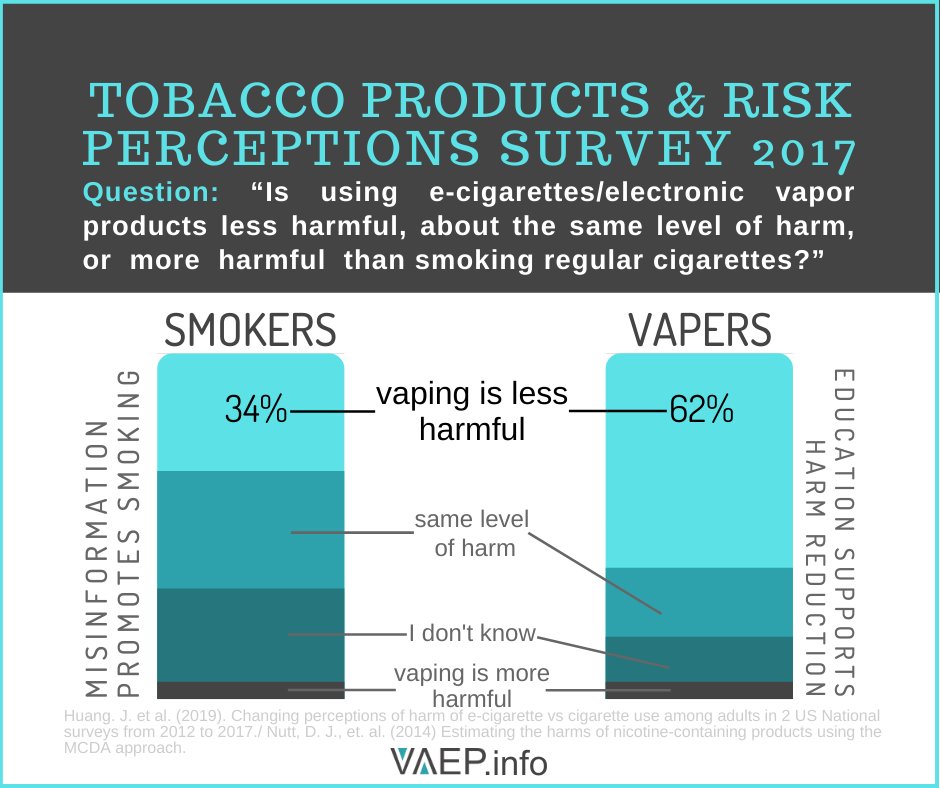
Did you know? Vaping is estimated to be just 5% the risk of smoking—but how many people actually know this?
A recent survey reveals a big knowledge gap: only 34% of smokers realize vaping is less harmful, compared to 62% of vapers. The more people learn, the more they choose harm reduction.
Let’s break the myths and share the facts—because education saves lives.
Discover more at https://t.co/hec76KdDJW
#HarmReduction #VapingEducation #VapeFacts #PublicHealth #TobaccoHarmReduction #VapeSmart #VAEPinfo #SpreadTheTruth
Ever wondered why the food industry works so hard to make healthier alternatives taste just as good as the original?
Because flavour matters!
So why are we talking about taking flavours away from an alternative that could help adult smokers move away from cigarettes?
"...several trials have found that e-cigarettes can promote abstinence from smoking among difficult-to-treat populations, including people who recently failed to quit smoking with a stop smoking program or people who are not motivated to quit at baseline"
https://t.co/xZ6M64iAO1
@MarewaGlover I agree with all your points Marewa. The god-complex is strong in quite a few of them.
The echo-chamber may have been protective at one point, but it's since been manipulated into an implement of groupthink and ideology.
Fault for that sits with a fairly small number.
I resisted the “it’s all about the money” explanation for a long time. It wasn’t about the money for me and I thought others in the sector were similarly driven by an altruistic desire to help, by the mission — here’s a serious PREVENTABLE cause of disease and death I can apply my knowledge and skills to. I had a public servant mentality. It was a civic duty.
I now accept that the people who have flooded in to what has become a bloated Elysium (as in the movie) have varied motives: money, status, winning, envy, a need to hate and hurt others, ideological agendas, power. Climbing the social ladder / staying out of the gutter is a powerful motivator.
But there is more than inner drivers. I don’t think enough attention has been paid to the powerful controlling effects of existing within a closed highly regulated bubble. Where, like in tobacco control, knowledge is highly regulated - what is acceptable knowledge to share, what is allowed to be said. I do believe that many workers within Big Tobacco Control honestly don’t know that they have been fed a sliver of what’s known, a lot of handy lies, a bow and arrow to work with (rather than up-to-date far more effective theory, skills and tools), and they are tricked using a mirage of conferences and fake awards celebrating their and the sector’s success that is also a complete lie.
Their day to day work is made simple — designed to keep them busy, distracted, unquestioning. Much of the ‘tobacco control’ research is what I call Lint Picking. The same bit of lint is pulled apart this way and that, argued over, turned upwards and then down, frozen, then heated. It’s just a useless bit of lint and their presentations and scientific papers about it don’t add an iota to the body of human knowledge (i.e. it’s not science — it’s theatre.) Then there’s the papers getting printed in ‘science’ journals that are pure political ‘advocacy’, completely manufactured to trick or force politicians to do as the so-called academics creating this rubbish have advised. Honestly, some of them think they are like Gods.
Simon Chapman, early on, created and promulgated a nasty attack narrative to scare people off ‘tobacco harm reduction’. He called it a cult. Cults are seriously dangerous manipulations of dark personalities. Children get sexually abused, people get killed. It’s not a term to be used flippantly. So, I don’t use the term but I definitely have seen and experienced some of the same controlling strategies and brainwashing tactics, that cults use, employed by people in tobacco control (and broader in the public health sector).
There are very serious dangers and harms in the world that should be a higher priority for research and discussion for sure. But at some point, some work needs to expose the toxic, complete waste of time and money side of tobacco control and restructure it from the purpose to the means.
To keep moral panic alive, they deny basic pharmacology: clean nicotine (without smoke) has a risk profile like caffeine, offering cognitive & focus benefit, esp. for neurodivergent adults.
People smoke for the nicotine, but they die from the tar. It’s time policy reflected it.
Follow the money:
Billionaires like Mike Bloomberg have poured $1.6B into global tobacco control w/strict abstinence-only strings attached.
~17 countries still have state-owned tobacco monopolies (eg China's CNTC) that protect cigarette revenues by banning safer alternatives.
A consumer can be the most moving speaker in the room and still have the least say in what happens next.
Imagine being asked to describe how you stopped smoking. You explain that the hardest part of switching was finding an alternative you could get reliably. Then the discussion moves on to which products adults should be able to buy, and that’s where your part ends.
Nobody has to take your experience as proof that the same approach would work for everyone. But you do have something to say about which obstacles were reasonable and which nearly sent you back to buying cigarettes. That’s a judgement you’re entitled to make, especially when you were the one standing at the counter.
If I’m trusted to describe the problem, I’d like to stay in the room while we discuss the solution.