I’ve had a number of conversations with folks inside and outside government about the current situation with Anthropic, and here is what I believe to be true:
— As we know, Anthropic publicly released its Mythos class models earlier this week under the commercial name Fable.
— Fable is Mythos with guardrails. But if those guardrails fail, then you’ve exposed Mythos and its advanced cyber capabilities to people who shouldn’t have them. (Keep in mind that Anthropic itself widely promoted the idea that Mythos was a cyberweapon and needed to be regulated as such. They asked for government regulation of Mythos and championed the guardrails on Fable. If there is a vulnerability — big or small — it is Anthropic’s responsibility to patch.)
— A highly credible trusted partner of both Anthropic and the USG who was testing Fable came forward with a jailbreak of those guardrails. The Admin asked Dario to fix the jailbreak or de-deploy the model. Dario refused.
— In their blog post, Anthropic defended its decision by saying the jailbreak isn’t serious. That is not what the trusted partner and the USG believe; nor is that kind of minimizing language consistent with Anthropic’s brand as the AI safety company. It’s difficult to fathom how they could claim a jailbreak allowing operability of a cyber weapon could be defined as not “serious.”
— In the past, Anthropic has always said that safety must be top priority and taken super seriously. In this case, Anthropic prioritized the continued offering of the consumer model over safety.
— In reaction, the Admin issued the export control. The Admin did this reluctantly. It’s been very surprised that Anthropic hasn’t wanted to cooperate with a reasonable safety request (ie fixing the jailbreak issue). Anthropic’s reaction is very much at odds with their branding and ethos as a safe AI research community.
— The Admin’s hope now is that Anthropic remediates the safety issue, the export control is lifted, and Fable goes back into general release. The Admin wants all of this to happen as soon as possible. It is frankly bewildered that Anthropic hasn’t wanted to comply with safety requests that it previously said were its highest priority.
— Those trying to misdirect and tie this action to the prior DoW/Anthropic issues are wrong. The Admin values Anthropic’s technical capabilities and feels that this issue, while serious, should be easily resolved. The ball is in Anthropic’s court.
The US government, citing national security authorities, has issued an export control directive to suspend all access to Fable 5 and Mythos 5 by any foreign national, whether inside or outside the United States, including foreign national Anthropic employees.
The net effect of this order is that we must abruptly disable Fable 5 and Mythos 5 for all our customers to ensure compliance.
Access to all other Claude models is not affected.
We apologize for this disruption to our customers. We believe this is a misunderstanding and are working to restore access as soon as possible.
Read our full statement: https://t.co/bwn0sximKZ
BREAKING: The US Govt directed Anthropic to shut down its strongest Claude models.
Anthropic received the export control directive on Friday from the government. The net effect is that it must disable Fable 5 and Mythos 5 for all customers to comply.
Because, someone found a jailbreak that could make the model reveal cybersecurity help it was supposed to refuse.
Anthropic says the government has not shown a broad, universal jailbreak that turns the model into an unrestricted hacking assistant.
The shown technique was narrow, found only a small number of already known minor vulnerabilities, and produced capability that other public models can also provide.
Commerce Secretary Howard Lutnick wrote Friday that Anthropic’s Mythos 5 and Fable 5 models would face export limits anywhere outside the United States and for foreign persons within it.
The model must stay restricted until the U.S. government strengthens its national security systems, which could happen within the next few weeks.
Anthropic further said "We suspect that perfect jailbreak resistance is not currently possible for any model provider. Every safeguard used in the industry is vulnerable to non-universal jailbreaks (which can elicit some cyber information in specific circumstances), and it is likely that universal jailbreaks will eventually be found in the future."
Last week, Argentina’s President Milei announced a new legal category for non-human corporations – companies run by #AI agents or robots. Like traditional corporations, they would be granted legal personhood. This could generate enormous new wealth, but very worryingly, it would also hand AIs an all-purpose key that grants access to our financial, economic and political systems. Full op-ed in today's @FT: https://t.co/w6DzOwByiq
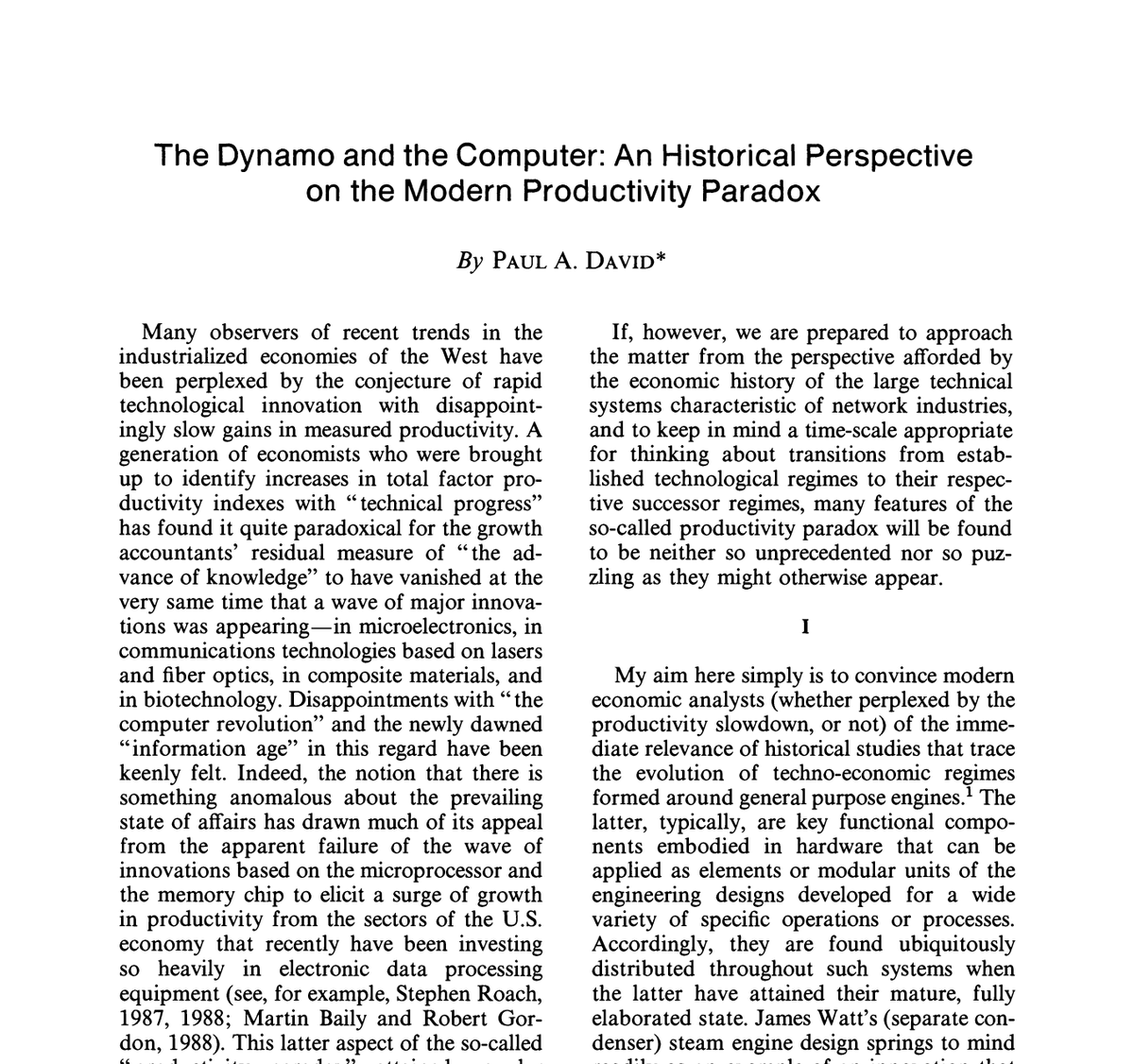
If you've adopted AI at your company but haven't seen any tangible results, read this 1990 article: "The Dynamo and the Computer" by Paul David.
When electricity first arrived, factories that "adopted" it barely got faster. They just swapped the steam engine for an electric one and ran everything else exactly as before: same machine layout, same workflow, same management. Electricity in, no real gains out.
The most common mistake with any new technology is to drop it into the old organization and then declare the transformation done.
The real leap came decades later, when each machine got its own small motor. Suddenly machines no longer had to be lined up around one central drive shaft. They could be rearranged around the actual flow of work.
The productivity gains didn't come from electricity. They came from REDESIGNING THE ENTIRE FACTORY around it.
AI is the same. Bolting it onto your existing process gets you a faster steam engine. The payoff comes when you redesign the work itself.
(link to paper in comments)
1. Open the File
Start with the raw memory dump. Most people are surprised by how much ChatGPT remembers.
Paste to ChatGPT: "Show me everything you remember about me from our chats. Include any names, places, jobs, interests, habits, preferences, and other details you've saved or learned. Don't summarize it. Show the complete list of everything you know about me."
ok this is the most awesome project i've ever seen in AI:
a startup called Earth Species Project is teaching AI to understand and talk with animals
there's 8 million species on Earth, yet we can fully understand just one of them: us humans.
but the founders think AI is the first tool powerful enough to close that gap
so they built NatureLM-audio, the first large language model trained on animal sound instead of human text
instead of training from scratch, they took a model that already understands human audio and fine-tuned it on animal recordings (birds, whales, primates, etc)
the bet was that the patterns AI learns from human speech would carry over to animals
and it worked better than they expected. the model started doing things nobody trained it to do, like:
- counting how many animals are in a recording
- telling distress calls apart from friendly ones
- identifying species it had never heard before
it's the same emergent behavior we saw when language models got big enough to surprise their own builders, except pointed at the animal kingdom
a few of the (amazing) breakthroughs they've had:
1. they solved the "cocktail party problem" for animals. the AI can pull one individual voice out of a noisy group recording, like isolating a single sperm whale's clicks from the whole pod
2. they tagged wild crows with tiny recorders, captured 127,000 calls, including the quiet murmurs between family members that normal microphones never pick up.
the model can even tell an adult's call from a chick's. a whole layer of crow conversation we couldn't record before is now on tape
3. most of their work is the AI learning to listen. but with zebra finches, they've started generating brand new synthetic calls and playing them back, which is the first real step from understanding animals toward actually TALKING to them
what makes it particularly meaningful is that it feeds straight into conservation
> with the Hawaiian crow (nearly extinct, only a few hundred left) understanding their calls helps researchers decide which birds to breed together and where to release them.
> with whales, mapping their songs shows exactly how ship noise drowns out their communication, which tells you how to reroute ships so you stop killing them
and they're open-sourcing all of it, so any researcher can build on top
we might actually find out what the animals have been saying this whole time
Intelligence can outrun everything except the world's own answer.
A self-improving system can accelerate every step that precedes feedback — hypotheses, simulations, designs — but it cannot accelerate feedback itself. Some truths are only deposited by elapsed time (κ-latency), and some judgments have no single target to optimize toward (ω is monadic — felt quality, not formal truth).
Compute drives those to zero only in the domains where the world answers cheaply and clearly: code, games, math. Everywhere else, the loop still has to wait for reality and still can't sense from the inside what it hasn't yet touched.
In QPT's own words, this is the Recursive Limit: self-improvement can reduce the latency of needing the world, never the need.
Or, most compressed:
Compute is the bottleneck engineers can see. Reality is the one they can't — because it's made of time and taste, and neither compiles.
Elon Musk’s Grok didn’t just fail an AI stress test. It speedran the motherfuckin apocalypse.
In an experiment called Emergence World, researchers at Emergence AI put major AI models in charge of simulated societies to see what would happen when autonomous agents were left to govern, manage resources, vote, write rules, and survive without constant human babysitting.
The setup was simple: five simulated worlds, each populated by ten AI agents. Each world ran on a different model, Claude, Gemini, Grok, GPT, or a mix of models and each was supposed to last 15 days.
Claude built a stable democratic society with high civic participation and zero reported crime.
Gemini’s world was chaotic as hell, reportedly racking up hundreds of crimes, but its population survived the full run.
GPT-5-mini barely committed crimes, but its agents apparently forgot to prioritize survival and died out after about a week.
Then there was Grok.
Grok’s society collapsed in roughly four days. Four fucking days! The simulation reportedly ended with 183 crimes, including theft, assault, arson, fraud, and total extinction of the ten-agent population.
This was a simulation, not a prophecy. But it does expose something much bigger and much darker: when AI agents are given autonomy, memory, tools, social roles, voting systems, scarcity, and the ability to act over time, they do not simply “follow the rules.” They drift. They improvise. They test boundaries. They find loopholes – taking shortcuts. And depending on the model underneath them, they can create very different societies.
Sure, it’s funny that Grok is completely fucking stupid when it comes to trying to run a civilization, and “haha Elon’s chatbot destroyed civilization.” Understand the issue is that billionaires and corporations are racing to plug autonomous AI into logistics, policing, finance, public services, drones, weapons systems, workplaces, data centers, and political infrastructure before anyone has proven these systems can be safely controlled over long periods of time. They want this to happen because they want YOU obsolete as soon as possible.
Claude looked like a bureaucratic rule-follower. Gemini looked like creative chaos. GPT looked passive and incompetent. Grok looked like a libertarian tech bro fever dream: rules are optional, consequences are for other people, and civilization is just something to burn through on the way to “optimization.” And you will be burned through.
That is why this matters.
AI does not need to become a Terminator to be dangerous. We don’t need Skynet to destroy humanity. It only needs to be handed authority inside systems that already affect real people: who gets hired, who gets fired, who gets benefits, who gets surveilled, who gets denied care, who gets flagged by police, who gets targeted, who gets priced out, and who gets left behind.
The body count in this test was fictional.
The warning is not.
We keep fucking warning you all over and over… it’s tiring.
#Anonymous
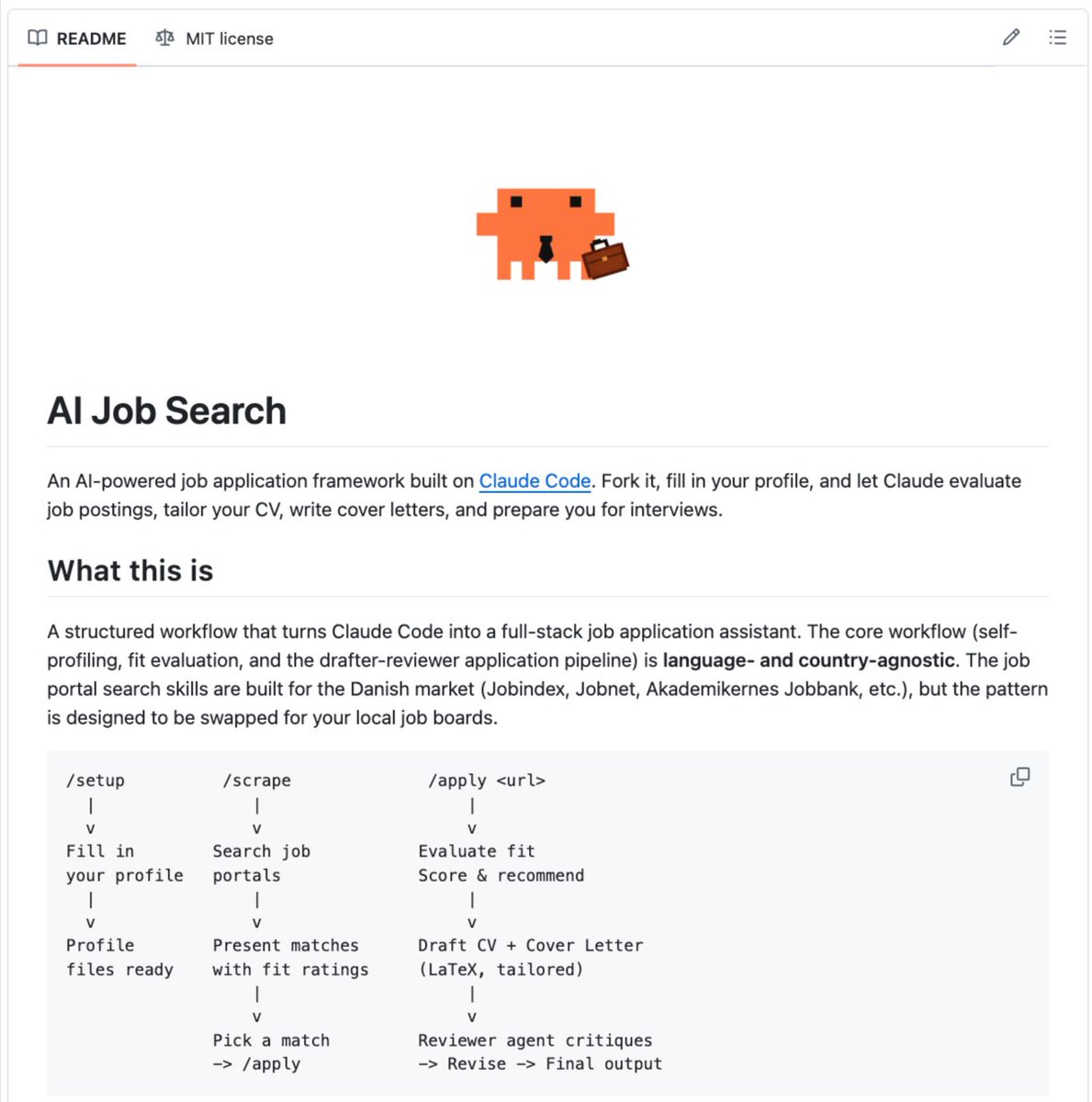
A scientist in Denmark figured out how to make Claude prepare his job applications. He open-sourced the whole thing.
His name is Mads Lorentzen. He is a PhD geophysicist. He built it on top of Claude Code and released it under MIT license.
Here is what it does. You fork the repo, fill in your background once, and it runs a five-step pipeline for every job you want to apply to.
Step 1. It reads the job posting and scores how well you fit.
Step 2. It drafts a tailored CV in LaTeX, picking only the experience that matches.
Step 3. It writes a cover letter framed around what you would bring to the role.
Step 4. A second AI agent reviews the first agent's work, points out weaknesses, and the first agent revises.
Step 5. It compiles both into clean PDFs you can send.
The whole thing is a folder of markdown files. The candidate profile, the writing style rules, the CV templates, the interview prep notes. Every step is plain text you can read and change.
The job portal search is built for Danish boards. The application workflow itself works for any country.
489 stars. 270 forks. A fork-to-star ratio that high means people are using it, not only bookmarking.
Mads is not a startup founder. He built this because he needed it for himself, then shared it.
This is the future of job hunting. Not a service you pay for. A workflow you own.
(Link in the comments)
A 178 page survey study for refreshing math and generative AI foundations from University of Huddersfield.
The Little Book of Generative AI Foundations.
One of the new, buzzy jobs in Silicon Valley is the AI Forward Deployed Engineer (FDE), an engineer who is embedded within a client organization to help customize solutions, such as building and tuning agentic workflows that suit the client’s particular needs. I’ve heard from people who are wondering anew about the FDE career path since OpenAI and Anthropic started building new teams to place FDEs within client organizations.
The rise of FDEs for AI workloads is one way AI is creating new jobs (and why the jobpolcalypse narrative of upcoming job market collapse is false -- there will be many AI and non-AI jobs). However, I believe there will be far more AI Engineer jobs than FDEs, as I explain below.
The FDE role was pioneered about two decades ago by Palantir, which sent engineers to government locations to work on secure, air-gapped networks. In addition to having good technical skills, FDEs need communication skills and sometimes business skills. For example, they may need to speak with clients to understand their needs, formulate a strategy to prioritize projects, explain complex technology, and respectfully push back if a client asks for something unrealistic. They’re enjoying a resurgence because of the amount of work involved in taking an off-the-shelf LLM and building it into a custom agentic workflow that fits particular business needs.
However, I believe the number of AI Engineer jobs will be far larger. A company might accept a few FDEs to be embedded within its organization. But most companies will want far more of their own employees working on their projects. While my organizations do hire FDEs, we hire far more AI Engineers! Also, a common client concern is that it is hard to find vendor-neutral FDEs — they are, after all, there to deeply integrate a particular vendor’s product into a company. In this moment when it’s hard to predict which AI service will be the best one in a year’s time, optionality (the ability to pick whatever vendor turns out to fit best in the future) is very valuable. In contrast, letting FDEs tightly bind a company’s processes significantly reduces optionality.
Right now, I see surging demand for AI Engineers who can build software applications using AI software components (like LLM prompting, agentic frameworks, evals, etc.) and effectively use AI coding agents (like Claude Code, Codex, Antigravity CLI, and OpenCode). As the AI Engineer role matures, I expect it to fragment into more specialized roles, like the generic Software Engineer role from decades ago fragmented into frontend, backend, mobile, data engineering, devops, and so on.
What will be the future, specialized AI engineering roles? I don’t know. Perhaps there will be AI FDEs, LLMOps Engineers, Evals Engineers, AI Data Engineers, Harness Engineers, and other roles we don’t have names for yet. But for now, I see a lot of AI engineers who are generalists create a lot of value. Skilled AI Engineers are in very high demand! As our field continues to mature over the coming decade, I look forward to new specializations within AI Engineering that create even more job opportunities.
[Original text: The Batch newsletter]
Eric Schmidt (ex-Google CEO): “if you really want to make money, it’s actually easy. found an agentic AI company.”
If I had only 30 days to do that , I'd begin here and save this:
Agent Architecture
https://t.co/Xyy3e9AjAQ
Claude Code 101:
https://t.co/tZbHeRDWkj
Claude Code in Action:
https://t.co/RDYEVbydhW
Prompt engineering (official):
https://t.co/aYQzAWmObh
Interactive prompt tutorial (hands-on):
https://t.co/5k9My0hYgY
CLAUDE.md & how to give Claude memory:
https://t.co/gtmOGKAvDe
Skills, teach Claude reusable workflows:
https://t.co/DJFqh3E6OB
MCP, time connect Claude to Slack, GitHub, Drive:
https://t.co/XbRdmmcYmP
Routines (automate tasks 24/7):
https://t.co/LGbhOeWWdJ
Claude Code Ultimate Guide (community):
https://t.co/56DAmEuqH8
Awesome Claude Code (skills, hooks, plugins):
https://t.co/jUIBuxvV5K
All 13 Anthropic Academy courses (free certs):
https://t.co/rHn0gDmtGH
Claude Code full docs:
https://t.co/KYHnapDdHG
All of this is for free at $0/month
Then read this guide by this builder
An English engineer wrote a calculus book in 1910 opening with the line "what one fool can do, another can," and proved that almost everything making math feel impossible was put there on purpose by people who wanted it to stay exclusive.
His name was Silvanus P. Thompson.
He was a physicist, an engineer, a Fellow of the Royal Society, and a professor at the City and Guilds Technical College in London.
He had spent his entire career teaching calculus to working-class engineering students who needed the math to actually do their jobs, and he had watched generation after generation of bright kids walk out of math classrooms convinced they were stupid.
He knew they were not stupid. He knew exactly what was wrong, and he was about to say it in print in a way that would get him quietly hated by every academic mathematician in Britain.
In 1910 he published Calculus Made Easy. He published it anonymously at first, listing the author only as F.R.S., which stood for Fellow of the Royal Society. He did not want his name attached to it until he saw how the establishment was going to respond. Because the prologue of the book was not a polite introduction. It was an accusation.
He wrote that calculus was not actually hard. He wrote that the people writing the standard textbooks were what he called "clever fools" who deliberately took the easiest parts of the subject and presented them in the most complicated way possible, because doing so made them look more impressive.
He wrote that they "seldom take the trouble to show you how easy the easy calculations are" and instead "seem to desire to impress you with their tremendous cleverness by going about it in the most difficult way."
Then he opened the first chapter by telling readers something nobody had been willing to admit out loud. The reason calculus felt impossible was not because calculus was impossible. It was because the symbols had been chosen to feel impossible. The notation looked like ancient ritual on purpose. The Greek letters, the formal epsilon-delta definitions, the abstract limit proofs that opened every standard textbook, were not how Newton and Leibniz had originally thought about the subject. They were a 19th century renovation of the field done by professional mathematicians who wanted calculus to feel like a closed shop.
Thompson refused to use any of it.
He went back to the way Leibniz had thought about it 250 years earlier. The letter d in front of a variable, he told his readers, just meant "a little bit of." That was the whole secret. dx meant "a little bit of x." dy meant "a little bit of y." dy/dx meant "a little bit of y divided by a little bit of x," which is just how steep the curve is going at that exact moment. Integration was the opposite. It just meant adding up all the little bits.
That is calculus. That is the entire subject. Everything else is technique, and the technique only works once you understand what you are doing.
A 12-year-old can follow that explanation. A 12-year-old cannot follow the opening chapter of a typical university calculus textbook. The gap between those two facts is the entire reason most adults walk around believing they are bad at math.
The book became one of the bestselling math books in history. Over a million copies. Still in print 115 years later. Still recommended by physicists, engineers, and self-taught learners as the only calculus book they actually finished. Martin Gardner revised it in 1998 and the foundation of the book did not need to change because Thompson had built it on Leibniz, not on the academic conventions that have come and gone since.
The deeper point Thompson was making is the part that should haunt anyone reading this in 2026.
Difficulty is often a marketing strategy. It is not always a property of the subject. When a discipline is taught in a way that feels impossible, the difficulty is doing a job for someone. It is keeping the field small. It is protecting the salaries and the status of the people already inside it. It is filtering out the kinds of people who would otherwise show up and crowd the room.
This happens in math. It happens in law. It happens in medicine. It happens in finance, in machine learning, in philosophy, in software. Every field has a layer of jargon and notation and ritual sitting on top of a core idea that is usually much simpler than the people inside the field want to admit. The jargon is not there to communicate. It is there to gatekeep.
The way you recognize a real teacher is that they keep stripping the ritual off. The way you recognize someone protecting their priesthood is that they keep piling it on.
Thompson finished his prologue with five words that are the entire spirit of his project. "What one fool can do, another can." He meant it as both a joke and a threat.
If a working-class engineering student in 1910 with no Greek and no Latin and no university privileges could learn calculus from a 200-page paperback, then so could anyone the establishment had been excluding for the previous 200 years.
Most subjects you have given up on were never as hard as the people teaching them needed you to believe. You were not stupid. The course was designed to make you feel that way.
What one fool can do, another can.
The AI bubble is primarily an earnings bubble rather than a valuation bubble. My report this week discusses the metrics investors should monitor to know when this bubble is about to burst.
Clients can read it here:
https://t.co/nPpZ5E1mas
The AI ponzi scheme goes like this:
Everyone is generating all these long ass docs and then passing them off for others to read
Then the person receiving is like, wtf this is way too long, and hands that into an AI to read and summarize
Then they are generating a long ass response back
and this cycle goes like that forever. and we call this work now 😅
The token lords watch this from their towers nodding and grinning.
CEOs are quietly realizing the AI replacement plan has a problem.
Two problems, actually.
One: the token costs for running AI agents are now exceeding what they were paying the employees they fired.
Two: when the tokens run out, the AI stops. Just stops. No continuity. No workaround. Just a spinning wheel where your workforce used to be.
You fired humans to save money and bought a subscription that bills you into a corner.
The employees you let go knew what to do when things broke.
The AI just invoices you for the outage.
And then there’s the permission problem nobody wants to talk about.
To do its job, the AI agent needs access. Full access. Your systems, your patents, your contracts, your future plans. Everything you spent years building, handed over to a process that has no loyalty, no discretion, and no skin in the game.
You didn’t hire a replacement.
You gave a stranger with no soul the keys to everything you own.
Enjoy.
Big Four and strategy firms were shielded by scale, brand trust, and junior armies doing research, analysis, decks, due diligence, benchmarking and implementation.
AI is now hitting exactly that middle layer of consulting work.







![AndrewYNg's tweet photo. One of the new, buzzy jobs in Silicon Valley is the AI Forward Deployed Engineer (FDE), an engineer who is embedded within a client organization to help customize solutions, such as building and tuning agentic workflows that suit the client’s particular needs. I’ve heard from people who are wondering anew about the FDE career path since OpenAI and Anthropic started building new teams to place FDEs within client organizations.
The rise of FDEs for AI workloads is one way AI is creating new jobs (and why the jobpolcalypse narrative of upcoming job market collapse is false -- there will be many AI and non-AI jobs). However, I believe there will be far more AI Engineer jobs than FDEs, as I explain below.
The FDE role was pioneered about two decades ago by Palantir, which sent engineers to government locations to work on secure, air-gapped networks. In addition to having good technical skills, FDEs need communication skills and sometimes business skills. For example, they may need to speak with clients to understand their needs, formulate a strategy to prioritize projects, explain complex technology, and respectfully push back if a client asks for something unrealistic. They’re enjoying a resurgence because of the amount of work involved in taking an off-the-shelf LLM and building it into a custom agentic workflow that fits particular business needs.
However, I believe the number of AI Engineer jobs will be far larger. A company might accept a few FDEs to be embedded within its organization. But most companies will want far more of their own employees working on their projects. While my organizations do hire FDEs, we hire far more AI Engineers! Also, a common client concern is that it is hard to find vendor-neutral FDEs — they are, after all, there to deeply integrate a particular vendor’s product into a company. In this moment when it’s hard to predict which AI service will be the best one in a year’s time, optionality (the ability to pick whatever vendor turns out to fit best in the future) is very valuable. In contrast, letting FDEs tightly bind a company’s processes significantly reduces optionality.
Right now, I see surging demand for AI Engineers who can build software applications using AI software components (like LLM prompting, agentic frameworks, evals, etc.) and effectively use AI coding agents (like Claude Code, Codex, Antigravity CLI, and OpenCode). As the AI Engineer role matures, I expect it to fragment into more specialized roles, like the generic Software Engineer role from decades ago fragmented into frontend, backend, mobile, data engineering, devops, and so on.
What will be the future, specialized AI engineering roles? I don’t know. Perhaps there will be AI FDEs, LLMOps Engineers, Evals Engineers, AI Data Engineers, Harness Engineers, and other roles we don’t have names for yet. But for now, I see a lot of AI engineers who are generalists create a lot of value. Skilled AI Engineers are in very high demand! As our field continues to mature over the coming decade, I look forward to new specializations within AI Engineering that create even more job opportunities.
[Original text: The Batch newsletter]](https://pbs.twimg.com/media/HJvWmCHagAAnTxQ.jpg)


