Image-blaster turns a single image into a 3D world (splat environment, meshed objects, ambient sound) in a matter of minutes. I fed it a 1984 East Berlin scene I created with GPT Image-2.
I'm very impressed. What I actually want is to fold this into a ComfyUI workflow: use the meshed world for blocking and camera framing, then feed those angles back into image and video models. I wish the meshes were not static and unrigged, but as a blocking input it's already useful.
The bigger point: the whole pipeline is run by Claude Code pulling from Marble, Hunyuan 3D, nano-banana, and ElevenLabs. Agents are going to do more and more of this kind of plumbing, and we'll be left to make the directorial decisions.
image-blaster by @neilsonks: https://t.co/V5m4Ka1oA0
I've been comparing LTX to Seedance this week. Most agree that Seedance 2 is the leader right now. So I wasn't really trying to see which model is better.
The question I care about is how close is LTX to Seedance. From what I see, it's not that far behind.
Seedance 2 feels like the first model that has crossed the line into "you can actually make something real with this." If LTX is just a few months behind, then we're just a few months away from an open-source model crossing that same line.
Once that happens, won't the lion's share of production move there? With the closed, expensive models reserved only for the genuinely specialized or difficult work?
I'm not sure. It's possible we just keep chasing the best, the way we always have.
But it's also possible that cheaper and less restrictive is what actually lets us be more creative, and make better things.
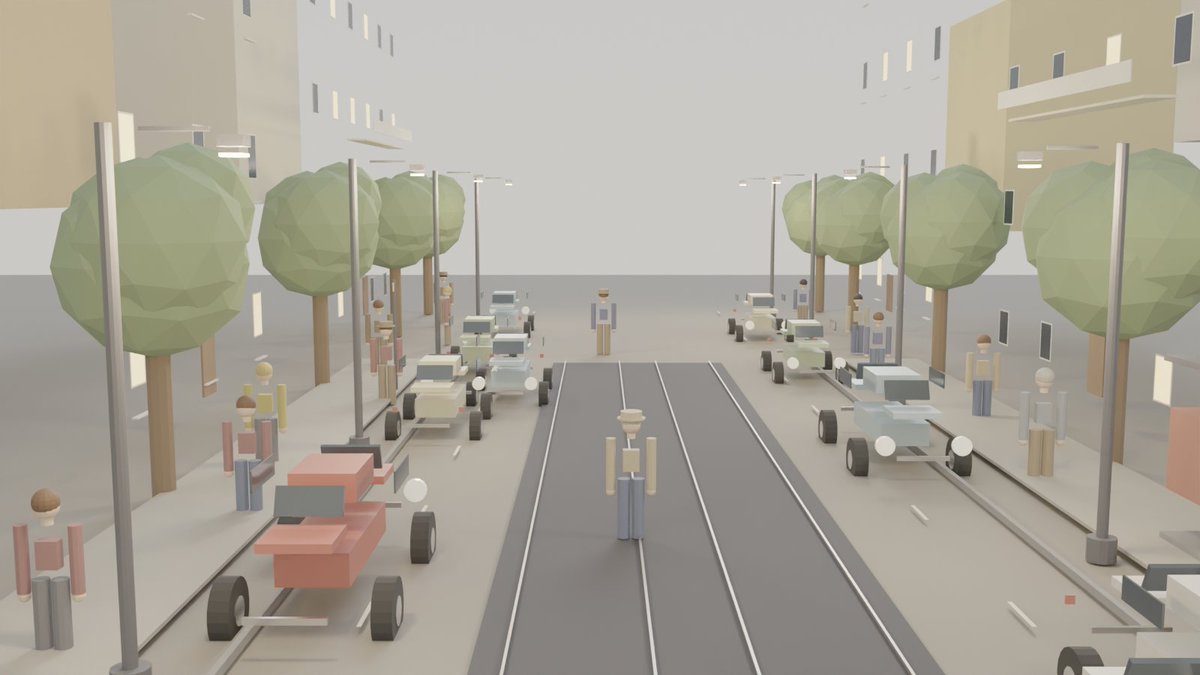
I tested the Blender connector with Claude this week. I asked it to build a 1984 East Berlin street scene, full of people, period-appropriate cars, the works.
This image is what came back.
It's not exactly what I was hoping for. The geometry is loose: arms float off bodies, windows hover near walls, and car parts don't quite meet.
But my request was a little silly. Asking an AI to model an entire era-specific street from scratch is like asking an LLM to write you a full novel and being disappointed it isn't a masterpiece. That's not really how we should be using these tools.
A lot of the negative reactions to this connector come from expecting the wrong thing. Anthropic has been clear about its intended use: it’s supposed to help with repetitive modeling tasks and scene cleanup, not generating finished work end-to-end.
What's actually interesting is how much it did, and how fast.
-It populated the file with hundreds of objects.
-It set up cameras and lighting.
-It adjusted exposure and iterated on framing.
It moved like a confident assistant, even if the underlying geometry was rough.
The real fit for this tool is as a helper for an experienced modeler on a big project. It can handle the monotonous placement, cleanup, and setup work while the human focuses on real craft.
What I'd actually like out of a tool like this is the ability to generate basic mock-ups of a scene that I could feed into image and video models as a reference for blocking.
And honestly, this probably isn't even the right tool for that, given all the world models coming out right now (like World Labs, Genie 3, and Lyra 2) that approach the spatial problem from a different direction entirely.
I ran an experiment to test whether a previs/animatic could drive Seedance 2.0 to produce a cinematic, photoreal scene — while preserving the camera move, blocking, and action from the previs.
Three approaches:
1. Animatic + text prompt. Weak. I reworded the prompt several times and could never quite get there.
2. Animatic + a photoreal version of the first frame (made in nano banana pro) + text prompt. Much better. The look and feel locked in, and the camera move and blocking carried through beautifully. The catch: it carried them through too well — the stiff walking and posture from the animatic came with it. To fix that, you'd need to refine the animatic well beyond what we'd want to invest in for this sort of workflow.
3. First frame + text prompt only — no animatic. My favorite. The most natural-looking of the three. But it doesn't honor the camera move or action nearly as well as the animatic-referenced runs.
The pattern I keep seeing: when the model has more freedom, it often produces more natural results because it's free to realize its full potential. The trade-off is control.
That's the tension. I'd rather not bundle the whole creative process into iterations of a single prompt. There should be a way to segment the pipeline so different teammates can own different stages, instead of everything collapsing into one generation step.
Internally we don't agree on this. And I keep asking myself how much energy is worth putting into these process debates when each new model generation rewrites the rules.
Due to portrait protection considerations, Seedance 2.0 does not currently support uploading real human face materials as a reference. You can try a different reference image or use text-to-video instead.
I have been testing the new Kling AI Avatar V2 (both Standard and Pro) against Fabric, which has been my go-to.
Fabric is still my favorite. The performance feels more natural and the lip sync is better.
With Kling V2, there's still something off with the mouth—it has an animated quality that V1 had, though it's improved. Strangely, Standard actually looked better than Pro in my test. Pro had some weird eye behavior that was distracting. It could be a bad seed, but it's worth noting.
If you've had better results with another model, I'd be curious to hear about it.